Dwi Wanna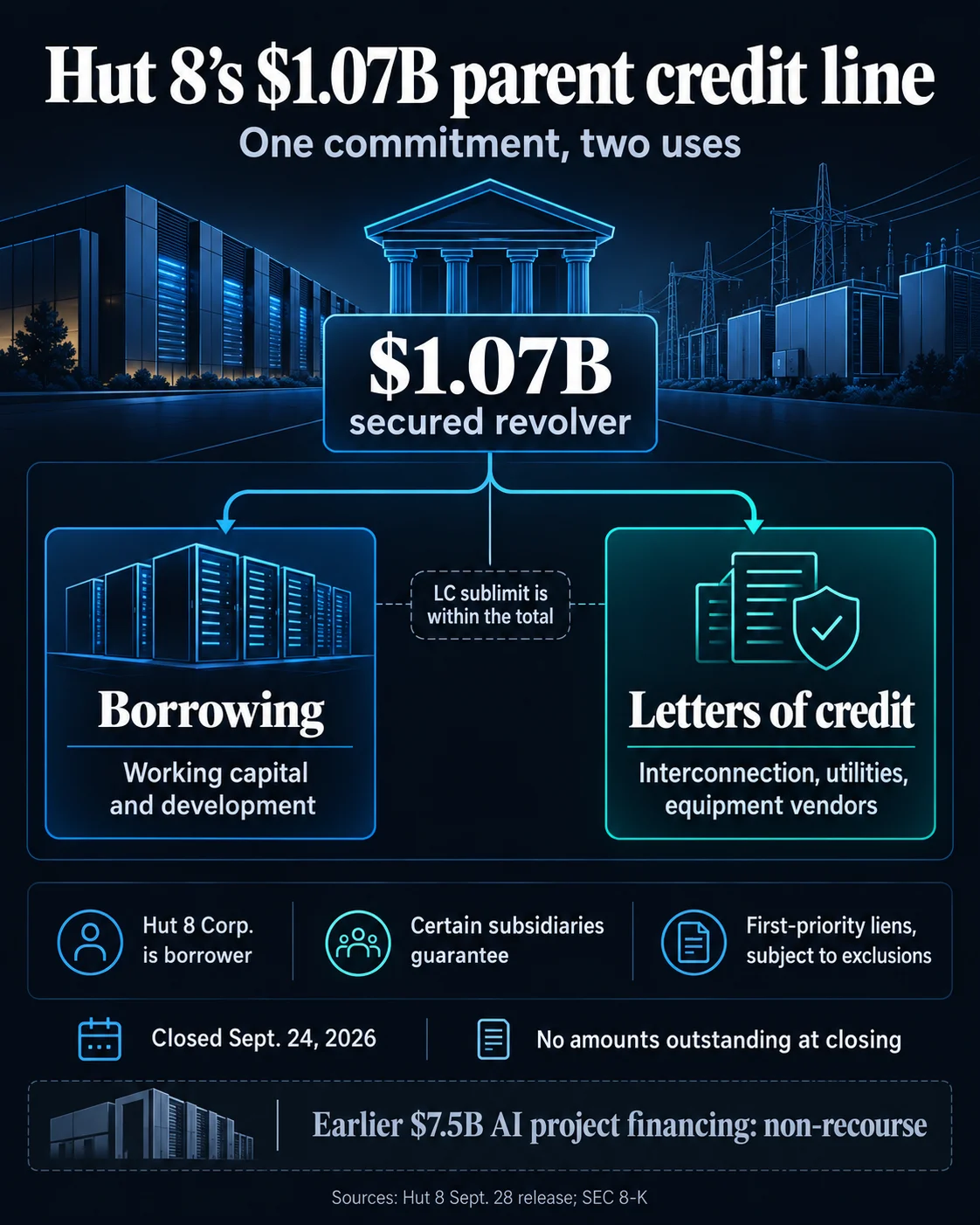
Hut 8 Corp., a prominent leader in the digital asset mining and energy infrastructure sectors, has finalized a massive $1.07 billion senior secured revolving credit facility, signaling a significant shift in the company’s capital structure and its long-term strategic focus on artificial intelligence (AI) and high-performance computing (HPC) infrastructure. The four-year agreement, which officially closed on September 24 and was publicly announced on September 28, provides the parent company with a sophisticated financial toolkit designed to accelerate the development of its large-scale energy projects while maintaining a flexible cash position.
The facility arrives at a critical juncture for the cryptocurrency mining industry. Following the 2024 Bitcoin halving, many major miners have sought to diversify their revenue streams by repurposing their power-dense infrastructure for AI and cloud computing. Hut 8’s new credit line is specifically structured to support this transition, offering both cash borrowing capabilities and a substantial sublimit for letters of credit. According to the company’s recent securities filings, no amounts were drawn from the facility at the time of closing, suggesting that the move is a preemptive strengthening of the balance sheet rather than a response to immediate liquidity needs.
Strategic Architecture of the $1.07 Billion Facility
The structure of this financing arrangement is notably complex, reflecting the scale of Hut 8’s ambitions in the AI infrastructure space. The $1.07 billion commitment includes a $1 billion sublimit for letters of credit. These financial instruments are vital for large-scale infrastructure development, as they allow a company to satisfy the collateral requirements of utility providers and equipment vendors without having to lock up significant amounts of cash.
In the energy sector, "interconnection deposits" are often required to secure a place in the power grid queue. By using letters of credit to back these obligations, Hut 8 can maintain a higher level of liquid cash for operational expenses or opportunistic acquisitions. The facility effectively creates a unified pool of bank capacity that can be toggled between cash loans and credit guarantees, providing the parent company with the agility to respond to the fluctuating demands of site construction and hardware procurement.
The credit agreement names Hut 8 Corp. as the primary borrower, with certain restricted subsidiaries acting as guarantors. To secure the facility, the company has granted first-priority liens covering substantially all assets of the borrower and its guarantors, subject to specific exclusions. This parent-level exposure distinguishes the new facility from the $7.5 billion in non-recourse project financing previously arranged for the company’s River Bend and Beacon Point AI campuses. While project financing is typically tied to the assets of a specific site, this revolving credit line places the broader corporate entity and its primary assets behind the debt, underscoring the high stakes of the company’s current expansion phase.
Financial Terms and the SOFR Benchmark
The cost of borrowing under this new facility is tied to the Term Secured Overnight Financing Rate (SOFR), the standard benchmark for dollar-denominated commercial loans. The initial margin is set at 1.75 percentage points above the SOFR benchmark. However, the agreement includes a performance-based pricing grid: the margin can fluctuate between 1.50 and 2.00 percentage points based on Hut 8’s debt-to-market-capitalization ratio.
This pricing mechanism aligns the interests of the lenders with the company’s equity performance. If Hut 8’s market capitalization increases significantly relative to its debt, the cost of borrowing decreases. Conversely, if the company becomes more highly leveraged or its stock price faces downward pressure, the interest expense will rise. This structure provides an incentive for management to maintain a balanced capital structure while pursuing aggressive growth in the AI sector.
The 40% Liquidity Covenant: A Double-Edged Sword
One of the most stringent aspects of the agreement is the inclusion of a minimum-liquidity covenant. Starting with the fiscal quarter ending March 31, 2027, Hut 8 will be required to maintain a liquidity threshold of 40% of the total commitment before a defined "stabilization date." Once stabilization is achieved—typically following the successful launch and steady-state operation of major projects—the requirement drops to 25%.
This covenant ensures that the company maintains a substantial cash buffer or undrawn credit capacity to weather potential market volatility. While it provides a safety net for lenders, it also places constraints on how aggressively Hut 8 can deploy its capital. To mitigate the risk of a covenant breach, the agreement includes "equity cure rights," which allow the company to issue new shares to raise the necessary funds to meet liquidity requirements if they fall below the mandated threshold.
As of June 30, Hut 8 reported a cash balance of $233.6 million. When combined with the $1.07 billion in new credit capacity, the company appears well-positioned to meet these future requirements, though the scale of its borrowing for the River Bend and Beacon Point projects will ultimately determine the pressure placed on its liquidity ratios.
Chronology of Hut 8’s Strategic Transformation
The securing of this credit line is the latest chapter in a series of transformative moves by Hut 8. Over the past 24 months, the company has evolved from a pure-play Bitcoin miner into a diversified digital infrastructure provider.
- Late 2023: Hut 8 completed a "merger of equals" with US Data Mining Group, Inc. (USBTC), significantly increasing its self-mining capacity and managed services business. This merger laid the groundwork for the current corporate structure.
- Early 2024: The company identified the burgeoning demand for AI compute and began pivoting its infrastructure toward HPC. This included the announcement of the River Bend and Beacon Point campuses, which are designed to house tens of thousands of high-end GPUs.
- Mid-2024: Hut 8 secured $7.5 billion in non-recourse project financing. This massive sum was earmarked specifically for the development of the AI campuses, keeping the debt off the parent company’s balance sheet and insulating the broader organization from project-specific risks.
- September 24, 2024: The $1.07 billion senior secured revolving credit facility is finalized, providing the parent company with the liquidity needed to bridge the gap between early-stage development and long-term project stability.
- March 31, 2027: The date on which the strict 40% liquidity covenants are set to take effect, marking a new era of financial discipline for the firm.
Broader Impact and Industry Implications
Hut 8’s move to secure over $1 billion in parent-level credit is a clear indicator of the "institutionalization" of the crypto-mining sector. As these companies grow, they are increasingly adopting the financial strategies of traditional infrastructure firms, such as utility companies and REITs (Real Estate Investment Trusts).
The shift toward AI and HPC is driven by the reality of the Bitcoin mining landscape. With global hash rates reaching record highs and the block reward decreasing, the margins for mining have become increasingly thin. AI, by contrast, offers high-margin, long-term contracts with enterprise clients. By building out "AI-ready" data centers, Hut 8 is positioning itself as a landlord and service provider for the next generation of technological growth.

Furthermore, the use of letters of credit to support utility obligations highlights a growing challenge in the industry: power availability. As the demand for electricity grows, utility companies are demanding more significant financial guarantees from large-scale users. Hut 8’s ability to secure a $1 billion letter-of-credit sublimit suggests that the banking sector has a high degree of confidence in the company’s ability to execute its infrastructure plans.
Expert Analysis: Risks and Opportunities
While the $1.07 billion credit line provides immense opportunity, it is not without risk. The decision to place first-priority liens on substantially all parent-level assets means that a failure to manage the transition to AI could jeopardize the entire company. Unlike the $7.5 billion non-recourse debt, this facility is "recourse," meaning lenders can look to the parent company’s assets if obligations are not met.
The AI market is also becoming increasingly competitive. Hut 8 is not only competing with other former miners like Core Scientific and MARA (formerly Marathon Digital) but also with established data center giants like Equinix and Digital Realty. The success of Hut 8’s strategy will depend on its ability to bring its campuses online quickly and secure high-value tenants before the market becomes saturated.
However, the financial flexibility granted by this new facility cannot be overstated. It allows Hut 8 to move faster than competitors who may be reliant on dilutive equity raises or more expensive, less flexible debt. By leveraging the SOFR-based pricing and the letter-of-credit sublimit, Hut 8 has optimized its cost of capital for a capital-intensive industry.
Conclusion: A New Benchmark for Digital Infrastructure
Hut 8’s successful closing of the $1.07 billion credit facility marks a milestone in the convergence of digital asset mining and AI infrastructure. By securing such a significant amount of liquidity under professional banking terms, the company has demonstrated that it has moved beyond the "startup" phase of the crypto industry and is now operating as a major player in the global infrastructure market.
As the company moves toward the stabilization of its River Bend and Beacon Point campuses, the financial world will be watching closely to see how it navigates the 40% liquidity covenant and the shifting dynamics of the AI compute market. For now, Hut 8 has equipped itself with the financial firepower necessary to lead the charge into a new era of high-performance computing.