Dwi Wanna
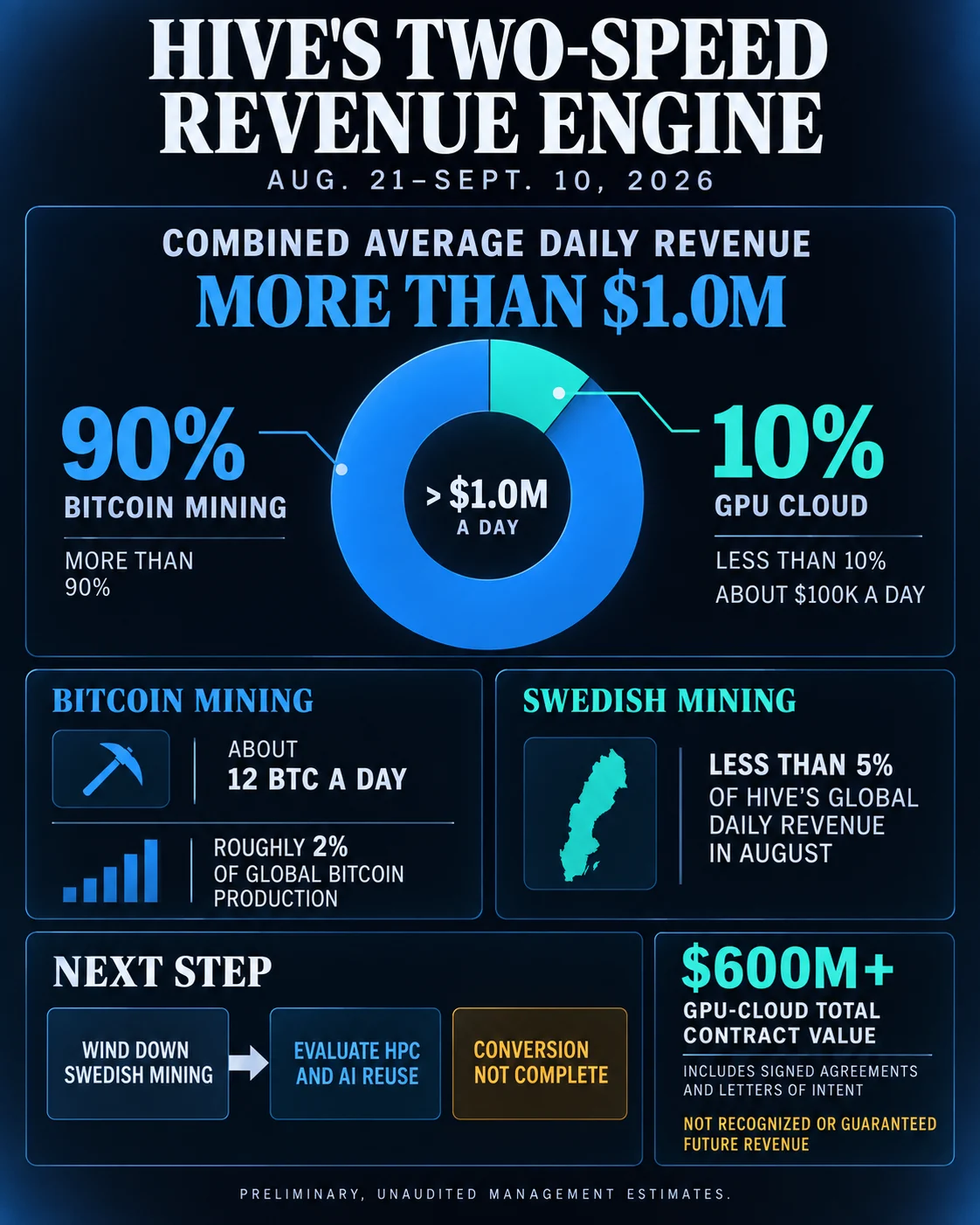
HIVE Digital Technologies, a leading institutional-grade digital asset miner and infrastructure provider, has released preliminary financial results for the period spanning August 21 to September 10, 2024, revealing a significant disparity between its legacy operations and its burgeoning high-performance computing (HPC) business. According to the update, the company generated more than $1 million in combined average daily revenue during the period. However, despite a high-profile strategic shift toward artificial intelligence (AI) and GPU cloud services, the data confirms that Bitcoin mining remains the overwhelming financial engine of the corporation, accounting for more than 90% of total daily income.
The disclosure provides a rare quantitative glimpse into the "two-speed transition" currently facing many industrial-scale miners. While HIVE has rebranded to emphasize its "Digital Technologies" capabilities, its GPU cloud business produced approximately $100,000 in daily revenue during the three-week window—roughly 10% of the company’s operational output. The remaining $900,000 or more per day was sourced directly from the production of Bitcoin, underscoring the continued importance of the cryptocurrency markets in sustaining the firm’s capital-intensive expansion into AI.
Operational Performance and Mining Metrics
During the reported period, HIVE maintained a robust presence in the global Bitcoin network, mining an average of approximately 12 Bitcoin per day. This output represents roughly 2% of the total global network production, a significant share for a single publicly traded entity. The company’s ability to maintain this level of production is contingent upon several volatile factors, including the prevailing market price of Bitcoin, the fluctuating network difficulty, and the overall efficiency of its ASIC (Application-Specific Integrated Circuit) fleet.
The revenue figures provided by management are preliminary and unaudited, serving as a snapshot of current performance rather than a definitive quarterly statement. Nevertheless, they highlight the efficacy of HIVE’s current mining strategy. By leveraging a geographically diversified fleet of data centers, the company has managed to navigate the post-halving landscape—a period following the April 2024 Bitcoin halving event which saw block rewards slashed by 50%—with enough scale to generate nearly $1 million in daily gross revenue from mining alone.
The Strategic Pivot: AI and GPU Cloud Infrastructure
HIVE’s transition into the AI sector is part of a broader trend among Bitcoin miners seeking to diversify their revenue streams and mitigate the cyclical risks associated with cryptocurrency prices. The company’s GPU cloud division is designed to offer processing power to developers, researchers, and enterprises involved in training large language models (LLMs) and other data-intensive applications.

Year-to-date, HIVE reported that it has closed more than $600 million in total contract value (TCV) within its GPU-cloud business. This figure includes a combination of signed customer agreements and formal letters of intent (LOIs). However, the company’s management was careful to distinguish between TCV and recognized revenue. In its September 10 update, HIVE cautioned investors that total contract value does not guarantee future revenue, as these contracts are often subject to delivery milestones, infrastructure readiness, and long-term execution.
This distinction is particularly relevant following reports in August regarding a massive $350 million AI cloud agreement. To fulfill the demands of such contracts, HIVE must undertake a significant capital expenditure (CAPEX) program. Estimates suggest the company requires approximately $185 million for a GPU buildout to meet the technical specifications of its primary AI clients. While the current $100,000 in daily GPU revenue proves that the business model is operational, the vast majority of the $600 million pipeline remains in the "potential" category, pending the successful deployment of high-end hardware like NVIDIA’s H100 and Blackwell chips.
Chronology of the Transition
The path to HIVE’s current "hybrid" model began several years ago but accelerated following major shifts in the blockchain industry.
- 2017–2021: The Ethereum Era: HIVE initially established itself as a major player in Ethereum mining, utilizing GPUs (Graphics Processing Units) rather than ASICs. This gave the company an early advantage in understanding GPU-based data center management.
- September 2022: The Merge: When the Ethereum network transitioned from Proof-of-Work to Proof-of-Stake, HIVE was forced to repurpose its massive fleet of GPUs. While many miners sold their hardware, HIVE began exploring High-Performance Computing (HPC) and AI as alternative use cases.
- July 2023: Rebranding: The company officially changed its name from HIVE Blockchain Technologies to HIVE Digital Technologies, signaling a formal commitment to the AI sector.
- August 2024: The $350 Million Deal: Reports surfaced of a landmark agreement with a major AI firm, setting the stage for the current expansion phase.
- September 2024: Current Revenue Snapshot: The latest figures show that while the AI pivot is yielding fruit, the company remains fundamentally a Bitcoin mining operation in terms of immediate cash flow.
Evaluating International Operations: The Swedish Strategy
A key component of HIVE’s long-term sustainability strategy involves its facilities in Sweden. The company has been a pioneer in "green mining," utilizing renewable energy and exploring ways to integrate its data centers into local economies. Currently, HIVE is evaluating the repurposing of its Swedish sites for high-performance computing.
In August, HIVE noted that its Swedish operations contributed less than 5% of its global daily revenue. Consequently, the company intends to wind down traditional Bitcoin mining at these specific facilities to make room for more lucrative HPC workloads. This transition involves a process known as "heat reuse," where the thermal energy generated by servers is redirected into district heating systems or industrial greenhouses.
However, the conversion of a facility from Bitcoin mining to AI is a complex engineering feat. Bitcoin mining uses specialized ASICs that require relatively simple cooling and power setups. In contrast, AI workloads require sophisticated GPU clusters, high-speed networking (such as InfiniBand), and significantly more robust cooling solutions. HIVE has cautioned that the wind-down of mining and the subsequent repurposing of these sites may not proceed according to the projected timeline, as technical and logistical hurdles remain.

Market Context and Industry Analysis
HIVE is not alone in its quest to capture a piece of the AI market. Competitors such as Core Scientific, Northern Data, and Hut 8 have all announced similar pivots. Core Scientific, for instance, recently signed a multi-billion dollar deal with CoreWeave to provide infrastructure for AI.
The primary driver behind this trend is the search for "fixed-income" stability. Bitcoin mining revenue is highly volatile, dependent on the spot price of a single asset. AI cloud services, however, typically operate on multi-year contracts with fixed monthly payments. For investors, this makes a company like HIVE more attractive because it combines the "moonshot" potential of Bitcoin with the steady, predictable cash flow of a SaaS (Software as a Service) or IaaS (Infrastructure as a Service) provider.
The challenge for HIVE lies in the "capital gap." Mining Bitcoin generates the cash needed to buy GPUs, but the cost of those GPUs is astronomical. A single NVIDIA H100 GPU can cost upwards of $30,000. To build a world-class AI cluster, HIVE must reinvest a significant portion of its mining profits or seek external financing, which can be expensive in a high-interest-rate environment.
Future Implications and Outlook
The next twelve months will be a critical testing period for HIVE Digital Technologies. The company must prove that it can convert its $600 million pipeline of letters of intent into recognized, recurring revenue. If successful, the 90/10 revenue split between Bitcoin and AI could shift closer to 50/50, providing the company with a much more balanced and resilient balance sheet.
For now, the "financial engine" remains the 12 Bitcoin mined every day. As long as Bitcoin prices remain high enough to cover operational costs, HIVE can afford to fund its transition. However, should the crypto market enter a prolonged "crypto winter," the pressure to accelerate the AI transition will become acute.
In conclusion, HIVE Digital Technologies represents a case study in industrial adaptation. By maintaining a dominant position in Bitcoin mining (controlling 2% of global production), the company has secured the capital necessary to participate in the AI revolution. The preliminary figures released this month confirm that while the company’s future may be in the cloud, its present is still firmly rooted in the blockchain. The success of this dual-track strategy will depend on management’s ability to execute complex infrastructure upgrades without disrupting the mining operations that pay the bills.