Dwi Wanna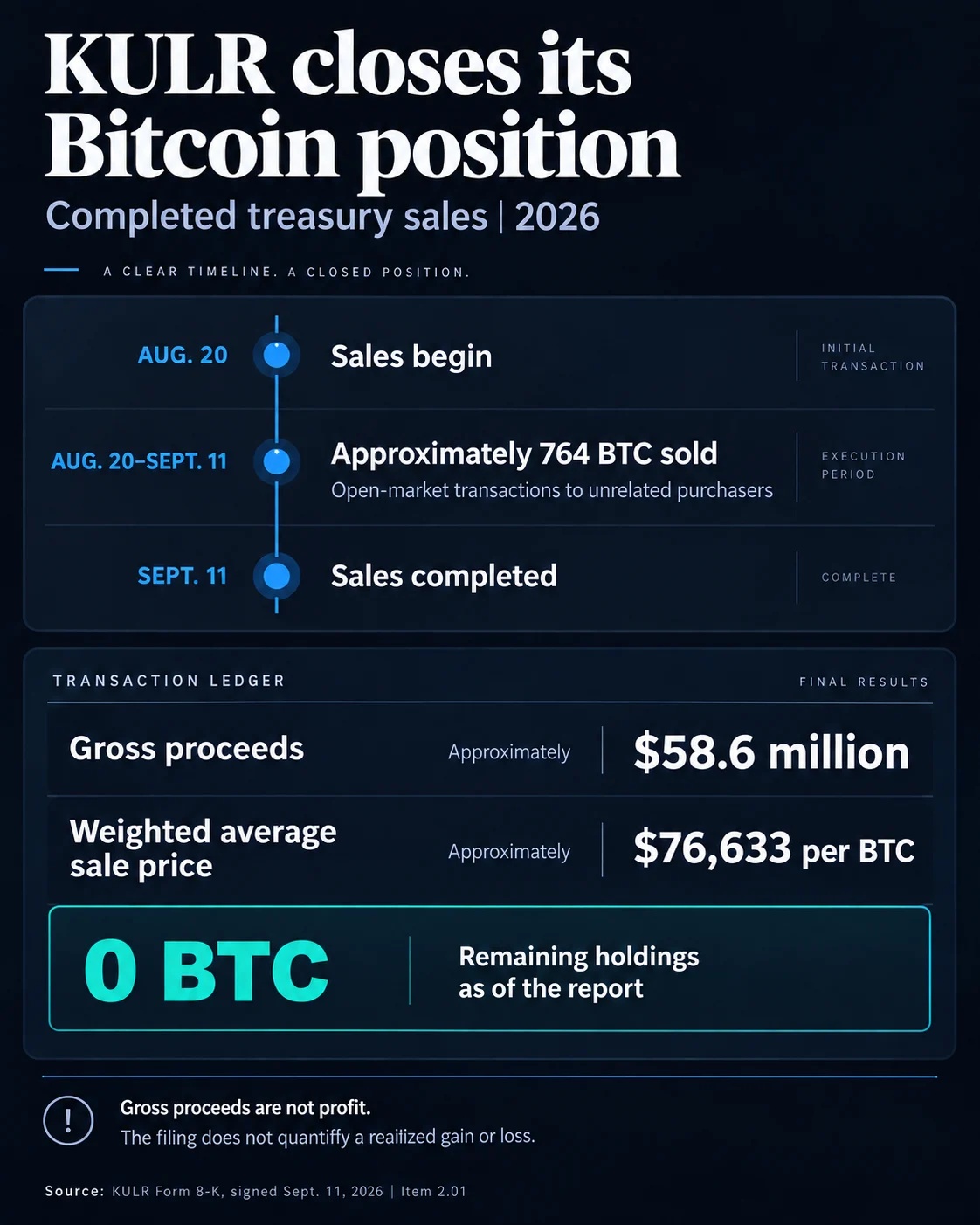
The liquidation marks the end of an ambitious, albeit brief, foray into the world of cryptocurrency treasury management for the San Diego-based company. The transactions were executed through a series of open-market sales to unrelated third parties at a weighted average price of approximately $76,633 per Bitcoin. This final disposal brings KULR’s Bitcoin balance to zero, effectively decoupling the company’s balance sheet from the high-velocity price fluctuations of the world’s largest cryptocurrency.
The Final Liquidation: Data and Execution
The decision to exit the Bitcoin market was not a sudden impulse but rather the culmination of a strategic shift that began earlier in the third quarter of 2026. The $58.6 million raised in this final tranche provides a significant liquidity injection for KULR, which has been navigating a period of intensive capital reallocation. While the SEC filing confirmed the gross proceeds and the average sale price, it notably did not disclose the original cost basis of the 764 coins. Consequently, it remains unclear whether the final disposal resulted in a realized capital gain or a loss relative to the initial purchase price.
The execution of these sales occurred during a period of relative strength for Bitcoin, with the $76,633 average price suggesting that KULR’s management sought to capitalize on market liquidity to exit their position without causing significant slippage. By utilizing open-market transactions, the company avoided the complexities of over-the-counter (OTC) bulk deals that sometimes require deep discounts, instead opting for a programmatic sell-off over a three-week window.
A Multi-Phase Retreat: The August Precedent
The final sale of 764 BTC follows a significant precursor event in August 2026. At that time, KULR disclosed that it had sold approximately 333 Bitcoin for roughly $21.5 million. The primary driver behind that initial liquidation was debt reduction; the company directed approximately $20 million of those proceeds toward repaying the principal owed to Coinbase.
This debt was linked to the company’s broader cryptocurrency strategy, which included not only holding Bitcoin as a treasury asset but also operating dedicated mining infrastructure. By settling the Coinbase debt, KULR began the process of de-risking its financial profile. The volatility of Bitcoin had previously created a double-edged sword for the company: while price surges bolstered the book value of its assets, price pullbacks triggered balance-sheet pressures that complicated its ability to secure traditional financing for its core battery technology business.
The August sale was the first clear signal to investors that KULR was pivoting away from its "Bitcoin Playbook." For many analysts, the move was seen as a necessary step to satisfy creditors and refocus the company’s narrative on its technological innovations in the energy sector rather than its performance as a proxy for digital asset prices.
From Mining to Management: The Shift to Core Competencies
KULR Technology Group’s initial entry into the Bitcoin ecosystem was multifaceted. Unlike many companies that simply purchase the asset for their treasury, KULR had integrated Bitcoin mining into its operational model. The company leveraged its expertise in thermal management—originally developed for NASA and aerospace applications—to optimize the cooling of mining rigs.
However, the capital-intensive nature of Bitcoin mining, coupled with the rising costs of electricity and the periodic "halving" events that reduce mining rewards, eventually made the venture less attractive compared to the growing demand for KULR’s core products. The company’s thermal management solutions are currently in high demand for electric vehicle (EV) batteries, energy storage systems (ESS), and aerospace defense.
Management’s decision to shut down the mining operation and liquidate the remaining coins reflects a broader corporate trend seen in 2026: the "return to purity." Investors have increasingly signaled a preference for companies to focus on their primary value propositions rather than acting as diversified investment funds. For KULR, this means prioritizing its proprietary carbon fiber thermal interface materials and its KULR ONE battery architecture.
Financial Analysis: Liquidity and Debt Management
The total capital recovered from the two-stage liquidation process—the 333 BTC sold in August and the 764 BTC sold in September—amounts to approximately $80.1 million in gross proceeds. This total represents a massive infusion of cash for a company with a market capitalization in the mid-cap range.
From a balance sheet perspective, the move accomplishes several objectives:
- Debt Eradication: By using the first $20 million to clear obligations with Coinbase, the company reduced its interest expense and improved its debt-to-equity ratio.
- Operational Runway: The remaining $60 million provides a substantial buffer for research and development (R&D) and the scaling of manufacturing facilities.
- Volatility Reduction: By holding zero Bitcoin, KULR’s quarterly earnings reports will no longer be subject to non-cash impairment charges or massive fluctuations in "other income" based on the crypto market’s performance.
While the company has not yet detailed the specific deployment of the final $58.6 million, the market expects the funds to be channeled into its high-growth energy platform. In previous statements, management emphasized the need to concentrate capital where it generates the highest return on investment (ROI), which, in KULR’s case, is the rapidly expanding battery safety market.
Broader Market Implications: The Corporate Treasury Landscape
KULR’s exit from the Bitcoin market serves as a case study for the challenges facing public companies that adopt digital assets. While pioneers like MicroStrategy have successfully transformed into Bitcoin-centric entities, other firms have found the "dual-track" model—running a traditional business while managing a crypto treasury—to be fraught with difficulty.

In 2026, the equity markets have become more discerning. Financing conditions have tightened, and the "crypto premium" that once boosted the stock prices of companies holding Bitcoin has, in many cases, evaporated or turned into a "volatility discount." KULR’s decision to abandon its treasury strategy mirrors moves by other small and mid-cap tech firms that have realized that the complexity of managing a crypto-heavy balance sheet can distract from operational execution.
Furthermore, the regulatory environment for corporate crypto holdings remains rigorous. The requirement for detailed disclosures and the potential for rapid shifts in accounting standards (such as fair-value accounting) require significant administrative overhead. For a company like KULR, which is competing in the highly technical and regulated aerospace and defense sectors, the trade-off between the potential upside of Bitcoin and the administrative burden of holding it eventually tipped in favor of liquidation.
Reaction and Outlook
While KULR Technology Group has not issued a formal press release beyond the required SEC filing, the move has been interpreted by the market as a "house-cleaning" measure. Analysts suggest that by removing the Bitcoin variable, KULR is making itself a more attractive target for institutional investors who want "clean" exposure to the battery technology and green energy sectors without the "noise" of cryptocurrency volatility.
It is important to note that KULR has not explicitly ruled out a return to the digital asset space in the future. The regulatory filing records the disposal of the assets but does not include a permanent prohibition against future purchases. However, given the total liquidation of mining assets and the repayment of crypto-linked debt, a return to the Bitcoin playbook appears unlikely in the near to medium term.
The focus now shifts to KULR’s upcoming quarterly earnings report. Investors will be looking for specific guidance on how the $58.6 million in new liquidity will be utilized. If the company can successfully translate this cash into increased production capacity or the acquisition of complementary technologies, the retreat from Bitcoin may be viewed as one of the most successful strategic pivots in the company’s history.
Conclusion: A Strategic Re-centering
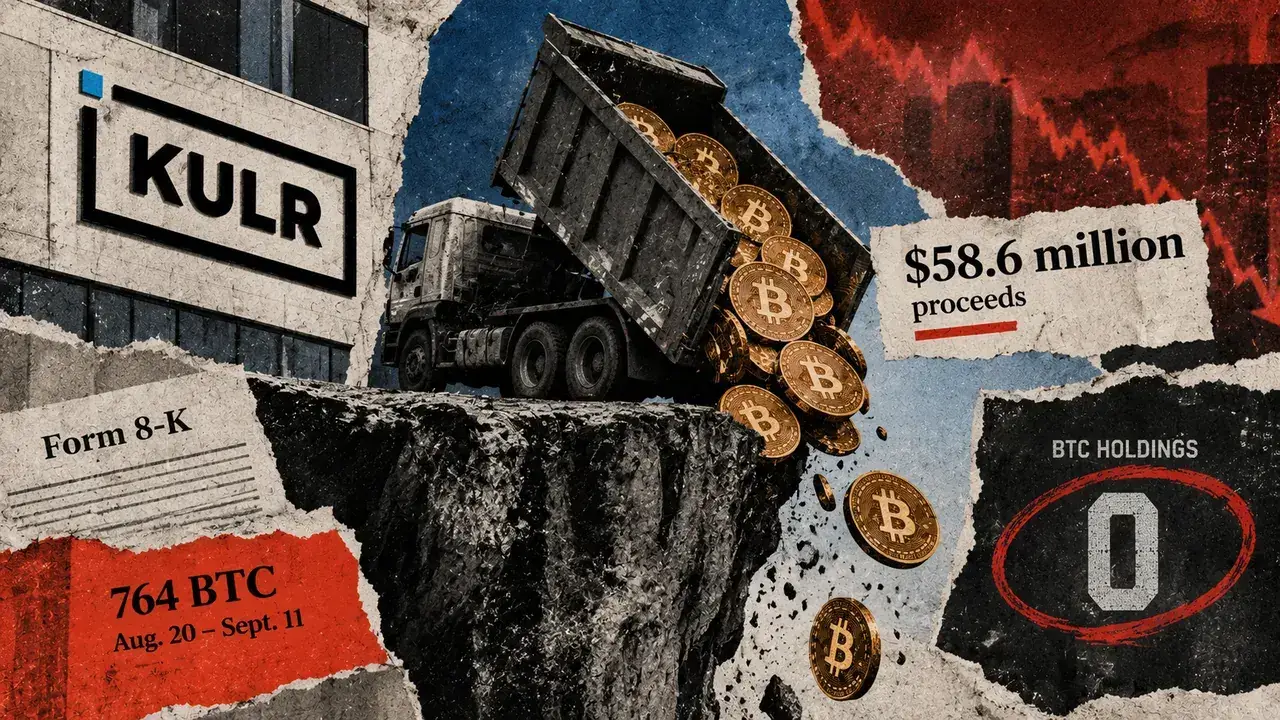
The departure of KULR Technology Group from the Bitcoin treasury ranks marks a significant moment in the ongoing evolution of corporate finance. By liquidating its last 764 BTC for $58.6 million, the company has chosen the certainty of cash and the focus of its core energy business over the speculative potential of digital assets.
This decision highlights the maturation of the battery technology sector, where the need for capital to meet global energy demands is outstripping the desire for treasury diversification. As KULR moves forward with a strengthened balance sheet and a singular focus on its thermal management innovations, it leaves behind a legacy of experimentation that ultimately led back to its industrial roots. For the broader market, KULR’s exit is a reminder that while Bitcoin offers a unique value proposition, the primary duty of a public tech company remains the advancement and commercialization of its core intellectual property.