admin
admin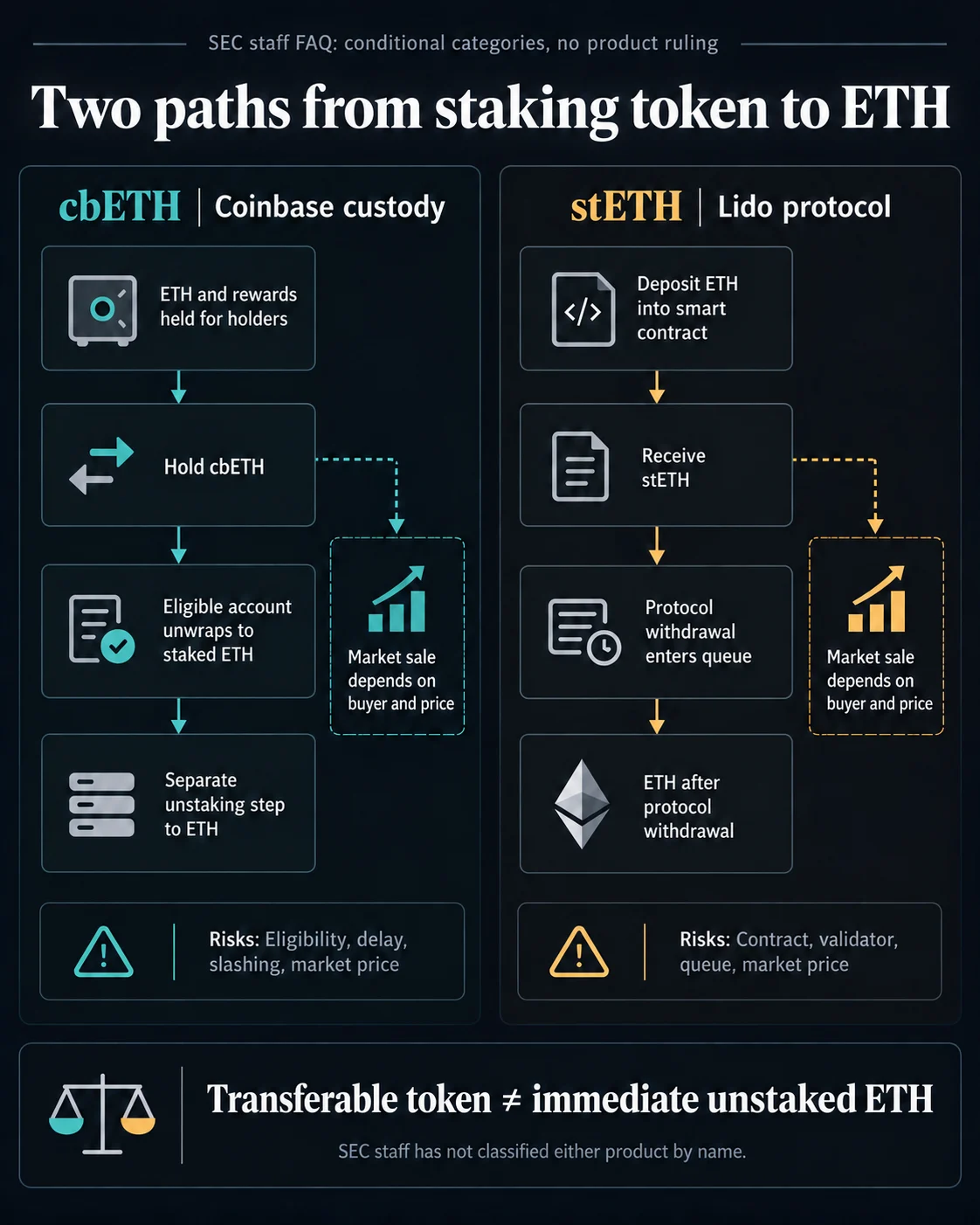
The U.S. Securities and Exchange Commission (SEC) has ignited a fresh wave of discussion within the cryptocurrency ecosystem with its September 25th staff Frequently Asked Questions (FAQ) concerning crypto assets. This guidance, while not formally classifying specific tokens like Coinbase’s cbETH or Lido’s stETH, offers a conditional distinction between what constitutes a mere "receipt" for a digital commodity and what might be deemed a "digital commodity" itself. This subtle yet significant differentiation hinges on the rights and controls associated with the underlying staked Ether (ETH). The core takeaway for an ETH holder engaging in liquid staking is that while they can sell their liquid staking token, the underlying ETH remains staked, and the transferability of the token does not guarantee immediate access to unstaked ETH or a sale at the precise value of the underlying position.
This development is particularly impactful given the burgeoning popularity of liquid staking, a mechanism that allows users to stake their ETH to earn rewards while retaining the ability to trade a representative token. Coinbase and Lido, two prominent players in this space, offer distinct operational models that the SEC’s guidance implicitly scrutinizes. Their disclosures highlight the practical realities for token holders: a transferable token, while offering liquidity, does not equate to immediate unstaked ETH or a guaranteed sale price reflecting the underlying asset’s full value.
Understanding the SEC’s Distinction: "Digital Tool" vs. "Digital Commodity"
The SEC’s Division of Corporation Finance, in its September FAQ, introduces the concept of a "digital tool" and a "digital commodity" within the context of staking receipts. A qualifying staking receipt for a digital commodity, under certain conditions, may be classified as a "digital tool." This designation suggests a more passive representation of ownership. Conversely, a token issued by a protocol-based liquid-staking provider might be categorized as a "digital commodity." This classification implies a more active role in the underlying crypto asset’s ecosystem and market dynamics.
Crucially, the SEC staff explicitly states that it does not assign specific classifications to Coinbase’s cbETH or Lido’s stETH by name. Instead, the determination of their regulatory status rests on their specific terms and conditions. These terms dictate who truly holds the deposited ETH, the mechanisms for token redemption, and the potential implications for holders who choose to sell their tokens rather than redeem them. This nuanced approach underscores the SEC’s intent to assess individual arrangements rather than impose blanket regulations on an entire class of assets.
Defining a "Receipt": The Rights It Represents
The SEC’s FAQ provides a framework for understanding what constitutes a "receipt" in this context. A receipt is defined by the rights it confers upon the holder. It serves as evidence that an asset has been deposited and, critically, that the depositor retains ownership of that asset. Under the FAQ’s interpretation, ownership and control of the deposited asset do not pass to the issuer of the receipt. This means the issuer cannot unilaterally transfer, lend, pledge, rehypothecate, or otherwise utilize the deposited asset, nor can they expose it to third-party claims.
It is imperative to understand that this description is not intended as a new, universal custody rule applicable to every token marketed as liquid staking. Rather, it delineates the characteristics of a receipt that the SEC staff is discussing. This distinction is vital because it separates the concept of a simple token of ownership from a token that might represent a more complex financial instrument or a direct stake in a functioning protocol.
Following this definition, the FAQ further elaborates on two potential classifications under the SEC’s March crypto-asset interpretation. A receipt for a digital commodity that is not subject to an investment contract may be considered a "digital tool" due to its primary function of evidencing ownership. However, a receipt issued by a protocol-based liquid-staking provider might be classified as a "digital commodity" itself. This is particularly true when the token’s value is intrinsically linked to a functioning crypto system and influenced by market supply and demand dynamics. The judicious use of the word "may" throughout this guidance is significant. It signals that neither classification is automatic; the SEC’s stance is that no individual product is assigned a definitive status merely because it carries the label of a "staking token."
A Historical Perspective: Previous Statements and Evolving Scrutiny
This recent FAQ builds upon earlier pronouncements from the SEC. In August 2025, a staff statement described liquid-staking tokens as transferable evidence of deposited assets and their accrued rewards. At that time, the discussion encompassed both smart-contract protocols and third-party custodians, with the securities-law view being limited to the specific arrangements described. Notably, that statement did not address more complex scenarios like restaking or arrangements where a provider exerts significant control over staking choices, guarantees rewards, or facilitates additional token returns. The SEC has been careful to note that falling outside the scope of such earlier statements does not, in itself, constitute a determination that an arrangement involves securities. This indicates a progressively detailed and cautious approach by the regulatory body.
These evolving categories are instrumental in shaping the SEC staff’s securities-law analysis of the described arrangements. However, they do not automatically grant access to or control over the underlying ETH. The practical differences in how Coinbase and Lido manage custody and redemption pathways offer a valuable comparison. The FAQ, it must be reiterated, makes no explicit determination regarding the regulatory status of either cbETH or stETH.

Visualizing the Differences: Coinbase’s cbETH vs. Lido’s stETH
A visual representation, akin to a flowchart, effectively illustrates the distinct operational models of cbETH and stETH. This diagram typically depicts Coinbase’s cbETH as potentially involving a custodial unwrapping process separate from the underlying ETH unstaking, while Lido’s stETH relies on a protocol withdrawal queue. Both tokens possess their own market-sale routes, each carrying distinct price risks for the holder.
Coinbase’s Custodial Path: Unwrapping and Redemption
Coinbase’s User Agreement for U.S. users outlines that cbETH represents ETH staked through Coinbase, encompassing earned rewards and deducting applicable fees or slashing penalties. Crucially, the agreement states that the staked ETH and its rewards, wrapped as cbETH, are held by Coinbase on behalf of token holders, with ownership not transferring to Coinbase. The act of selling or transferring cbETH, therefore, effectively transfers the underlying ownership interest and the associated contractual redemption right to the recipient.
This transferability provides a holder with a means to exit their position before the staked ETH is formally unstaked. Coinbase’s product guidance indicates that cbETH can be sold, sent to external wallets, or held. However, selling cbETH constitutes a market transaction. Coinbase itself warns in its user agreement that the token’s price can deviate significantly from the price of ETH or staked ETH. The exchange does not guarantee the availability of a buyer or provide a backstop for cbETH liquidity. This means holders are subject to market forces and the willingness of other participants to trade at a given price.
The contractual redemption route, often referred to as "unwrapping," represents a distinct process from a market sale. Coinbase’s agreement specifies that eligible cbETH holders must possess a Coinbase account in good standing and meet staking eligibility requirements to unwrap their tokens. Geographic limitations and processing delays may also apply. Unwrapping returns staked ETH, with rewards less applicable fees and slashing, but this is not immediately spendable, unstaked ETH. To obtain spendable ETH after unwrapping, a further unstaking request must be submitted, and the Ethereum network’s unstaking process must be completed. Consequently, a transferable token like cbETH does not offer every holder an identical or immediate redemption route.
Lido’s Protocol Path: Withdrawal Queues and Market Dynamics
Lido’s contract documentation presents a different operational paradigm. When a user deposits ETH into Lido’s protocol smart contract, they receive stETH. To reclaim their ETH through the protocol, a holder must submit a withdrawal request, which then enters a queue. Alternatively, the stETH token can be sold to another trader on the secondary market, circumventing the waiting period associated with the protocol withdrawal.
These two distinct routes expose stETH holders to different sets of constraints and risks. Lido’s risk disclosure acknowledges that protocol withdrawals can experience delays due to queue capacity limitations and the rate of Ethereum validator exits. The ETH ultimately received is subject to the protocol’s accounting practices and can be impacted by adverse events, such as slashing penalties incurred by validators.
The secondary-market sale of stETH offers greater speed, but only if a willing buyer exists at an acceptable price. The disclosure further warns that bid-ask spreads, slippage, and discounts relative to ETH can widen considerably during periods of strained liquidity. Beyond these market-related risks, Lido’s disclosure also identifies smart-contract risks, governance risks, and validator risks. It explicitly states that stETH and its wrapped version, wstETH, do not possess general, protocol-level regulatory approval. This candid acknowledgment of potential vulnerabilities is a critical aspect of their risk management communication.
The Label Game: "Liquid" Doesn’t Guarantee Immediate ETH Access
The contrasting models of cbETH and stETH serve as potent illustrations of why the term "liquid" in liquid staking refers to the token’s ability to be traded, not necessarily to a guaranteed conversion into unstaked ETH at a fixed value. With cbETH, a holder’s ability to access their staked ETH hinges on either Coinbase’s custodial terms and its eligibility process for contractual unwrapping, or on finding a willing buyer in the market. With stETH, the holder has the option of navigating the protocol’s withdrawal queue or engaging with the secondary market. In either scenario, the price realized on the secondary market can diverge from the intrinsic value of the underlying staked position. This divergence is a direct consequence of market liquidity, demand, and the inherent risks associated with the staking process.
The SEC’s September 25th FAQ, it is important to reiterate, does not assign a definitive regulatory classification to either cbETH or stETH by name. Furthermore, these are non-binding staff views, meaning they do not create new legal obligations for market participants. Their most valuable contribution lies in the nuanced distinction they draw: before considering a liquid-staking token as directly interchangeable with ETH, a holder must thoroughly understand who retains ultimate ownership of the deposited asset, who manages the redemption pathway, what form of asset is returned, and what potential delays or losses might be incurred. A broad regulatory category, by itself, is insufficient to answer these critical product-level questions. The true regulatory implications will likely be determined on a case-by-case basis, scrutinizing the specific terms and operational realities of each liquid staking product. The ongoing evolution of this regulatory landscape suggests that clarity may be a long time coming, and vigilance from both issuers and holders will be paramount.