admin
admin
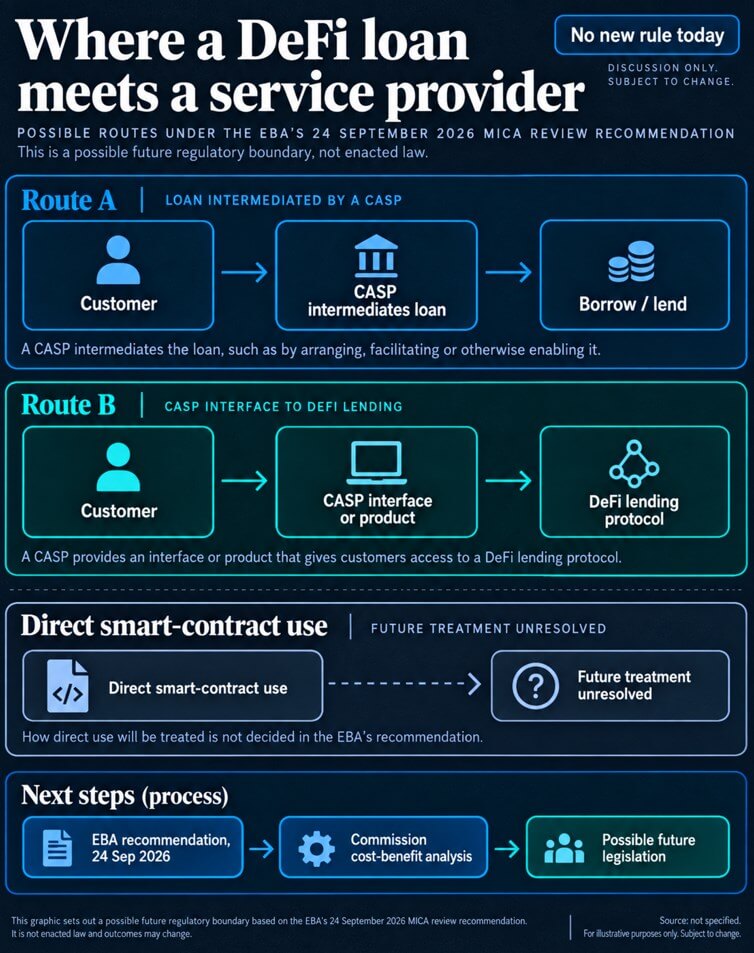
The European Banking Authority (EBA) has formally requested the European Commission to undertake a comprehensive examination of new regulatory considerations for crypto firms that facilitate customer access to decentralized finance (DeFi) lending protocols. This pivotal recommendation, detailed in the EBA’s response dated September 24 to a targeted consultation on the Markets in Crypto-Assets (MiCA) regulation, calls for a thorough cost-benefit analysis of potential new duties for entities involved in intermediated borrowing and lending, as well as for crypto-asset service providers (CASPs) that offer clients pathways into DeFi lending through interfaces or specific products.
This EBA submission places companies that bridge users to on-chain DeFi loan protocols, even when the loan itself operates autonomously via smart contracts, directly within the purview of the Commission’s review. It is crucial to note that the EBA’s response is a request for legislative assessment, not an enactment of new rules; therefore, it does not alter existing lending regulations. The EBA explicitly cited consumer protection risks as the primary driver for its call to investigate this burgeoning area of the crypto market.
EBA Identifies Key Areas for MiCA Review
The EBA has outlined two primary avenues for potential regulatory adjustments concerning DeFi lending access. The first proposal suggests incorporating intermediating crypto borrowing and lending activities into MiCA’s existing list of regulated CASP services. This would bring entities that actively facilitate loans between borrowers and lenders under a more defined regulatory framework.
The second, and perhaps more nuanced, proposal focuses on establishing specific requirements for CASPs that provide users with access to DeFi lending protocols. This could encompass a broad spectrum of services, from user-friendly interfaces that abstract away the complexities of direct smart contract interaction to product offerings that grant exposure to DeFi lending opportunities without requiring users to engage directly with the underlying protocols.
The European Commission will be tasked with weighing the current scale and growth trajectory of these activities, the extent of retail investor participation, and the perceived seriousness of the associated risks before determining whether legislative action is warranted. The EBA suggests that potential measures to mitigate borrowing risks could include suitability tests to ascertain whether a customer is adequately equipped to engage in DeFi lending, alongside the implementation of leverage caps and more comprehensive disclosure requirements regarding fees, yields, and collateral management.
For CASPs facilitating access to DeFi protocols, the EBA advocates for enhanced warning mechanisms. These warnings would inform users that engaging with truly decentralized protocols may operate outside the established regulatory safeguards, highlighting the inherent risks involved. Furthermore, the EBA floated the idea of implementing a certification process for lending protocols to assess and ensure their resilience against cyberattacks, a critical concern in the blockchain ecosystem.

Addressing Unauthorised Token Issuers in DeFi
A separate, yet significant, consideration raised by the EBA pertains to tokens whose issuers have not obtained the necessary authorization under MiCA. The EBA proposes that CASPs could be prohibited from intermediating or facilitating borrowing and lending activities involving assets that meet MiCA’s definition of an asset-referenced token or an e-money token, but whose issuers lack the requisite authorization. This restriction would effectively limit CASPs’ involvement with lending activities that utilize such unauthorized tokens, aiming to prevent regulatory arbitrage and protect investors from potentially less scrutinized financial instruments.
The EBA’s detailed response meticulously outlines the potential consumer harms that these proposals aim to address. These include a lack of transparency regarding essential financial information such as fees, projected yields, and evolving collateral requirements. The potential for leverage to significantly amplify losses for retail investors is also a major concern, as is the risk of commingling of funds, service outages, security breaches (hacks), and inadequate record-keeping practices within DeFi lending operations. The absence of robust creditworthiness checks and the consequent risk of users becoming over-indebted were also highlighted as critical issues demanding regulatory attention.
Understanding the Nuance of DeFi Access
The current landscape of DeFi access is characterized by a variety of pathways, often illustrated by popular wallet providers. For instance, MetaMask, a widely used cryptocurrency wallet, offers a lending guide that describes in-app access to stablecoin pools on protocols like Aave. The mobile interface provides users with straightforward steps for depositing tokens to earn yield. Similarly, Aave’s own access guide indicates that users can engage with its protocol through its native interface, third-party applications, or by directly interacting with its smart contracts.
These examples underscore the diverse routes through which individuals can access decentralized lending infrastructure. However, neither the MetaMask nor the Aave documentation specifies whether these features are available to customers within the European Union, nor do they clarify how such operators would be classified under a hypothetical future CASP rule as proposed by the EBA. The EBA’s proposal specifically targets CASPs that actively facilitate access, suggesting a focus on the intermediary’s role rather than solely on the decentralized protocol itself.
Future legislative efforts would need to precisely define what constitutes "facilitating access" and determine how direct interactions with smart contracts should be treated. Depending on these definitional choices, applications could face regulatory scrutiny and be required to implement warnings or compliance checks at their entry points, while the underlying DeFi protocols continue to execute loan agreements autonomously on the blockchain.
The European Commission’s targeted consultation, which serves as the foundation for the EBA’s response, concluded on September 30. The feedback gathered from this consultation is intended to inform the Commission’s report on MiCA’s implementation and the evolving dynamics of the crypto asset market. The Commission has indicated that it may accompany this report with a legislative proposal if deemed necessary. Until such a proposal is put forth, the EBA’s recommendations serve as a strong signal of potential future regulatory boundaries for accessing DeFi lending services. The ultimate reach and specific requirements of any new regulations remain to be decided.
The EBA’s document also emphasizes the need for regulatory measures to be tailored to the specific nature and scale of different DeFi activities. It prompts the Commission to consider factors such as the type of activity, the volume of transactions, the degree of retail investor involvement, and the overall materiality of the risks associated with each particular DeFi lending product or service. This nuanced approach acknowledges that a one-size-fits-all regulatory framework may not be appropriate for the diverse and rapidly evolving DeFi ecosystem.
Broader Implications and Future Outlook
The EBA’s proactive stance reflects a growing recognition among regulators of the need to address the complexities introduced by DeFi. While MiCA provides a foundational framework for crypto-assets and CASPs within the EU, its application to the more decentralized and permissionless aspects of DeFi presents unique challenges. The EBA’s request for examination signals a commitment to ensuring that consumer protection keeps pace with technological innovation.
The potential implications of these proposed changes are significant. If the Commission adopts the EBA’s recommendations, CASPs that currently offer DeFi lending access could face new compliance obligations, potentially including enhanced due diligence on their users, stricter disclosure requirements, and capital adequacy rules, depending on the final regulatory shape. This could lead to increased operational costs for these firms, which may then be passed on to consumers.
Conversely, a more regulated environment could foster greater trust and confidence among retail investors, potentially leading to increased adoption of DeFi services by a wider audience. The clarity provided by well-defined rules could also spur further innovation within the regulated space, as firms understand the boundaries within which they can operate.
The distinction between direct smart contract interaction and facilitated access through an interface or product is a critical point of divergence that regulators will need to navigate carefully. Imposing strict regulations on protocols that are inherently decentralized and operate autonomously could be technically challenging and potentially stifle the core principles of DeFi. However, failing to regulate the intermediaries that connect users to these protocols could leave consumers exposed to significant risks.
The EBA’s call for a cost-benefit analysis is a crucial step in ensuring that any new regulations are proportionate and effective. Regulators will need to balance the imperative of consumer protection with the need to foster innovation and maintain the competitiveness of the EU’s digital asset market. The coming months will be critical as the European Commission deliberates on the EBA’s recommendations, with the potential to shape the future regulatory landscape for DeFi lending within the European Union. The outcome of this review will have far-reaching consequences for both crypto firms and the consumers they serve.