admin
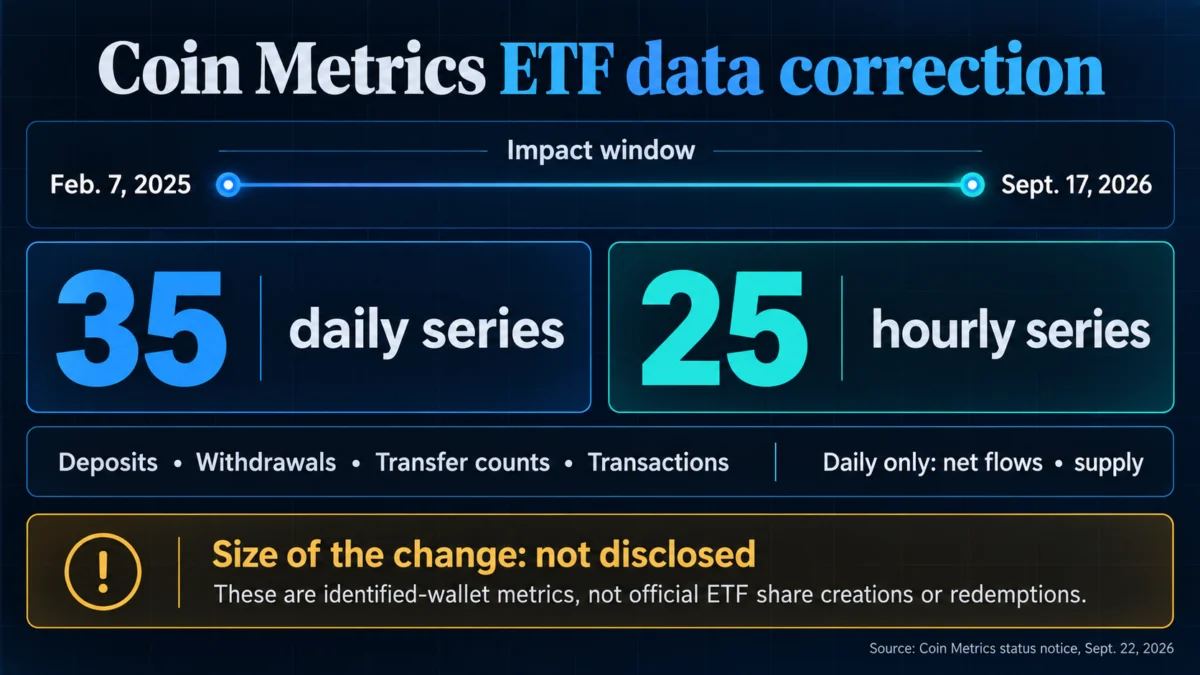
Coin Metrics has undertaken a significant revision of its on-chain data pertaining to Bitcoin Exchange-Traded Funds (ETFs), impacting a substantial period of over 19 months. This recalculation, which became public on September 22nd, 2026, affects users who rely on the firm’s identified-wallet series for their analytical work. The correction spans data from February 7th, 2025, through September 17th, 2026, encompassing 35 daily and 25 hourly data series. These series include crucial metrics such as ETF deposits, withdrawals, transfer counts, and transaction volumes. Notably, the daily list also incorporates net-flow and supply measures directly linked to Bitcoin ETFs.
It is imperative to understand that the data revised by Coin Metrics represents provider-derived observations of activity within blockchain addresses that the firm has identified as belonging to ETF operations. These are not official records of ETF share creation, redemption, or internal fund accounting. The announcement from Coin Metrics offers no clarity on the specific cause or triggers for this extensive recalculation. Furthermore, the notice conspicuously omits any details regarding the magnitude of the changes. No before-and-after values, aggregate differences, or percentage shifts have been disclosed. The public has not been informed whether the revisions generally increased or decreased the recorded figures, nor has any information been provided about the largest individual adjustments or any specific research that might have been impacted.
Unpacking the Scope of the Data Correction
The methodology employed by Coin Metrics for tracking ETF-related on-chain activity is crucial to understanding the potential implications of this revision. According to their documentation, an ETF deposit is defined as assets transferred into an address identified by Coin Metrics as being associated with an ETF. The calculation of dollar-denominated deposit flows is derived from these native-unit flows, utilizing Coin Metrics’ proprietary PriceUSD metric.
Conversely, their withdrawal methodology counts assets that have moved out of the control of these identified ETF addresses. For Bitcoin withdrawals specifically, Coin Metrics’ approach involves excluding the impact of change outputs. This means that any coins returned to the same fund cluster are not categorized as a separate inflow, a detail that can influence net flow calculations.
Another critical aspect is the coverage limitation inherent in Coin Metrics’ data collection. The firm explicitly states that its ETF transaction-count metric only incorporates data from ETFs and addresses that it has successfully identified. This self-imposed limitation means that this specific metric should be considered a minimum potential value, representing only what Coin Metrics could confidently attribute. The daily correction list also extends to Coin Metrics’ ETF supply series, which tracks the total amount of Bitcoin held by these identified ETF wallets over time.
Distinguishing On-Chain Activity from Official Fund Operations
It is vital to reiterate that wallet movements observed on the blockchain cannot be treated as a direct, one-to-one proxy for the authorized participant (AP) creation or redemption processes that underpin ETF operations. Coin Metrics’ work focuses on attributing blockchain activity based on its identification of wallet addresses. In contrast, the regulated ETF process is initiated by orders for ETF shares. This process often involves an in-kind mechanism, which was notably clarified and permitted under the U.S. Securities and Exchange Commission’s (SEC) July 2025 approval. This approval allowed for the creation and redemption of crypto exchange-traded products (ETPs) using underlying digital assets, a process distinct from simply tracking wallet movements.

The September 22nd notice from Coin Metrics clearly delineates that the correction pertains to "Coin Metrics Network Data," not a revision of issuer records. This distinction is fundamental: the data reflects Coin Metrics’ interpretation of on-chain events related to identified ETF wallets, not the internal accounting or operational reports of the ETF issuers themselves.
Implications for Data Users and Researchers
The practical impact of this data correction is therefore largely confined to those who have directly utilized the affected Coin Metrics series in their work. Individuals or entities that have stored these daily or hourly values, or incorporated them into analytical models, charts, or research reports covering the period from February 2025 to September 2026, may now need to revisit and update their historical data. This process would involve backfilling the corrected history and re-running any analyses or visualizations that relied on the previously published figures.
Crucially, the notice from Coin Metrics does not provide evidence that unrelated ETF analysis, which might not have directly depended on these specific on-chain wallet metrics, has been impacted. The integrity of analyses based on official ETF filings, share creation/redemption data reported by issuers, or market-level data not directly tied to Coin Metrics’ wallet identification would likely remain unaffected.
The Importance of Transparency and Future Expectations
Until Coin Metrics provides further details, such as specific delta disclosures or a more comprehensive explanation of the root cause of the correction, the most responsible conclusion remains narrow and cautious. The firm has indeed updated a substantial segment of its Bitcoin ETF on-chain wallet data. However, without the disclosure of how significantly these figures have shifted, the precise impact on historical analysis and the broader understanding of ETF on-chain flows remains uncertain for the public.
The incident underscores the inherent challenges in tracking and interpreting on-chain data, particularly for complex financial instruments like ETFs. While on-chain data offers a valuable layer of transparency, its accuracy and completeness are dependent on the methodologies and identification capabilities of data providers. For the cryptocurrency ecosystem to mature, increased transparency from data providers regarding significant data revisions is paramount. This allows users to confidently build upon reliable information and fosters a more robust analytical framework for understanding the flow of assets within the digital asset space. The industry will be looking to Coin Metrics for a more detailed follow-up that clarifies the nature and extent of these revisions, ensuring greater confidence in the data used for critical market analysis.
Background and Context: The Rise of Bitcoin ETFs
The period covered by Coin Metrics’ data revision coincides with a pivotal moment in the history of Bitcoin and the broader cryptocurrency market: the approval and launch of spot Bitcoin ETFs in the United States. In January 2025, the SEC granted approval for several spot Bitcoin ETFs, marking a significant milestone that opened the doors for institutional and retail investors to gain exposure to Bitcoin through traditional financial channels. This event led to substantial inflows into these ETFs, impacting Bitcoin’s price and market dynamics.
The data that Coin Metrics provides aims to offer insights into the on-chain movements associated with these ETFs. By identifying wallets believed to be controlled by ETF issuers, the firm’s metrics attempt to track the flow of Bitcoin into and out of these investment vehicles. This can include inflows from investors purchasing ETF shares (which often results in the ETF issuer buying Bitcoin on the open market or receiving it in-kind) and outflows when investors redeem ETF shares (leading to the ETF issuer selling Bitcoin).

The ability to accurately track these on-chain flows is crucial for several reasons:
- Market Analysis: Understanding the net flow of Bitcoin into and out of ETFs can provide valuable signals about investor sentiment and demand for Bitcoin. Large, consistent inflows can be interpreted as a bullish sign, while outflows might suggest a weakening of demand.
- Price Correlation: Researchers and traders often seek to correlate on-chain ETF activity with Bitcoin’s price movements to identify potential causal relationships or predictive patterns.
- Transparency and Trust: For some in the crypto community, on-chain data provides a layer of transparency and verifiable activity that complements traditional financial reporting.
The period from February 2025 to September 2026 saw significant developments in the Bitcoin ETF market, including substantial growth in assets under management (AUM) and evolving trading volumes. The accuracy of data covering this period is therefore of high importance to market participants.
The Challenge of Wallet Identification
A core challenge in providing on-chain ETF data lies in the accurate identification of ETF-controlled wallets. Unlike traditional financial institutions, which have clear reporting mechanisms, blockchain wallets are pseudonymous. Data providers like Coin Metrics employ sophisticated methods to cluster addresses and identify those likely associated with specific entities, such as cryptocurrency exchanges, custodians, or, in this case, ETFs. These methods can involve analyzing transaction patterns, known exchange deposit/withdrawal addresses, and publicly available information.
However, these identification processes are not infallible and can be subject to errors or require adjustments over time. For instance, an address initially misidentified as belonging to an ETF might later be reclassified, or new addresses associated with an ETF might be discovered. Such reclassifications or discoveries can necessitate revisions to historical data. The broad scope of Coin Metrics’ correction—spanning 19 months and affecting numerous data series—suggests that the underlying identification or calculation methodologies may have undergone a significant re-evaluation.
The lack of disclosed specifics about the cause of the correction leaves room for speculation. It could range from a refinement in the algorithms used to identify ETF-controlled wallets, a correction of errors in how Bitcoin was valued for dollar-denominated metrics, or an adjustment in how certain types of transactions were categorized. Regardless of the specific reason, the absence of transparency regarding the magnitude of the changes creates uncertainty for those relying on the data.
Forward-Looking Implications
While the immediate impact is on past analysis, the long-term implications of such data revisions hinge on the commitment of data providers to transparency and accuracy. For the burgeoning digital asset market, reliable and auditable data is fundamental to fostering trust and facilitating informed decision-making. The incident serves as a reminder for users of on-chain data to:
- Understand Data Provider Methodologies: Users should be aware of how data is collected, processed, and identified, and understand the inherent limitations.
- Seek Transparency: When significant data revisions occur, clear explanations and quantifiable impact assessments are crucial.
- Cross-Reference Data: Where possible, it is prudent to cross-reference on-chain data with other sources, such as official issuer reports or market data, to gain a more comprehensive view.
The continued evolution of the Bitcoin ETF landscape, and the broader digital asset market, will undoubtedly depend on the development of robust and transparent data infrastructure. Coin Metrics’ revision, while currently lacking detail, highlights the ongoing efforts and challenges in providing accurate and reliable on-chain analytics for these innovative financial products. The market will be watching for future updates that provide greater clarity and restore confidence in the data’s integrity.