Dwi Wanna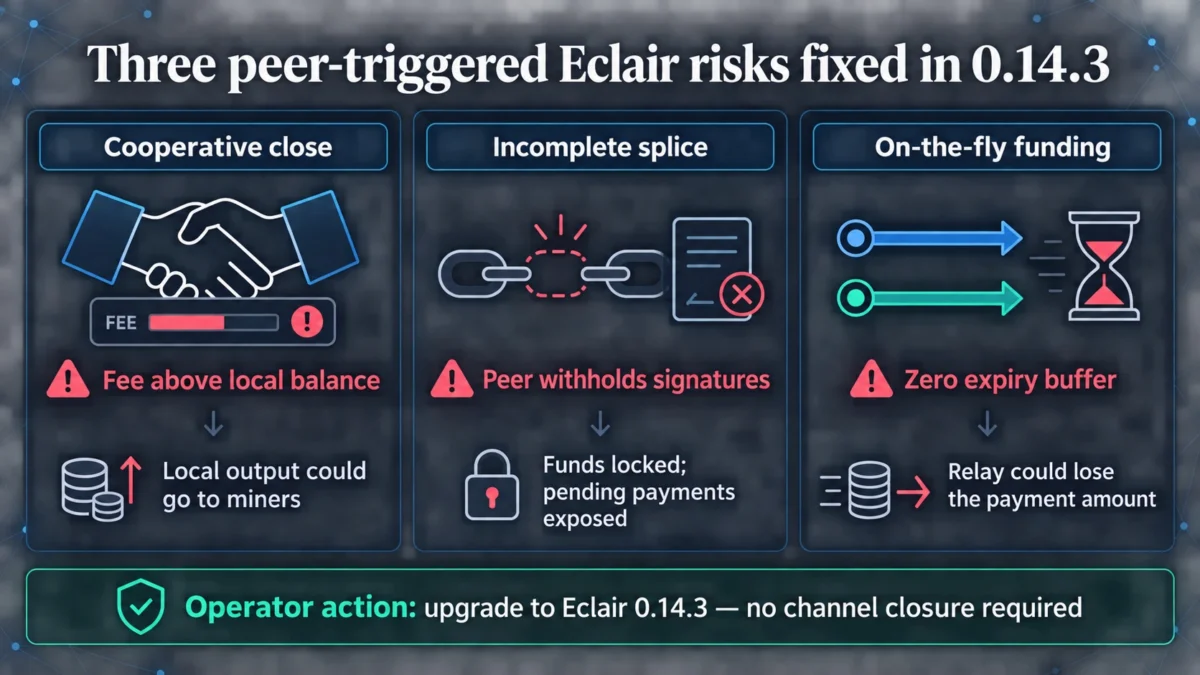
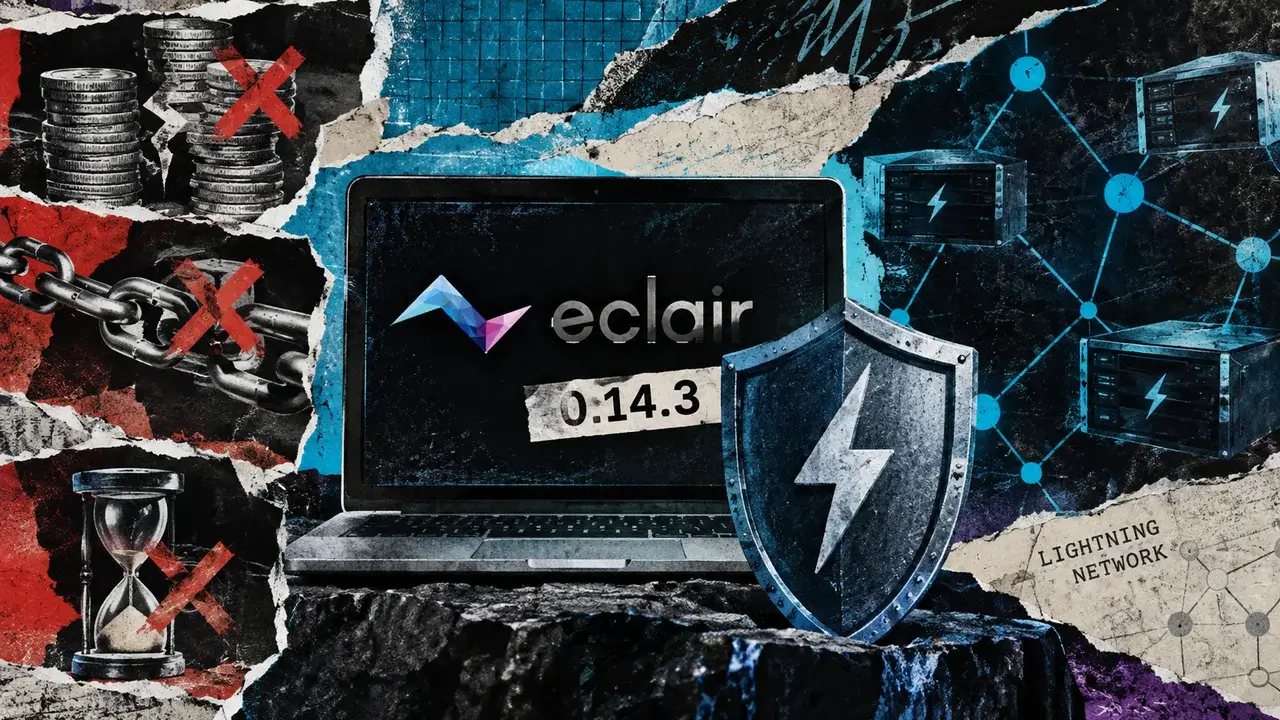
The Lightning Network, a Layer 2 scaling solution built atop the Bitcoin blockchain, relies on complex smart contracts known as Hashed Timelock Contracts (HTLCs) and off-chain state updates to facilitate near-instant, low-cost transactions. However, the complexity of these protocols introduces potential attack vectors, particularly during channel management operations such as closures, splicing, and liquidity provisioning. ACINQ, which maintains the Eclair implementation and the popular Phoenix Wallet, has issued an urgent recommendation for all node operators to upgrade to the latest version to prevent adversarial peers from exploiting these newly identified weaknesses.
Technical Analysis of the Eclair Vulnerabilities
The most direct threat addressed in the 0.14.3 release pertains to the process of cooperative channel closures. In a standard cooperative close, both peers agree to settle the channel balance and broadcast a final transaction to the Bitcoin mainnet. Under certain conditions, specifically when the Eclair node is responsible for paying the transaction fee, the protocol allows for a negotiation period to determine the appropriate fee rate.
The vulnerability stemmed from a lack of strict validation during this negotiation phase. An adversarial peer could propose an exorbitantly high transaction fee—one that exceeded the victim’s entire local balance. Due to a flaw in Eclair’s fallback negotiation logic, the software could accept this proposal. In such a scenario, the resulting transaction would allocate the victim’s entire balance to the miner’s fee, leaving the operator with zero return from the channel closure. While the attacker does not directly receive these funds, the "griefing" attack results in a total loss for the victim, highlighting a critical failure in the software’s economic safeguards. To remediate this, the patch introduces a hard cap on closing fees, automatically rejecting any proposal that exceeds a user-configured maximum.
A second vulnerability identified by ACINQ involves the "splicing" feature. Splicing is a relatively recent advancement in the Lightning protocol that allows operators to add or remove funds from an existing channel without needing to close and reopen it. This process improves capital efficiency and reduces on-chain footprints. However, ACINQ discovered a weakness in how Eclair handled the signing process during a splice. If an Eclair node provided its signature first and the counterparty maliciously withheld their signature, the channel could be left in a state of limbo.
This "unfinished splice" could result in funds being stranded, as the latest valid state of the channel might depend on an unconfirmed and unpublishable transaction. Furthermore, this state created a secondary risk involving payments in flight. An attacker could intentionally allow an incoming payment to expire while simultaneously publishing an older, valid channel state to collect the outgoing leg of the payment using a known secret. This "state-reversion" exploit leverages the timing of HTLC expirations to create a deficit for the relaying node. The Eclair 0.14.3 update addresses this by ensuring the node force-closes the channel using the most recent state that is backed by a fully signed and verifiable funding transaction.
The third flaw was found in Eclair’s "on-the-fly" funding mechanism, often referred to as Just-In-Time (JIT) channel creation. This feature is designed to improve user experience by allowing a channel to be opened and funded simultaneously with the receipt of an initial payment. ACINQ found that a malicious wallet could manipulate the timing of payment-expiry buffers. By carefully timing the expiration of the incoming payment, the attacker could collect the outgoing payment on-chain, forcing the relay operator to absorb the financial loss. The updated software now implements rigorous checks on relay fees and expiry buffers before any funds are committed to an on-the-fly funding request.
Chronology of Discovery and Mitigation
The discovery of these vulnerabilities underscores the ongoing security challenges inherent in developing Layer 2 protocols. While the specific timeline of the internal discovery remains confidential to prevent pre-patch exploitation, the following chronology outlines the public response:
- Early September 2026: ACINQ’s internal security audits and peer-review processes identify anomalies in fee negotiation and splicing state management.
- September 14, 2026: ACINQ officially tags and releases Eclair v0.14.3 on GitHub. The release notes explicitly categorize the update as a security release, urging immediate adoption.
- September 15-17, 2026: Major Lightning Network service providers and routing nodes begin the migration process. Technical analysis of the patch begins to circulate within the developer community.
- September 18, 2026: Bitcoin Optech, a prominent technical newsletter, publishes a detailed breakdown of the vulnerabilities, providing the broader community with an explanation of the risks associated with channel closing and splicing.
- Late September 2026: The release of Eclair 0.14.3 is followed by a wider industry discussion regarding "peer-triggered risks," leading to renewed calls for standardized fee caps across all Lightning implementations, including LND and C-Lightning.
Broader Ecosystem Pressures and Targeted Probing
The vulnerabilities in Eclair do not exist in a vacuum. They are part of a widening trend of security pressures facing Bitcoin Lightning operators. Earlier in the same month, BTCPay Server, a widely used open-source payment processor, reported a surge in automated attacks targeting node infrastructure. These attacks specifically focused on servers where administrators had manually exposed the Application Programming Interface (API) for LND (Lightning Network Daemon).
The mechanism of these attacks involved bots scanning for unauthenticated password-change endpoints. Attackers targeted a specific vulnerability window that occurs when an LND wallet is locked. If successful, the attacker could reset the wallet password and generate a "macaroon"—a specialized credential used for authentication in the Lightning ecosystem. With a high-level administrative macaroon, an attacker could gain full control over the node’s funds and routing logic.
In response to these external threats, BTCPay Server introduced a series of defensive measures, including the enforcement of unique passwords for LND wallets and the blocking of sensitive management routes at the network edge. These incidents, combined with the Eclair patches, suggest that as the Lightning Network grows in value and utility, it is becoming an increasingly attractive target for sophisticated, automated exploitation attempts.
Supporting Data and Security Benchmarks
The 0.14.3 release also introduced a significant change to the default fee policy of Eclair nodes. To mitigate risks associated with "bad external fee data"—where a node might receive inaccurate fee estimates from a compromised or malfunctioning oracle—ACINQ has implemented a default ceiling of 50 satoshis per virtual byte (sat/vByte) for automatically estimated channel-opening and splice fees.

This benchmark is significant because it provides a safety buffer against "fee-burning" attacks. By limiting the exposure to high-fee environments, node operators can ensure that even if a peer or an external data source attempts to manipulate the transaction costs, the node will refuse to sign any transaction that exceeds this threshold without manual intervention.
Current data from the Lightning Network indicates a growing concentration of capital in routing nodes. As of late 2026, the network capacity exceeds several thousand BTC, with tens of thousands of active channels. The risk of a "balance-to-miner" flaw is particularly concerning for high-capacity nodes that facilitate large-scale institutional payments, where a single exploited channel closure could result in the loss of multiple bitcoins.
Official Responses and Industry Implications
ACINQ’s response to these vulnerabilities has been characterized by transparency and a "defense-in-depth" approach. In their official communication, the company emphasized that while the vulnerabilities were "peer-triggered," they required specific conditions to be met. Nonetheless, the recommendation for an immediate upgrade was classified as "strong," reflecting the potential for loss of principal funds.
Industry analysts suggest that these events will likely lead to a shift in how Lightning Network software handles peer-to-peer negotiations. There is a growing consensus that Layer 2 protocols must move away from "optimistic" acceptance of peer proposals toward a "zero-trust" model. In this model, every proposal—whether for a fee, a splice, or a payment route—is validated against a strict set of local security policies before being processed.
The implications for the broader Bitcoin ecosystem are twofold. First, the discovery and rapid patching of these bugs demonstrate the robustness of the open-source development model. The ability of the ACINQ team to identify, fix, and disclose these issues before widespread exploitation occurred is a testament to the maturity of the project. Second, the nature of the "miner-fee" exploit highlights a unique aspect of Bitcoin’s security: the miners act as the ultimate sink for lost funds. While this does not benefit the attacker financially, it creates a "scorched earth" scenario that could be used for corporate sabotage or to undermine confidence in specific Layer 2 implementations.
As the Lightning Network continues to evolve, the focus is expected to remain on hardening these complex state machines. The transition to more secure defaults, such as the 50 sat/vByte ceiling and improved signature verification during splices, represents a necessary step in the journey toward a truly resilient global payment network. For now, the message to the community remains clear: the security of off-chain finance is a continuous process of vigilance, and keeping software up to date is the most effective defense against an increasingly sophisticated adversarial landscape.