admin
admin
Bitcoin has surged to an eight-month high, breaking above the significant $86,000 mark and putting the psychological $90,000 threshold firmly back in sight. This powerful rally, which commenced early in the week, was significantly propelled by a wave of short liquidations across cryptocurrency derivative markets. While the immediate sentiment among many traders is bullish, a less comfortable development is simultaneously unfolding beneath the surface: market leverage is accumulating at an alarming pace, nearly matching the velocity of the price increase. This divergence between price action and underlying market structure presents a complex picture for the world’s largest cryptocurrency, prompting both excitement and a degree of apprehension among market participants and analysts alike.
The Mechanics of the Rally: A Short Squeeze Narrative
The current upward trajectory gained substantial momentum when Bitcoin decisively breached the $82,000 level on Monday. This particular price point had previously acted as a formidable ceiling, thwarting several earlier attempts to push higher and marking a critical resistance zone for bulls. The breakthrough was not merely a result of organic buying pressure; rather, it ignited a cascade of short liquidations. According to data compiled by CoinGlass, this single move triggered the forced closure of approximately $750 million worth of bearish crypto derivative positions.
A short liquidation occurs when a trader who has bet on a price decline (a "short" position) is forced to buy back the asset to cover their position as its price rises, to prevent further losses. This forced buying creates additional, albeit artificial, demand in the market, effectively accelerating the upward price movement. Jim Ferraioli, head of crypto research at Schwab, succinctly captured the immediate cause, telling CoinDesk, "Bitcoin up 5% this morning due to short perpetual futures contracts being liquidated." This mechanism, often referred to as a "short squeeze," has played a pivotal role in shaping the latest phase of Bitcoin’s rally.
While powerful, a short squeeze-driven rally carries inherent caveats. It implies that a significant portion of the price increase is due to forced buying rather than genuine, fundamental spot demand from new investors or those accumulating for long-term holdings. As such, the market faces the critical task of demonstrating sufficient underlying demand to sustain the higher price levels once this temporary, liquidation-induced buying pressure dissipates. The question remains whether this initial thrust can transition into a more robust, demand-driven advance, or if it risks becoming a fleeting spike.
Beneath the Surface: The Leverage Conundrum
Even as Bitcoin celebrates its recent gains, a growing concern looms over the market’s health: the rapid resurgence of leverage. One of the clearest indicators of this trend is the significant jump in futures open interest, which represents the total value of all outstanding derivative contracts that have not yet been settled.
Since Bitcoin embarked on its latest ascent, an estimated $2 billion in new leveraged exposure has flooded into the market, according to data from Coinalyze. This increase in open interest is particularly noteworthy because it occurred even as traders who were betting against Bitcoin were being forced out of their positions. This distinction is crucial for understanding the nature of the current rally. A price increase underpinned by fresh spot demand – where buyers are acquiring actual Bitcoin – signals fundamental strength. In contrast, a rally increasingly fueled by traders opening new leveraged positions, often chasing momentum with borrowed capital, suggests a market becoming more speculative and potentially more fragile.
Nicolai Sondergaard, a senior research analyst at Nansen, highlighted this emerging imbalance, noting that the key difference in the current market dynamic is that the price has turned bullish faster than the underlying positioning. This suggests that the price movement is currently more a reflection of derivative market activity than a broad-based shift in investor conviction in the spot market. While leverage can amplify gains during an uptrend, it also dramatically increases the market’s vulnerability to sudden reversals and cascading liquidations, a phenomenon crypto markets have witnessed with painful frequency in the past.
Institutional Barometer: ETF Dynamics and Investor Sentiment
The institutional landscape, particularly the performance of U.S. spot Bitcoin Exchange-Traded Funds (ETFs), presents a mixed, albeit cautiously optimistic, picture. These ETFs, which allow traditional investors to gain exposure to Bitcoin without directly holding the asset, are considered a crucial gateway for institutional capital.

Following Bitcoin’s initial breakout, the ETF market experienced a period of uncertainty. On Tuesday and Wednesday of the previous week, U.S. spot Bitcoin ETFs collectively recorded substantial outflows totaling $746 million. This dip was largely attributed to renewed macroeconomic jitters and persistent regulatory uncertainty, specifically the failure of the Clarity Act in the Senate, which dampened investor enthusiasm for risk assets.
However, the tide quickly turned. Thursday saw a robust reversal, with $160 million flowing back into these ETFs, followed by an even stronger influx of $433 million on Friday. This rebound in inflows is an encouraging sign for bullish investors, suggesting that institutional interest remains resilient and that the dip was likely seen as a buying opportunity. Despite this positive reversal, traders will be closely monitoring whether these inflows can maintain their strength and consistency to provide sustained support for the market beyond the initial breakout phase.
An additional positive indicator from the ETF market is the average cost basis for U.S. spot ETF buyers, which has now moved to approximately $82,225. This means that, as a collective group, ETF investors are currently in profit, having acquired their Bitcoin exposure at an average price below the current market value. This shift back into profitability could potentially reduce selling pressure from these institutional holders in the near term, contributing to market stability.
Navigating the Technical Landscape: Key Resistance and Support Levels
The break above $82,000 holds significant technical importance for Bitcoin. This level had proven to be a stubborn resistance point, with previous attempts to breach it, notably in May, ultimately failing and leading to a subsequent decline below $60,000 in June. The decisive move past this barrier signals a shift in market control from sellers to buyers, at least in the short to medium term.
With $82,000 now acting as a potential support level, traders are actively eyeing the next set of critical resistance zones. Nicolai Sondergaard identified $87,000 as the immediate key area to watch, followed closely by the highly anticipated psychological threshold of $90,000, and then roughly $92,000. Jasper De Maere, an OTC trader at Wintermute, echoed this sentiment, suggesting that a test of $90,000 is a distinct possibility if the current momentum can be sustained.
Further bolstering the bullish technical picture, Bitcoin has successfully reclaimed its 50-week moving average. This longer-term technical indicator is closely watched by many market participants as it often provides a clearer signal of the prevailing trend, filtering out short-term noise. De Maere noted the historical significance of this level, pointing out that the 50-week moving average had frequently acted as strong resistance during previous bear market periods. Reclaiming it therefore provides additional technical confirmation for traders seeking evidence that Bitcoin’s June low may indeed have marked a broader turning point and the potential start of a new, sustained uptrend. This technical reclamation could attract more long-term oriented investors and signal increased confidence in the market’s recovery.
Resilience Amidst Macroeconomic Crosscurrents
Bitcoin’s recent surge is particularly noteworthy given the challenging macroeconomic backdrop against which it has unfolded. The broader financial markets have been grappling with several uncertainties that typically exert downward pressure on risk assets, including cryptocurrencies.
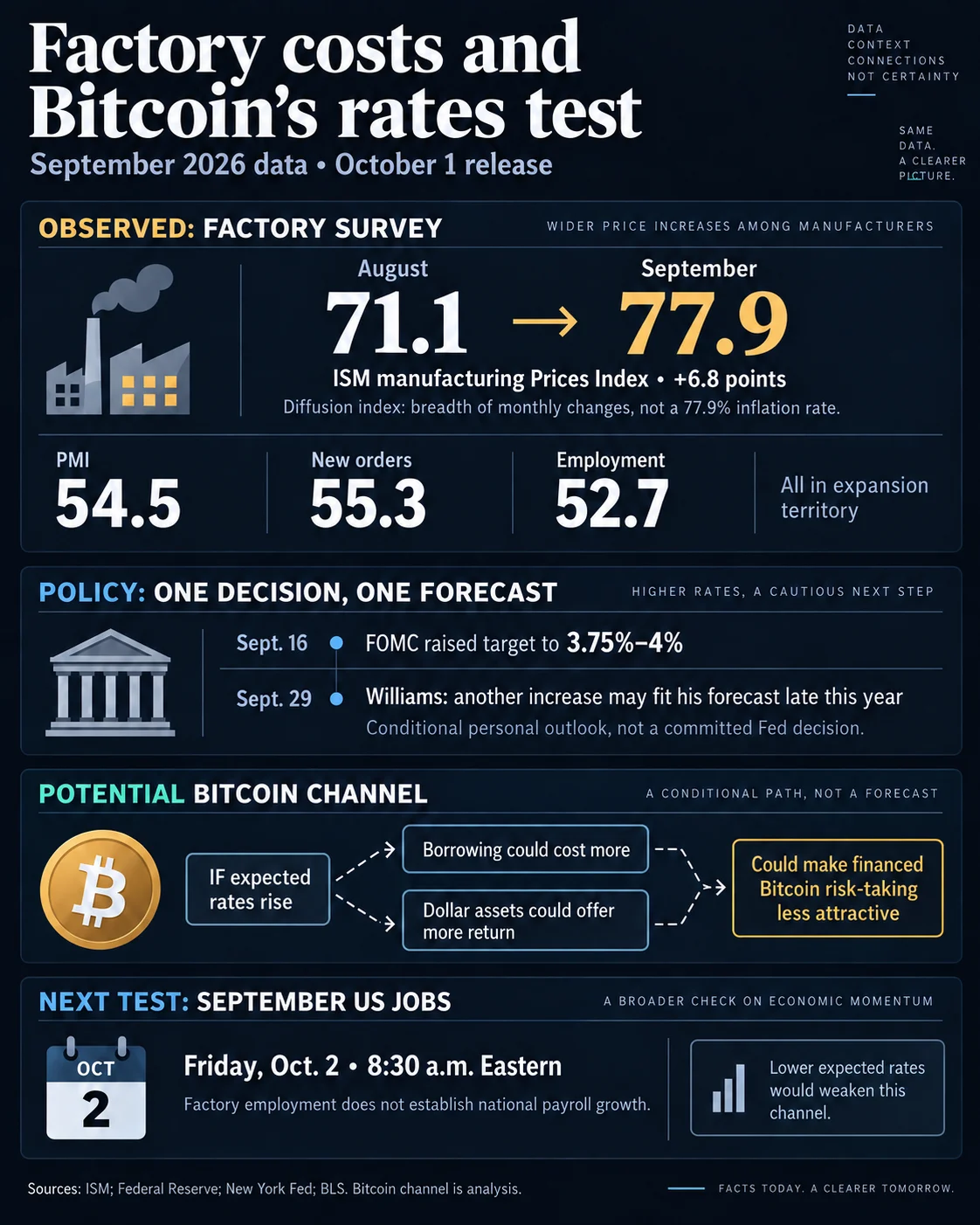
Last week, efforts to advance the Clarity Act in the Senate, a legislative initiative aimed at providing regulatory certainty for the crypto industry, ultimately failed. This setback added a layer of regulatory ambiguity, which often makes institutional investors hesitant. Simultaneously, the Federal Reserve proceeded with another interest rate increase, accompanied by what was perceived as relatively hawkish commentary regarding future monetary policy. Higher interest rates generally make traditional, less risky assets like bonds more attractive, thereby reducing appetite for volatile assets like Bitcoin. Furthermore, ongoing concerns about global inflation, persistent geopolitical tensions, and the general slowdown in various economies create an environment that is typically unfavorable for speculative investments.
Despite these significant headwinds, Bitcoin has not only held its ground but has continued its upward trajectory. This resilience suggests that the cryptocurrency may be developing a degree of decoupling from traditional market forces, or that its internal supply-demand dynamics and market structure are currently powerful enough to override external pressures. This defiance could also be interpreted as a sign of Bitcoin’s growing maturity and its emerging role as a distinct asset class with its own drivers.
The Crucial Test: Sustaining Spot Demand and Managing Leverage

The biggest question confronting Bitcoin bulls now is whether the spot market can effectively catch up with the derivatives-driven momentum. The sustainability of this rally hinges critically on the emergence of genuine, organic demand for Bitcoin itself, rather than solely relying on leveraged positions in futures markets.
Sondergaard issued a clear warning: "If the ETF and spot flows don’t follow, this breakout could turn into a leverage-driven move." He further cautioned that a rise in government bond yields or another unforeseen geopolitical shock could swiftly reverse the current positive trend. This underscores the central risk facing Bitcoin following a short squeeze. While forced buying can propel prices sharply higher in the short term, it does not inherently represent lasting market demand or a fundamental shift in investor sentiment.
If traders continue to open new leveraged long positions while genuine spot buyers remain cautious or absent, the market becomes increasingly precariously balanced. Such a scenario makes Bitcoin highly vulnerable to a sudden liquidation cascade, where even a minor price dip can trigger forced selling from overleveraged positions, which then intensifies the decline as more positions are liquidated, creating a dangerous feedback loop. Crypto markets have a painful history of experiencing how quickly such a dynamic can unravel, wiping out billions of dollars in leveraged positions in a matter of hours.
For now, traders are meticulously watching several key indicators. De Maere specifically pointed to ETF flows over the coming days as a critical barometer of institutional interest. He also highlighted excessive positioning in perpetual futures, funding rates (which indicate the cost of holding leveraged positions), and the upcoming Friday options expiry as factors that could significantly influence whether the rally has further room to run or if it is poised for a correction. A healthy market would see positive ETF inflows and stable funding rates, suggesting balanced demand rather than speculative excess.
Beyond Bitcoin: Altcoin Movements and Broader Market Sentiment
The positive sentiment generated by Bitcoin’s performance has not been confined solely to the largest cryptocurrency. Altcoins, the myriad of alternative cryptocurrencies, have also begun to move higher alongside Bitcoin. This broader market movement often suggests that risk appetite is spreading beyond the safety and dominance of Bitcoin, indicating a more generalized bullish outlook across the digital asset ecosystem. When altcoins start to perform, it typically signals a ‘risk-on’ environment where investors are willing to take on more exposure to potentially higher-reward, higher-risk assets.
However, Jim Ferraioli offered a more nuanced perspective on altcoin performance. He suggested that the more important question is whether activity across these smaller blockchain networks actually increases – in terms of development, user adoption, and transactional volume – rather than their prices simply rebounding after being heavily oversold during a downturn. A sustainable altcoin rally would be driven by fundamental growth and utility, not just speculative capital chasing Bitcoin’s coattails.
Expert Outlook and The Road Ahead
Some market observers are already describing the latest move as the definitive beginning of a new bullish cycle. Chris Sullivan, co-portfolio manager at Hyperion Decimus, characterized it as "the first major rally of a new bull market." However, even in this optimistic assessment, he included a crucial caveat, warning that a "substantial correction could follow once the move loses momentum." This caution is paramount, even if Bitcoin successfully reaches the $90,000 mark. The journey to new all-time highs is rarely a straight line, and healthy market cycles often involve significant pullbacks that consolidate gains and shake out overleveraged positions.
For the immediate future, the market has undeniably achieved a significant milestone by breaking through a major resistance zone and successfully forcing a large number of short sellers to capitulate. The immediate threat of bearish pressure has been mitigated by the short squeeze. However, the next crucial phase of this rally will depend less on these liquidation-driven purchases and more on whether genuine spot demand, consistent ETF inflows, and sustainable, healthy positioning can emerge to support the elevated prices.
Bitcoin may currently have the tantalizing $90,000 target firmly in its sights, representing a powerful psychological and technical hurdle. Yet, the more profound and enduring question for investors and analysts alike is not merely whether it can reach this level, but whether it can sustainably hold those gains in the aftermath of the short squeeze, demonstrating true market strength beyond the derivatives-fueled momentum. The coming days will be critical in determining the underlying health and long-term trajectory of this latest Bitcoin surge.