admin
The first week of November marked a pivotal moment for the cryptocurrency industry as major exchanges moved to publish previously guarded figures: the share of customer digital assets safeguarded in "cold storage." This unprecedented wave of transparency was directly triggered by a sophisticated attack on Binance’s hot wallets on October 29, which saw an estimated $6.36 billion siphoned off, predominantly within a mere 20 minutes, according to blockchain analytics firm TRM Labs. The incident not only sent ripples of concern through the digital asset community but also underscored the critical importance of robust security protocols and the distinction between online (hot) and offline (cold) storage mechanisms.
The market’s immediate reaction to the Binance breach was palpable. Bitcoin’s price, observed on live charts, experienced a sharp decline, falling below $78,000 in the hours following the theft. While a rebound to $80,564 was noted by November 5 as markets attempted to stabilize, a broader "risk-off" sentiment subsequently led to a more significant sell-off, pushing Bitcoin down to $75,620 by November 6. This price volatility highlighted a crucial aspect: while cold storage percentages indicate the quantity of assets secured offline, the dollar value of that security is inextricably linked to the ever-fluctuating price of the underlying cryptocurrency.
The Catalyst: Binance’s Hot Wallet Breach and Its Immediate Aftermath
The October 29 attack on Binance, one of the world’s largest cryptocurrency exchanges, represented a stark reminder of the persistent vulnerabilities inherent in digital asset platforms. Hot wallets, by their nature, are online-connected and facilitate rapid transactions, making them convenient for users but also prime targets for malicious actors. The sheer scale of the theft – $6.36 billion – was staggering, demonstrating the sophisticated capabilities of modern cybercriminals. While Binance CEO Richard Teng quickly moved to reassure users, stating that the "vast majority" of user assets were held in cold wallets and that "no user bears the loss," the event undeniably shook confidence across the ecosystem. The speed with which the funds were exfiltrated, mostly within minutes, painted a chilling picture of a meticulously planned operation.
Binance’s swift response involved temporarily halting withdrawals, a standard but disruptive measure, while its security teams investigated the breach. Within days, withdrawals were phased back in, signaling a return to operational normalcy. However, the incident spurred a broader conversation within the industry about accountability, transparency, and the necessity of demonstrating tangible proof of asset security.
Market Repercussions and Bitcoin’s Volatility
The immediate aftermath of the Binance hack saw Bitcoin’s price drop approximately 4% within hours. This initial dip reflected direct market apprehension regarding the security of centralized exchanges. However, the market exhibited a degree of resilience, with Bitcoin recovering most of these losses within a week. The price trajectory unfolded as follows:
- October 29, approximately 23:50 UTC: Bitcoin falls below $78,000, representing a decline of about 4.1% in 24 hours, directly following the hot-wallet theft.
- November 1, 10:18 UTC: The price steadies around $78,064 as Binance begins to restart withdrawals in phases.
- November 5: Bitcoin rebounds to $80,564, marking a 5.4% increase on the day, as initial panic subsides and markets show signs of stabilization.
- November 6, 04:00 UTC: A more significant downturn occurs, with Bitcoin dropping to $75,620, an approximate 6% decline in 24 hours.
Crucially, the sharp fall on November 6 is largely attributed by market commentators to broader macroeconomic factors rather than new issues related to the Binance hack. This "risk-off" environment was characterized by a sell-off in AI and tech stocks, coupled with discussions about potentially tougher US regulatory oversight for the crypto sector. The confluence of these factors led to the liquidation of approximately $1.25 billion in leveraged crypto positions within 24 hours. The Crypto Fear & Greed Index, a sentiment gauge, plummeted from 50 ("Neutral") to 28 ("Fear") on November 6, underscoring the shift in investor sentiment driven by external market pressures. This distinction is vital; while the hack caused an initial tremor, the market’s sustained volatility was heavily influenced by wider economic currents, demonstrating that even robust exchange security might not fully insulate digital assets from macro trends.
The Imperative for Transparency: Understanding Cold Storage Ratios
At the heart of the industry’s response to the Binance hack is the concept of the cold-storage ratio. This metric represents the percentage of an exchange’s customer crypto assets held in offline wallets, completely disconnected from the internet. The remaining portion resides in "hot wallets," which are online to facilitate rapid withdrawals and trading activities. While hot wallets offer unparalleled convenience, their internet connectivity makes them inherently more susceptible to cyberattacks, as demonstrated by the Binance incident.
The October attack explicitly targeted this vulnerable layer. Binance’s internal policy, like many large exchanges, already favored a high cold storage percentage, which was crucial in limiting the overall impact on user funds. However, a theft measured in billions of dollars, even if covered by the exchange, necessitated a more explicit commitment to transparency from the wider industry. Regulators, particularly in jurisdictions with existing frameworks, also took notice. South Korea, for instance, has long mandated that exchanges maintain at least 80% of customer digital assets in cold storage, with its Financial Supervisory Service (FSS) regularly collecting these figures. This pre-existing regulatory stance provided a benchmark for what constitutes responsible asset management in the crypto space.
Industry’s Response: A Wave of Disclosures

In the wake of the Binance hack, several prominent global and Korean-based exchanges moved to disclose their cold-storage ratios, offering a glimpse into their security postures. These figures varied significantly, from just above the South Korean minimum to over 99%, indicating diverse approaches to risk management and operational efficiency.
A summary of reported figures includes:
- Large US-listed exchange: More than 99% of customer assets in cold storage (as per a November 4 blog post).
- South Korea’s largest exchange: 99.17% in cold storage (end of September, reported by FSS).
- Second-largest Korean exchange: 94.76% in cold storage (end of September, reported by FSS).
- Global exchange (security page): More than 95% of client crypto in cold storage (updated September 18).
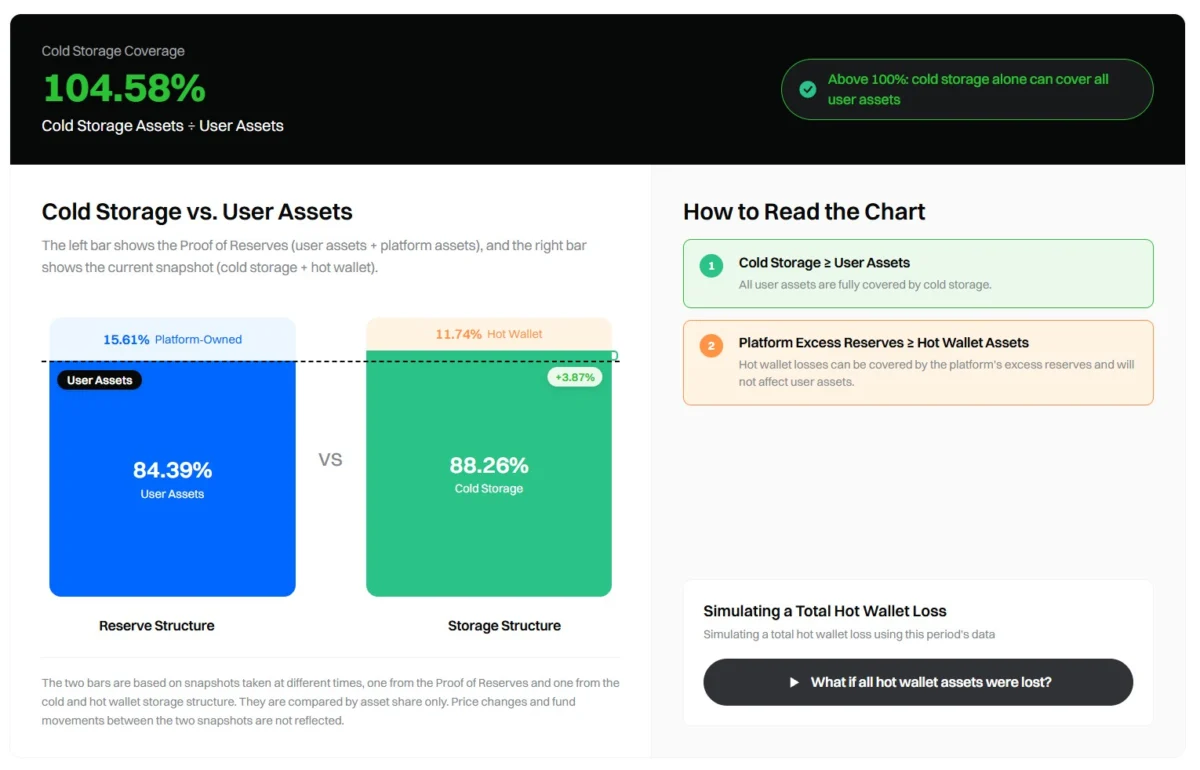
- Global exchange (launching "Proof of Security" report): 88.26% of total assets in cold storage (November 5).
- Three smaller Korean exchanges: Reported figures of 85%, 82.79%, and 80.54% (end of September, reported by FSS).
These disclosures, while a positive step, often came with varying reporting dates and methodologies, underscoring the need for standardized reporting.
One exchange, Gate, went beyond a simple percentage disclosure by launching a framework it termed "Proof of Security (PoSEC)" on November 5. While standard Proof-of-Reserves reports confirm that an exchange holds sufficient assets to cover customer balances, PoSEC adds a crucial "stress test." It provides granular visibility into the asset storage structures, detailing the split between hot and cold wallets, and critically, demonstrating whether cold storage alone could fully repay all customers even if every hot wallet were completely drained. Gate reported an impressive 104.58% in this scenario, meaning its cold reserves would still cover all customer assets in such an extreme event. This implies total platform assets of roughly 118% of customer balances (calculated as 104.58 ÷ 88.26 ≈ 1.18). While the data was undergoing third-party audit review at the time of publication, this initiative represents a significant leap forward in transparently demonstrating an exchange’s resilience against worst-case scenarios.
Quantifying Risk: Cold Storage in Dollar Terms
The inherent volatility of cryptocurrency prices means that a cold-storage percentage alone only tells half the story. The real-world dollar exposure of an exchange’s hot wallet depends equally on its hot-wallet share and the prevailing Bitcoin price at any given moment. To illustrate this, consider a hypothetical exchange holding 50,000 BTC for its customers. Using Bitcoin’s price of $75,620 per coin (November 6, 04:00 UTC), the total value of these assets would be approximately $3.78 billion.
Here’s how different hot-wallet shares translate to dollar values in this scenario:
| Hot-wallet share | BTC online | Dollar value on November 6 |
|---|---|---|
| 0.83% (99.17% cold) | 415 BTC | About $31.4 million |
| 1% (99% cold) | 500 BTC | About $37.8 million |
| 5% (95% cold) | 2,500 BTC | About $189 million |
| 11.74% (88.26% cold) | 5,870 BTC | About $444 million |
| 20% (Korea’s 80% minimum) | 10,000 BTC | About $756 million |
(Calculations are based on BTC online × $75,620.19)
This table vividly demonstrates that even a seemingly small percentage in hot storage can represent hundreds of millions of dollars in potential exposure, particularly for exchanges holding substantial customer assets. Furthermore, the daily fluctuations in cryptocurrency prices dramatically alter the value of stolen funds, even if they remain dormant. For instance, the 18,270 BTC still controlled by the Binance attacker, valued at $80,564 on November 5, were worth approximately $1.47 billion. Just one day later, at $75,620, their value had dropped to about $1.38 billion – a swing of roughly $90 million without any movement of the coins themselves. This highlights the dynamic nature of risk assessment in the crypto space.
Beyond the Numbers: Implications for User Trust and Regulation
While a higher cold-storage ratio directly limits an exchange’s potential loss in a single attack, its impact on the Bitcoin price is indirect. Bitcoin’s price is determined by global market dynamics, and as the week following the Binance hack demonstrated, broader macroeconomic movements and investor sentiment often exert a more dominant influence than isolated exchange incidents. The relatively quick recovery to $80,564 by November 5 suggested that the market largely compartmentalized the theft as a company-specific security breach rather than a fundamental flaw in the Bitcoin protocol itself.
Nevertheless, the collective push for transparency in cold storage ratios is a crucial step towards rebuilding and strengthening user confidence in centralized crypto exchanges, particularly in the aftermath of high-profile collapses like FTX and numerous other hacks. A higher ratio signifies a more conservative and secure approach to asset management, fostering greater trust over time.
Moreover, the response to the Binance hack showcased the increasing effectiveness of blockchain analytics and industry collaboration in mitigating losses. Blockchain analysts at Elliptic estimated that approximately $2.85 billion of the stolen funds were frozen or seized, with a significant 94% of this being stablecoins whose issuers have the ability to block addresses. This capability, while raising questions about decentralization, proved instrumental in recovering a substantial portion of the illicitly obtained assets.

However, cold storage is not an infallible solution. Hong Kong’s Securities and Futures Commission, for example, issued a warning to exchanges in August 2023, highlighting that vulnerabilities in wallet systems can affect both hot and cold setups if not properly managed. This underscores that while a high cold-storage ratio is a strong indicator of security, it is not an absolute guarantee against all forms of sophisticated attacks or insider threats. Comprehensive security extends to robust internal controls, multi-signature protocols, physical security of cold storage facilities, and rigorous auditing.
The Road Ahead: Evolving Security Standards
The Binance hack and the subsequent industry disclosures mark an important evolutionary step for cryptocurrency exchanges. The demand for greater transparency, driven by both market participants and regulators, is pushing platforms to adopt more sophisticated and verifiable security frameworks. The emergence of concepts like PoSEC, which stress-test an exchange’s ability to cover all customer assets from cold storage alone, sets a new benchmark for accountability.
For users, understanding an exchange’s cold-storage practices, alongside monitoring Bitcoin’s price movements, becomes an essential component of due diligence. A five-step routine can help:
- Locate the exchange’s security page: Most reputable exchanges will have a dedicated section detailing their security measures.
- Find the cold-storage ratio: Look for the percentage of assets held offline. Note the date of the figure, as it can change.
- Check for Proof-of-Reserves or Proof-of-Security: Verify if the exchange provides audited reports demonstrating solvency and asset distribution.
- Compare the ratio with industry standards: Evaluate how the exchange’s percentage stacks up against others, particularly those with regulatory mandates like South Korea’s 80% minimum.
- Consider the exchange’s overall reputation and insurance: A high cold-storage ratio is one piece of the puzzle; a strong track record and robust insurance policies further enhance security.
Ultimately, the future of cryptocurrency exchanges hinges on their ability to marry the convenience of centralized services with the ironclad security principles of the underlying blockchain technology. As the industry matures, proactive security disclosures, transparent asset management, and continuous innovation in safeguarding customer funds will be paramount to fostering long-term trust and widespread adoption. For individual investors, the principle of self-custody – holding coins in a wallet they control offline – remains the ultimate defense against exchange-specific risks, offering a parallel path for those who prioritize absolute control over convenience.
FAQs
Why don’t exchanges keep 100% of crypto in cold storage?
Exchanges need a portion of funds in hot wallets (online) to process user withdrawals and facilitate trading activities quickly. Moving funds from cold storage typically involves manual approvals and multi-person authorization, which can take hours. Most large exchanges maintain a small hot-wallet buffer to cover normal daily withdrawal volumes, replenishing it from cold storage as needed.
What is a proof-of-reserves report?
A proof-of-reserves report is an audit where an exchange demonstrates that the digital assets it holds on-chain (its reserves) are equal to or exceed the total customer balances. Many reports now incorporate cryptographic methods, such as Merkle trees, allowing users to verify that their individual balance is included in the total without revealing other users’ information. The snapshot date of the report is critical, as exchange balances are constantly changing.
Is cold storage the same as a hardware wallet?
They are closely related concepts. A hardware wallet is a specific type of cold storage device commonly used by individuals to keep their private keys offline. Exchanges, however, typically employ more complex cold storage setups, which might include multiple hardware devices, geographically distributed vaults, multi-signature wallets, and rigorous physical security protocols. The fundamental principle, however, is the same: keeping private keys isolated from internet-connected systems to prevent unauthorized access.
What is a multisig wallet?
A multisig, or multi-signature, wallet requires multiple distinct private keys to authorize a transaction. For example, a "3-of-5" multisig wallet would require approval from any three out of five designated private keys to move funds. Exchanges frequently utilize multisig setups for cold storage, ensuring that no single point of failure (like a stolen laptop or compromised password) can lead to the draining of funds. The trade-off is increased operational complexity and slower transaction speeds due due to the multiple approval steps.
Why does the Bitcoin price differ slightly between websites?
Bitcoin’s price can vary slightly between different websites or exchanges due to several factors. Each platform pulls price data from different trading venues, and updates occur at slightly different intervals. Some sites might display the last traded price on a specific exchange, while others show an aggregated average across multiple markets. These discrepancies typically amount to a few dollars at any given second. For consistent analysis, it is important to note the time of the quote and use the same data source for all calculations.