admin
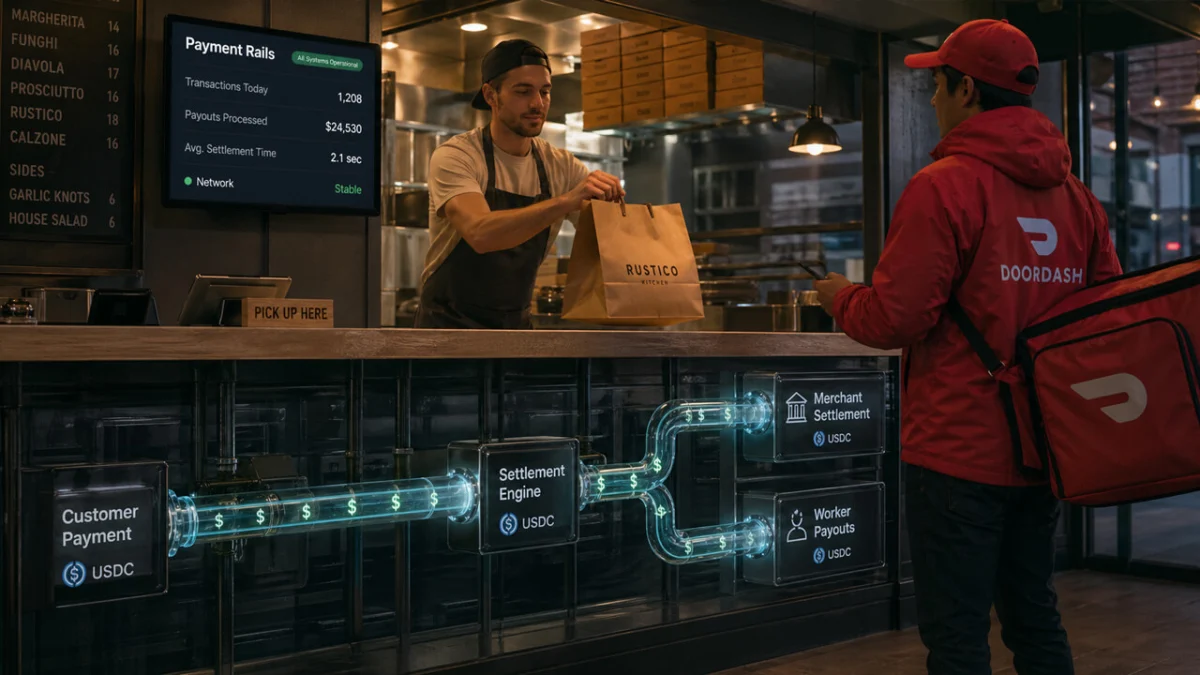
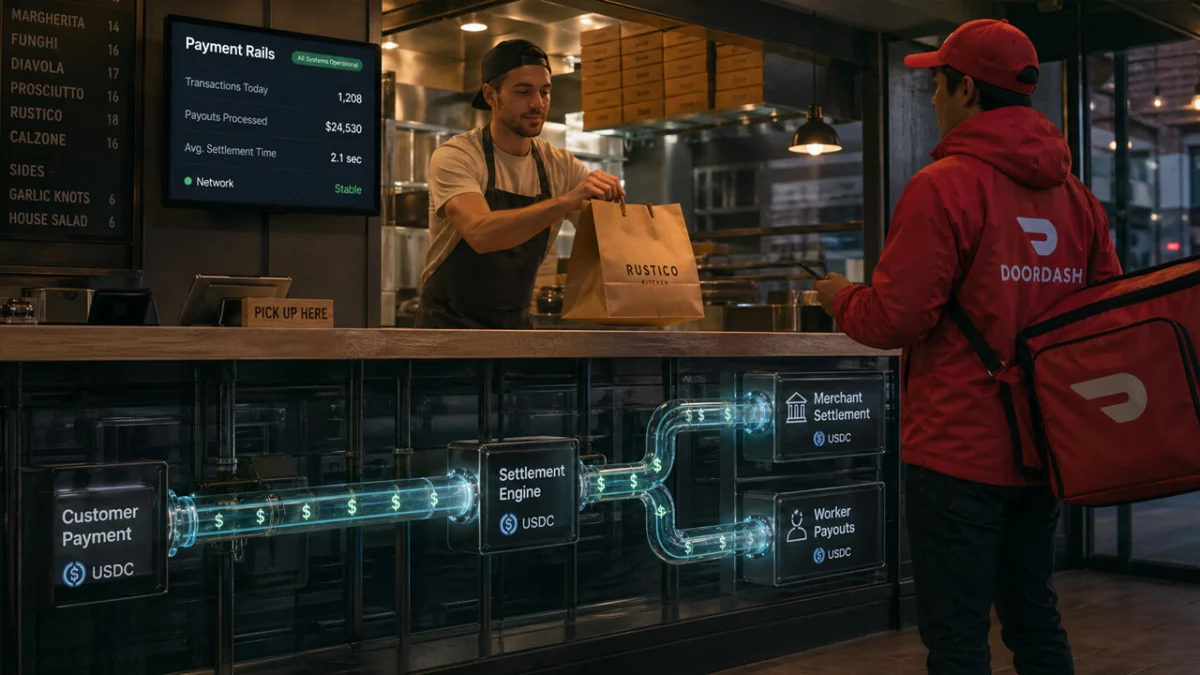
DoorDash, the leading food delivery and logistics platform, has officially entered a partnership with Tempo, a blockchain infrastructure provider backed by Stripe and Paradigm, to integrate stablecoin-powered payouts into its vast marketplace. This initiative marks one of the most significant real-world applications of stablecoin technology to date, moving the asset class from speculative trading into the core operational infrastructure of a global enterprise. Operating across more than 40 countries, DoorDash manages a complex ecosystem where financial flows move in multiple directions simultaneously: customers pay at the digital checkout, merchants await settlement for fulfilled orders, and millions of independent contractors, known as Dashers, rely on timely payouts to manage their daily expenses and liquidity.
The decision to adopt stablecoin rails addresses a fundamental inefficiency in the traditional financial system. While the consumer-facing side of the DoorDash app provides a seamless, near-instant experience, the backend financial movement remains tethered to legacy banking systems. These systems are often fragmented by regional regulations, restricted by banking hours, and burdened by settlement delays that can range from several hours to several business days. By leveraging Tempo’s blockchain infrastructure, DoorDash aims to compress these settlement windows, providing faster and more cost-effective access to earnings for its global network of stakeholders.
The Operational Challenge of Global Payouts
The move toward stablecoin integration is driven by a specific operational problem: the friction of the payout gap. In a marketplace of DoorDash’s scale, the users who feel payment friction most acutely are rarely the ones focused on the technical nuances of cryptocurrency. For merchants, particularly small and medium-sized businesses, delayed settlements directly impact working capital. Slow access to funds can hinder a restaurant’s ability to manage payroll, purchase inventory, or handle short-term liquidity needs.
For Dashers, the need for immediate cash availability is often a matter of daily survival. This urgency is exacerbated during periods of economic volatility, such as rising fuel prices or increased costs of living. DoorDash has previously recognized these pressures, implementing measures such as gas relief programs for U.S. and Canadian Dashers. However, these are temporary subsidies; a systemic shift toward instant, stablecoin-based payouts represents a structural solution to the problem of earnings accessibility.
The current financial plumbing used by most global marketplaces relies on a series of intermediaries, including acquiring banks, issuing banks, clearinghouses, and cross-border settlement networks like SWIFT. Each step introduces a layer of fees and a potential delay. In a cross-border context, foreign exchange (FX) friction adds another layer of cost and complexity. Stablecoins, which are pegged to the value of a fiat currency like the U.S. Dollar, offer a way to bypass many of these traditional bottlenecks by moving value over a unified, 24/7 digital ledger.
A Chronology of Infrastructure Development
The integration of DoorDash into the Tempo ecosystem is the result of a multi-year shift in how major fintech and technology firms view blockchain technology.
- Late 2023: Stripe and Paradigm introduced Tempo, a Layer 1 blockchain specifically engineered for payment infrastructure. Unlike general-purpose blockchains that prioritize decentralization at the expense of speed or cost, Tempo was designed for high throughput and sub-second finality, catering specifically to enterprise-scale payment flows.
- Early 2024: A coalition of major financial and technology players, including Deutsche Bank, Shopify, OpenAI, Revolut, and Visa, were identified as early partners or interested parties in the Tempo network. This signaled a shift in the industry’s focus toward "stablecoin-native" fees and infrastructure.
- Mid-2024: Stripe intensified its focus on stablecoins, publishing a series of technical guides on payout strategies and cross-border treasury movement. This period also saw Stripe’s high-profile $1.1 billion acquisition of Bridge, a stablecoin platform, further cementing its commitment to this technology.
- Late 2024: DoorDash, along with Coastal Bank and ARQ, officially joined the initiative to introduce stablecoin payments, moving the project from the theoretical phase into active marketplace implementation.
DoorDash co-founder Andy Fang has emphasized that the primary appeal of this technology is its ability to solve real-world logistical problems. By making payouts faster and more affordable, the company can improve the overall health of its marketplace, ensuring that the participants who provide the labor and the product are compensated with the same speed at which the service is delivered.
Technical Foundations: Why Tempo Matters
Tempo was built to address the specific failures of existing blockchain networks when applied to the gig economy. Many early attempts to use blockchain for payments suffered from volatile "gas" fees (transaction costs) and slow confirmation times. For a Dasher wanting to cash out $50, a $5 transaction fee or a 30-minute wait is unacceptable.
Tempo’s architecture focuses on three critical pillars for enterprise adoption:
- High Throughput: The ability to handle thousands of transactions per second, matching the volume of a global marketplace.
- Sub-Second Finality: Ensuring that once a transaction is initiated, it is settled almost instantly, eliminating the "settlement risk" associated with traditional banking.
- Predictable Fees: Using stablecoin-native fees to ensure that the cost of moving money remains low and consistent, regardless of network traffic.
This infrastructure allows DoorDash to potentially bypass the "banking cutoff" problem—the period during weekends or holidays when traditional bank transfers cease to move. With stablecoins, a merchant could theoretically receive settlement for a Friday night rush on Friday night, rather than waiting until the following Monday or Tuesday.
Supporting Data: The Rise of Stablecoin Utility
The shift toward using stablecoins as backend "plumbing" is supported by staggering growth in transaction volumes. According to industry data, stablecoin transaction volume reached approximately $28 trillion in the first quarter of 2024 alone. While a significant portion of this volume—estimated by some analysts to be as high as 76%—is driven by automated bots and exchange-related activities, the sheer scale demonstrates the robustness of the underlying technology.
Furthermore, the cost-benefit analysis for cross-border transfers is compelling. Traditional cross-border remittances can cost an average of 6% to 7% of the total transaction value, according to World Bank data. Stablecoin transactions, even when factoring in "on-ramp" and "off-ramp" fees (converting fiat to crypto and back), can often reduce these costs by more than 50%, while cutting settlement time from days to seconds.
For a company like DoorDash, which operates in 40 jurisdictions, the ability to centralize treasury operations using a stablecoin-native format could lead to significant savings in foreign exchange overhead and administrative costs.
Official Responses and Industry Implications
While DoorDash has not yet released a full technical breakdown of which specific payout flows will move to the blockchain first, the company’s leadership has been clear about the strategic intent. Andy Fang noted that the goal is to align the movement of money with the speed of the digital economy.
Stripe has also been vocal about the role of stablecoins in modern finance. The company’s recent research highlights that businesses are increasingly looking for ways to reduce the "float" time—the period where money is stuck in transit. By partnering with DoorDash, Stripe and Tempo are demonstrating that stablecoins are no longer just an asset for crypto-native startups, but a viable tool for some of the world’s largest consumer platforms.
Coastal Bank and ARQ, which are also part of the Tempo rollout, represent the regulated financial side of this transition. Their involvement suggests that the necessary compliance, Know Your Customer (KYC), and Anti-Money Laundering (AML) frameworks are being integrated directly into these new payment rails. This address one of the primary concerns for enterprise adoption: the need for a "permissioned" or highly regulated environment that satisfies global financial authorities.
The "Invisible" Future of Blockchain
The most profound implication of the DoorDash-Tempo partnership is that the next wave of crypto adoption may be invisible to the end user. In this model, a Dasher does not necessarily need to understand how a blockchain works, nor do they need to manage private keys or navigate decentralized exchanges. They simply see an option for "Instant Payout" in their app, and behind the scenes, the value is moved via stablecoins on the Tempo network, converted back to local fiat currency, and deposited into their account.
This "backend-first" approach solves the user experience (UX) hurdles that have historically plagued the crypto industry. It treats blockchain as a superior piece of financial plumbing rather than a new consumer product.
As stablecoins move deeper into the operating infrastructure of companies like DoorDash, Shopify, and OpenAI, the distinction between "crypto" and "fintech" continues to blur. The success of this integration will be measured not by the number of people talking about stablecoins, but by the reduction in settlement times and the increased liquidity for the millions of workers and businesses that power the global gig economy.
In conclusion, DoorDash’s move signals a maturation of the digital asset space. By focusing on the practical, unglamorous problems of payout timing and settlement costs, the company is helping to build a more efficient financial foundation for the internet-native economy. If this pilot proves successful at scale, it is likely that other major platforms with high-frequency payout needs—such as Uber, Airbnb, or Etsy—will follow suit, fundamentally redesigning the financial plumbing of modern commerce.