admin
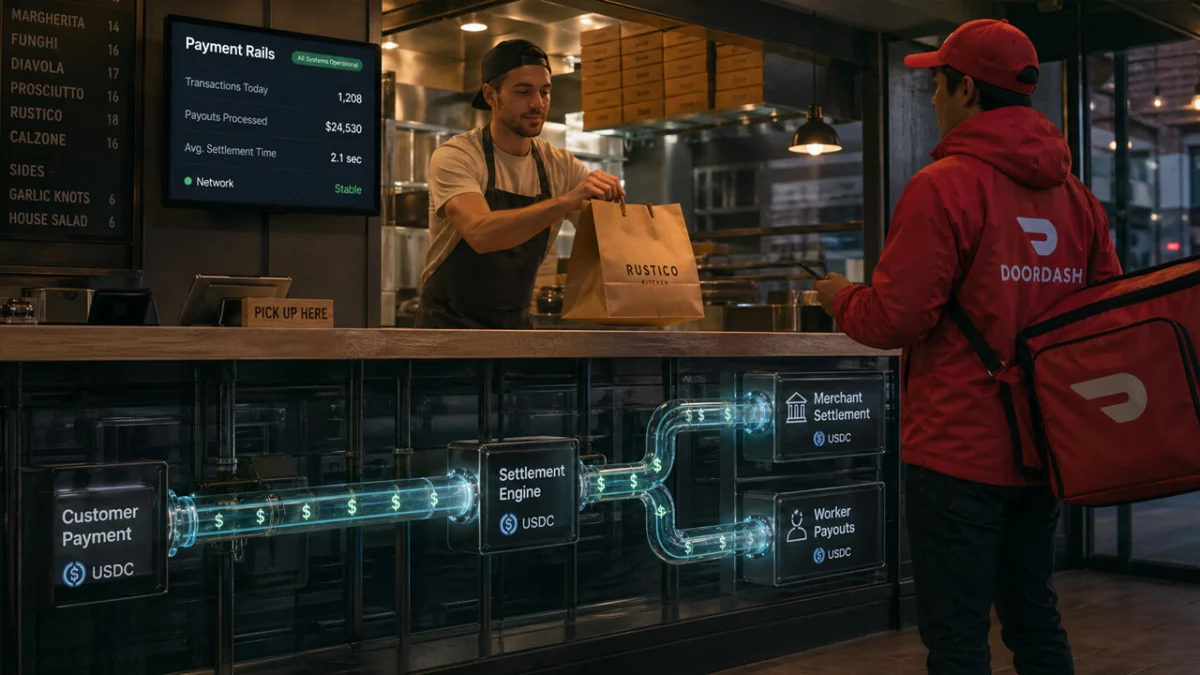
DoorDash, the leading global food delivery and logistics platform, has officially entered into a strategic partnership with Tempo, a high-performance blockchain infrastructure provider backed by Stripe and Paradigm, to integrate stablecoin-powered payouts into its international marketplace. The move represents one of the most significant real-world applications of blockchain technology to date, signaling a shift from speculative crypto-assets toward the use of digital currencies as fundamental enterprise infrastructure. By leveraging stablecoins, DoorDash aims to resolve long-standing inefficiencies in its three-sided marketplace, which involves millions of customers, merchants, and independent contractors—known as Dashers—across more than 40 countries.
The integration is designed to address the "last mile" of financial transactions: the movement of funds from the platform to the bank accounts of the people who power the ecosystem. Currently, the movement of money within a global marketplace of this scale is hindered by a fragmented legacy banking system characterized by regional settlement rails, restrictive banking hours, and varying jurisdictional regulations. For DoorDash, the introduction of stablecoin payouts via the Tempo network offers a way to bypass these traditional bottlenecks, providing faster, more predictable, and more cost-effective access to earnings for its global workforce and merchant partners.
The Operational Imperative: Solving the Payout Gap
The primary driver behind DoorDash’s adoption of stablecoins is the operational friction inherent in traditional cross-border and domestic settlement. In a standard transaction, a customer pays for an order instantly at checkout, but the resulting funds often take hours or even days to reach the merchant or the Dasher. This delay is largely due to the reliance on legacy systems such as ACH in the United States, SEPA in Europe, and various local real-time payment systems that do not always interoperate seamlessly.
Andy Fang, co-founder of DoorDash, highlighted that the appeal of the Tempo partnership lies in its ability to make payouts both faster and more affordable. In a high-volume, low-margin industry like delivery, the speed of capital rotation is critical. Merchants, particularly small-to-medium-sized restaurants, rely on rapid settlement to manage payroll, purchase inventory, and maintain short-term liquidity. When settlement delays occur, it puts a strain on their working capital, potentially affecting their ability to operate efficiently.
For Dashers, the timing of payouts is often a matter of immediate financial necessity. Unlike traditional salaried employees, gig workers frequently rely on their earnings to cover daily expenses such as fuel, vehicle maintenance, and living costs. DoorDash has historically recognized this pressure, recently implementing gas price relief measures and emergency support programs in the U.S. and Canada. By moving to a stablecoin-based payout model, DoorDash can offer Dashers near-instant access to their funds, regardless of banking holidays or traditional settlement windows.
Technical Foundation: The Role of Tempo and Stripe
The infrastructure facilitating this shift is Tempo, a Layer-1 blockchain specifically engineered for payment use cases. Introduced last year as a joint initiative between the payments giant Stripe and the venture capital firm Paradigm, Tempo was designed to solve the throughput and finality issues that have historically prevented large-scale enterprises from using public blockchains like Ethereum or Bitcoin for daily operations.
Tempo’s architecture prioritizes high throughput and sub-second finality, meaning transactions are confirmed and irreversible almost instantly. Furthermore, the network utilizes stablecoin-native fees, allowing users to pay transaction costs in the same digital dollars they are transferring, rather than requiring them to hold a volatile native gas token. This design choice is crucial for enterprise adoption, as it removes the complexity of managing multiple asset types for simple payment tasks.
The partner list for Tempo underscores its position as a serious contender for the future of financial plumbing. Alongside DoorDash, the network counts major institutions and tech leaders such as Deutsche Bank, Shopify, OpenAI, Revolut, Visa, Coastal Bank, and ARQ among its early adopters and collaborators. This coalition suggests a growing consensus among fintech and traditional finance leaders that stablecoins—digital assets pegged to the value of a fiat currency like the U.S. Dollar—are the most viable path for modernizing global value transfer.
Chronology of the Stablecoin Evolution in Enterprise Payments
The integration of stablecoins into DoorDash’s backend is the culmination of several years of incremental development within the fintech sector. To understand the significance of this move, it is necessary to look at the timeline of how stablecoins transitioned from niche trading tools to enterprise-grade settlement layers:
- 2020–2021: The Speculative Era. Stablecoins were primarily used as a "safe haven" for crypto traders moving between volatile assets like Bitcoin. Institutional interest was largely confined to hedge funds and crypto-native startups.
- 2022: The Infrastructure Pivot. Major payment processors, led by Stripe and Visa, began exploring stablecoins as a way to settle merchant transactions. Stripe famously re-entered the crypto space by allowing creators on X (formerly Twitter) to receive payouts in USDC via the Polygon network.
- 2023: The Birth of Tempo. Stripe and Paradigm revealed Tempo, a dedicated blockchain meant to serve as a high-speed rail for stablecoins. This marked a shift from using general-purpose blockchains to using purpose-built payment networks.
- Early 2024: Market Validation. Stablecoin transaction volumes surged. Reports indicated that in the first quarter of 2024 alone, approximately $28 trillion in value flowed through stablecoin networks. While a significant portion of this (estimated at 76%) was attributed to automated bot activity and exchange-related movements, it demonstrated the sheer scale and reliability of the technology.
- Late 2024: Deep Integration. DoorDash, Shopify, and other major marketplaces began moving beyond pilot programs to integrate stablecoin payouts directly into their core operational infrastructure.
Supporting Data: The Efficiency Gap in Global Finance
The move toward stablecoins is supported by staggering data regarding the costs of the current financial system. According to World Bank data, the global average cost of sending remittances remains around 6%, a figure that stablecoins could theoretically reduce to less than 1%. For a company like DoorDash, which processes tens of billions of dollars in Gross Order Value (GOV) annually, even a fractional reduction in transaction fees and FX friction results in hundreds of millions of dollars in saved value across the ecosystem.
Furthermore, the stability of the assets is key. Unlike Bitcoin, which can fluctuate significantly in value within minutes, stablecoins like USDC (Circle) or USDT (Tether) maintain a 1:1 peg with the dollar. This allows DoorDash to use blockchain technology without exposing its balance sheet or its partners to market volatility. The $28 trillion volume recorded in Q1 2024 proves that the "plumbing" is already capable of handling massive loads; the DoorDash integration simply moves that capacity into the consumer-facing economy.
Reactions and Strategic Implications
Industry analysts view the DoorDash move as a "silent revolution." Unlike the NFT craze or the early Bitcoin hype, which focused on consumer-facing speculation, this development focuses on backend efficiency. Most Dashers and merchants may not even realize they are using a blockchain; they will simply notice that their money arrives faster and with fewer fees.
"The most important mainstream crypto development isn’t a consumer frenzy; it’s a subtle redesign of the financial plumbing," noted one fintech analyst following the announcement. "DoorDash is proving that the business case for stablecoins is no longer theoretical. It is about working capital, liquidity, and operational reliability."
Coastal Bank and ARQ, which are also participating in the Tempo ecosystem, represent the bridge between traditional banking and this new digital rail. Their involvement suggests that regulated financial institutions are increasingly comfortable with stablecoins, provided they are issued and moved within compliant frameworks. This addresses one of the primary concerns of enterprise adoption: the need for rigorous Anti-Money Laundering (AML) and Know Your Customer (KYC) protocols.
Challenges and the Path Forward
Despite the optimism, several hurdles remain. DoorDash has yet to release a full technical breakdown of which specific payout flows will move to the blockchain first. It is likely that the system will initially function as a hybrid model. In this setup, blockchain technology handles the cross-border movement and internal reconciliation, while traditional fiat ramps (banks) handle the final conversion into a user’s local currency.
There are also regulatory considerations. As stablecoins move deeper into the "operating infrastructure" of global commerce, they will face increased scrutiny from central banks and financial regulators. The success of the DoorDash-Tempo partnership will depend on its ability to maintain compliance across the 40+ different jurisdictions where DoorDash operates.
However, the general direction is unmistakable. By integrating stablecoins, DoorDash is setting a precedent for other global marketplaces like Uber, Airbnb, and Amazon. If stablecoins can successfully manage the complex payout needs of a delivery giant, they will likely become the standard for all internet-native commerce. The measure of success for this technology will not be its visibility, but its invisibility—solving the fundamental problems of money movement before the end user even realizes there was a problem to begin with.