admin

A wrapped version of the privacy-focused cryptocurrency Monero, known as XMR1, experienced a catastrophic plunge of over 99% on the Hyperliquid decentralized exchange on Friday. The dramatic collapse was triggered by a wallet that had received a substantial volume of tokens directly from the asset’s deployer account, subsequently selling approximately $13.5 million worth of the asset, according to comprehensive analysis by blockchain analytics firm Bitquery. The incident has sent ripples through the decentralized finance (DeFi) ecosystem, raising critical questions about the security of wrapped assets and the infrastructure underpinning them.
The Precipitous Decline: A Detailed Account
The value of XMR1 plummeted from an approximate peak of $500 to a mere $1 in an astonishingly brief period, roughly 30 minutes, marking a staggering 99.8% decline. This rapid devaluation primarily affected XMR1, a token designed to represent Monero on different blockchains, rather than Monero’s native cryptocurrency, XMR. The event unfolded on Hyperliquid, a platform specializing in perpetual futures trading, where the liquidity for XMR1 was seemingly exploited.
Wrapped tokens serve a crucial function in the crypto landscape, enabling assets from one blockchain to be utilized and traded on another, often more active or feature-rich, network. For instance, wrapped Monero allows Monero’s value to be represented on an Ethereum Virtual Machine (EVM) compatible chain, facilitating its integration into DeFi protocols that typically operate on these networks. However, the very mechanism that enables this interoperability also introduces new layers of complexity and potential points of failure, as dramatically demonstrated by the XMR1 incident.
Unraveling the On-Chain Trail: Bitquery’s Forensic Investigation
Blockchain analytics firm Bitquery swiftly initiated an on-chain investigation to trace the origins and flow of the funds involved in the exploit. Their analysis, publicly detailed, revealed that a specific wallet had received an astounding 5.2 million XMR1 tokens directly from the deployer account. This deployer account is typically responsible for minting and managing the wrapped asset. Following this transfer, the wallet proceeded to sell approximately $13.5 million worth of XMR1 on Friday, initiating the market collapse.
The trail of illicit funds, meticulously tracked by Bitquery, painted a clear picture of the perpetrator’s attempts to launder the proceeds. Initially, $13.28 million in USDC (USD Coin), a stablecoin, was transferred to the Arbitrum network, a popular Ethereum Layer 2 scaling solution. From Arbitrum, $13.22 million of this USDC was subsequently exchanged for 7,467 Ether (ETH) using CoW Protocol, a decentralized trading aggregator known for optimizing transactions. The majority of this newly acquired ETH was then bridged to the main Ethereum blockchain, a common maneuver for large-scale fund movements and further obfuscation.
Despite the comprehensive tracing of funds, Bitquery’s on-chain investigation faced limitations in identifying the ultimate beneficiary or the precise method of the initial compromise. The firm stated that its analysis could not establish how the deployer account’s private key was obtained or who precisely controlled it during these critical transfers. This crucial gap leaves the exact circumstances of the suspected compromise unconfirmed, fueling speculation within the community regarding the nature of the attack, whether it was an external hack, an insider job, or a sophisticated social engineering scheme.
Contextualizing Wrapped Assets and Monero
To fully grasp the implications of the XMR1 incident, it is essential to understand the underlying technologies and their inherent characteristics.

Monero (XMR): The Privacy Coin
Monero (XMR) stands as a leading privacy-centric cryptocurrency, renowned for its strong anonymity features. Unlike Bitcoin and Ethereum, where transactions are publicly viewable on the blockchain, Monero employs advanced cryptographic techniques such as ring signatures, stealth addresses, and confidential transactions to obscure sender, receiver, and transaction amounts. This fungibility and privacy have made Monero a preferred choice for individuals and entities seeking to conduct transactions without public scrutiny, including those engaged in illicit activities. Monero’s native blockchain is distinct and separate from EVM-compatible chains.
Wrapped Tokens: Bridging Blockchains
Wrapped tokens like XMR1 are synthetic assets pegged to the value of another cryptocurrency. They are designed to facilitate interoperability, allowing non-native assets to be used on different blockchain networks, particularly within the burgeoning DeFi ecosystem on Ethereum and its Layer 2s. The wrapping process typically involves locking the original asset (e.g., XMR) in a smart contract or with a custodian on its native chain, and then minting an equivalent amount of the wrapped token (e.g., XMR1) on the target chain. The unwrapping process reverses this, burning the wrapped token and releasing the original asset.
The security of a wrapped token hinges critically on several factors:
- Custody Mechanism: How the underlying assets are held. Is it a centralized custodian, a multi-signature wallet, or a decentralized smart contract?
- Bridge Security: The robustness of the cross-chain bridge technology used for wrapping and unwrapping.
- Smart Contract Audits: The security of the smart contracts governing the wrapped token’s lifecycle.
- Oracle Reliability: If price feeds or other external data are used.
In the case of XMR1, it appears the vulnerability was not in the core Monero protocol itself, but rather in the infrastructure or operational security surrounding the wrapping mechanism or the deployer key responsible for XMR1 on its host chain (likely an EVM chain where Hyperliquid operates). This distinction is crucial for understanding the nature of the exploit and its impact. The incident highlights that while the underlying Monero remains secure, the "wrapped" version’s security is only as strong as its weakest link in the wrapping process.
The Shadow of Prior Exploits: A Complex Connection
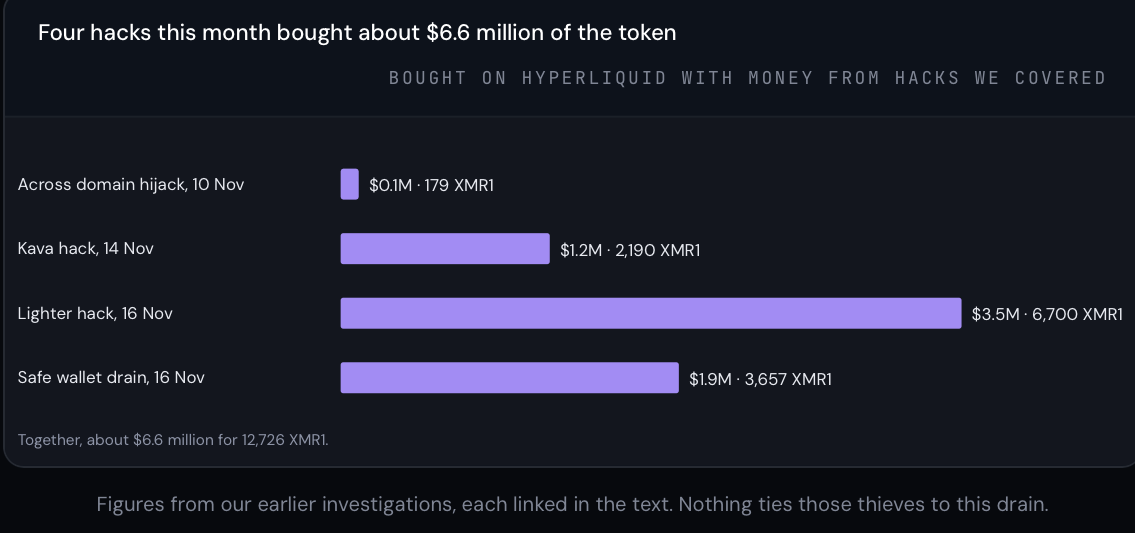
Adding a layer of complexity and intrigue to the XMR1 collapse, Bitquery’s investigation unearthed a fascinating, albeit indirectly linked, detail. The firm discovered that proceeds from four separate cryptocurrency hacks that occurred earlier in November had been used to purchase approximately $6.6 million worth of XMR1. These earlier incidents involved Across Protocol, Kava, Lighter, and Safe, collectively representing significant breaches in the DeFi space.
The purchase of XMR1 by wallets associated with these previous hacks was apparently intended as a route to acquire native Monero (XMR). This strategy is commonly employed by cybercriminals and exploiters to "clean" or obfuscate stolen funds, leveraging Monero’s robust privacy features to break the chain of traceability on public blockchains like Ethereum. Once converted to native XMR, the funds become exceedingly difficult to track, offering a layer of anonymity that other cryptocurrencies cannot easily provide.
Crucially, Bitquery emphasized that while these prior hack proceeds were used to acquire XMR1, the firm found no on-chain evidence linking those specific incidents to Friday’s suspected exploit of the XMR1 deployer account. This means that while XMR1 was a vehicle for money laundering from earlier exploits, the catastrophic plunge on Friday appears to be a distinct, separate event, potentially perpetrated by a different actor who gained control of the XMR1 deployer key. This distinction underscores the dual challenges faced by the crypto ecosystem: combating direct exploits and preventing the use of privacy coins for illicit fund movements.
Wagyu’s Response: Infrastructure Breach Allegations
In the wake of the XMR1 collapse, PerpetualCow, the pseudonymous operator behind Wagyu, the service responsible for creating and managing XMR1, issued a public statement attributing the incident to an alleged infrastructure breach. PerpetualCow claimed that a security compromise occurred at their hosting provider, 1984, asserting that customer data and internal server files had been exposed.
According to PerpetualCow’s account, the critical XMR1 deployer key, which controls the minting and distribution of XMR1 tokens, had been stored on a server. Although this server was subsequently deleted, PerpetualCow alleged that the hosting provider, 1984, had retained logs and files associated with it. This retention, despite the server’s deletion, is presented as the vector through which the deployer key might have been compromised, enabling unauthorized access and the subsequent illicit sale of XMR1 tokens. This type of vulnerability, where sensitive data persists even after deletion requests, is a serious concern for any cloud or hosting service.
PerpetualCow also took responsibility for the unfortunate incident, pledging to personally reimburse affected traders. This commitment, while offering a glimmer of hope to those who suffered losses, comes with the caveat that no specific timeline for reimbursement or the methodology of loss assessment has yet been provided. Furthermore, Wagyu announced plans to relaunch its service at a later date, signaling an intention to learn from the incident and rebuild. However, the exact nature of the relaunch, including enhanced security measures and a new wrapping mechanism, remains unspecified. Cointelegraph reached out to PerpetualCow for additional details regarding the suspected breach and the reimbursement plans but had not received a response by the time of publication. The lack of independent verification of the hosting provider’s breach adds to the uncertainty surrounding the incident.
Broader Implications for DeFi and Wrapped Assets
The XMR1 incident on Hyperliquid carries significant implications for the broader DeFi ecosystem, wrapped assets, and investor confidence.
Security Vulnerabilities in the DeFi Stack: This event serves as a stark reminder of the multi-layered security challenges inherent in decentralized finance. While smart contract audits are crucial, this exploit highlights that operational security, infrastructure provider integrity, and the secure management of private keys for deployer accounts are equally vital. A single point of failure in any of these areas can have catastrophic consequences, even for projects built on otherwise robust blockchain technologies.
Centralization Risks within Decentralized Finance: The very nature of wrapped tokens, particularly those relying on a deployer account or a centralized custodian to manage the underlying asset, introduces elements of centralization into an otherwise decentralized paradigm. This incident underscores that users engaging with wrapped assets must scrutinize the entire wrapping process, including the trustworthiness of the operators and the security of their infrastructure, as these elements represent significant counterparty risks.
Impact on Market Confidence and Trust: Such high-profile exploits inevitably erode investor trust, particularly among retail participants who may not fully grasp the technical nuances and risks involved. The dramatic 99% plunge of XMR1 could make users more wary of engaging with wrapped versions of cryptocurrencies or smaller, less established DeFi protocols. This increased caution could lead to reduced liquidity and slower innovation in certain segments of the DeFi market.
Regulatory Scrutiny and Consumer Protection: As the frequency and scale of crypto exploits continue to rise, regulatory bodies globally are increasingly scrutinizing the digital asset space. Incidents like the XMR1 collapse provide further ammunition for regulators to push for stricter oversight, enhanced consumer protection measures, and clearer accountability frameworks for DeFi projects and their operators. The opaque nature of some aspects of the exploit (e.g., the unknown identity of the perpetrator, the unconfirmed infrastructure breach) complicates efforts to ensure accountability and recovery for affected users.
The Indispensable Role of On-Chain Forensics: Bitquery’s swift and detailed on-chain analysis once again demonstrates the invaluable role of blockchain analytics firms in enhancing transparency and combating illicit activities within the crypto ecosystem. Their ability to trace funds across multiple chains and protocols is critical for understanding attack vectors, identifying perpetrators, and potentially aiding in asset recovery, even if the ultimate identity remains elusive.
Looking Ahead: The Future of XMR1 and Wrapped Monero
The future of XMR1 and Wagyu’s wrapped Monero service remains uncertain. While PerpetualCow has pledged reimbursement and a relaunch, the lack of a clear timeline, coupled with the need to implement significantly enhanced security measures, means that rebuilding trust will be an uphill battle. Any future iteration of XMR1 or similar wrapped Monero projects will need to demonstrate an exceptionally high degree of transparency, undergo rigorous security audits, and potentially adopt more decentralized or multi-party custody solutions to mitigate the risks highlighted by this incident.
For the broader crypto community, the XMR1 exploit serves as a stark reminder of the nascent and often volatile nature of the digital asset market. It reinforces the imperative for users to conduct thorough due diligence, understand the specific risks associated with each asset and protocol, and exercise caution when engaging with new or less established projects. As the ecosystem matures, the demand for robust security, clear accountability, and resilient infrastructure will only intensify, shaping the evolution of decentralized finance.