admin
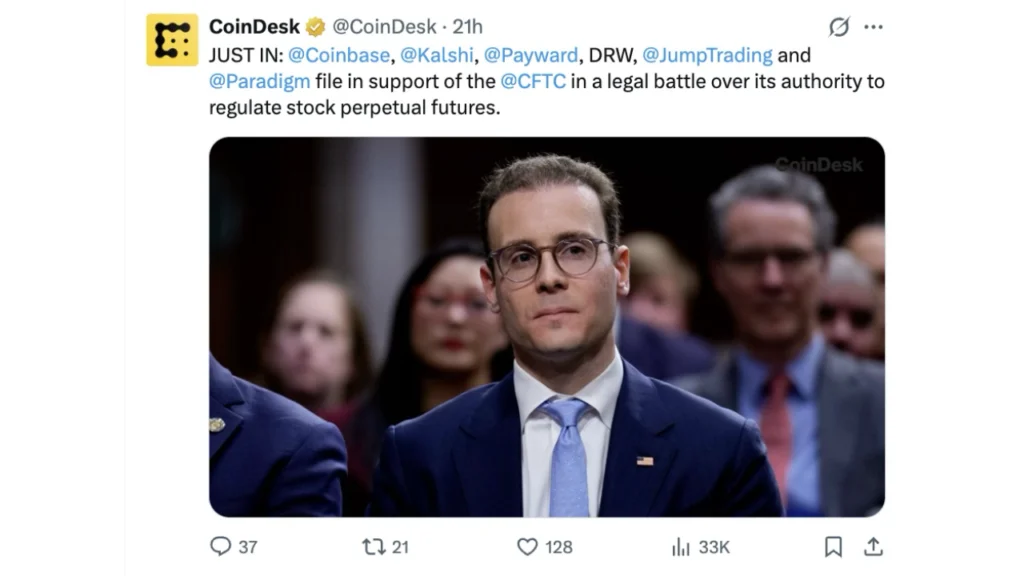
A high-stakes legal confrontation is unfolding in federal court, drawing a clear line between established Wall Street giants and the burgeoning world of crypto-native financial innovation. At the heart of the dispute is the classification and regulatory oversight of single-stock perpetual futures – never-expiring derivative contracts that have become a cornerstone of offshore cryptocurrency trading. On one side stands the Capital Markets Alliance (CMA), a newly formed trade group whose members include powerful entities like Citadel Securities and Cboe, challenging the Commodity Futures Trading Commission (CFTC). On the other, the CFTC finds an unusual ally in leading crypto and prediction-market firms, including Coinbase, Kalshi, Kraken parent Payward, DRW Holdings, Jump Trading, and Paradigm, all backing the agency’s authority. The core legal question revolves around whether these innovative contracts are "security futures" falling under the joint jurisdiction of the CFTC and the Securities and Exchange Commission (SEC), or "security-based swaps" that would be solely regulated by the SEC, potentially restricting their access to retail investors. While a federal judge has allowed trading of these nascent products to continue for now, an early judicial signal suggests the challengers may ultimately prevail, casting a shadow of uncertainty over their future in U.S. markets.
The legal battle commenced swiftly after the CFTC greenlit the trading of single-stock perpetual futures. On November 2, applications from Coinbase, Kalshi, and Payward to list these perpetual futures on U.S. stocks were "deemed approved" by the CFTC. This "deemed approved" status typically arises when the agency does not disapprove a product application within a specific statutory timeframe. The very next day, November 3, CFTC Chairman Michael Selig publicly announced that eligible exchanges could offer these contracts, signaling a significant push towards fostering innovation within the U.S. derivatives markets. However, the regulatory agency’s celebratory announcement was quickly met with legal action. Within hours of Chairman Selig’s statement, the Capital Markets Alliance filed a lawsuit in the U.S. District Court for the Southern District of New York, seeking to nullify the CFTC’s approvals and halt all trading of these instruments while the case proceeds.
The Rise of Perpetual Futures: A Brief History and Mechanism
To understand the gravity of this dispute, one must first grasp the nature and significance of perpetual futures. Often simply called "perps," these derivatives allow traders to speculate on an asset’s price movements without ever owning the underlying asset itself. Unlike traditional futures contracts, which have a defined expiration date, perpetual futures, as their name suggests, never expire. This key characteristic eliminates the need for traders to "roll over" their positions into new contracts as expiration approaches, reducing transaction costs and simplifying long-term strategic positioning.
Perpetual futures first gained prominence in the cryptocurrency market, pioneered by exchanges like BitMEX in 2016. Their perpetual nature, combined with the ability to trade with significant leverage, quickly made them the most liquid and widely traded instruments in the offshore crypto derivatives landscape. Their design ensures that the contract’s price remains closely anchored to the underlying asset’s spot price through a unique mechanism known as "funding payments." These payments occur periodically (e.g., every eight hours) between traders holding long and short positions. If the perpetual future trades at a premium to the underlying asset, long position holders pay short position holders. Conversely, if the perpetual future trades at a discount, short position holders pay long position holders. This funding rate incentivizes convergence between the perpetual contract’s price and the spot price of the underlying asset, making it an efficient tool for continuous exposure.
The concept of applying this design to single company shares, creating a "stock perp," represents a significant evolution. A U.S. trader could, in theory, maintain a leveraged position on an individual stock indefinitely without ever holding the physical shares, offering a new avenue for speculation, hedging, and capital efficiency within equity markets. This innovation, however, directly challenges existing regulatory frameworks designed for more traditional financial products.
A Deep Dive into the Regulatory Turf War: Futures vs. Swaps
The core of the legal challenge lies in a nuanced but critical distinction within U.S. financial law. Under the existing statutes, a derivative contract tied to a single stock can be classified in one of two ways, each with distinct regulatory implications:
- Security Future: These are futures contracts on a single security or a narrow-based security index. They fall under the joint regulatory oversight of both the CFTC (primarily for futures markets) and the SEC (primarily for securities markets). The Commodity Futures Modernization Act of 2000 (CFMA) and subsequent legislation provided the framework for the reintroduction of single-stock futures after a two-decade ban, establishing this joint oversight.
- Security-Based Swap: These are swaps that are based on a single security or a narrow-based security index. These instruments are exclusively regulated by the SEC, particularly under Title VII of the Dodd-Frank Wall Street Reform and Consumer Protection Act of 2010. The SEC’s regime for security-based swaps generally imposes stricter requirements, including mandatory clearing and reporting, and often restricts their availability to institutional or "eligible contract participant" (ECP) traders, effectively keeping them away from ordinary retail investors.
The Capital Markets Alliance argues that single-stock perpetual futures, with their indefinite duration and continuous funding payments, functionally behave more like security-based swaps than traditional futures contracts. They contend that the absence of an expiry date fundamentally alters the contract’s nature, moving it beyond the scope of a "future" as traditionally understood in U.S. law. If the CMA’s interpretation prevails, the CFTC would be deemed to have exceeded its statutory authority in approving these products, as they would rightfully belong under the sole purview of the SEC’s more restrictive swaps regime. This would have profound implications for market access, operational requirements, and the competitive landscape for these products.
The CFTC, through a spokesperson, has strongly rebuffed the CMA’s lawsuit, labeling it "troubling" and characterizing it as a "litigation campaign intended to block innovation." This statement underscores the agency’s commitment to its mandate of promoting responsible innovation within the markets it oversees, particularly in response to the directive under the previous administration to explore avenues for bringing offshore derivatives trading onshore.
The Crypto Firms’ Robust Defense: Innovation and Competition
In a significant show of solidarity, the six crypto and trading firms — Coinbase, Kalshi, Payward, DRW Holdings, Jump Trading, and Paradigm — filed an amicus curiae ("friend of the court") brief with the U.S. District Court on Monday, November 9. Their counter-argument directly challenges the CMA’s definitional stance, reframing the central question. They contend that whether stock perps resemble swaps is irrelevant; the critical legal test is whether they qualify as security futures under existing law. Their brief asserts unequivocally that they do.

Furthermore, these firms push back against any suggestion that the CFTC is attempting to circumvent the SEC. They highlight that both regulatory bodies, the CFTC and SEC, had previously and jointly sought public comment on whether perpetual contracts should be classified as security futures. In their view, this collaborative effort demonstrates that both agencies responsible for overseeing the security futures category already consider these products to fall within its scope. This coordinated regulatory engagement, they argue, validates the CFTC’s approval process.
Beyond the legal definitions, the crypto firms also introduce a compelling commercial argument. They portray stock perps as a superior and more efficient product compared to conventional single-stock futures, primarily due to the elimination of expiration and roll-over costs. They assert that the CMA’s members, established players in the derivatives market, had ample opportunity to develop and offer similar innovative products themselves. Instead, the firms allege, the lawsuit is a strategic move to suppress competition and maintain the existing market dominance of traditional financial institutions by preventing new, more efficient products from gaining traction in the U.S. market. This perspective frames the legal battle as a clash between entrenched interests and nascent innovation, rather than solely a regulatory interpretation dispute.
Chronology of Key Events Leading to the Current Legal Showdown
The current legal confrontation is not an isolated incident but rather the latest development in a broader regulatory and market evolution:
- June [Year Implied by Original Article, let’s assume current year – 1 or 2, e.g., 2024]: CME Group, one of the world’s largest derivatives exchanges, filed a lawsuit against the CFTC in Washington, D.C., federal court. This suit challenged the agency’s May 29 approval of a Kalshi bitcoin perpetual contract, arguing that such crypto-based perpetuals should be classified as swaps under the Dodd-Frank Act. The CFTC dismissed this suit as "frivolous," and the court’s ruling is still pending.
- October 29 [Year Implied, same as above]: Intercontinental Exchange (ICE), the owner of the New York Stock Exchange (NYSE), announced a significant partnership with Trade.xyz. The collaboration aims to build U.S.-regulated perpetual venues leveraging Hyperliquid technology. This move indicates that not all traditional Wall Street players are opposed to perpetuals; rather, the underlying tension is often about who controls the infrastructure and under which regulatory framework these products operate.
- November 2 [Current Year]: Coinbase, Kalshi, and Kraken parent Payward’s applications to list single-stock perpetual futures in the U.S. were "deemed approved" by the CFTC. This pivotal moment marked the official entry of these innovative products into the regulated U.S. market.
- November 3 [Current Year]: CFTC Chairman Michael Selig publicly announced the approvals, framing them as part of the agency’s mandate to foster responsible innovation and bring thriving offshore markets onshore. Hours later, the Capital Markets Alliance filed its lawsuit, initiating the current legal battle.
- November 9 [Current Year]: Coinbase, Kalshi, Payward, DRW Holdings, Jump Trading, and Paradigm filed their amicus brief, formally joining the legal proceedings in support of the CFTC.
A Second Front and a Warning from the Bench
This current lawsuit marks the second instance within months where the CFTC’s authority over perpetual contracts has been challenged in federal court. While the CME Group’s earlier lawsuit in D.C. concerned a bitcoin perpetual, the stakes and potential outcomes differ significantly. If CME Group were to win its case, crypto perpetuals would likely remain under CFTC oversight but would be subjected to the more stringent "swaps rulebook," entailing increased compliance burdens. However, if the CMA prevails in the current Manhattan case, the classification of stock perpetuals as security-based swaps would effectively remove them from the CFTC’s jurisdiction entirely, placing them solely under the SEC’s more restrictive regime. This crucial distinction explains why crypto firms, while allowing the CFTC to handle the CME challenge alone, have chosen to actively participate and file their own arguments in the stock perpetual futures case, recognizing the profound impact a CMA victory would have on their ability to offer these products in the U.S.
The judicial landscape for the current case already presents a challenging outlook for the CFTC and its allies. U.S. District Judge Valerie Caproni, presiding over the case, has allowed trading of stock perpetual futures to continue for now, acknowledging the immediate commercial interests at play. However, in an early and significant indication of her thinking, Judge Caproni also found that the Capital Markets Alliance is "likely to succeed" on its claim that the CFTC exceeded its statutory authority in approving these products. This early warning from the bench signals a potentially difficult path ahead for the CFTC and the crypto firms, forcing traders and exchanges to prepare for the possibility of a legal reversal.
Broader Implications: Innovation, Competition, and Regulatory Control
The dispute over single-stock perpetual futures transcends mere legal definitions; it sits within a larger policy push and reflects fundamental tensions in the evolving financial landscape. There has been a concerted effort, particularly under the previous presidential administration, to bring the vast and largely unregulated offshore perpetual futures market onshore, aiming to capture liquidity and enhance U.S. competitiveness. CFTC Chairman Michael Selig has consistently framed the agency’s approvals as integral to its mandate to promote responsible innovation and adapt to evolving market structures.
The outcome of this case will undoubtedly set a significant precedent for how novel financial products, particularly those blurring the lines between traditional asset classes and derivatives, are classified and regulated in the United States. It highlights an ongoing regulatory turf war between the CFTC and SEC, each vying for jurisdiction over rapidly innovating sectors like cryptocurrency derivatives. This broader battle has been evident in numerous other instances, including debates over whether various crypto tokens constitute securities and the regulatory oversight of different crypto trading platforms.
Furthermore, this legal fight is a stark illustration of the commercial competition between established Wall Street institutions and emerging crypto-native firms. While the CMA represents traditional market participants who often benefit from existing regulatory structures, the crypto firms champion a more innovative, potentially disruptive approach to financial markets. The partnership announced between NYSE owner ICE and Trade.xyz suggests that the broader Wall Street community is not uniformly opposed to the concept of perpetuals; rather, the real contest is less about whether perpetuals come to America, and more about who controls the market and under which rulebook they operate.
For retail investors, the stakes are particularly high. If stock perpetual futures are ultimately classified as security-based swaps, access to these products would likely be severely restricted, limiting participation to institutional investors and eligible contract participants. This would contradict the crypto firms’ stated aim of expanding access to more efficient trading instruments for a broader investor base.
As the case proceeds, the financial industry, regulators, and traders will closely watch Judge Caproni’s next steps. Her decision on whether to formally accept the industry’s amicus brief and, more critically, whether to grant the CMA’s request to halt trading, will determine the immediate future of U.S. stock perpetual futures. Given her initial assessment that the CFTC likely overstepped its authority, the path forward is fraught with uncertainty, signaling that market participants must prepare for a range of potential outcomes that could reshape the landscape of U.S. derivatives markets for years to come. The outcome of this legal battle will not only define the fate of these specific contracts but also offer crucial insights into the future direction of financial innovation and regulation in the United States.