admin
admin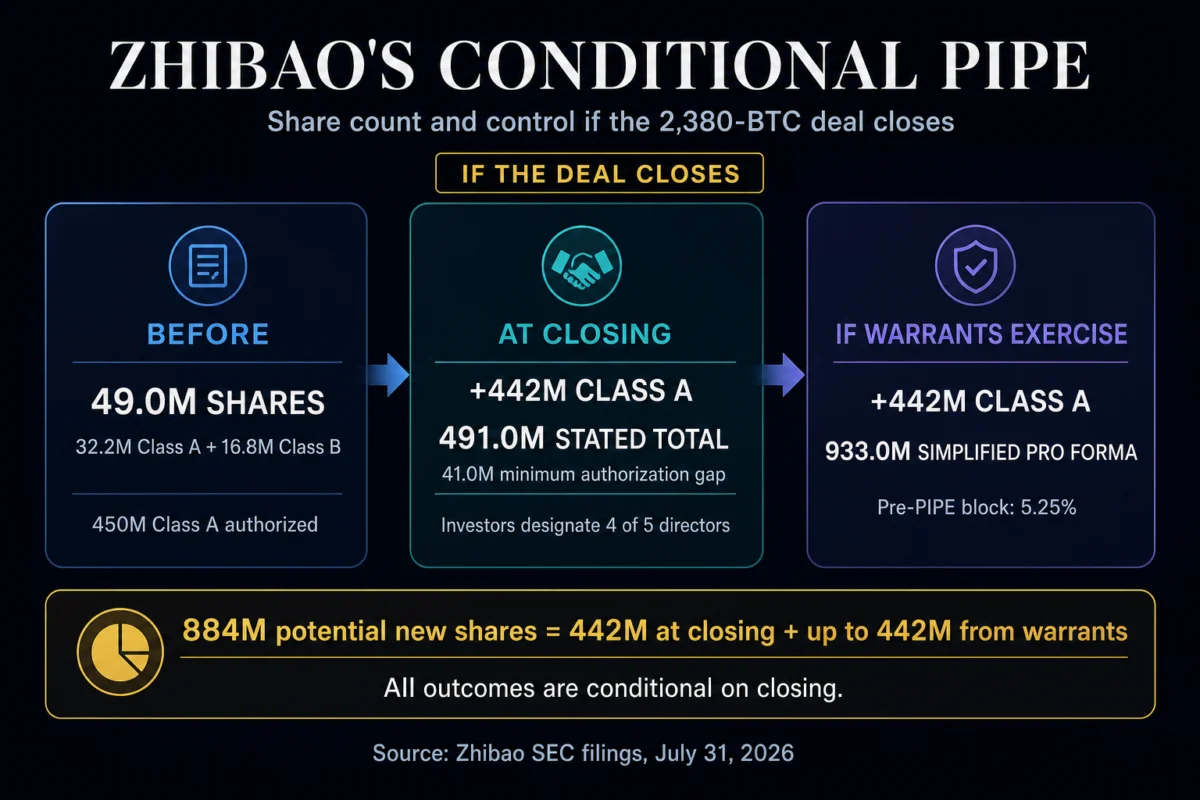
The Anatomy of the Deal: A Strategic Takeover
The securities purchase agreement, dated July 31st, outlines a transaction where the investors will acquire 442 million units at a price of $0.35 per unit. Each unit is structured to include one Class A ordinary share and a two-year warrant, granting the holder the right to purchase an additional Class A share at the same $0.35 exercise price. This structure has the potential to issue a substantial 884 million new shares: 442 million at the initial closing and a further 442 million upon the exercise of the warrants.
The immediate consequence of this agreement, should it proceed to closing, will be a dramatic shift in Zhibao Technology’s governance. The investors are set to appoint four out of the five directors on the company’s board and will also have the authority to select the new Chief Executive Officer (CEO) and Chief Financial Officer (CFO). This signifies the resignation of four incumbent directors and the current CEO and CFO, with Botao Ma being the sole director slated to remain.
The valuation of the Bitcoin contribution is fixed at $65,000 per BTC, based on July 30th prices, which equates to the total payment of 2,380 BTC. The agreement details ten distinct investor entities, each allocated 44.2 million units, translating to an investment of $15.47 million per entity, payable with 238 BTC. This meticulous breakdown suggests a coordinated and well-planned acquisition strategy.
Navigating the Capital Structure Maze
A critical hurdle for Zhibao Technology lies within its existing share structure, which, as it stands, cannot accommodate even the initial issuance of new shares without significant adjustments. The company’s latest filings reveal an outstanding share count of 32,184,970 Class A ordinary shares and 16,816,692 Class B ordinary shares. The current authorization for Class A shares stands at 450 million.
The Class B shares hold a significant advantage, converting one-for-one into Class A shares and carrying a voting power of 20 votes per share prior to conversion. The conversion of these Class B shares, combined with the issuance of the initial tranche of shares at closing, would result in a total of 491,001,662 Class A shares. This figure already exceeds the company’s present authorized limit by at least 41,001,662 shares, underscoring the immediate need for an increase in authorized capital.

This substantial issuance would lead to a severe dilution of the pre-PIPE shareholdings. The existing 49,001,662 shares would represent approximately 9.98% of the stated post-closing share base. Furthermore, Class B shareholders would effectively lose their considerable 20-to-one voting advantage. If all the newly issued warrants are subsequently exercised, the total share base could swell to at least 933,001,662 shares, shrinking the pre-PIPE stake to a mere 5.25%. It is important to note that this simplified pro forma calculation does not account for older outstanding warrants, convertible notes, employee awards, or other potential future adjustments, which could further alter the dilution landscape.
An accompanying infographic visually illustrates this complex share structure adjustment, highlighting Zhibao’s 49 million pre-PIPE shares, the 442 million Class A shares at closing, the significant 41 million authorization gap, and the potential for up to 442 million additional shares from warrant exercises.
Unresolved Conditions: The Path to Closing
The agreement stipulates that the closing of the transaction is targeted to occur within 12 business days of July 31st, unless an alternative date is mutually agreed upon in writing by the parties. However, several significant conditions precedent must be met before the deal can be finalized. These include, but are not limited to, securing sufficient authorized capital, the conversion of Class B shares, obtaining necessary shareholder and regulatory or exchange approvals, ensuring no objections from the stock exchange, and maintaining compliance with Nasdaq listing rules.
Critically, the public filings provide no clear timeline for when a shareholder vote will be held, when the capital increase will be finalized, or when Nasdaq clearance will be obtained. These outstanding approvals and actions have the potential to significantly extend the closing beyond the initial 12-business-day target.
Adding another layer of complexity, Zhibao Technology is currently facing a minimum bid deficiency notice from Nasdaq. The exchange alerted the company on July 10th, citing its stock’s consistent closing below $1 from May 27th through July 9th. Zhibao has until January 6, 2027, to regain compliance, which requires its stock to close at or above $1 for at least 10 consecutive business days. The PIPE agreement documents do not explicitly define the relationship between this Nasdaq compliance issue and the closing of the proposed transaction, leaving investors and observers to speculate on its potential impact.
The Bitcoin Enigma: Funding and Control
The verified availability of the substantial Bitcoin sum remains another crucial, yet unconfirmed, condition. Each of the ten investor entities is required to represent that they legally and beneficially own their allocated BTC and must deposit it into a custodian wallet designated by the company on or before the closing date, unless a written waiver is provided.

However, the current filings do not provide identifying information for the natural-person controllers behind these entities, nor do they name the custodian or the specific wallet address. Furthermore, there has been no independent verification to confirm that the required 2,380 BTC is indeed readily available for transfer. Until a formal closing disclosure is made, detailing the completion of all necessary approvals and the successful transfer of the Bitcoin, the proposed share issuance, the significant Bitcoin contribution, and the anticipated management overhaul remain contingent and subject to change.
Background and Potential Implications
This transaction marks a bold and unconventional approach to capital raising and corporate control, leveraging the volatile yet increasingly influential cryptocurrency market. The use of Bitcoin as a payment mechanism for such a large-scale PIPE deal is relatively rare, particularly for a Nasdaq-listed entity. It highlights a growing willingness among some companies to explore alternative financing avenues and potentially signals a new trend in how digital assets can be integrated into traditional corporate finance.
The sheer volume of Bitcoin being used, coupled with the significant equity stake it confers, suggests a strategic intent to gain substantial control over Zhibao Technology. The wholesale replacement of the existing leadership team indicates a desire for a complete strategic redirection or operational overhaul. The mystery surrounding the identity of the investors further adds to the intrigue, raising questions about their long-term vision for the insurtech company.
The potential dilution for existing shareholders is substantial, raising concerns about their future stake and voting power. The shift in governance will undoubtedly lead to a re-evaluation of Zhibao’s business strategy, operational priorities, and future market positioning. The successful integration of Bitcoin payments and the company’s ability to navigate the Nasdaq compliance issues will be critical factors determining the ultimate success of this complex transaction.
The implications of this deal extend beyond Zhibao Technology itself. It could serve as a precedent for other companies seeking capital, particularly in the technology and digital asset sectors. The regulatory landscape surrounding such transactions remains complex and evolving, and the outcome of this deal could influence future regulatory scrutiny and guidelines. The successful or unsuccessful conclusion of this ambitious agreement will be closely watched by the financial and cryptocurrency communities alike.
The coming days and weeks will be crucial as Zhibao Technology and its ten mystery investors work to meet the conditions precedent. The market will be keenly observing for any disclosures regarding shareholder votes, capital increases, Nasdaq approvals, and, most importantly, the confirmed transfer of the 2,380 BTC. The future of Zhibao Technology, and potentially a new model for corporate finance, hangs in the balance.