admin
admin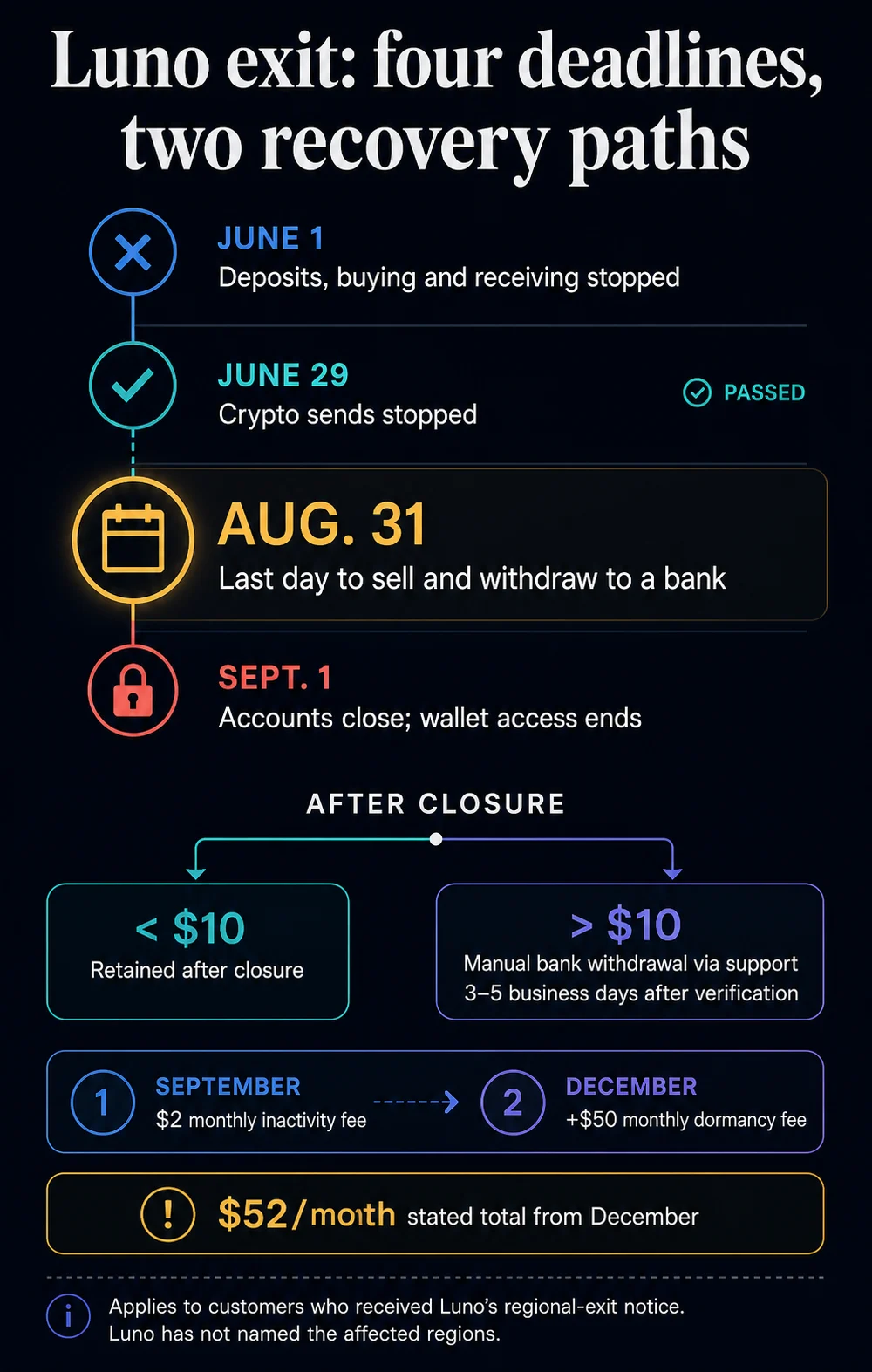
Crypto platform Luno has enacted a significant restriction for a segment of its user base, halting all cryptocurrency transfers out of their accounts as of June 29. This move effectively forces these affected customers to convert their digital assets into fiat currency and withdraw them to their bank accounts by August 31, or face escalating monthly fees as their accounts are slated for closure on September 1. The platform has not publicly identified the specific regions or the exact number of customers impacted by these changes, adding a layer of uncertainty for those affected.
The restrictions began earlier in June, with Luno disabling crypto deposits, purchases, and incoming transfers for the affected users on June 1. The subsequent closure of outgoing crypto transfers on June 29 marks a critical turning point, eliminating the option for users to preserve their holdings by moving them to alternative wallets or exchanges. For these individuals, the only remaining standard avenue to access their funds is through selling their cryptocurrency and initiating a fiat withdrawal to a linked bank account.
A Tightening Timeline and Escalating Costs
The sequence of events leading to this ultimatum for Luno users can be traced back to the platform’s issuance of a "regional-exit notice." While the specific locales are not explicitly named, Luno’s country availability page currently lists Kenya, Nigeria, South Africa, Indonesia, and Malaysia as supported regions. Conversely, a list of 33 "unsupported countries" is provided, leaving hundreds of other territories unaddressed. This broad categorization suggests that a substantial number of users across diverse geographical locations may be subject to these new regulations.
The regional-exit guidance document itself, initially created on May 28 and updated on July 29, lacks publicly accessible records detailing specific amendments. This opacity further complicates the situation for users attempting to understand the precise implications for their accounts. The core message, however, is clear: for those who received the notice, the window to move their crypto assets in kind has closed.

Navigating the Withdrawal Process
For users who still hold cryptocurrency on Luno and were impacted by the transfer ban, the immediate priority is to navigate the fiat withdrawal process. The deadline for standard bank withdrawals is August 31. After this date, Luno’s accounts for these users will be closed on September 1.
A crucial consideration for users is Luno’s minimum withdrawal threshold. Balances equivalent to less than $10 will not be processed for withdrawal. The company has stated that these small balances will be retained by Luno after September 1. For users with balances exceeding $10, a manual withdrawal process will be available after account closure. However, this requires direct contact with Luno’s support team and the submission of verified bank details or a recent bank statement. Luno estimates that completed manual withdrawals will take between three to five business days.
It is important to note that these manual withdrawals do not grant continued access to the ordinary account functionalities. The ability to sell assets and initiate standard bank transfers will cease on August 31, and wallet access will be terminated the following day. Users with balances below the $10 threshold are excluded from the manual withdrawal option entirely, while those above the threshold must undergo additional verification steps.
The Peril of Dormant Funds
The financial implications for users who fail to withdraw their funds by the deadlines are significant, with escalating monthly fees set to erode any remaining balances. Following the account closures on September 1, remaining funds may be subject to a $2 monthly inactivity fee. This fee is slated to begin in September.

The situation becomes more acute from December onwards, when an additional $50 monthly dormancy fee will be applied for continued storage of funds. This brings the total stated charges for dormant accounts to a substantial $52 per month. Luno has not explicitly confirmed whether this fee schedule might vary across the unnamed affected jurisdictions. The cumulative effect of these fees can rapidly diminish any cryptocurrency holdings, particularly for users who are unable to complete the withdrawal process within the stipulated timeframes.
Luno’s Stated Rationale and Market Context
In its public statements, Luno has indicated that its withdrawal from these affected regions is a strategic decision aimed at focusing on its core markets within Africa and Southeast Asia. The company has emphasized that this move is not linked to insolvency, a security breach, or any specific regulatory directive. This assertion aims to reassure other users and stakeholders about the platform’s overall stability.
However, the abrupt nature of these restrictions and the lack of clear communication regarding the affected regions can create significant disruption and anxiety for the users involved. The cryptocurrency market has seen its share of regulatory scrutiny and platform-specific challenges in recent years. While Luno’s decision is framed as a business strategy, the practical impact on its affected users is substantial, forcing them to make rapid financial decisions under pressure.
The broader implications of Luno’s actions extend beyond the immediate user base. Such decisions by major crypto platforms can influence user confidence and the perceived stability of the broader digital asset ecosystem. As the industry matures, transparency and clear communication regarding operational changes become increasingly critical for maintaining trust. The current situation with Luno highlights the ongoing tension between business strategy and the need for user-centric practices in the rapidly evolving world of cryptocurrency. Users who find themselves in this predicament are urged to act swiftly to secure their funds before the August 31 deadline, and to be aware of the potential financial consequences of inaction.