admin
admin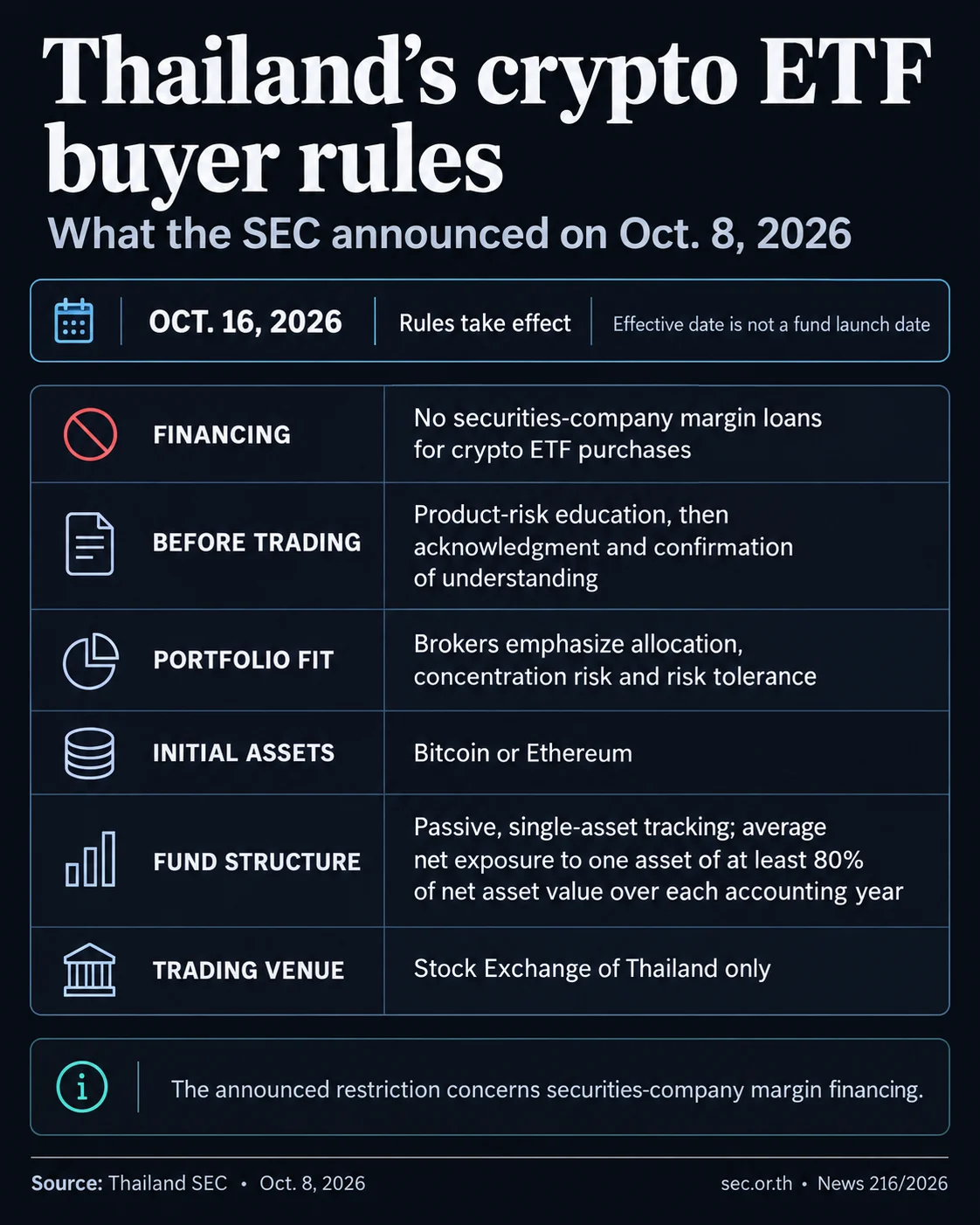
Thailand has officially laid the groundwork for the introduction of domestic Bitcoin and Ethereum Exchange Traded Funds (ETFs) on its stock exchange, while simultaneously implementing measures to curtail retail investors’ access to competing overseas investment products. This significant regulatory development, announced by the Securities and Exchange Commission (SEC) on October 8th, signifies Thailand’s strategic move to cultivate its own cryptocurrency investment ecosystem and bolster its domestic financial institutions. The new framework, comprising 11 regulatory notifications, is set to take effect on October 16th, marking a pivotal moment for the nation’s digital asset landscape.
The timing of Thailand’s decision closely mirrors the remarkable success of spot Bitcoin and Ethereum ETFs in the United States. Since their launch earlier this year, these US-based funds have witnessed substantial inflows, accumulating approximately $70.37 billion in combined net inflows. As of October 12th, these vehicles held an impressive $121 billion in combined net assets, according to data from SoSoValue. This global trend underscores the burgeoning investor appetite for regulated, accessible exposure to major cryptocurrencies, a market Thailand now aims to tap into, albeit with a distinct domestic focus.
Prioritizing Domestic Growth: A Shielded ETF Ecosystem
Under the newly established regulatory regime, Thailand will initially impose a ban on the issuance and offering of investment products that are linked to foreign crypto ETFs. This prohibition extends to depositary receipts, which could otherwise serve as a conduit for local investors to gain indirect exposure to overseas cryptocurrency funds through domestic securities markets. Furthermore, securities companies will be restricted from facilitating investments in foreign crypto ETFs for any clients who do not meet the stringent criteria of institutional or ultra-high-net-worth investors.
These restrictions are not an outright embargo on all overseas crypto investments but are rather targeted. They specifically impact certain investment products and brokerage services that are generally accessible to ordinary investors. The SEC’s stated objective behind these measures is to foster the development of Thailand’s nascent domestic crypto ETF ecosystem and to enhance the capabilities of local financial institutions. By channeling investment interest towards domestically regulated products, Thailand seeks to ensure that capital remains within its borders and contributes to the growth of its own financial infrastructure.
This strategic approach also involves an expansion of investment options for existing asset managers. Previously, Thai mutual funds and private funds were permitted to invest in foreign crypto ETFs but were precluded from investing in domestic equivalents. The revised rules now empower these funds to invest in Thai-listed crypto ETFs, subject to adherence to existing investment limitations. This dual approach—limiting foreign competition while expanding domestic opportunities—is expected to create a robust demand for local products and simultaneously reduce the appeal and availability of certain foreign alternatives for a broad segment of investors.
The implications of this regulatory framework extend to the broader Thai financial industry. It presents potential opportunities for Thai asset managers, custodians, and other licensed digital asset businesses to actively participate in this emerging market. As these domestic ETFs begin to trade, these entities will be crucial in providing the necessary infrastructure, management, and safeguarding services. However, for retail investors, these restrictions could translate into a narrower selection of competing products. Consequently, the fees, liquidity, and tracking performance of the soon-to-be-launched domestically listed funds will become paramount considerations once trading commences. Investors will be keen to evaluate how these local products stack up against international benchmarks, especially in terms of cost-effectiveness and efficiency.
Robust Safeguards: Investor Protection and Market Integrity
Beyond the strategic limitations on foreign products, Thailand’s regulatory framework meticulously outlines operational requirements designed to mitigate risk and ensure that crypto ETFs function harmoniously within the existing securities market. Initially, only Bitcoin and Ethereum will be recognized as eligible underlying assets for these ETFs. A key requirement is that each ETF must passively track a single cryptocurrency, eschewing complex strategies or baskets of digital assets.

To maintain stability and adherence to their underlying asset, funds will be mandated to sustain an average net exposure of at least 80% of their net asset value to the chosen cryptocurrency over each accounting year. This ensures that the ETF’s performance remains closely correlated with the price movements of its designated digital asset.
Asset managers seeking to establish these crypto ETFs will be required to demonstrate a high level of preparedness. This includes showcasing adequate personnel with the requisite expertise, robust operational systems capable of handling digital asset management, and well-defined arrangements with service providers. Crucially, any digital assets held by these ETFs must be safeguarded by custodians who are themselves regulated by Thailand’s SEC, adding a layer of institutional trust and oversight.
The investor protection measures are further extended to the trading activities themselves. Securities companies will be explicitly prohibited from offering margin loans for crypto ETF purchases. This restriction is designed to prevent investors from leveraging borrowed funds to amplify their exposure, thereby managing the inherent volatility of cryptocurrencies and limiting the potential for significant leveraged losses.
A significant emphasis is placed on pre-trade risk awareness. Before engaging in any trading of crypto ETFs, investors will be required to undergo educational sessions detailing the products’ unique characteristics and inherent risks. Following this education, they must formally acknowledge their understanding of these risks. This proactive approach aims to foster a more informed investor base, reducing the likelihood of individuals investing in products they do not fully comprehend. Furthermore, brokers will be tasked with actively promoting portfolio diversification and encouraging investment decisions that align with an individual investor’s stated risk tolerance.
In a move that further integrates the digital asset sector with traditional finance, the regulator has also separately permitted licensed digital asset fund managers to undertake outsourced investment management functions. Additionally, qualified digital asset businesses may now apply to serve as supervisors for mutual funds, signaling a broader acceptance and integration of regulated digital asset entities within the broader financial services industry.
A Deliberate Path Forward: Consultation and Future Milestones
The finalization of these regulations follows a period of extensive consultation, which took place between April and September. During this period, the SEC engaged with various stakeholders, and according to the regulator, the majority of respondents expressed support for the proposed measures. This broad consensus suggests that the framework is perceived as a balanced approach, addressing both the opportunities and the inherent risks associated with cryptocurrency investments.
The immediate next milestone is October 16th, when the new regulatory framework officially becomes effective. While the foundational rules are now in place, the SEC has not yet approved any specific Bitcoin or Ethereum ETF applications, nor has it announced a definitive timeline for when trading of these products will commence on the Stock Exchange of Thailand. This suggests a phased approach, with the regulatory infrastructure being established first, followed by the vetting and approval of individual fund proposals.
The introduction of domestic crypto ETFs in Thailand represents a strategic pivot in how the nation engages with the burgeoning digital asset market. By carefully constructing a regulated environment that prioritizes local development and imposes specific restrictions on foreign competition for retail investors, Thailand is charting a course to capture the growth potential of cryptocurrencies within its own financial borders. The success of this initiative will hinge on the robust execution of these regulations, the attractiveness and performance of the forthcoming domestic ETFs, and the continued commitment to investor protection as the market evolves.