admin
admin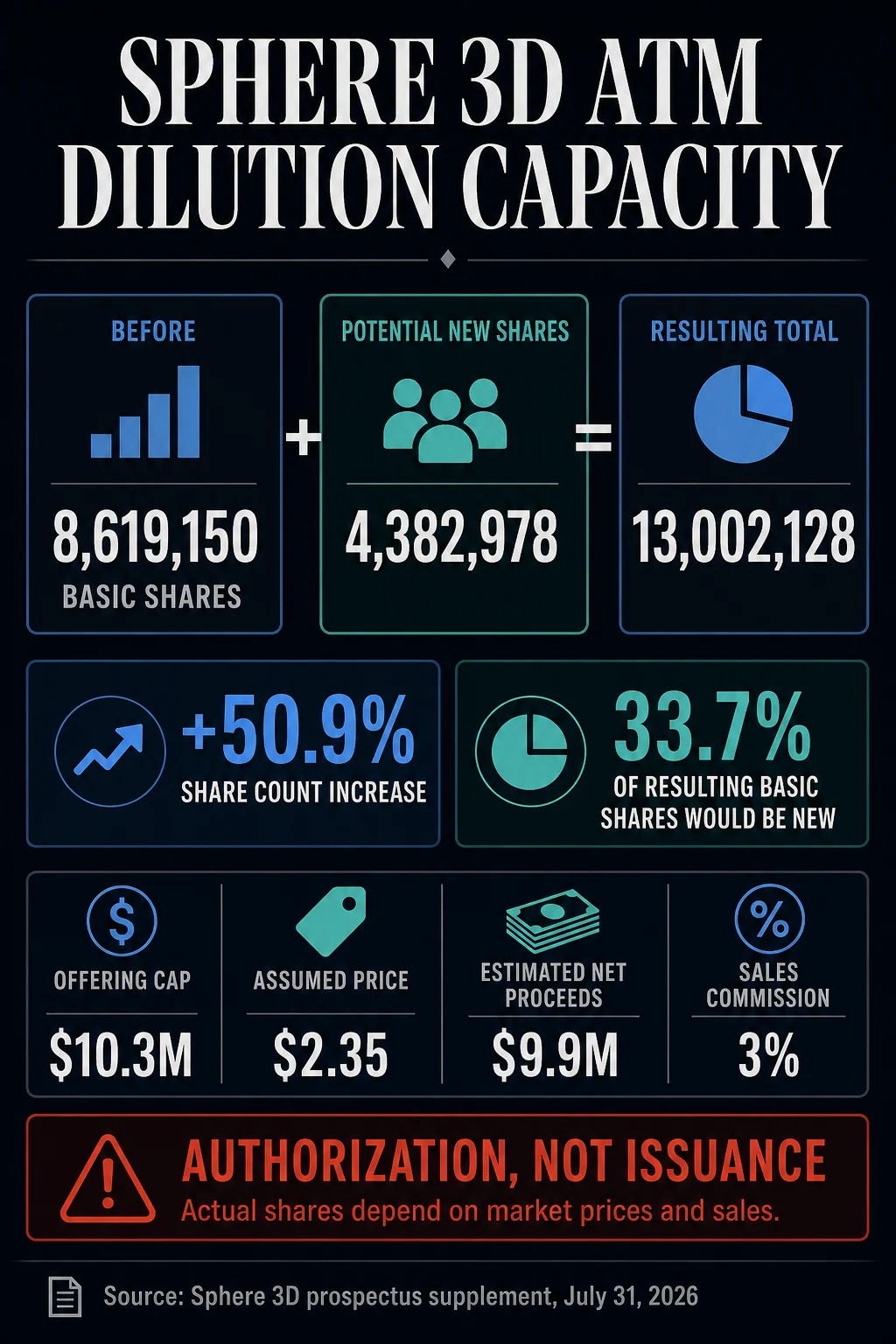
Bitcoin miner Sphere 3D is poised to significantly dilute its existing shareholders, potentially by as much as 50.9%, as it navigates a pronounced cash crunch. The company has amended its "at-the-market" (ATM) stock-sale capacity to allow for up to $10.3 million in new equity issuance, a move that could drastically alter the company’s capital structure. This aggressive dilution strategy underscores the immediate financial pressures facing the publicly traded miner, which also retains the option to sell its mined Bitcoin to shore up working capital or fund growth initiatives.
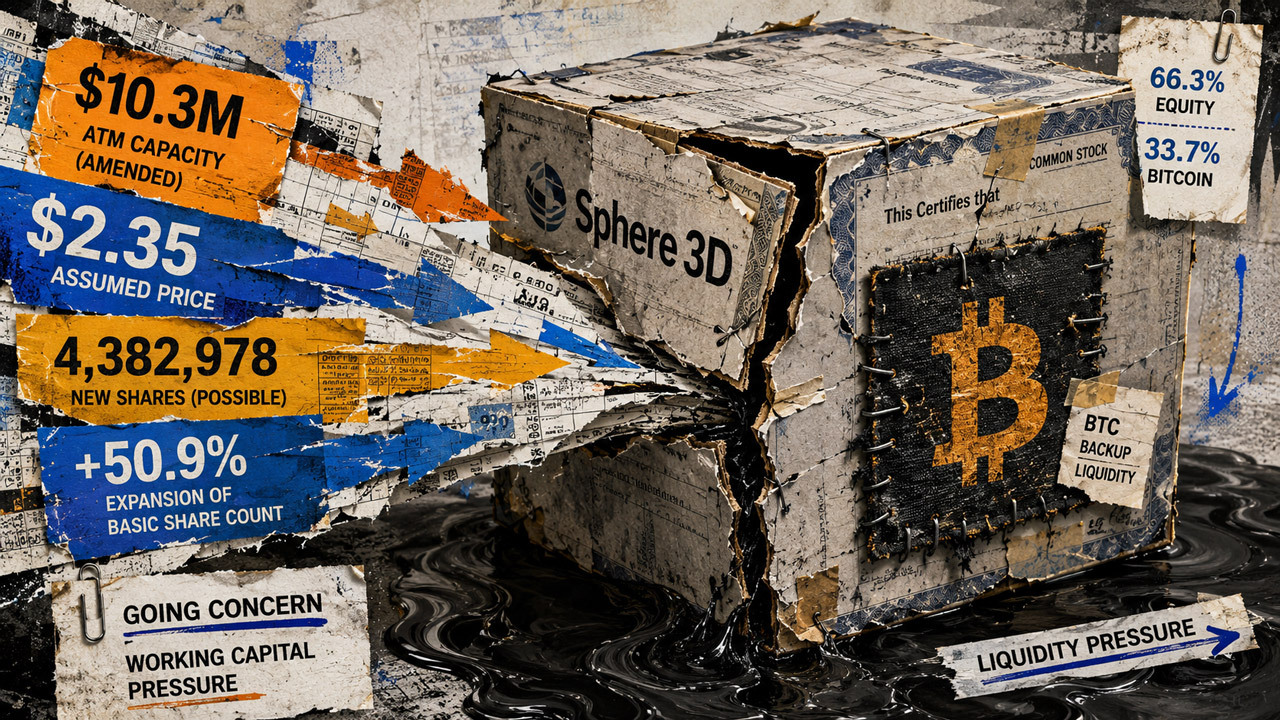
The magnitude of the potential dilution is starkly illustrated by the company’s prospectus supplement filed on July 31. Assuming an average share price of $2.35, the full utilization of the $10.3 million ATM facility would result in the issuance of approximately 4,382,978 new common shares. This influx of new equity would expand Sphere 3D’s basic share count from its current 8,619,150 shares to a projected 13,002,128 shares. Such an expansion represents a substantial 50.9% increase in outstanding shares, effectively halving the ownership stake of current shareholders if the entire facility is drawn down.
It is crucial to note that this amended facility is an authorization for future sales, not a completed issuance. The designated sales agents, A.G.P. and Maxim, are not obligated to sell a minimum number of shares. The actual number of shares issued will be contingent upon prevailing market prices and the company’s ongoing liquidity needs. While the filing indicates that the 4,382,978 new shares would constitute approximately 33.7% of the resultant basic total, this calculation excludes a significant pool of potential future shares. This includes stock options, restricted stock units (RSUs), restricted stock awards, shares issuable upon the conversion of preferred stock, outstanding warrants, and shares reserved for future equity incentive programs. Therefore, the ultimate dilution could be even more pronounced than the initial 50.9% projection based on basic shares.
The company anticipates netting approximately $9.9 million from the full assumed offering, after accounting for a 3% sales-agent commission and estimated offering expenses. This move follows a period where Sphere 3D has already utilized its equity channels. A concurrent Form 8-K filing reveals that through July 30, the company had already sold 2,172,789 shares under its prior, superseded ATM prospectus, raising $5.13 million in gross proceeds. These prior sales are distinct from and do not reflect the utilization of the newly amended facility.
Background: The Merger and Mounting Liquidity Concerns
Sphere 3D’s current financial predicament and its reliance on equity financing are inextricably linked to its recent business activities, including its merger with a subsidiary of Hut 8 Mining. While the specific details of the merger’s financial implications are complex, the company’s financial statements, particularly those reflecting the combined entities, highlight a pressing need for liquidity.
The most recent combined baseline financial data available predates the ATM amendment. Pro forma accounts as of March 31, 2026, indicated that Sphere 3D and its merged entity, Cathedra, collectively held $3.38 million in cash and $2.06 million in digital currencies. These figures are presented as if the merger had occurred on that specific date and do not represent the most current post-closing balances.
Sphere 3D’s standalone quarterly financial statements, also as of March 31, 2026, reported $3.15 million in cash and 26.2 Bitcoin (BTC), valued on the balance sheet at $1.79 million. During that quarter, the company generated $2.79 million from the sale of Bitcoin, with all such dispositions reportedly funding its operational expenses.
Bitcoin as a Working-Capital Fallback
The company’s strategic approach to managing its liquidity appears to involve a dual strategy: equity issuance and the utilization of its mined Bitcoin reserves. The July prospectus explicitly states that management reserves the right to continue selling mined Bitcoin as needed for working capital or to support growth objectives. This policy, while offering operational flexibility, also signals that Bitcoin holdings are viewed not just as an asset but as a readily deployable source of funds to bridge financial gaps. There is no indication of a specific Bitcoin sale order currently in place; rather, it’s a standing policy designed to provide management with options during periods of financial strain.
This strategic flexibility is juxtaposed against documented signs of liquidity pressure. Sphere 3D’s audited financial statements for 2025 included a "going-concern" explanatory paragraph, a standard disclosure when there are substantial doubts about a company’s ability to continue as a going concern. Similarly, Cathedra’s audit report contained a separate going-concern matter. Further emphasizing these concerns, Cathedra’s interim financial accounts as of March 31, 2026, revealed a working-capital deficiency of C$4.35 million and reported net cash used in operating activities totaling C$1.17 million during the first quarter of that year. These figures collectively paint a picture of a company actively seeking to bolster its financial reserves to meet its short-term obligations and operational needs.
Timeline of Events and Disclosure
The recent ATM amendment was filed on July 31, 2026, as a prospectus supplement. This followed an earlier ATM program that had already seen a portion of its authorized shares sold. The previous program’s disclosures indicate that sales under that superseded prospectus occurred up to July 30, 2026. As of an August 3, 2026, review of Sphere 3D’s SEC filings feed, no subsequent company filings had officially disclosed any share sales under the amended facility. However, this does not preclude the possibility of trades that could be reported in future disclosures, as there is often a time lag between the execution of trades and their formal reporting to regulatory bodies.
The implications of this dilution are significant for existing shareholders. A 50.9% increase in shares outstanding, assuming full utilization of the ATM, would mean that for every two shares an investor currently holds, they would effectively own only one share in the enlarged equity base. This could lead to a substantial decrease in the earnings per share (EPS) and potentially depress the stock price, especially if the market perceives the dilution as a sign of financial distress rather than a strategic move to ensure operational continuity and future growth.
Broader Market Context and Industry Pressures
Sphere 3D operates within the highly competitive and capital-intensive Bitcoin mining industry. The sector is subject to volatile cryptocurrency prices, fluctuating energy costs, and the constant need for hardware upgrades and operational efficiency improvements. During periods of depressed Bitcoin prices or increased operational costs, miners often face significant financial strain, leading to strategies such as equity financing, debt issuance, or the sale of digital assets.
The decision to pursue such a substantial ATM offering suggests that Sphere 3D’s management has determined that equity dilution, despite its negative impact on existing shareholders, is the most viable path to securing the necessary capital. The company’s dual approach of ATM sales and the potential for Bitcoin sales reflects a common strategy among miners to maintain flexibility in their treasury management. However, the scale of the proposed dilution indicates that the immediate cash requirements may be substantial, potentially exceeding what can be comfortably raised through routine Bitcoin sales.

Analysis of Implications
The immediate implication for investors is a significant reduction in their proportional ownership of the company. If the full $10.3 million is raised at the assumed price, the total number of shares will increase by over 50%. This dilutive effect can lead to a lower stock price per share, as the company’s overall market capitalization is spread across a larger number of shares. Earnings per share will also decrease, potentially impacting the attractiveness of the stock to investors who prioritize profitability metrics.
Furthermore, the need for such a large ATM offering can be interpreted by the market as a signal of financial vulnerability. While companies often use ATM programs for general corporate purposes, a large authorization like this, coupled with existing going-concern disclosures, suggests that Sphere 3D is under considerable financial pressure. This perception can lead to increased investor caution and potentially a further decline in the stock price, creating a challenging cycle for the company.
The policy of treating mined Bitcoin as a working-capital fallback also highlights the company’s reliance on its operational output to sustain itself. While this is a standard practice in the industry, it underscores the direct link between Bitcoin price performance and Sphere 3D’s financial stability. A sustained downturn in Bitcoin prices could further exacerbate the company’s liquidity challenges, potentially necessitating additional equity raises or other financing measures.
Official Statements and Future Outlook
As of the latest available information, Sphere 3D’s official disclosures have focused on the procedural aspects of the ATM amendment and prior sales. The company’s management has not issued specific public statements detailing the exact reasons for the accelerated need for capital beyond the general context of working capital requirements and potential growth opportunities. However, the language in their filings, including the going-concern disclosures, implicitly points to significant financial challenges.
The future outlook for Sphere 3D will heavily depend on its ability to manage its cash burn, the price of Bitcoin, and the effectiveness of its operational strategies. The newly authorized ATM facility provides a crucial lifeline, but its utilization comes at a substantial cost to existing shareholders. The company’s ability to successfully navigate this period of financial strain will be a key determinant of its long-term viability and its capacity to capitalize on any potential upswing in the cryptocurrency market. Investors will be closely monitoring future filings for any indication of share sales under the amended facility and the company’s ongoing financial performance. The coming months will be critical in determining whether Sphere 3D can successfully stabilize its financial position and emerge from its current cash crunch without further jeopardizing shareholder value.