admin
admin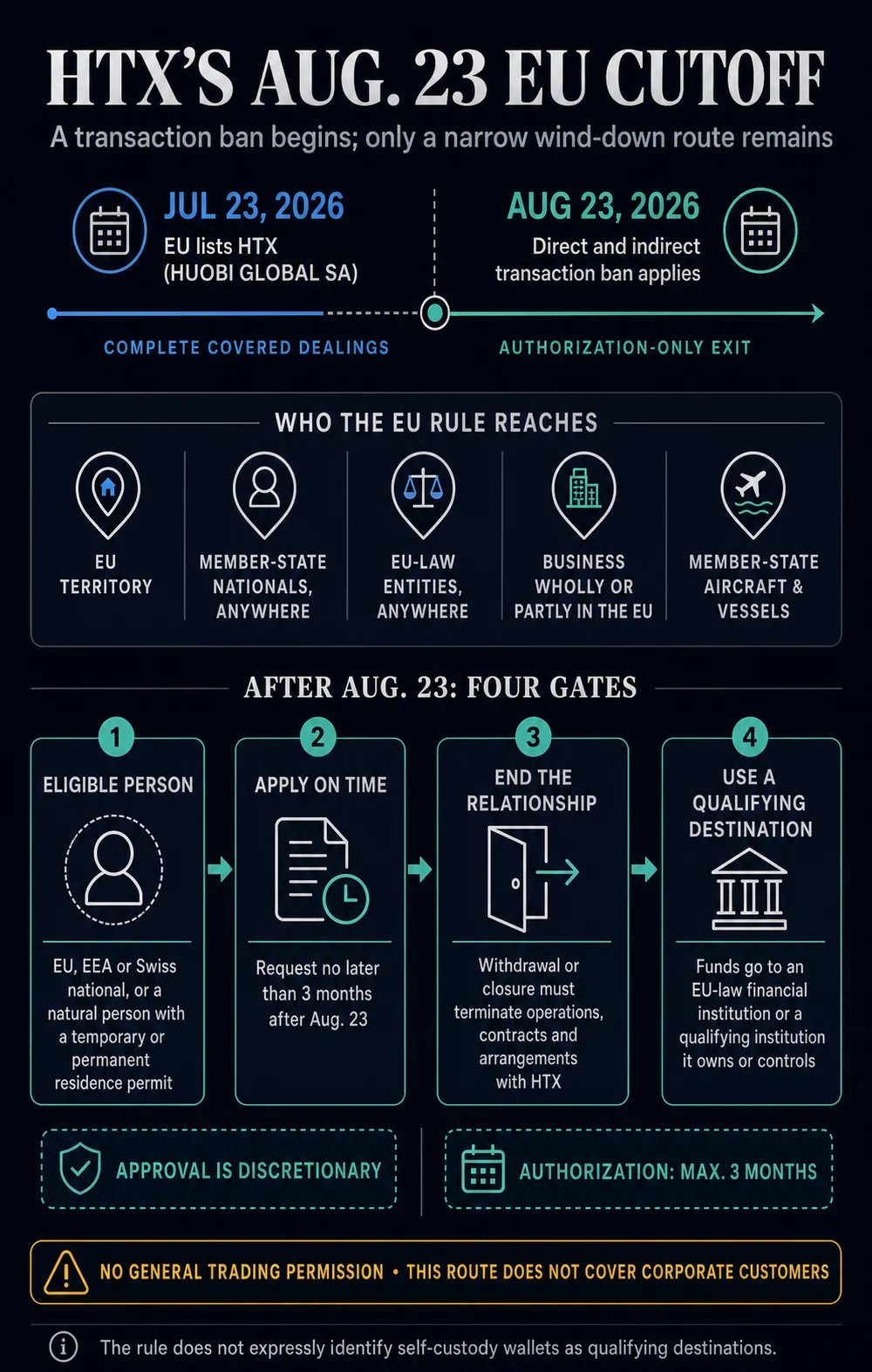
European Union sanctions targeting HTX (formerly Huobi Global SA) are poised to create a significant hurdle for corporate entities and individuals with accounts on the cryptocurrency exchange, as a sweeping transaction ban takes effect on August 23, 2026. This stringent regulation, outlined in Council Regulation (EU) 2026/1848, effectively seals off direct and indirect dealings with HTX for entities falling under the EU’s jurisdiction. While the regulation provides a narrow window for certain individuals to withdraw funds or close accounts, this process is contingent on discretionary approval from national authorities and requires a complete cessation of all dealings with the exchange.
The implications of this directive are profound for the digital asset landscape, particularly for businesses and individuals operating within or connected to the European Union. The designation of HTX in Annex XLV of the Council Regulation signifies a direct prohibition on transactions. This ban extends beyond simple monetary transfers, encompassing any form of dealing, payment, or withdrawal that falls within the scope of EU sanctions law. The effective date of August 23, 2026, means that all such activities must be concluded prior to this deadline, or necessitate a specific, and difficult to obtain, authorization.
A Strict Regulatory Framework: Understanding the Scope of the Ban
Council Regulation (EU) 2026/1848, which amends and expands upon existing EU sanctions frameworks, specifically targets entities deemed to pose a risk to the Union’s security or foreign policy objectives. The inclusion of "HTX (HUOBI GLOBAL SA)" in Annex XLV is a clear signal of the EU’s intent to sever financial ties with the platform. Crucially, the regulation’s reach is broad, encompassing not only direct transactions with the designated entity but also indirect dealings. This includes operations conducted by entities acting on behalf of or at the direction of HTX, as well as any crypto-asset or payment service providers that function as mirror entities or successors.
The jurisdictional reach of these sanctions is primarily governed by Article 13 of Regulation 833/2014, which extends the prohibitions to a wide array of actors. This includes any transactions conducted within EU territory, as well as those occurring aboard aircraft or vessels registered under a member state’s jurisdiction. Furthermore, the rules apply to nationals of EU member states, irrespective of their location, and to companies or other entities incorporated under the laws of a member state, regardless of where they operate. The prohibition also extends to any entity conducting business wholly or partly within the Union. It is important to note that mere connections to the European Economic Area (EEA) or Switzerland, without a direct EU nexus, do not automatically bring a transaction under the purview of Article 13. However, EEA or Swiss nationality or qualifying residency can be a factor in eligibility for the separate exit provisions, even if it doesn’t independently establish EU sanctions jurisdiction.
Navigating the Post-Cutoff Landscape: Limited Withdrawal Provisions
For individuals and, crucially, corporate entities still holding assets on HTX after the August 23 cutoff, the situation becomes significantly more complex. The regulation does provide a limited exception, allowing for the withdrawal of funds or the closure of accounts under specific, stringent conditions. This provision, however, is not a blanket reprieve. A member-state competent authority may grant authorization for a transaction that is "strictly necessary" for an eligible person to exit their relationship with HTX.

The eligibility for this authorization is restricted. It primarily covers EU, EEA, and Swiss nationals, along with natural persons who possess a temporary or permanent residence permit in one of these jurisdictions. Significantly, this particular exit provision does not extend to corporate customers. This means that businesses with accounts on HTX, regardless of their operational ties to the EU, will likely find themselves with no legal recourse to withdraw their digital assets once the sanctions take full effect, facing a complete "dead end" with zero legal exit routes.
Key Conditions for Post-Cutoff Withdrawals
The process for obtaining such an authorization is arduous and subject to strict timelines and conditions. The applicant must not only demonstrate the necessity of the withdrawal but also commit to terminating all their operations, contracts, and other agreements with HTX. The approval itself is discretionary, meaning it is not guaranteed and depends on the judgment of the relevant national authority. Furthermore, any granted authorization may come with specific conditions attached, and critically, it does not permit any continued trading or engagement with the exchange beyond the withdrawal of existing funds.
The window for submitting a request for authorization is also narrow, with applications needing to be filed no later than three months after the ban commences on August 23, 2026. Once an authorization is granted, it remains valid for a limited period of no more than three months, further emphasizing the urgency and finality of the exit process.
Destination of Authorized Funds: A Critical Consideration
The regulation also imposes strict requirements on where authorized funds can be transferred. The funds must be moved to a credit or financial institution that is established under the laws of an EU member state. Alternatively, they can be moved to a third-country institution that is owned or controlled by an entity established in an EU member state. Notably, the provision does not explicitly recognize a self-custody wallet as a qualifying destination for these authorized withdrawals. This requirement reinforces the EU’s intent to maintain oversight and control over financial flows associated with sanctioned entities.
HTX’s Pre-Existing Restrictions and the Impact of the EU Directive
It is important to consider HTX’s own user agreement, which was updated on June 18, 2026. This agreement already prohibits users located in all EU member states from accessing its services. This pre-existing restriction suggests that the new EU sanctions directive may not dramatically impact a broad, established population of active EU residents who are already debarred from using the platform. However, the implications could be significant for residual accounts held by EU nationals who may be abroad, or for covered counterparties whose dealings fall within the EU rule’s reach. The exact quantification of these affected groups remains unclear, as no public figures have been released detailing the number of such accounts or users.

A separate development occurred in May 2026, when HTX issued a statement regarding a UK sanctions action. In that statement, the exchange clarified that Huobi Global S.A. was distinct from the online exchange. However, the later EU regulation specifically names "HTX (HUOBI GLOBAL SA)" together, creating ambiguity about how HTX will manage the EU cutoff. The distinction previously made in response to UK sanctions may not hold in the context of this new EU directive, potentially leading to further confusion and challenges for users attempting to navigate the withdrawal process.
Broader Implications for the Crypto Market and Regulatory Compliance
The EU’s decisive action against HTX underscores a growing trend of increased regulatory scrutiny and enforcement within the global cryptocurrency market. As regulators worldwide seek to bolster financial stability, combat illicit activities, and enforce foreign policy objectives, cryptocurrency exchanges and their users must remain acutely aware of evolving compliance obligations. The HTX sanctions serve as a stark reminder that the decentralized nature of cryptocurrencies does not exempt them from the reach of traditional financial regulations and geopolitical pressures.
For businesses operating in the digital asset space, this development highlights the critical importance of robust compliance frameworks, thorough due diligence on counterparties, and proactive engagement with regulatory bodies. The potential for significant financial losses and reputational damage in the event of non-compliance is a clear and present danger. The intricate web of EU regulations, including the stringent requirements for withdrawal authorizations and the specified destinations for funds, emphasizes the need for specialized legal and compliance expertise.
The timeline of events leading up to the August 23 deadline is crucial for affected parties. All transactions and dealings falling under the EU sanctions must be completed before this date. For those eligible individuals seeking to withdraw assets, the period between August 23 and November 23, 2026, represents the window for filing authorization requests. Any granted authorizations will then have a further limited validity of three months, effectively pushing the final exit for some into early 2027. This compressed timeline demands swift and decisive action from those impacted.
The EU’s directive on HTX represents a significant development in the regulatory landscape of digital assets. It signals a clear intent to enforce sanctions through the cryptocurrency ecosystem, with potentially severe consequences for non-compliance. The lack of legal exit routes for corporate entities underscores the inherent risks associated with operating in this rapidly evolving and increasingly regulated industry. The emphasis on discretionary approval for individuals, coupled with strict conditions and limited timelines, suggests that the EU is prioritizing the enforcement of its sanctions over facilitating easy exits from designated platforms. As the August 23 deadline approaches, the focus will be on how HTX responds and how effectively affected parties can navigate the complex regulatory environment to mitigate potential losses.