Dwi Wanna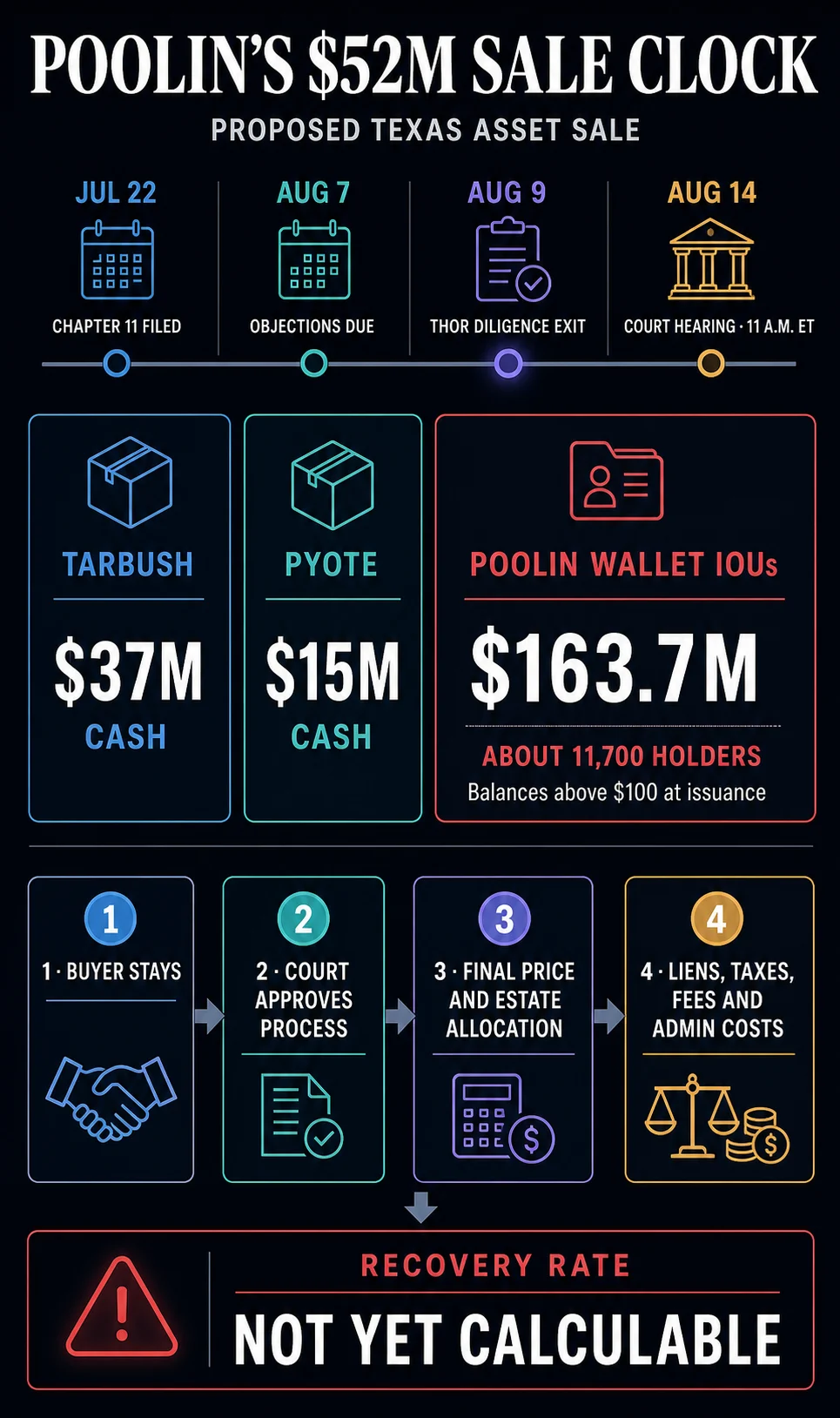
The complex restructuring of Poolin Technology, once one of the world’s preeminent Bitcoin mining pools, has entered a critical phase following its Chapter 11 bankruptcy filing on July 22, 2026. At the heart of the proceedings is a stark financial disconnect: the company faces approximately $163.7 million in liabilities owed to roughly 11,700 wallet holders, while its primary path to liquidity rests on the proposed $52 million sale of mining assets in West Texas. This valuation gap, coupled with a labyrinthine corporate structure, suggests that creditors face a protracted and uncertain road to any meaningful recovery. The immediate stability of the case hinges on an August 9 deadline, a date by which the prospective buyer, Thor CALAP LLC, must decide whether to proceed with the acquisition or exercise its right to terminate based on unsatisfactory due diligence.
The Genesis of the Liquidity Crisis
The current bankruptcy proceedings are the culmination of a financial downward spiral that began during the "crypto winter" of 2022. At that time, Poolin, operating under the brand name of one of the top five global mining pools, began experiencing severe liquidity constraints. These issues were exacerbated by a combination of declining Bitcoin prices, surging energy costs in key mining jurisdictions, and a significant increase in network difficulty that compressed profit margins for all major players in the sector.
In September 2022, Poolin was forced to freeze withdrawals from its wallet service, citing "liquidity problems" caused by a surge in withdrawal demands and a mismatch in asset-liability durations. To manage the fallout, the company issued IOU tokens to its users, representing the balances held in their accounts. These IOUs were distributed to approximately 11,700 customers whose balances exceeded $100. While the company initially expressed hopes of resuming normal operations through debt restructuring and asset optimization, the subsequent four years saw the firm struggle to bridge the capital gap, eventually leading to the July 2026 Chapter 11 filing in the United States.
Detailed Breakdown of the Texas Asset Sale
The cornerstone of Poolin’s recovery plan is the divestiture of its West Texas mining infrastructure. The proposed transaction involves two distinct asset packages located in the energy-rich Permian Basin region. Under the terms of the Asset Purchase Agreements (APAs) filed with the bankruptcy court, Thor CALAP LLC has emerged as the stalking horse bidder.
The first package, known as the Tarbush asset package, is priced at $37 million in cash. The second, the Pyote package, is valued at $15 million. Together, these $52 million in assets represent the primary source of tangible value within the debtor estates. Thor CALAP LLC has already provided deposits of $1.85 million for Tarbush and $750,000 for Pyote to secure its position.
However, the sale is far from guaranteed. The purchaser maintains a "due diligence" out-clause that remains active until August 9. If Thor CALAP LLC identifies significant operational, environmental, or title issues at the Texas sites, it may withdraw from the deals entirely. Such a withdrawal would leave the debtors without a lead bidder and could significantly delay the liquidation process, potentially eroding the remaining value of the estates through increased administrative and legal costs.

The Corporate Shield: Debtor Estates and Intercompany Claims
One of the most significant hurdles for the 11,700 wallet creditors is the legal separation between the entities that owe them money and the entities that own the valuable Texas assets. In the bankruptcy filing, Poolin Technology—the entity responsible for the wallet IOUs—is listed separately from Lonestar Dream Inc. and Lonestar Taproot LLC, the subsidiaries that hold the Texas mining sites.
According to the first-day declaration, Poolin Technology itself possesses relatively meager assets: approximately $1.2 million in cash, an office lease, and an intercompany claim against the Lonestar entities. This structure means that wallet holders are not direct creditors of the Texas assets being sold. Instead, their recovery depends on Poolin Technology successfully asserting its intercompany claim against the Lonestar businesses once the $52 million sale is finalized.
In bankruptcy law, intercompany claims are often subject to intense scrutiny and can be subordinated to other secured or priority claims. Consequently, even if the $52 million sale closes successfully, the net proceeds must first satisfy any secured liens against the Lonestar properties, followed by the administrative costs of the bankruptcy, before any funds can flow back to Poolin Technology to satisfy the $163.7 million in wallet obligations.
Timeline of the Bankruptcy Proceedings
The court has established an aggressive timeline for the bidding and sale process, reflecting the debtors’ desire to minimize "burn rate" and preserve the value of the mining infrastructure, which has been idle since July 10.
- July 22, 2026: Poolin Technology and affiliates file for Chapter 11 protection.
- August 7, 2026: Deadline for parties to file objections to the proposed bidding procedures and the sale motion.
- August 9, 2026: Deadline for Thor CALAP LLC to terminate the purchase agreements based on due diligence.
- August 14, 2026 (11:00 a.m. ET): Scheduled court hearing to approve the bidding procedures.
- September 8, 2026: Final deadline for competing bids to be submitted.
- September 10, 2026: An auction will be held if qualified competing bids are received.
- September 16, 2026: Final sale hearing to confirm the purchaser and the terms of the transaction.
This schedule is designed to facilitate a "Section 363" sale, which allows a company to sell assets free and clear of liens and interests. While this process is typically faster than a traditional reorganization, the complexity of the creditor pool and the intercompany dynamics suggest that the distribution of proceeds will take much longer than the sale itself.
Quantifying the Creditor Deficit
The financial disclosures provided by the debtors highlight a massive shortfall. The preliminary prepetition obligations are estimated at $173.1 million, with $163.7 million specifically tied to the wallet IOUs. Against this, the $52 million in proposed sale proceeds—before accounting for taxes, broker fees, legal expenses, and professional fees—covers less than 30% of the total debt.
Furthermore, the debtors have stated that they do not intend to resume mining or hosting operations at the Texas sites. This decision effectively transforms the case into a liquidating Chapter 11, where the goal is to wind down the business rather than emerge as a going concern. For creditors, this means there is no "upside" potential from future mining profits; the recovery is strictly limited to the terminal value of the equipment and real estate.

Professional Fees and Administrative Costs
In large-scale crypto bankruptcies, administrative costs frequently consume a significant portion of the available estate. The Poolin case involves multiple debtor entities, a complex international creditor base, and the need for specialized technical and legal expertise. Professional fees for attorneys, financial advisors, and claims agents can easily reach millions of dollars over the course of a year.
Because administrative expenses are paid "off the top" before general unsecured creditors (like the wallet holders) receive a distribution, every month the case remains open reduces the eventual recovery percentage. The court must also account for any valid liens held by utility providers or equipment lessors in Texas, which may further dilute the pool of funds available for the 11,700 IOU holders.
Broader Implications for the Mining Industry
The Poolin bankruptcy serves as a sobering reminder of the risks inherent in custodial crypto services and the volatility of the Bitcoin mining sector. During the 2021-2022 bull market, many mining pools expanded aggressively, taking on debt and diversifying into hosting services. When the market turned, those with high leverage and mismatched liquidity profiles were the first to fail.
The outcome of the Poolin case will likely influence how future mining bankruptcies are handled, particularly regarding the treatment of "IOUs" and the rights of wallet users in relation to infrastructure assets. If the court finds that the intercompany claims are valid and enforceable, it may provide a roadmap for other distressed crypto firms to aggregate value from subsidiaries. Conversely, if the sale fails or the proceeds are swallowed by higher-priority claims, it will underscore the precarious position of unsecured creditors in the decentralized finance and mining ecosystem.
Conclusion and Outlook
As the August 9 diligence deadline approaches, the fate of 11,700 creditors hangs in the balance. The $52 million offer from Thor CALAP LLC represents the best, and perhaps only, significant source of recovery. However, the $111.7 million deficit between the sale price and the wallet liabilities remains a daunting reality.
Market observers and creditors will be watching the August 14 hearing closely. The court’s decision on the bidding procedures will determine whether competition can drive the price higher or if the Thor CALAP offer is the ceiling for recovery. Regardless of the sale price, the final distribution to wallet holders will remain indeterminable until the claims reconciliation process is complete and the hierarchy of intercompany obligations is fully resolved by the bankruptcy court. For now, the "IOUs" issued in 2022 remain exactly that: promises of payment in a legal process that is only just beginning to unfold.