Dwi Wanna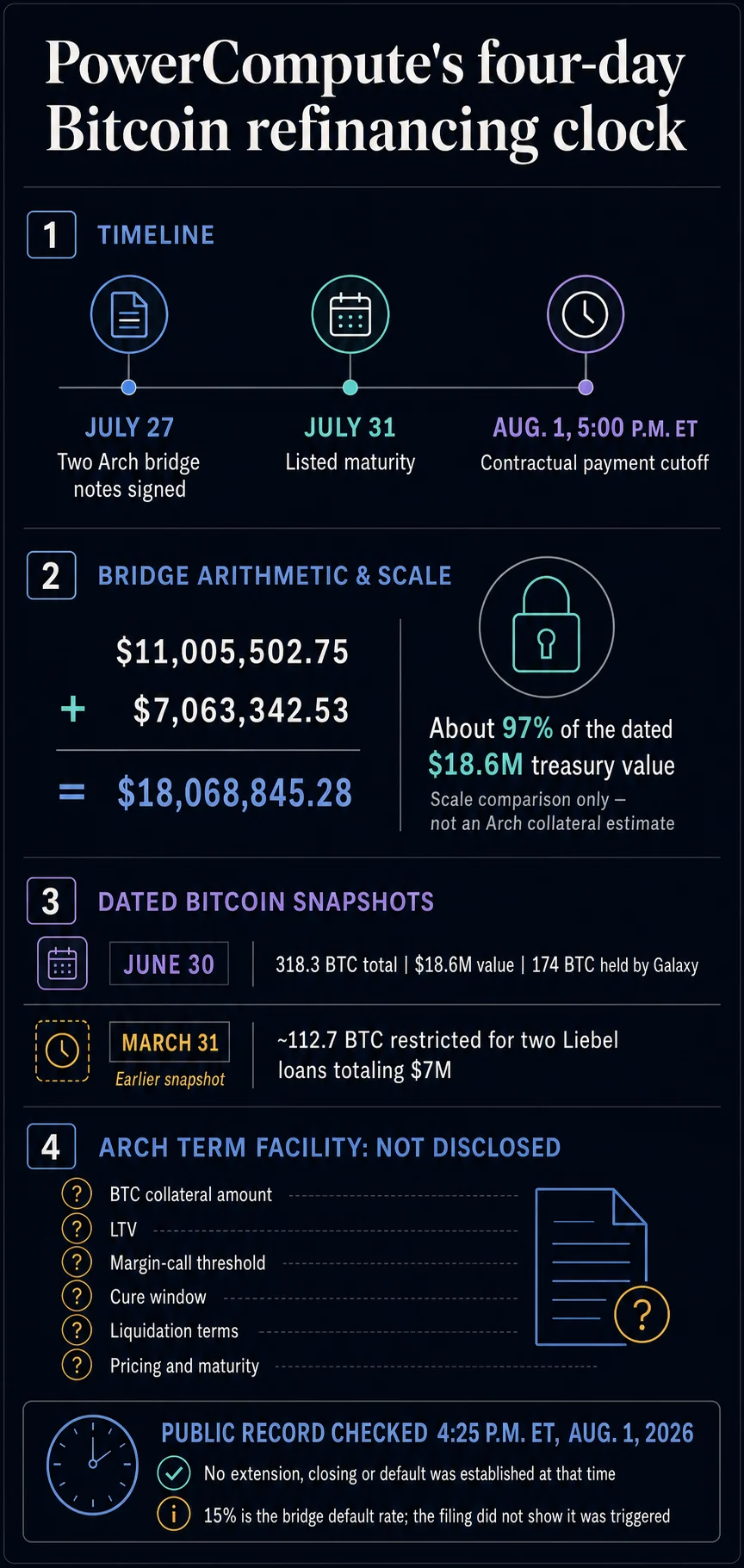
PowerCompute, a Bitcoin mining enterprise currently undergoing a strategic pivot into high-performance computing (HPC), has entered a period of significant financial uncertainty following the expiration of a high-stakes bridge loan. The company’s subsidiary, US Digital, recently disclosed the acquisition of approximately $18.07 million in short-term financing from Arch Lending. This bridge loan, structured across two separate notes, was intended to serve as a temporary liquidity bridge while the company finalized a more permanent Bitcoin-secured term facility. However, the contractual deadline for repayment or refinancing passed on August 1, 2026, without any public confirmation of a resolution, leaving investors and market analysts questioning the status of the company’s primary assets.
The financial maneuver is being characterized by industry observers as an aggressive gamble, as the total principal of the bridge loan represents roughly 97% of the $18.6 million valuation PowerCompute assigned to its entire Bitcoin treasury as of June 30, 2026. With the silence from the company’s investor relations department and a lack of fresh SEC filings following the expiration of the payment window, the mining firm faces potential default interest rates and questions regarding the security of its Bitcoin holdings.
The Mechanics of the Four-Day Bridge Loan
The bridge financing agreement was disclosed in a July 27 SEC filing, revealing that US Digital had signed two promissory notes with Arch Lending. The first note carried a principal amount of $11,005,502.75, while the second note was valued at $7,063,342.53. Together, the aggregate debt totaled $18,068,845.28.
The terms of these notes were exceptionally tight. Despite being signed on July 27, the listed maturity date was July 31—a mere four days later. The agreement allowed for a grace period or final payment cutoff until 5:00 p.m. ET on August 1. The primary purpose of this rapid-fire capital injection was to facilitate the immediate and full repayment of existing debts owed to Galaxy Digital and the entity known as Liebel (referred to in various filings as both SE & AJ Liebel and DE & AJ Liebel).
The strategy appeared to be a consolidation move: pay off legacy creditors using short-term funds to clear the way for a comprehensive, long-term Bitcoin-secured term facility with Arch Lending. However, as the clock struck 5:01 p.m. on August 1, the anticipated documentation for the long-term facility remained unfiled. As of August 3, PowerCompute’s official channels, including its SEC submission feed and its corporate press release archive, have remained inactive regarding the status of this debt.
Analyzing the Treasury Risk: A 97% Collateral Threshold
The most striking aspect of this bridge loan is its size relative to the company’s balance sheet. According to PowerCompute’s June production update, the company held a total of 318.3 BTC. At the time of the treasury valuation on June 30, this stack was worth approximately $18.6 million.
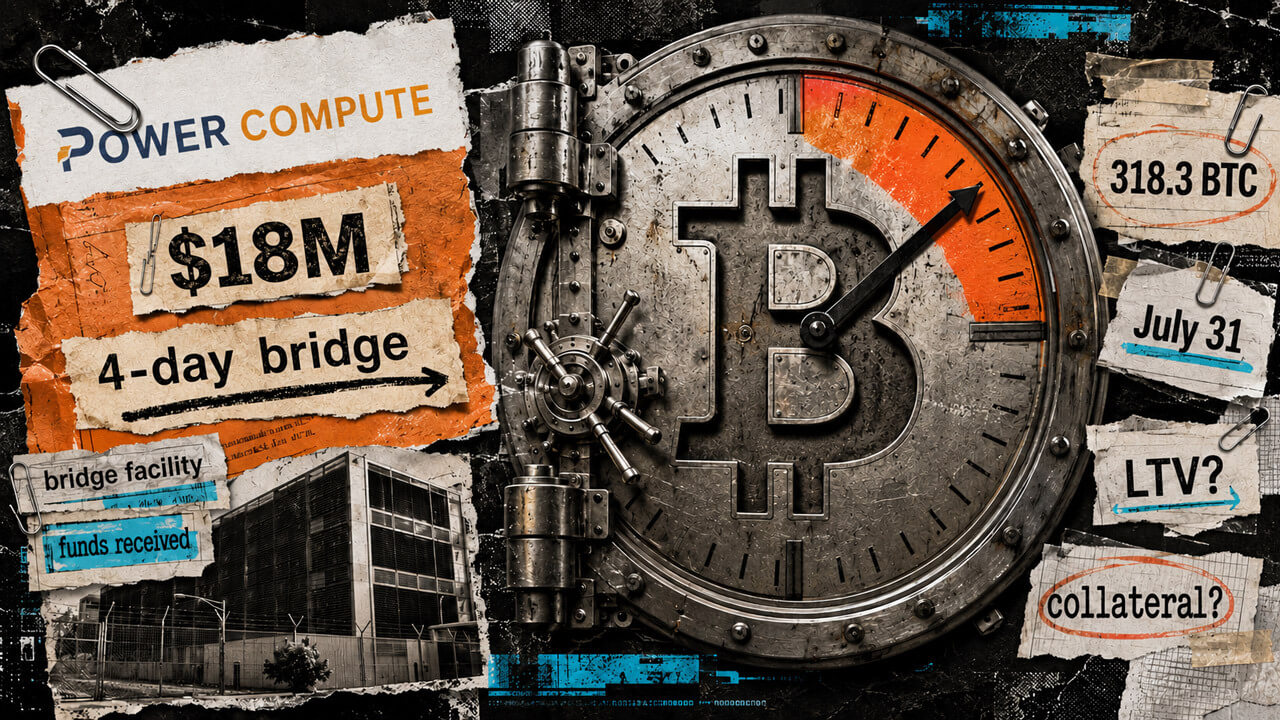
By taking on $18.07 million in debt, PowerCompute effectively leveraged almost its entire digital asset reserve. In the volatile world of cryptocurrency, such a high loan-to-value (LTV) ratio is often considered high-risk. While the specific LTV required by Arch Lending for the bridge loan was not publicly disclosed, the proximity of the loan amount to the total treasury value suggests that nearly every satoshi owned by the company is currently encumbered.
Furthermore, the breakdown of where this Bitcoin is held adds another layer of complexity. Prior to the bridge loan:
- Galaxy Digital held 174 BTC as collateral for a previous loan facility.
- Liebel held approximately 112.7 BTC in restricted custody.
- The remaining balance constituted the company’s unencumbered liquidity.
If the bridge loan was used to pay off Galaxy and Liebel, the Bitcoin held by those creditors should, in theory, have been released. However, it remains unclear if that Bitcoin was returned to PowerCompute’s direct control or if it was transferred directly into the custody of Arch Lending to secure the bridge notes. The company has not clarified whether the Bitcoin previously held by legacy creditors was supplemented with additional coins to meet Arch Lending’s collateral requirements.
The Cost of Silence: Default Terms and Market Reactions
The bridge notes specify a 15% annual default interest rate. While the public record does not yet establish that a default has occurred, the lack of an 8-K filing announcing an extension or the successful closing of the long-term facility has created a vacuum of information.
In the corporate world, silence following a hard deadline is rarely interpreted positively. If the 15% default rate has been triggered, PowerCompute would face an additional interest burden of roughly $7,400 per day. For a mining company already navigating the thin margins of the post-halving environment, these costs can rapidly erode operational viability.
There is also the possibility of a "silent extension," where the lender and borrower agree to move the goalposts without an immediate public disclosure, provided the delay is not deemed "material" in the very short term. However, given that the loan involves nearly the entirety of the company’s treasury, any change in terms would almost certainly require an SEC filing to inform shareholders of the shifting risk profile.
The Strategic Pivot: From Mining to High-Performance Computing
PowerCompute’s aggressive financial maneuvering comes at a time when the Bitcoin mining industry is undergoing a massive identity shift. Following the April 2024 halving, which cut block rewards in half, many miners have found that pure-play Bitcoin extraction is no longer sufficiently profitable to sustain high growth.

In response, PowerCompute has joined the ranks of miners like Core Scientific and Bit Digital by diversifying into high-performance computing (HPC) and AI data center services. This pivot requires massive capital expenditure for specialized hardware (GPUs) and infrastructure upgrades. The bridge loan from Arch Lending was likely intended not just to settle old debts, but to clean up the balance sheet to make the company more attractive for the larger capital raises necessary for the HPC transition.
The risk, however, is that by leveraging its Bitcoin treasury so heavily to fix its debt structure, the company may be leaving itself with no safety net if the Bitcoin market experiences a sudden downturn. If the price of Bitcoin were to drop significantly while the loan is at a 97% treasury-value ratio, the company would likely face margin calls or immediate liquidation of its holdings, effectively ending its role as a "HODL" miner.
Broader Implications for the Crypto Lending Market
The situation with PowerCompute and Arch Lending highlights the evolving nature of crypto-collateralized lending. In the previous market cycle, firms like Celsius and Voyager failed due to under-collateralized lending and risky rehypothecation. In the current cycle, institutional lenders like Galaxy Digital and Arch Lending have moved toward more structured, transparent (to a point) facilities.
However, the PowerCompute case demonstrates that even with institutional lenders, the "bridge" between legacy debt and new facilities can be a treacherous one. The use of Bitcoin as 1:1 or near 1:1 collateral for operational debt is a double-edged sword. While it allows miners to access USD liquidity without selling their Bitcoin (and thus avoiding capital gains taxes and losing upside potential), it tethers the company’s solvency directly to the volatility of the spot market.
Chronology of the Refinancing Attempt
To understand the urgency of the current situation, one must look at the timeline of events leading up to the August 1 deadline:
- June 30, 2026: PowerCompute reports a treasury of 318.3 BTC valued at $18.6 million.
- July 27, 2026: US Digital (PowerCompute subsidiary) signs two bridge notes with Arch Lending totaling $18.07 million.
- July 29, 2026: The company issues its last investor-relations press release, which does not mention the bridge loan specifics.
- July 31, 2026: The bridge notes reach their listed maturity date.
- August 1, 2026 (5:00 p.m. ET): The contractual payment cutoff passes.
- August 3, 2026: Market observers note the lack of SEC filings or updates, signaling a period of "total silence."
Conclusion: The Unresolved Collateral Stack
As it stands, the status of PowerCompute’s 318.3 BTC remains the most critical unanswered question for shareholders. Until the company discloses the outcome of the refinancing and the specific terms of the Arch facility—including the loan-to-value ratio, margin-call thresholds, and liquidation terms—the June 30 treasury figures cannot be viewed as a reliable measure of liquidity.
The company is at a crossroads. If the silence precedes an announcement of a successfully closed long-term facility, PowerCompute will have successfully consolidated its debt and cleared a path for its HPC expansion. If, however, the silence is a precursor to a default or a forced liquidation of its Bitcoin reserves, it will serve as a cautionary tale of the dangers of extreme leverage in the digital asset mining sector. For now, the market remains in a state of watchful waiting, looking for the next filing to reveal whether this $18 million gamble paid off or if the "bridge" has led to a financial dead end.