Dwi Wanna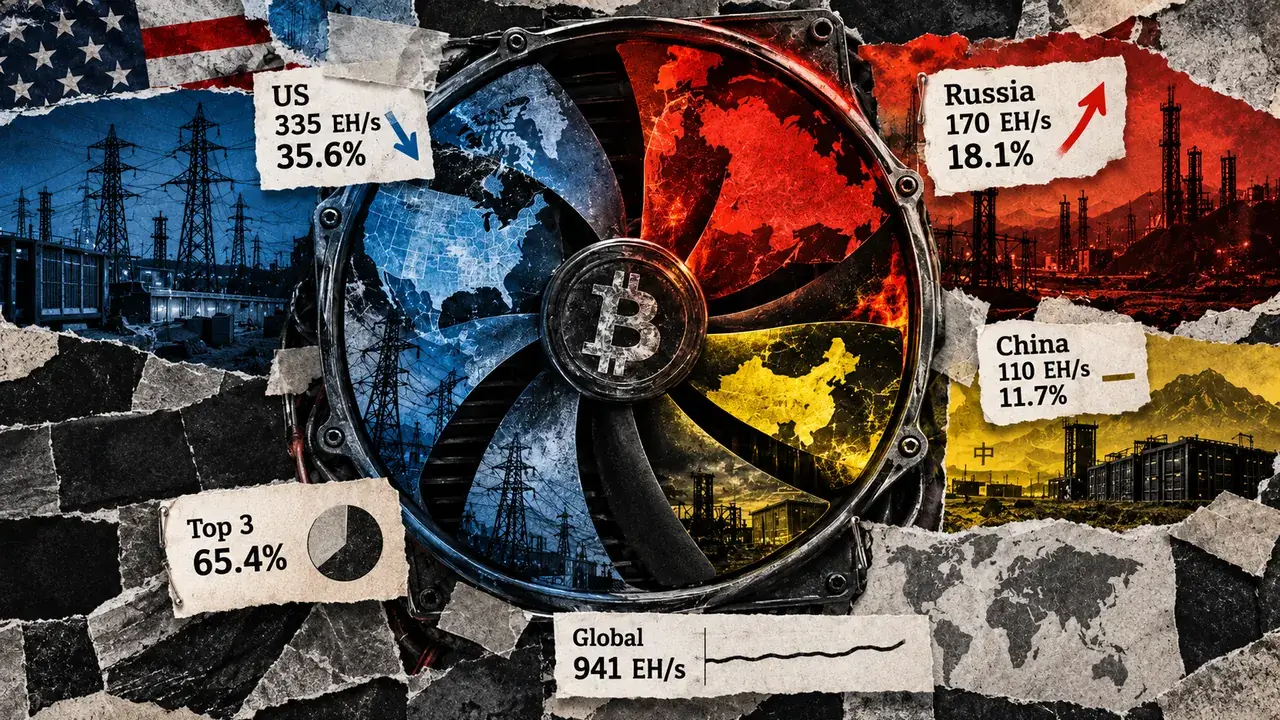
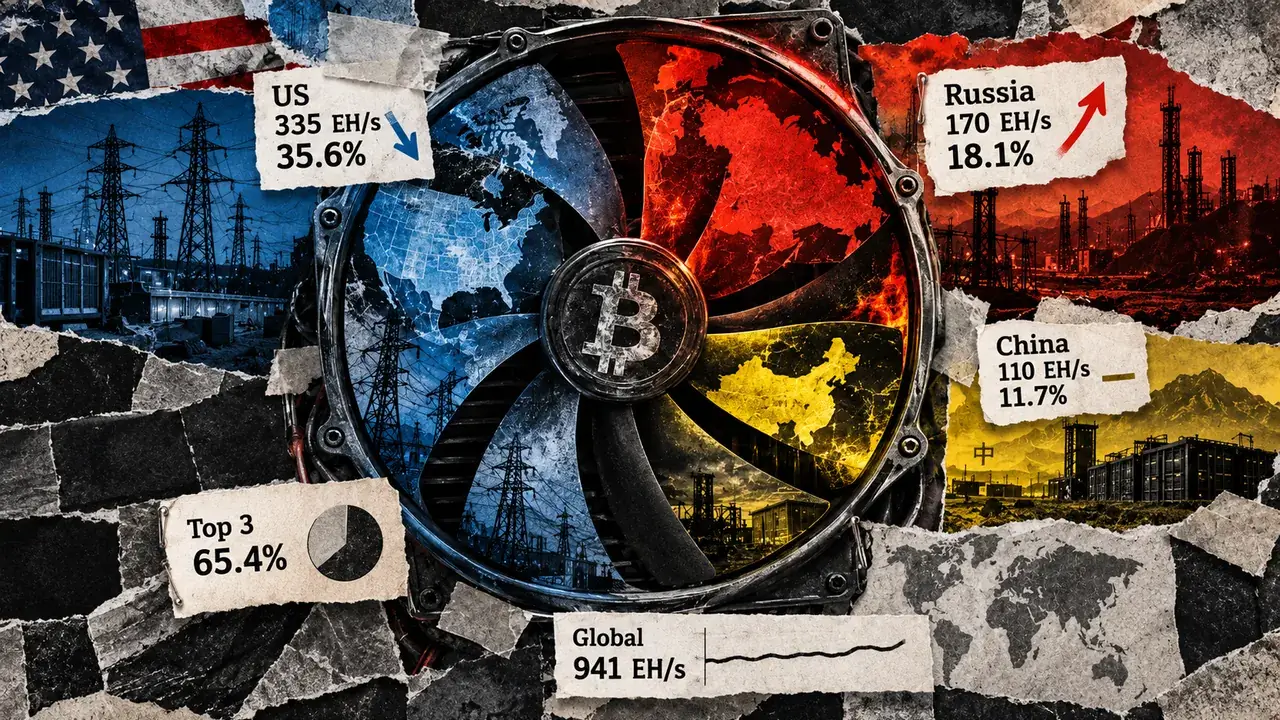
The landscape of global Bitcoin mining is undergoing a subtle but significant transformation, characterized by a contraction in the United States’ dominant market share and a corresponding rise in Russian mining activity. According to the latest country-level estimates released by Luxor Technology’s Hashrate Index on October 5, the United States saw its estimated hashrate—the total computational power dedicated to securing the Bitcoin network—drop from 345 Exahashes per second (EH/s) in the previous quarter to approximately 335 EH/s. In contrast, Russia’s mining output surged, climbing from 162 EH/s to 170 EH/s over the same period.
While the global hashrate remained remarkably stable, fluctuating only slightly from 940 EH/s to 941 EH/s on a 30-day simple moving average, the internal distribution among the world’s leading mining jurisdictions has shifted. The United States, Russia, and China remain the undisputed "Big Three" of the industry, collectively accounting for roughly 65.4% of the network’s total power. However, this combined share represents a modest 0.8% decline from the 66.2% recorded in the previous assessment, suggesting a slow but perceptible migration of hashing power toward emerging markets and secondary jurisdictions.
The Statistical Breakdown of the Q4 2026 Update
The Hashrate Index report, labeled as the fourth-quarter update, primarily reflects data and observations gathered during the third quarter of 2026. By comparing these figures to the July 16 edition—which focused on June estimates—analysts have identified a clear divergence in the trajectories of the two largest mining nations.
The United States, which has long been the primary destination for industrial-scale mining following China’s 2021 regulatory crackdown, saw its total network share slip from 36.7% to 35.6%. This decline of 1.1 percentage points occurs at a time when American miners are increasingly diversifying their business models. Conversely, Russia’s share of the global network rose from 17.2% to 18.1%, solidifying its position as the primary challenger to American dominance.
China, despite its official ban on cryptocurrency mining, continues to host a resilient and significant mining population. However, its estimated hashrate also saw a decline, falling from 115 EH/s to 110 EH/s, bringing its global share down to 11.7% from 12.2%. The stability of the global total at 941 EH/s indicates that the losses in the U.S. and China were largely absorbed by the growth in Russia and other smaller jurisdictions, such as those in Southeast Asia and parts of the Middle East.
The AI Pivot: A Structural Shift in American Infrastructure
The contraction of the U.S. hashrate is not necessarily an indicator of a declining interest in Bitcoin, but rather a reflection of a massive structural shift within the American data center industry. A growing number of publicly traded mining companies are repurposing their high-density power infrastructure to accommodate the explosive demand for Artificial Intelligence (AI) and High-Performance Computing (HPC).
This trend is substantiated by recent corporate disclosures. Keel Infrastructure, in its August 10 operational update, confirmed that it had fully decommissioned its U.S. Bitcoin mining operations. The move was a strategic decision to clear space for the construction of HPC facilities, which often offer more predictable and higher-margin revenue streams compared to the volatile rewards of Bitcoin mining. Similarly, Core Scientific, one of the largest players in the space, detailed an ongoing process in its July 28 results to repurpose existing mining sites for high-density colocation services.
For many U.S. firms, the calculation is simple: the energy and cooling infrastructure required for Bitcoin mining is remarkably similar to that needed for AI model training. As the "halving" cycles of Bitcoin continue to reduce block rewards, the opportunity cost of mining Bitcoin versus hosting GPUs for AI companies has shifted in favor of the latter. This migration of hardware and energy capacity out of the Bitcoin network explains why the U.S. hashrate has faltered even as global interest in digital assets remains high.
Russia’s Strategic Growth and Regulatory Clarity
While the U.S. pivots toward AI, Russia has been aggressively expanding its mining footprint. This growth is driven by several factors, including an abundance of low-cost energy in regions like Siberia and a shifting regulatory environment that has become increasingly supportive of industrial mining as a means of utilizing stranded energy and generating tax revenue.
Russia’s rise to 170 EH/s represents a significant milestone. Unlike the U.S., where miners are facing increased scrutiny over energy consumption and competition from the AI sector, Russian operators have focused on scaling traditional mining farms. The geopolitical climate has also played a role; with international sanctions limiting certain financial avenues, Russia has increasingly viewed Bitcoin mining as a strategic industry. The Russian government’s recent efforts to formalize the legal framework for mining have provided the "boots-on-the-ground" certainty required for large-scale capital investment in ASIC (Application-Specific Integrated Circuit) hardware.
Methodology and the Challenges of Geographic Estimation
Determining the exact physical location of Bitcoin mining hardware is an inherently difficult task. Hashrate Index utilizes a weighted combination of mining pool data, ASIC trading flows, and firmware adoption trends to produce its estimates. However, as noted by the Cambridge Centre for Alternative Finance (CCAF), these methodologies have limitations.
Mining pools often provide a skewed sample of the network, and the use of Virtual Private Networks (VPNs) or proxy servers can easily mask the true location of a mining machine. For instance, a miner operating in China may route their connection through a server in the United States to evade local detection, leading to an overestimation of U.S. hashrate and an underestimation of Chinese activity.
Furthermore, the Hashrate Index report acknowledges that its figures are a 30-day simple moving average. This means the data is a lagging indicator and does not represent a "live" census of the network on any given day. The 0.8% decline in the top three countries’ share suggests a marginal increase in decentralization, but the report offers no specific confidence range to prove statistical significance, leaving some room for debate regarding the precision of these shifts.
Location vs. Control: The Decentralization Debate
A critical distinction in the Bitcoin ecosystem is the difference between geographic location, beneficial ownership, and pool coordination. While the Hashrate Index tracks where the machines are physically located, this does not necessarily correlate with who controls the network’s decision-making power.
Bitcoin mining involves three distinct layers:
- The Miners: The physical hardware providing the hashing work.
- The Pools: The entities that coordinate the work of many individual miners and select which transactions to include in a block.
- The Owners: The individuals or corporations that own the hardware and receive the rewards.
Current industry standards, such as the legacy Stratum protocol, generally allow mining pools to select transactions, meaning that even if a machine is located in Russia, a pool headquartered in the U.S. or Europe might be the one deciding which transactions are processed. While the adoption of Stratum V2 is designed to allow individual miners to reclaim the power of transaction selection, its current usage remains limited.
Therefore, the shift of hashrate from the U.S. to Russia represents a change in geographic exposure and energy consumption, but it does not automatically imply a shift in the political or operational control of the Bitcoin network. True decentralization would require not only a wider geographic spread of hardware but also a more diverse array of independent parties choosing block contents.
Environmental and Regional Factors
Beyond the AI pivot and geopolitics, regional environmental factors have also contributed to the fluctuating hashrate. In Ethiopia, which had briefly emerged as a promising new frontier for mining due to its massive hydroelectric projects, recent power restrictions have led to a decline in activity. The Ethiopian government’s decision to prioritize domestic energy needs over mining exports highlights the "nomadic" and precarious nature of the industry in developing nations.
Seasonal variations also play a role. Mining activity often follows the "wet" and "dry" seasons in regions reliant on hydroelectric power. A decline in hashrate in a specific country could be a temporary result of power rationing or high seasonal temperatures that make cooling too expensive, rather than a permanent exit from the industry.
Implications for the Future of the Network
The latest data suggests that the Bitcoin mining industry is entering a state of maturity where "geographic arbitrage" is becoming more sophisticated. As the U.S. market becomes more expensive and competitive due to the AI boom, the network is naturally seeking out the next path of least resistance—in this case, Russia and other lower-cost jurisdictions.
For the Bitcoin network, this shift is a double-edged sword. On one hand, the movement of hashrate away from a single dominant country (the U.S.) is a positive step for geographical decentralization, reducing the risk that a single government could cripple the network through regulation or hardware seizures. On the other hand, the concentration of nearly 20% of the network within Russia introduces its own set of geopolitical risks and concerns regarding the long-term stability of the hashrate.
The stability of the global hashrate at 941 EH/s, despite these internal migrations, underscores the robustness of the Bitcoin protocol. As machines are turned off in Texas to make way for AI servers, new machines are being plugged in in Siberia or Southeast Asia. This constant "plug-and-play" nature of the network ensures that the security of the blockchain remains uncompromised, even as the map of the mining world is redrawn.
Ultimately, the Q4 2026 update from Hashrate Index serves as a reminder that Bitcoin mining is an ever-evolving global competition. The next phase of the industry will likely be defined by how miners balance the lucrative lure of AI with the foundational role of securing the world’s largest decentralized financial network. Whether the U.S. will continue to cede ground or find a way to integrate mining with its burgeoning AI infrastructure remains the most critical question for the years ahead.