Dwi Wanna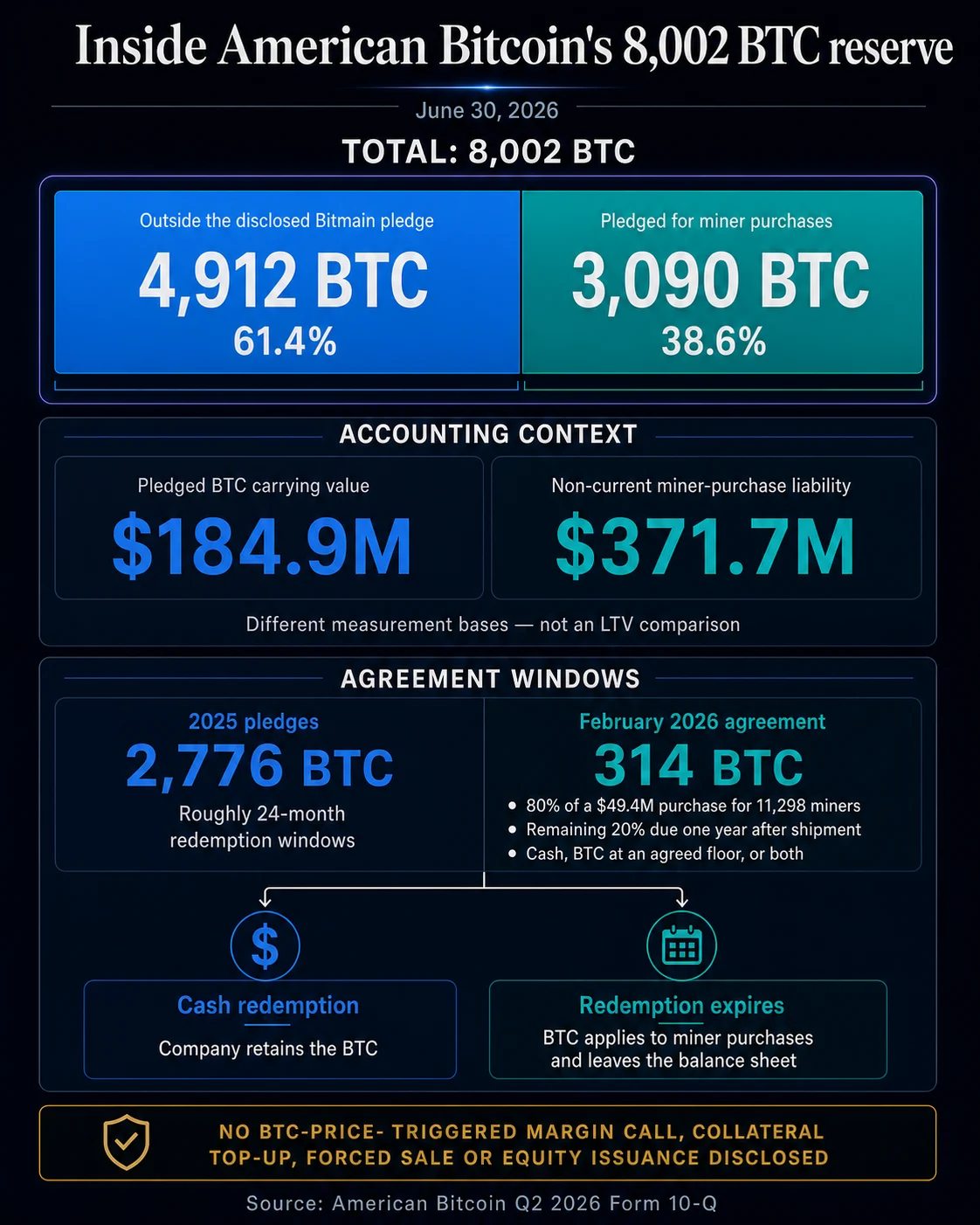
American Bitcoin, the cryptocurrency mining venture co-founded by Eric Trump and backed by the Trump family, revealed in its second-quarter 2026 financial filing that a significant portion of its digital asset reserves is currently encumbered by hardware procurement agreements. As of June 30, 2026, the company held a total reserve of 8,002 BTC. However, approximately 38.6% of this total—amounting to 3,090 BTC—has been pledged to Bitmain, the world’s leading manufacturer of cryptocurrency mining servers, as part of a strategic arrangement to expand the company’s operational capacity. The remaining 4,912 BTC are held outside of these specific pledge agreements, providing the firm with a degree of unencumbered liquidity, though the pledged assets represent a substantial commitment of the company’s balance sheet to future infrastructure growth.
The company’s structure and its rapid ascent in the North American mining sector have drawn significant industry attention since its inception. Formed in 2025 through a partnership between Hut 8, a veteran in the digital asset infrastructure space, and American Data Centers, the venture was positioned as a major domestic player in the race for computational dominance. At the time of its launch, Hut 8 maintained an 80% equity stake, while Eric Trump assumed the roles of co-founder and Chief Strategy Officer. Donald Trump Jr. also holds a supportive role in the venture, marking a high-profile intersection between the former First Family’s business interests and the burgeoning Bitcoin mining industry.
The Mechanics of the Bitmain Pledge and Redemption Windows
The financial arrangement between American Bitcoin and Bitmain is structured through a series of purchase and redemption agreements that allow the mining company to retain certain economic benefits while securing the hardware necessary for expansion. According to the Q2 SEC filing, the 3,090 pledged BTC remain on American Bitcoin’s balance sheet because the company retains "redemption rights and economic exposure." This accounting treatment is pivotal; it signifies that while the coins are earmarked for Bitmain, the company still benefits from any potential appreciation in Bitcoin’s price and maintains the legal right to "buy back" the coins before specific deadlines.
The mechanics of these deals are governed by "redemption windows." For each tranche of Bitcoin pledged, American Bitcoin has the option to pay the outstanding equipment balance in cash before the window closes. If the company chooses to pay in cash, it retains the Bitcoin on its balance sheet as an unencumbered asset. However, if a redemption window expires without a cash payment, the pledged Bitcoin is officially transferred to Bitmain to settle the purchase price of the mining equipment, at which point the assets are removed from the company’s balance sheet.

This strategy allows American Bitcoin to hedge its capital expenditures. Most of the current pledged balance stems from several tranches established in 2025, totaling 2,776 BTC. These agreements typically feature a 24-month redemption window from the initial pledge date. A more recent agreement, finalized in February 2026, involved the acquisition of 11,298 miners at a price point of approximately $49.4 million. For this specific deal, American Bitcoin pledged 314 BTC to cover 80% of the purchase price. The remaining 20% is due one year after the hardware is shipped and can be settled in cash, Bitcoin (valued at a pre-agreed floor price), or a combination of both. This February 2026 pledge also carries a 24-month window, with an additional option for a 12-month extension, providing the company with significant flexibility in managing its treasury.
Financial Performance and Accounting Complexity
The Q2 2026 report highlights the complexities of modern digital asset accounting. The company reported a carrying value of $184.9 million for the pledged Bitcoin, while simultaneously booking a $371.7 million non-current miner-purchase liability. Analysts note that these figures represent different accounting metrics and should not be viewed as a direct loan-to-value ratio. The carrying value reflects the fair market value of the coins as of the June 30 reporting date, whereas the liability reflects the long-term contractual obligations associated with the hardware agreements.
Despite the growth in its Bitcoin holdings—which increased by 14% during the quarter—American Bitcoin reported a GAAP (Generally Accepted Accounting Principles) net loss of $57.2 million for the second quarter. This loss was driven largely by a $71.2 million digital-asset impairment loss, a reflection of the volatility in the cryptocurrency markets. This was partially offset by an $18.3 million gain from derivative instruments and $28.2 million in depreciation and amortization expenses.
It is important to note that the GAAP net loss does not necessarily reflect the company’s immediate cash flow or liquidity position. In fact, American Bitcoin successfully raised $33.6 million in net proceeds through its at-the-market (ATM) equity program, selling 2.15 million split-adjusted Class A shares. This capital injection helped bolster the company’s cash reserves, even as shares outstanding rose by approximately 3%. Notably, the company’s "satoshis per share" metric—a favorite among Bitcoin-standard investors—increased by 11% during the quarter, suggesting that the company is successfully growing its Bitcoin reserves faster than it is diluting shareholders.
Market Context and Economic Sensitivity
The timing of these redemption windows is critical given the broader market environment. On August 3, 2026, Bitcoin was trading near $62,600, which is approximately 50% below the peak it reached in October 2025. At these price levels, the total pledged pool of 3,090 BTC was valued at roughly $193 million, while the company’s unencumbered 4,912 BTC were worth approximately $307 million.

The fluctuations in Bitcoin’s price do not automatically trigger a forfeiture of the pledged assets. The agreements are time-bound rather than price-bound, meaning the company is not subject to "margin calls" in the traditional sense. However, a prolonged bear market or a stagnant price environment significantly alters the "opportunity cost" of the redemption. If the price of Bitcoin remains low, the company may find it more economically viable to let the pledged Bitcoin settle the debt rather than exhausting its cash reserves to save the coins. Conversely, if Bitcoin enters a new bull cycle, the company will likely prioritize cash payments to retain its BTC, which would then be worth significantly more than the equipment debt it secured.
Industry Implications and Strategic Outlook
The strategy employed by American Bitcoin reflects a broader trend in the industrial mining sector where large-scale operators use their "HODL" reserves as collateral for infrastructure expansion. This model, while capital-efficient during periods of price appreciation, introduces a layer of balance sheet risk that is closely tied to the 24-month hardware cycles.
Industry observers suggest that the involvement of the Trump family has provided the company with significant branding power and access to capital markets, but the operational success of the venture will ultimately depend on its ability to manage these Bitmain agreements. By pledging nearly 40% of its reserves, American Bitcoin has signaled a "growth-first" mentality, prioritizing the acquisition of the latest ASIC (Application-Specific Integrated Circuit) technology to maintain its hash rate share.
The 11,298 miners acquired in the February 2026 deal are expected to significantly boost the company’s total exahash capacity, placing it among the top tier of North American miners. As the company navigates the remainder of 2026, the focus will likely remain on its ability to generate sufficient cash flow from operations to satisfy the redemption windows of its 2025 tranches. If successful, American Bitcoin could emerge with both a massive, state-of-the-art mining fleet and a fully unencumbered Bitcoin reserve. If market conditions remain suppressed, however, the company may be forced to choose between further shareholder dilution to raise cash or allowing nearly 3,100 BTC to leave its balance sheet forever.
As of the latest reports, Bitcoin’s dominance in the global market remains strong at 58.77%, with a total market capitalization of $1.29 trillion. For companies like American Bitcoin, the stakes of treasury management have never been higher. The firm’s ability to balance its role as a Bitcoin accumulator with its requirements as a high-overhead industrial power consumer will serve as a litmus test for the "Trump-backed" entry into the digital asset space. For now, the market awaits the next series of redemption windows, which will determine whether the company’s 8,002 BTC reserve remains a cornerstone of its value proposition or a temporary tool for industrial scaling.