admin
admin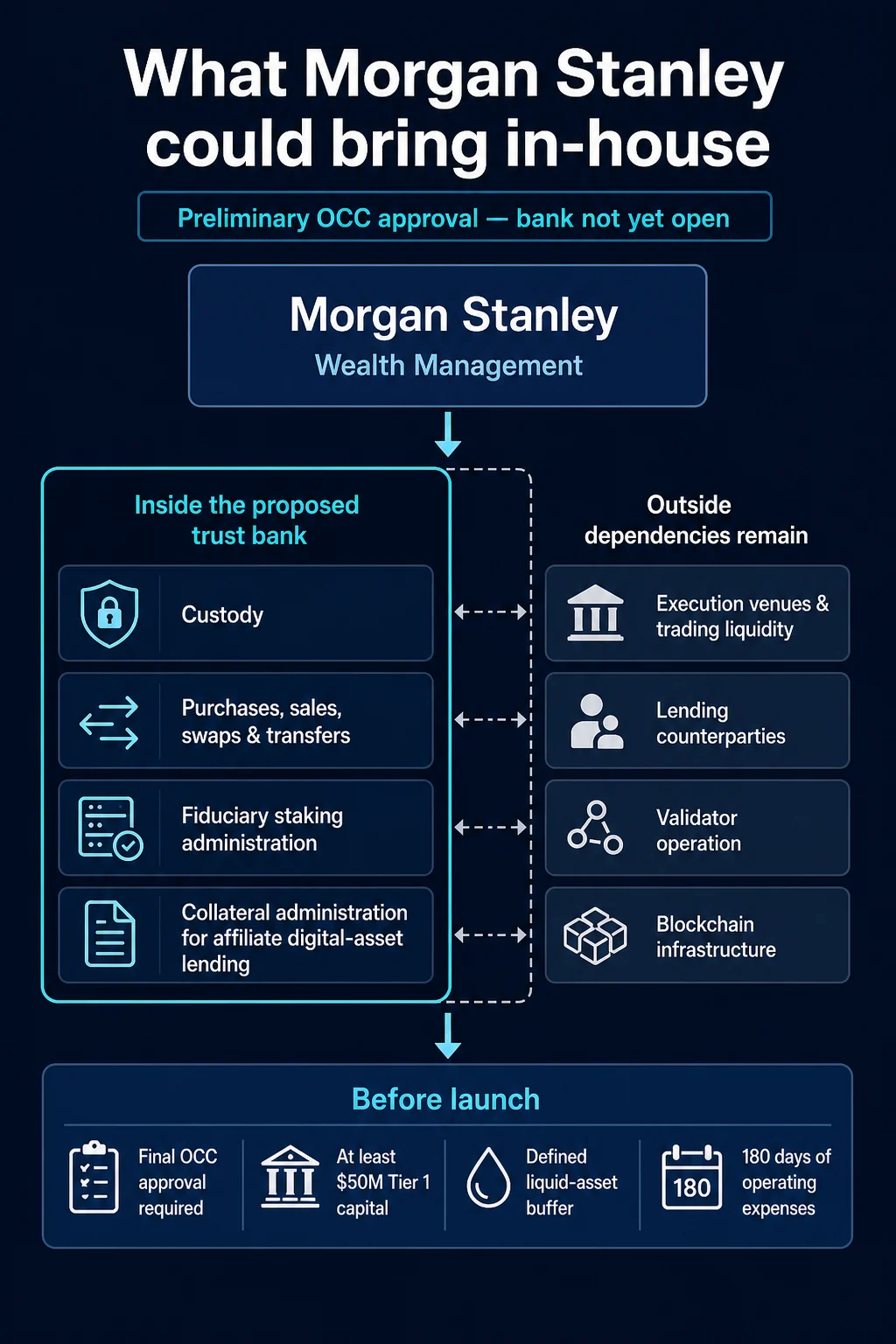
In a significant development for the burgeoning digital asset landscape, Morgan Stanley has received preliminary conditional approval from the Office of the Comptroller of the Currency (OCC) to establish a national trust bank dedicated to digital assets. This landmark decision, rendered in June, paves the way for the financial behemoth to internalize a suite of crucial cryptocurrency functions, including custody, transaction administration, fiduciary staking, and collateral support for lending activities. The move signals a deepening integration of digital assets within traditional finance and could reshape the competitive dynamics for existing crypto-native service providers.
The Genesis of Morgan Stanley Digital Trust
The OCC’s conditional approval allows for the creation of Morgan Stanley Digital Trust, a wholly owned national trust bank. This entity is designed to serve the wealth management clients of Morgan Stanley, offering a regulated framework for managing digital assets that have historically been handled by specialized third-party firms. The application, publicly available, details the proposed structure and operational scope of this new subsidiary, highlighting its ambition to become a central hub for institutional crypto services within the Morgan Stanley ecosystem.
The OCC’s classification of this filing as a new bank charter, under a holding company with requested trust powers, underscores the seriousness with which regulators are approaching the integration of digital assets into the established financial system. This designation provides Morgan Stanley with a robust, federally regulated vehicle to conduct a broad spectrum of digital asset operations, from the secure safekeeping of assets to the intricate management of their lifecycle.
Scope of Proposed Internalized Services
The proposed services by Morgan Stanley Digital Trust are comprehensive and designed to cover the end-to-end management of digital assets for its clients. These include:
- Custody: Securely holding and safeguarding clients’ digital assets, a foundational requirement for any institutional player in the crypto space.
- Transaction Administration: Facilitating and managing a range of digital asset transactions, including purchases, sales, swaps, and transfers. This encompasses the operational backbone required for efficient and compliant trading activities.
- Fiduciary Staking: Engaging in staking activities on behalf of clients in a fiduciary capacity. Staking, a mechanism for earning rewards by participating in the validation of transactions on proof-of-stake blockchains, is a key revenue-generating and yield-enhancing service for digital asset holders.
- Collateral Support: Providing collateral administration for affiliate digital asset lending. This involves managing the assets pledged as collateral in lending arrangements, a critical function for facilitating liquidity and risk management within the digital asset lending market.
By bringing these functions in-house, Morgan Stanley aims to streamline operations, enhance control over client assets and transactions, and potentially reduce costs associated with outsourcing these services. The consolidation of these critical functions under one regulated entity could lead to a more integrated and seamless client experience, allowing for greater oversight and a more cohesive approach to digital asset management.
Timeline and Regulatory Milestones
The journey towards the establishment of Morgan Stanley Digital Trust has been a methodical process, marked by key regulatory engagements. While the preliminary conditional approval was granted in June, the OCC application record indicates the charter action was approved on June 18. This approval is contingent upon Morgan Stanley meeting specific capital and liquidity requirements, as detailed in Corporate Decision 1378.

According to Corporate Decision 1378, Morgan Stanley Digital Trust must demonstrate a minimum of $50 million in Tier 1 capital. Furthermore, the institution is required to maintain a set pool of liquid assets and possess sufficient liquidity to cover 180 days of operating costs. These stringent requirements reflect the OCC’s commitment to ensuring the stability and solvency of digital asset custodians and trust institutions. The successful fulfillment of these conditions will be critical for the final approval and operational launch of the trust bank.
The OCC’s engagement with digital asset institutions has been evolving. Earlier in 2024, the OCC issued interpretive letters and guidance clarifying the authority of national banks and federal savings associations to provide cryptocurrency custody services. This regulatory groundwork has been instrumental in creating a clearer path for financial institutions like Morgan Stanley to pursue such initiatives. The conditional approval for Morgan Stanley Digital Trust represents a significant milestone in this ongoing regulatory evolution, signaling a more robust framework for the integration of digital assets into the traditional banking sector.
Impact on Crypto-Native Intermediaries
The internalizing of these core services by a financial giant like Morgan Stanley is poised to exert considerable pressure on existing crypto-native intermediaries. Third-party custodians, staking administrators, and collateral service providers whose business models heavily rely on offering these very functions to institutional clients will likely face increased competition.
The ability of Morgan Stanley to manage custody, transaction administration, staking, and collateral support within its own regulated structure could diminish the reliance of its wealth management clients on external providers. This shift could lead to a reduction in the number of third-party handoffs in the digital asset management workflow, concentrating more of the service relationship and operational control within Morgan Stanley.
For crypto-native firms, this development necessitates a strategic re-evaluation of their value proposition. They will need to emphasize areas where they can offer unique advantages or specialized expertise that Morgan Stanley’s in-house solution may not fully replicate. This could include advanced trading strategies, participation in nascent blockchain ecosystems, or highly specialized advisory services that extend beyond core custody and staking. The competitive landscape is thus set to become more challenging, pushing crypto intermediaries to innovate and differentiate themselves further.
External Infrastructure and Essential Dependencies
Despite the significant scope of services Morgan Stanley intends to bring in-house, the operation of a digital asset trust bank remains inherently dependent on external infrastructure and specialized services. The OCC filing explicitly outlines what Morgan Stanley aims to control internally, while acknowledging the continued reliance on outside entities for critical operational components.
These external dependencies include:

- Access to Execution Venues: The ability to trade digital assets effectively requires seamless connectivity to various cryptocurrency exchanges and trading platforms. These venues provide the liquidity necessary for efficient price discovery and transaction execution.
- Trading Liquidity: Securing sufficient trading liquidity is paramount for executing large orders without significant price slippage. This liquidity is often sourced from a network of market makers and other participants in the broader crypto market.
- Lending Counterparties: For its affiliate digital asset lending operations, Morgan Stanley will still require robust relationships with reliable lending counterparties. These entities play a crucial role in facilitating the lending and borrowing of digital assets within the ecosystem.
- Validator Operations: In the context of fiduciary staking, Morgan Stanley will need to engage with or operate validator nodes on proof-of-stake blockchains. While they may internalize the administration, the actual technical operation of these nodes often requires specialized infrastructure and expertise, potentially involving partnerships with blockchain infrastructure providers.
- Broader Blockchain Infrastructure: The underlying blockchain networks themselves, including their security, scalability, and upgrade mechanisms, form the foundational infrastructure upon which all digital asset activities are built. Morgan Stanley, like all participants, relies on the integrity and ongoing development of these networks.
The OCC filing clearly delineates the boundaries of Morgan Stanley’s ambition, highlighting what it seeks to control within its regulated banking framework and what will remain external. This strategic approach recognizes that while internalizing core functions offers significant advantages, the interconnected nature of the digital asset ecosystem necessitates ongoing engagement with external markets and infrastructure providers.
Broader Implications for Institutional Finance
The move by Morgan Stanley represents a significant step in the maturation of digital assets as an asset class within institutional finance. By establishing a regulated trust bank, the firm is signaling a long-term commitment to the sector and providing a clear pathway for its wealth management clients to engage with digital assets in a secure and compliant manner.
This development could serve as a catalyst for other traditional financial institutions to explore similar strategies. As regulatory clarity increases and the operational challenges of managing digital assets become more manageable, more large banks may consider internalizing these functions. This trend could lead to a further convergence of traditional finance and the digital asset space, blurring the lines between established financial services and the innovative world of cryptocurrencies.
Moreover, the increased involvement of major financial institutions like Morgan Stanley can contribute to greater market stability and investor confidence. The rigorous regulatory oversight applied to national trust banks, coupled with the established reputations of these institutions, can help to mitigate some of the perceived risks associated with digital assets.
However, it also raises important questions about market concentration and the future role of specialized crypto firms. As large players consolidate key functions, the competitive landscape for smaller, more agile crypto-native companies will undoubtedly shift. These firms will need to adapt by focusing on innovation, niche markets, or providing services that complement, rather than directly compete with, the offerings of large financial institutions.
The approval of Morgan Stanley Digital Trust is not merely a procedural step; it is a strategic maneuver that reflects the evolving perception and integration of digital assets within the global financial system. It underscores the growing recognition of cryptocurrencies not just as speculative instruments, but as a class of assets with the potential to transform financial services, provided they are managed within robust, regulated frameworks. The coming years will likely see further developments as Morgan Stanley implements its plans and the broader industry responds to this significant shift.