admin
admin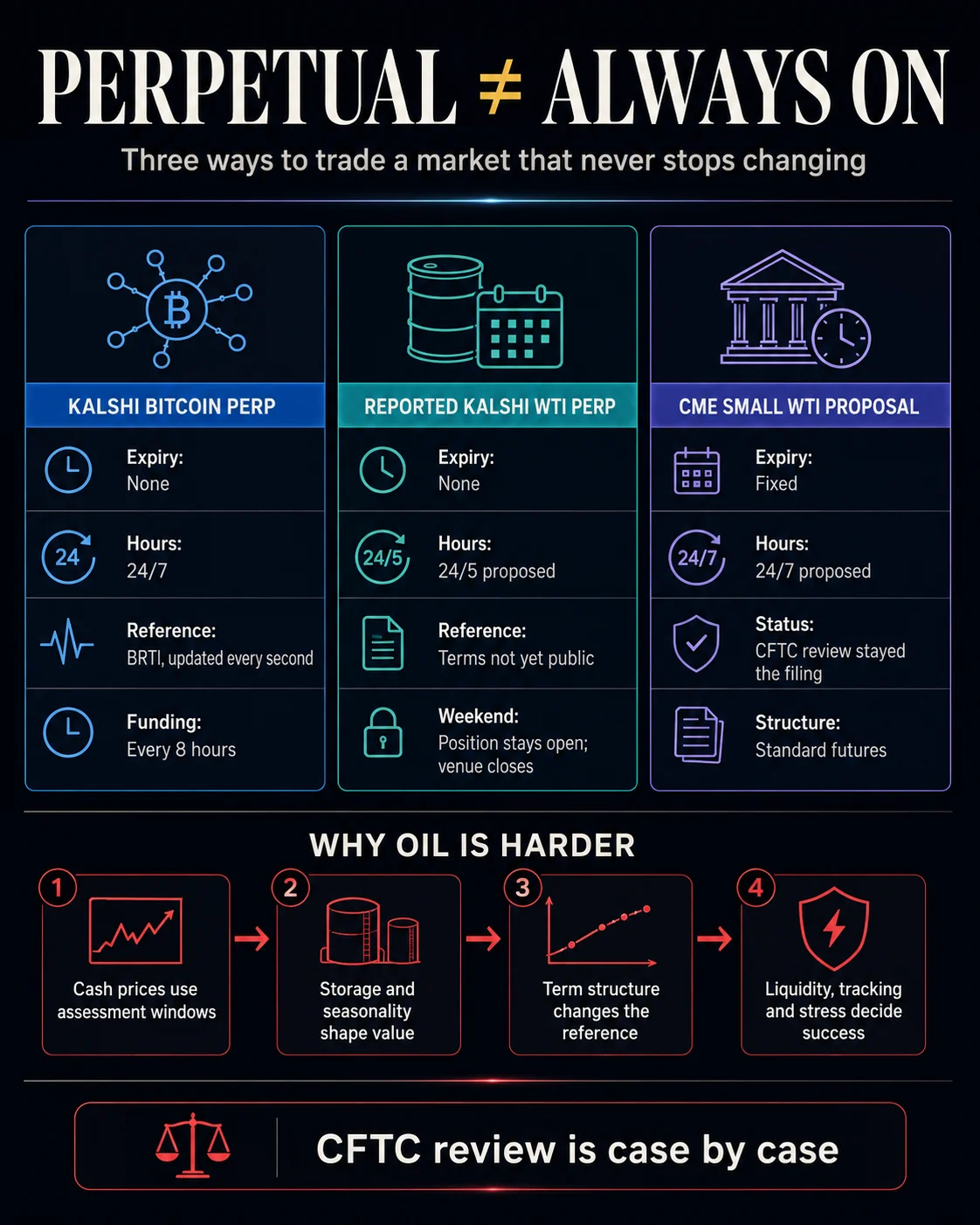
Kalshi, the U.S.-regulated exchange that secured approval for a Bitcoin perpetual futures contract in May, is reportedly preparing to petition the Commodity Futures Trading Commission (CFTC) for the go-ahead on a perpetual futures contract tied to West Texas Intermediate (WTI) crude oil. This move, as reported by Reuters on September 2, could mark a significant milestone, introducing the first oil perpetual to trade on a regulated U.S. platform and extending a product structure born in the cryptocurrency space into the heart of the benchmark U.S. oil market. The exchange’s approach, however, introduces a crucial divergence from its crypto-native model, potentially impacting the contract’s utility and regulatory reception.
The Evolution of Perpetual Contracts and the Oil Market Landscape
Perpetual futures, a derivative instrument that has gained considerable traction in cryptocurrency markets, are characterized by their lack of a fixed expiration date. Instead of a traditional expiry, these contracts employ a funding mechanism, where payments are exchanged between long and short positions at regular intervals. This mechanism aims to keep the derivative’s price closely aligned with the underlying asset’s spot price, allowing traders to maintain positions indefinitely without the need for manual rollovers as contract months approach expiration.
The success of Kalshi’s Bitcoin perpetual, which trades 24 hours a day, seven days a week, relies heavily on the continuous and globally distributed nature of Bitcoin’s spot market. The contract references a real-time Bitcoin index, updated every second, with funding payments occurring every eight hours. The CFTC’s approval for this product was partly predicated on Bitcoin’s always-on trading environment and its transparent, globally observable spot trading activity.
However, the proposed WTI oil perpetual faces a different market structure. Crude oil prices are intrinsically linked to physical supply, storage logistics, and geopolitical events. The traditional futures market reflects these realities through contracts with distinct delivery months, each representing a specific point in time for the physical commodity. While Kalshi plans to offer its WTI contract on a 24-hour, five-day-a-week schedule, this deliberate closure during weekends diverges from the continuous nature of the crypto market and presents a unique set of challenges and opportunities.
Navigating Regulatory Scrutiny: The 24/5 Compromise
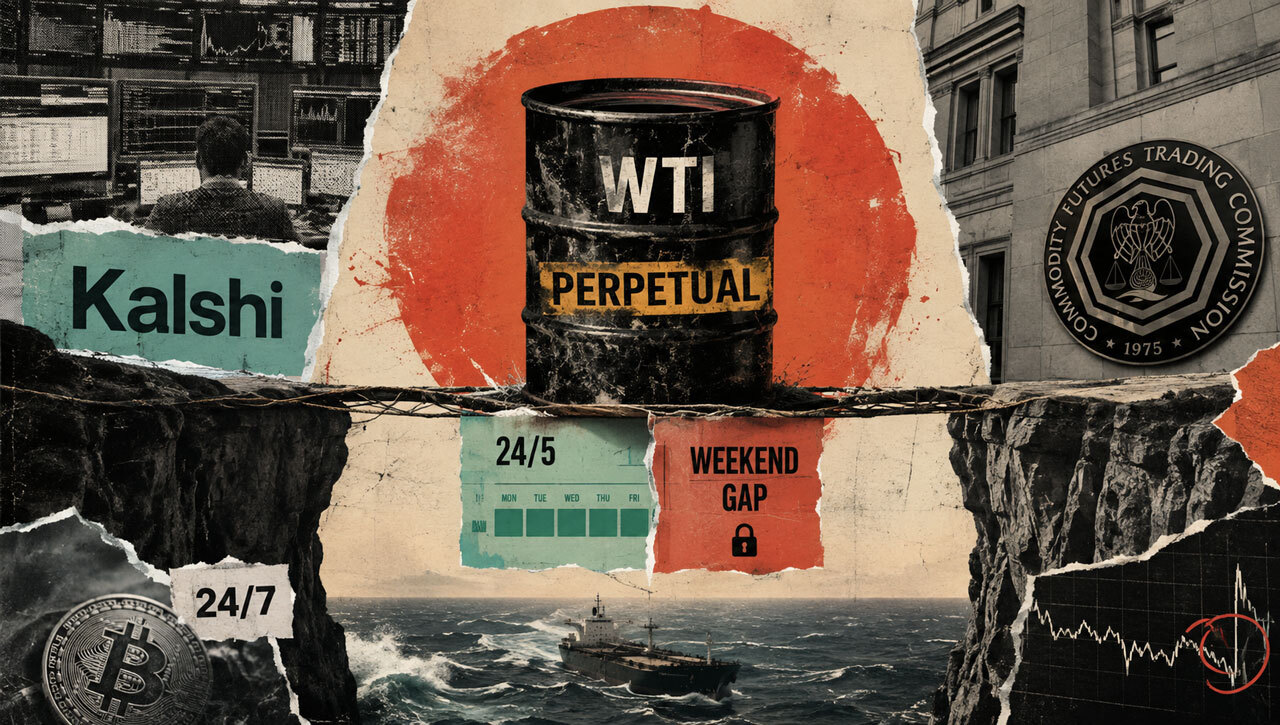
Reuters indicated that Kalshi intends to offer the WTI contract for 24 hours a day, five days a week. This schedule, while potentially easing its path through Washington by avoiding the complexities of weekend oil price discovery and associated regulatory oversight, may simultaneously diminish its most compelling use case. Unlike Bitcoin, which benefits from constant global spot trading across numerous venues, oil prices are influenced by physical market dynamics that can shift significantly over weekends, even when traditional futures markets are closed.
The existing WTI futures market already operates for nearly 24 hours a day, from Sunday evening through Friday, with a daily trading pause. Kalshi’s proposed 24/5 schedule means that its primary advantage over conventional futures would stem from the elimination of contract expiration, rather than providing continuous price discovery during periods when traditional markets are inactive. This structure also sidesteps many operational complexities associated with weekend trading but leaves positions exposed to news and events that accumulate during the closure, necessitating price adjustments upon reopening.
The Challenge of Reference Pricing and Market Integrity
A critical aspect of any perpetual contract is the credibility of its reference price mechanism. For Bitcoin, the existence of a globally accessible and continuously observable spot market provides a robust foundation for its perpetual contracts. The proposed WTI perpetual, however, faces a more intricate challenge. The physical crude oil market operates through a series of dispersed transactions and assessments that occur within defined windows, rather than a single, continuously observable spot price akin to Bitcoin.
The CFTC has explicitly acknowledged these complexities in its review of energy perpetuals. The agency has sought to understand whether a perpetual contract could reliably reference a physical assessment, a futures contract, or a composite of the two without becoming susceptible to manipulation or exhibiting unreliability.
The intricate sequence of oil deliveries carries inherent informational value that a single, no-expiry price must compress. Storage costs, financing expenses, and the availability of physical barrels all contribute to shaping the futures curve. Contango, where longer-dated contracts trade at higher prices than near-term ones, can signal abundant supply and the costs associated with holding inventory. Conversely, backwardation, where near-term contracts command higher prices, often indicates physical scarcity and the premium placed on immediate access to barrels.
A perpetual contract aims to absorb these economic dynamics, effectively transferring the costs and benefits of rolling positions into the contract’s funding mechanism. If Kalshi’s reference price closely tracks the front-month futures contract, the methodology must still account for the transition to subsequent contracts as delivery dates approach. This inherent roll cost or benefit would likely resurface, either through the reference price itself or via the funding rate.
Historical Precedents and Regulatory Concerns
The market’s experience with negative oil prices, such as the dramatic collapse of the WTI contract below zero in April 2020, underscores the critical importance of reference price selection. During that period, storage capacity at Cushing, Oklahoma, became severely constrained, driving the expiring WTI contract into negative territory while later-dated contracts remained positive. A perpetual contract, lacking a terminal delivery event, would necessitate a clear decision from Kalshi on whether its mark price should reflect such extreme physical stress or adhere to a broader, smoothed measure. Furthermore, its funding and liquidation systems would need to be capable of operating effectively at or below zero. The CFTC’s prior approval of Kalshi’s Bitcoin perpetual was specifically limited to contracts tied to digital commodities with deep, active, and continuous spot trading, a condition that oil markets may not fully satisfy in the same manner.
CME’s Parallel Endeavor and Regulatory Stance
The regulatory landscape for such innovative energy derivatives is also shaped by parallel developments. CME Group, a major derivatives exchange, announced its own proposal for a small, cash-settled 10-Barrel WTI Crude Oil future with a proposed 24/7 trading schedule, while retaining a fixed expiration structure. The CFTC subsequently stayed CME’s self-certification of this product, indicating a thorough review process. This action highlights the agency’s close examination of extended-hours oil trading products and leaves Kalshi’s own proposal subject to similar scrutiny.
Potential Use Cases and Market Implications
The immediate operational benefit of an approved Kalshi WTI perpetual would likely be for traders seeking sustained exposure to oil prices without the burden of manual contract rollovers. This could appeal to companies with ongoing revenue streams or costs tied to oil prices, such as producers, refiners, transporters, and fuel consumers, who already utilize futures, options, and swaps for hedging. However, the CFTC has specifically requested evidence of an additional commercial need that perpetual contracts would fulfill and whether their users would primarily be hedgers or speculators.
Interestingly, the most compelling argument for the utility of an oil perpetual might lie in the very feature Kalshi appears to have omitted from its reported design: continuous trading through weekends. A study by Dune of trading activity on the crypto venue Hyperliquid examined 30 weekend closures and found that its WTI perpetual accounted for approximately three-quarters of the price movement observed when conventional futures reopened. During periods of significant price shifts over weekends, the perpetual contract accurately predicted the direction of the market. This suggests a potential role for perpetuals in providing price discovery during times when traditional markets are closed, particularly in response to unfolding geopolitical events or supply-side news.
However, the Hyperliquid study also noted increasing slippage on larger orders during weekend closures as the order book thinned, indicating that liquidity can become a concern. The venue’s Brent perpetual also exhibited more volatile price movements than Brent futures over similar weekends, raising questions about its reliability as a benchmark during periods of market inactivity.
Kalshi’s reported 24/5 design, by eschewing weekend trading, relinquishes this potential price discovery function. Its primary audience might therefore be traders seeking to establish and maintain large oil positions with relatively low collateral and automated management of contract transitions. The final terms of Kalshi’s proposed contract, which were not disclosed at the time of the Reuters report, will be crucial in determining its broader applicability and appeal.
The Narrow Regulatory Path Ahead
The regulatory path for Kalshi’s WTI perpetual appears to be exceptionally narrow. The CFTC’s approval of the Bitcoin perpetual was followed by a policy statement that directs perpetual contracts for other asset classes into a case-by-case review process. The agency’s subsequent inquiry into energy perpetuals has laid bare the significant structural challenges that must be addressed. The fundamental mismatch lies in oil market regulations, which are historically built around delivery months, while perpetual contracts are designed to exist without a final convergence event. This divergence necessitates careful consideration for reference pricing, position limits, margin requirements, and liquidation rules.
The inherent leverage in perpetual contracts, coupled with relatively low collateral requirements, can magnify modest oil price movements into substantial losses. Moreover, funding obligations accrue for as long as a position remains open, adding another layer of complexity for traders. The forthcoming contract specifications from Kalshi will dictate critical parameters such as eligible traders, position sizing relative to collateral, accepted collateral assets, and liquidation triggers.
The Market Experiment: Approval and Beyond
Should Kalshi receive approval, it would signify that its proposed design meets the necessary legal and market-integrity thresholds. However, the ultimate utility and success of the contract will hinge on its trading performance and market acceptance. Liquidity and accurate price tracking will be paramount. For a crude oil perpetual to be informative, it requires sufficient participation on both sides of the market to ensure its price and funding rate reflect genuine market sentiment rather than being driven by a few concentrated positions.
Market participants will closely observe how effectively the contract tracks the chosen WTI reference price during regular trading sessions, in response to inventory reports, geopolitical shocks, and market reopenings. Wide bid-ask spreads or persistent deviations from the reference price could render the contract costly and less effective, forcing the funding rate to absorb a disproportionate amount of price adjustment.
The history of abrupt supply shocks and even negative prices in the oil market provides regulators with tangible scenarios against which to evaluate the robustness of such a system. Kalshi is making a strategic bet that a unique product innovation from the crypto market – exposure without expiry – can be successfully adapted to physical oil, even with the compromise of a weekly trading pause. While this compromise may facilitate regulatory approval, it potentially dilutes the novel aspect of the crypto model that offered oil traders something beyond their existing market. If the product primarily serves to internalize roll management within the contract while tracking a largely weekday market, it may function as a more accessible vehicle for speculation rather than a significant contributor to oil price discovery. The forthcoming filing from Kalshi will ultimately reveal whether it has forged a broader purpose for this innovative derivative.