admin
admin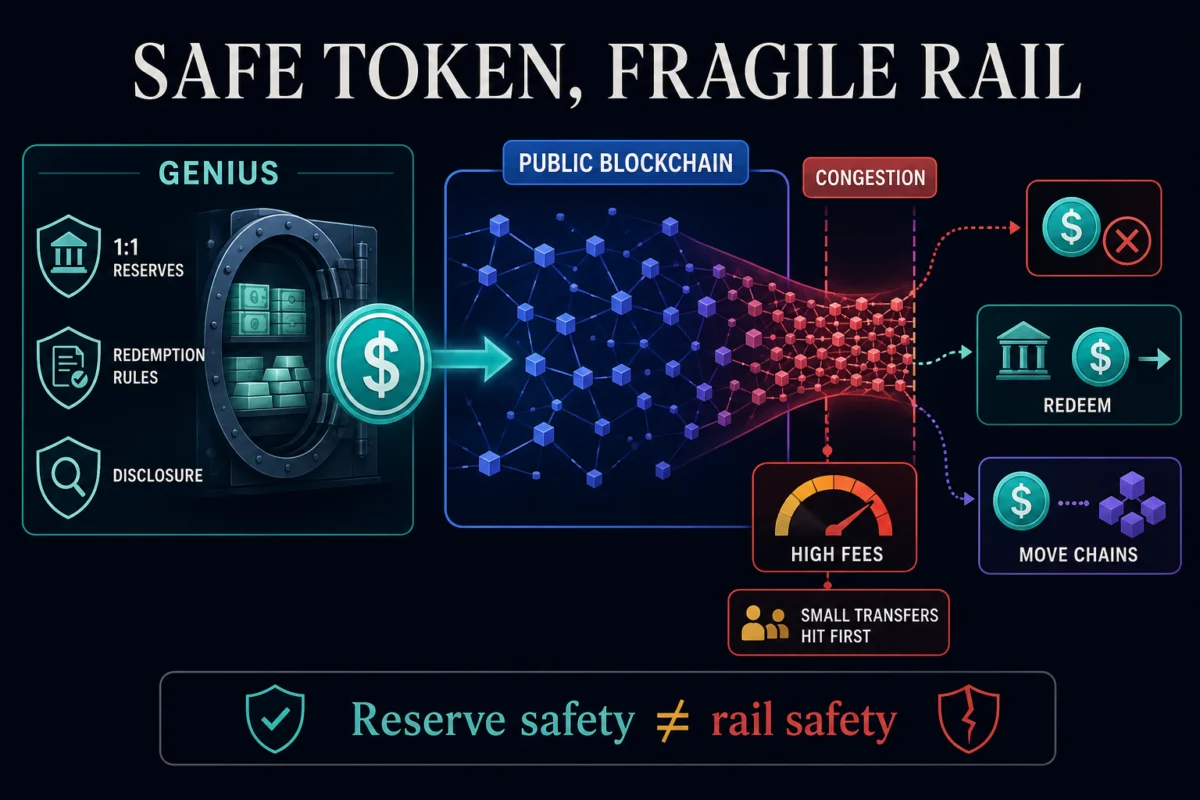
A significant development in the regulatory landscape for digital currencies emerged with the introduction of the GENIUS Act, a comprehensive federal framework designed to govern payment stablecoin issuers in the United States. This legislation, enacted with the intention of bolstering the stability and trustworthiness of dollar-pegged digital assets, introduces stringent reserve requirements aimed at ensuring that each stablecoin token functions as a secure claim on U.S. dollars. Concurrently, the act acknowledges the distinct nature of the underlying public blockchains facilitating these transactions, allowing them to maintain their own fee markets and capacity limitations.
This regulatory push comes at a time when concerns about the resilience of digital monetary systems are being amplified. A notable Federal Reserve staff paper, initially dated June 2, 2026, and subsequently updated on August 31, 2026, sheds light on the potential vulnerabilities inherent in even a perfectly backed digital dollar. Titled "The Fragility of Perfectly Safe Digital Money," the paper, authored by Federal Reserve economists, employs modeling to illustrate how transaction congestion on public blockchains can, under certain conditions, lead to destabilization. It is crucial to note that the views expressed in this paper do not necessarily reflect the official stance of the Federal Reserve Board or the broader Federal Reserve System, as is standard practice for such academic contributions.
The core of the Fed paper’s concern lies in the economics of transaction fees. When these fees escalate to a certain point, the cost of executing small payments can render them economically unviable for users. This erosion of utility can, in turn, diminish the perceived value and adoption of a stablecoin. The model predicts that in scenarios where a stablecoin exhibits weak payment-network effects—meaning its value is significantly tied to how widely it is accepted and used by others—individual decisions to exit the network can coalesce into a larger, coordinated redemption event. Within the empirical framework of the paper, "redemption" is interpreted broadly, encompassing not only direct cash-outs to fiat currency but also the migration of stablecoin assets to alternative blockchains. This nuanced definition highlights that pressure on a stablecoin’s circulation can manifest in various ways beyond traditional bank runs.
The Federal Reserve economists emphasize that their model presents a latent mechanism for potential instability, rather than a direct forecast of an imminent crisis. However, the findings sharpen a critical question as the Treasury Department undertakes the implementation of the GENIUS Act. While the law equips regulators with broad authorities to oversee issuers, their reserves, and their redemption commitments, the explicit reserve provisions and the Treasury’s current Section 3 proposal for implementation do not impose specific price or capacity standards for the public blockchains themselves. This creates a dichotomy: robust regulation for the issuers of stablecoins, but less direct control over the operational characteristics of the networks on which they reside.
The Mechanics of Congestion-Induced Runs
Traditional analyses of stablecoin fragility have historically centered on the issuer’s underlying assets. The primary concern has been whether the reserves backing the stablecoin are sufficient and liquid enough to meet redemption demands. If a token promises to be redeemable for one U.S. dollar, but its reserves decline in value or cannot be readily liquidated, token holders have a rational incentive to redeem their holdings before others do, fearing a loss of value. This dynamic, often described as a "run on the bank," has been a focal point for regulators.
However, the Federal Reserve economists deliberately abstract away from this traditional source of fragility in their model. They construct a scenario where the stablecoin is assumed to be fully and safely backed by its reserves, effectively removing the risk of asset depreciation or illiquidity as a direct cause of instability. Instead, their model isolates the interaction between transaction fees and network effects as the critical driver of fragility. The fundamental insight is that the utility and value of a payment asset are intrinsically linked to its widespread acceptance and use by other participants in the network.
Under conditions of low transaction congestion, the payment network possesses sufficient capacity to absorb temporary shocks without significant disruption. However, the paper’s findings suggest that under conditions of high congestion, particularly when combined with weak network effects, a threshold can be reached. Beyond this threshold, the escalating transaction fees can reduce the usability of the stablecoin for everyday transactions. As fewer users find it economically viable to transact, the token becomes less attractive, weakening the network effects. This creates a feedback loop: reduced use makes the token less appealing, prompting more holders to exit the network, which can then escalate into coordinated and abrupt redemptions.
It is important to reiterate the paper’s specific definition of "redemption" in its empirical analysis. In the main empirical panel, redemption is measured as a negative change in a stablecoin’s circulation on the Ethereum blockchain. This metric is designed to capture broader pressures on Ethereum-based stablecoin activity and can represent various actions taken by users. These actions include, but are not limited to, cashing out stablecoins for fiat currency directly with the issuer. They can also include migrating stablecoin holdings to a different blockchain that offers lower transaction fees or better performance, or even simply reducing holdings on Ethereum for other reasons. Therefore, the data capture pressure on Ethereum’s circulation, rather than providing a precise count of customers solely cashing out with an issuer.
The study employs an unbalanced weekly panel dataset, drawing from five prominent stablecoins between November 2017 and December 2025, for which data were available. One of the most striking distributional results emerges from the period between 2021 and 2025. During this time, for transactions involving less than the median amount of USDC (United States Dollar Coin), the ratio of transaction fees to the value of the transfer frequently exceeded 100% at the 75th percentile of observations. In contrast, for transactions exceeding the median value, this fee-to-value ratio was almost never more than 5%.
This statistic does not imply that users routinely paid more in fees than the value of the assets they were transferring. Instead, it describes the economic realities of attempted and completed transfers during periods of high network congestion. In such expensive periods, a typical network fee could easily surpass the value of many small transfers. A user facing this situation might opt to avoid completing the transfer, wait for fees to subside, batch multiple transactions together, or seek alternative methods of transfer, potentially through a custodian. This pattern illustrates how network congestion can effectively ration access to the network based on the size of the transfer, even while the stablecoin itself remains technically redeemable at its stated value by the issuer.
Empirical Evidence and its Implications
The Federal Reserve paper combines a theoretical economic model with several empirical tests designed to investigate different facets of stablecoin behavior. These distinct pieces of evidence answer different questions and should not be conflated into a single, overarching causal claim.
| Evidence Type | Key Result | What it Supports | Limitations |
|---|---|---|---|
| Weekly Stablecoin Panel | A one-standard-deviation increase in gas fees ($10.83) was associated with a roughly 0.9 percentage-point rise in weekly redemptions when network effects were low. | Fee sensitivity is most pronounced when a stablecoin’s payment network is weak. | Gas fees alone were statistically insignificant; the result applies specifically to states with low network effects. |
| Ethereum Empty-Slot Design | The average empty-slot rate was 0.7%; a one-standard-deviation increase (0.004) corresponded to approximately $0.77 more in gas fees. | A plausibly exogenous shock to network capacity leads to higher transaction fees. | This design establishes the link between capacity and fees, not the subsequent redemption response. |
| Matched ETH-Tron USDT Transfers | From May 2020 to December 2025, a $1 increase in lagged, demeaned gas fees was associated with a 3% to 4% increase in net matched value moving from Ethereum to Tron. | Higher Ethereum fees coincide with a reallocation of stablecoin value to other blockchains. | This association cannot identify individual beneficial owners or definitively establish the motive behind every transfer. |
In the weekly panel analysis, transaction fees (gas) by themselves were not statistically significant in driving redemptions. The reported 0.9 percentage-point effect on redemptions only materialized when high fees interacted with weak network effects. This specific condition—high fees coupled with weak network effects—was present in approximately 7% to 7.5% of the observed data points. This finding is consistent with the theoretical model’s prediction of a threshold effect, where instability is contingent on multiple factors, rather than being a universal causal relationship.
The analysis using Ethereum’s "empty-slot" design offers a more robust causal inference for the initial link in the chain of events. Empty blocks on Ethereum are generally considered to be unrelated to the immediate demand for specific stablecoins. However, a reduction in available blockspace, leading to fewer empty slots, inherently reduces network capacity and drives up gas fees. This experimental design helps to establish that a shock to network capacity can indeed lead to higher transaction fees. It does not, however, directly prove that the same capacity shock caused subsequent redemption events by users.
The matched-transfer analysis, which compares identical USDT transfers on Ethereum and Tron within a 60-minute window, also represents an association rather than a direct causal link. This method is consistent with users switching from one blockchain to another. However, it is unable to identify the beneficial owner behind every matched transfer, nor can it definitively establish the precise motive for each move or exclude all alternative explanations for the observed pattern.
Collectively, these empirical findings support a conditional warning rather than a definitive forecast. They suggest that network congestion can indeed create an incentive for users to exit a particular blockchain, and that historical data show some stablecoin activity has moved to less expensive networks when Ethereum’s fees have become prohibitively high.

GENIUS Act: Safeguarding the Token, Not Necessarily Every Rail
The GENIUS Act mandates that permitted payment stablecoin issuers must maintain reserves that are at least one-to-one, backed by specified liquid assets. Furthermore, it requires issuers to establish clear public redemption procedures, disclose their purchase and redemption fees, and adhere to stringent monthly reporting, examination, and certification standards. These regulatory requirements encompass crucial areas such as capital adequacy, liquidity management, asset diversification, operational controls, and information technology security.
These comprehensive rules are designed to address several significant failure modes that could undermine the stability of stablecoins. They tackle issues such as inadequate or illiquid reserves, opaque redemption promises, issuers with insufficient capital, and weak operational and technological safeguards. Importantly, the GENIUS Act provides regulators with a clearer and more empowered pathway to supervise the entities responsible for creating and issuing dollar tokens.
The Treasury Department’s implementation proposal, published on August 17, 2026, and subsequently in the Federal Register on August 18, 2026, focuses specifically on Section 3 of the Act. This section outlines restrictions on the offering and sale of payment stablecoins within the United States. The public comment period for this proposal was set to conclude on October 19, 2026. The Treasury has indicated that the anticipated effective date for the issuer licensing framework is January 18, 2027, with a broader restriction on digital asset service providers expected to take effect on July 18, 2028.
The proposed rule draws a distinction between direct transfers between two individuals acting on their own behalf, which includes self-custody transactions, and compensated services. Services such as exchanges, transfer businesses, and custodians that facilitate these transactions can qualify as digital asset service providers, bringing them under specific regulatory oversight.
This distinction has implications for who bears compliance duties. However, the economic realities of a congested base layer—the underlying public blockchain—persist across these categories. A stablecoin issuer might maintain perfectly liquid reserves, yet users could still confront transaction fees that are disproportionately large compared to the value of their intended payment.
The distinction in the proposed rule is narrow in its direct application. Issuer purchase and redemption fee disclosures pertain to charges levied by the issuer itself, which are distinct from blockchain gas fees or exchange withdrawal fees. The current text of the proposed regulations leaves the pricing and capacity of the base layer—the public blockchain—outside the explicit stablecoin rules. Nevertheless, the GENIUS Act also grants supervisors broad authority over an issuer’s operational and technological risks. This means regulators could scrutinize how an issuer manages its exposure to the underlying blockchain infrastructure, even if they do not directly control the public blockspace. The Treasury’s rulemaking process remains open, and specific implementation choices could still evolve before the regulations become effective.
This leaves two distinct safety tests operating in parallel. Supervisors will examine whether an issuer can honor its dollar claim and effectively manage its operations. Simultaneously, users will experience whether the chosen blockchain network can reliably carry their dollar claim at a price that is proportionate to the value of the payment being made.
Fee Dynamics Reveal Vulnerabilities
A snapshot of stablecoin distribution across various blockchain networks, taken shortly before the drafting of this analysis, offers insights into their varying fee markets. Data from DefiLlama’s chain dashboard and API indicated a total stablecoin supply of approximately $147.3 billion on Ethereum, $93.2 billion on Tron, and $15.7 billion on Solana. Minor variations existed in totals displayed on the dashboard due to timing and methodological differences.
At the time of this snapshot, Ethereum was not experiencing significant congestion. Etherscan’s gas tracker showed gas prices hovering around 0.127 to 0.128 gwei, with ETH trading near $2,404. For an illustrative ERC-20 token transfer requiring approximately 65,000 gas units, this translates to a network cost of roughly two U.S. cents. It is important to note that actual gas usage and wallet estimates can vary.
Transaction costs on Tron and Solana are structured differently. Tron charges 100 sun per Energy unit. A third-party estimate for an unstaked USDT transfer to an existing account required around 65,000 Energy, and to a new account, approximately 131,000 Energy, resulting in costs of roughly 6.5 to 13.1 TRX before considering staking or rented Energy. Solana’s base fee is set at 5,000 lamports per signature. A recent analytics snapshot indicated a median total fee of approximately 5,800 lamports, with a 99th-percentile fee around 651,400 lamports.
A direct dollar-price comparison across these networks can be misleading due to their fundamentally different fee structures, observation methodologies, and the inherent volatility of these figures. The more useful comparison is structural: the cost of a "stablecoin fee" varies significantly depending on the specific blockchain rail and the prevailing transaction conditions. Furthermore, these network charges are distinct from exchange withdrawal or platform fees, which intermediaries set independently.
The immediate impact of network congestion is typically felt by the smallest transactions, which have the least capacity to absorb a fixed network charge. A small, self-custody user might be compelled to delay a payment, consolidate multiple transfers into a single transaction, move their assets to an exchange for more economical withdrawals, or even cease using that particular blockchain altogether. This response can be an economic necessity, even if the stablecoin token itself remains fully redeemable at par by its issuer.
Larger intermediaries, such as exchanges, market makers, bridging services, stablecoin issuers themselves, and corporate treasury desks, are more likely to be the next to exhibit visible balance movements. These entities possess the liquidity to move substantial amounts of assets, potentially altering chain-level circulation or replenishing inventories where users wish to transact. This ordering of effects is an inference based on how the market typically operates, rather than a direct owner-level finding presented in the Federal Reserve paper.
Destination chains can consequently inherit both increased activity and potential pressure. A surge in stablecoin activity on one chain might deepen liquidity on another, while simultaneously testing the routes and intermediaries responsible for rebalancing inventory across networks. These secondary effects are analytical inferences rather than findings identified within the paper’s owner-level data. The broader policy question extends beyond whether an issuer holds sufficient U.S. Treasury bills; it also encompasses whether users have access to a tolerably priced route to redeemable dollar claims when a particular blockchain rail is under stress.
The snapshot taken on September 3rd, while indicating calm fees on Ethereum at that specific observation time, does not provide a measure of system-wide redemption pressure. The Federal Reserve paper reframes the gap between blockchain resilience and stablecoin safety as a monitorable risk, rather than definitive evidence of an imminent event. Regulators and market participants can observe key indicators such as fee-to-transfer-value ratios segmented by transaction size, abrupt shifts in chain-level stablecoin circulation, matched cross-chain flows, and imbalances in exchange wallet holdings.
The GENIUS Act can significantly enhance the safety of stablecoin tokens themselves by ensuring robust issuer reserves and operational standards. However, it does not guarantee the resilience of every pathway or network through which these stablecoins can be accessed and transacted. If the implementation of the Act solely defines safety in terms of reserve quality, future stress episodes could reveal a scenario where the dollar token itself remained sound, but access to it became severely compromised due to underlying network limitations.