admin
admin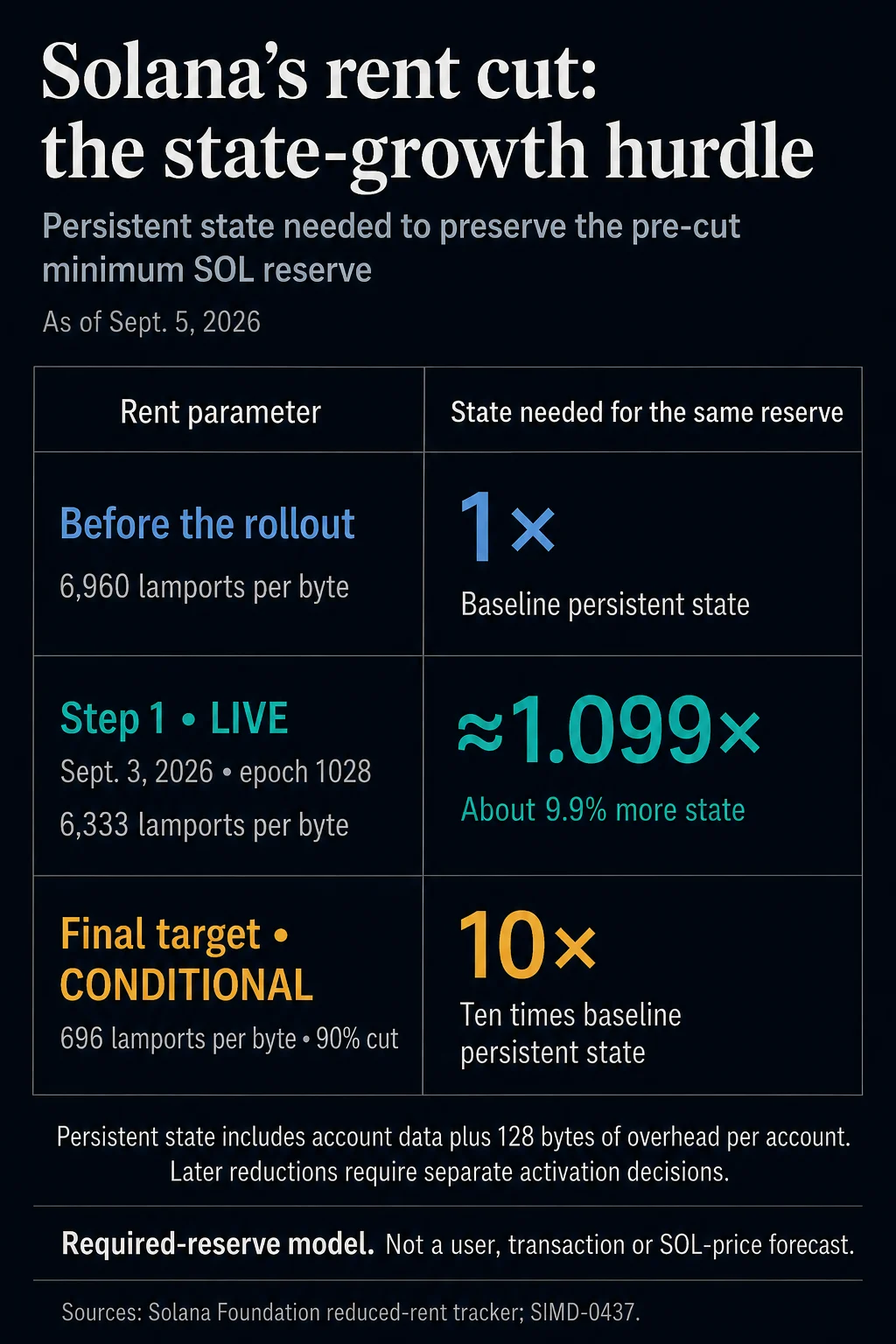
Eligible Solana token-account owners can now reclaim excess SOL previously held as a reserve to maintain their token accounts, following the activation of the network’s first rent reduction on September 3rd. This pivotal change, designed to streamline capital requirements and foster broader adoption, also substantially lowers the upfront capital needed for businesses to fund new account creation. The full implementation of the proposed rent reduction plan aims to fundamentally alter the relationship between network growth and the SOL held against storage, potentially enabling a tenfold expansion of persistent account state before requiring the same minimum SOL reserves as before the rollout.
The Solana Foundation has confirmed that the initial reduction, a decrease of approximately 9%, has successfully gone live on the mainnet. While the dramatic tenfold comparison refers to the ambitious final target of the staged reduction plan, even this early adjustment already diminishes the SOL reserves necessary to keep token accounts operational. This strategic move signals a significant shift in Solana’s economic model, prioritizing accessibility and capital efficiency for its users and developers.
Understanding Solana’s "Rent" Mechanism and the Gradual Reduction
Solana’s "rent" is not a recurring fee paid to validators, but rather a balance held against account storage. This balance is generally recoverable when an account is closed, acting more like a security deposit for data persistence. By reducing the required minimum balance, the network makes it more accessible for new accounts to be established with less SOL. Simultaneously, existing accounts that were holding reserves above the previous minimum can now reclaim that excess capital.
The rent reduction process is being implemented in five distinct stages, as outlined in SIMD-0437, the official rent-reduction specification. The initial reduction, which took effect at epoch 1028 on September 3rd, lowered the reserve parameter from 6,960 lamports per byte to 6,333 lamports per byte. This marks the first step towards a final target of 696 lamports per byte, a reduction of over 90% from the original rate.
The minimum SOL reserve for an account is calculated based on its data size plus a fixed overhead of 128 bytes, multiplied by the current lamports-per-byte parameter. For a standard Solana token account, which typically contains 165 data bytes, this results in an effective size of 293 bytes.
To illustrate the impact of these reductions, consider the hypothetical scenario of one million identical standard token accounts:
| Scenario | Lamports per byte | Required Reserve (for 1M accounts) | Reduction vs. Original |
|---|---|---|---|
| Before the Rollout | 6,960 | 2,039.28 SOL | Baseline |
| First Step (Live Sept. 3) | 6,333 | 1,855.569 SOL | 183.711 SOL |
| Final Target (Conditional) | 696 | 203.928 SOL | 1,835.352 SOL |
It is crucial to note that these figures represent calculated minimum requirements for a fixed population of accounts, not actual SOL withdrawals. The "Final Target" row assumes the complete activation of all five planned reductions. The actual SOL freed up will vary based on the diverse sizes and usage patterns of accounts across the network.
The "Tenfold Hurdle" and Its Implications for Network Scalability
The ambitious "tenfold" comparison arises from the relationship between the rent reduction and the total persistent state on the network. At one-tenth of the original reserve rate, the network would need to accommodate ten times the amount of rent-bearing state to maintain the same aggregate minimum SOL reserve. This metric is specifically designed to measure the growth of total persistent state, including the overhead associated with each individual account. It’s important to distinguish this from user counts, transaction volumes, or SOL prices, which are separate indicators of network health and adoption. The tenfold threshold primarily describes the potential for increased storage requirements to be supported with significantly less SOL.
The immediate impact of the first reduction, however, is more modest. At 6,333 lamports per byte, approximately 9.9% more rent-bearing state is required to preserve the original minimum SOL requirement. Both these comparisons, the immediate and the ultimate, focus on the mandated reserves. Users retain the flexibility to hold balances well above these minimum floors.
The visual representation of this comparison, as of September 5th, 2026, clearly illustrates the progressive nature of the rent reduction. The original 6,960 lamports per byte set the baseline. The currently live rate of 6,333 lamports per byte necessitates roughly 1.099 times the amount of state to maintain the same SOL reserve. The conditional final target of 696 lamports per byte would require ten times the state to preserve the pre-reduction minimum SOL reserve, underscoring the profound impact of the full plan.
Capital Reclaimability and Authority Dynamics
The most immediate and tangible benefit of the rent reduction is the liberation of capital currently held on the Solana blockchain. The Solana Foundation has provided a detailed reclamation guide, outlining the "WithdrawExcessLamports" instruction. This function allows token account owners to move SOL exceeding the current minimum requirement without closing the account or altering its token balance. The Token-2022 program also supports this crucial instruction.
The authority to initiate these withdrawals is a key consideration. For standard token accounts, the owner of the account must explicitly authorize the transfer. In cases involving token mints, authorization typically comes from the mint authority or, if that authority has been revoked, from the mint account itself. Accounts managed by custom programs require the owning program to implement specific withdrawal logic and verify the relevant authorities.

This distinction in authority has significant economic implications. For instance, a payments provider that funded a customer’s token account cannot automatically assume it has the right to reclaim excess SOL simply by having covered the initial deposit. The party entitled to authorize the withdrawal might be entirely separate from the entity that originally supplied the SOL.
The process of moving surplus balances involves an authorized transaction that ensures the minimum reserve is maintained. This operation facilitates the internal transfer of existing SOL between accounts, preserving the total circulating supply without issuing new tokens. As of the article’s reporting, specific data on the aggregate volume of completed withdrawals or subsequent SOL sales has not been publicly disclosed.
Fostering Future Adoption and Developer Innovation
Beyond the immediate capital release, the rent reduction offers a direct advantage for future onboarding and application development. Whoever funds a new account will require less SOL upfront, potentially enabling service providers to support a larger number of customer accounts with the same capital outlay. This is particularly impactful for scenarios where end-users do not directly purchase SOL themselves. The effective redeployment of existing surplus capital, however, remains contingent on the established authority structures and program configurations.
The long-term impact of this policy will be closely tied to the lifespan of accounts on the network. While gross account creation figures can paint a picture of activity, the amount of persistent state remaining on-chain is a more accurate indicator of sustained network utilization.
An analysis conducted by Solana Foundation researcher Umberto Natale in July 2023 revealed that a significant portion, 75.5%, of account-creation events in his studied cohort were closed within the same transaction. It’s important to note that these observations were not deduplicated by address, meaning repeated creation and closure cycles could be counted as separate events. Such workflows can generate considerable on-chain activity without leaving substantial persistent account storage behind.
However, these historical findings do not definitively predict user behavior in response to the current rent reduction. The same study also cautioned that correlations observed between SOL prices and account activity were descriptive rather than causal, making it difficult to establish a direct link between lower rent costs and shifts in demand.
Therefore, a comprehensive evaluation of this policy’s success will necessitate tracking not only account creation metrics but also the growth of persistent account bytes and their associated minimum reserves. Simply counting new accounts will not be sufficient to ascertain whether the network has effectively absorbed the lower reserve rate.
SOL Demand Beyond Account Reserves
It is essential to recognize that SOL’s utility extends far beyond its role in account reserves. Under Solana’s fee structure, transactions incur costs in SOL. Half of the base fee is burned, while the other half is allocated to validators. Priority fees, entirely paid by the user, are also directed to validators. These transaction fees represent a distinct demand channel for SOL, separate from the refundable account reserves. An increase in network activity could naturally lead to higher fee consumption. However, transaction throughput alone does not provide a clear indication of the total amount users are paying or the balances they are retaining.
Furthermore, SOL holders can actively participate in securing the network by delegating their stake to validators. This process not only contributes to network security but also makes them eligible for staking rewards. The reclaimed capital from reduced rent reserves could potentially be directed towards staking, further contributing to network security and decentralization, or used to fund the creation of more accounts, driving further network growth. While these are plausible outcomes, the provided information does not offer quantified data to establish either as a direct result of the rent reduction. Consequently, these possibilities currently serve as potential, rather than confirmed, offsets to the lower reserve requirements.
A recent analysis by CryptoSlate examining activity and fee economics highlighted a crucial distinction: network usage and token economics can evolve independently. The rent reduction introduces a specific economic incentive where network growth can be supported with a reduced amount of SOL per unit of persistent state. This decoupling of state growth from SOL requirements is a significant development for the network’s scalability and accessibility.
The Path Forward: Staged Rollouts and Future Monitoring
As of September 5th, the second phase of the rent reduction, lowering the rate to 5,080 lamports per byte, is active on the testnet. Mainnet deployment for this stage is anticipated in mid-September. The final three stages are scheduled for release with the Agave 4.4 upgrade in November. Crucially, each subsequent activation remains subject to a thorough review of network state growth. A rollback mechanism is in place, allowing for the restoration of the original parameter if necessary.
The upcoming stages of this reduction will be critical in determining the full extent of capital savings for users and developers. The subsequent monitoring of persistent state growth and actual SOL reclamation will provide clear insights into how much of this saved capital translates into increased account capacity, enhanced working capital for businesses, or a reduced overall SOL commitment against network storage. This phased approach, coupled with ongoing observation, ensures a measured and responsive implementation of this transformative economic upgrade for the Solana ecosystem.