admin
admin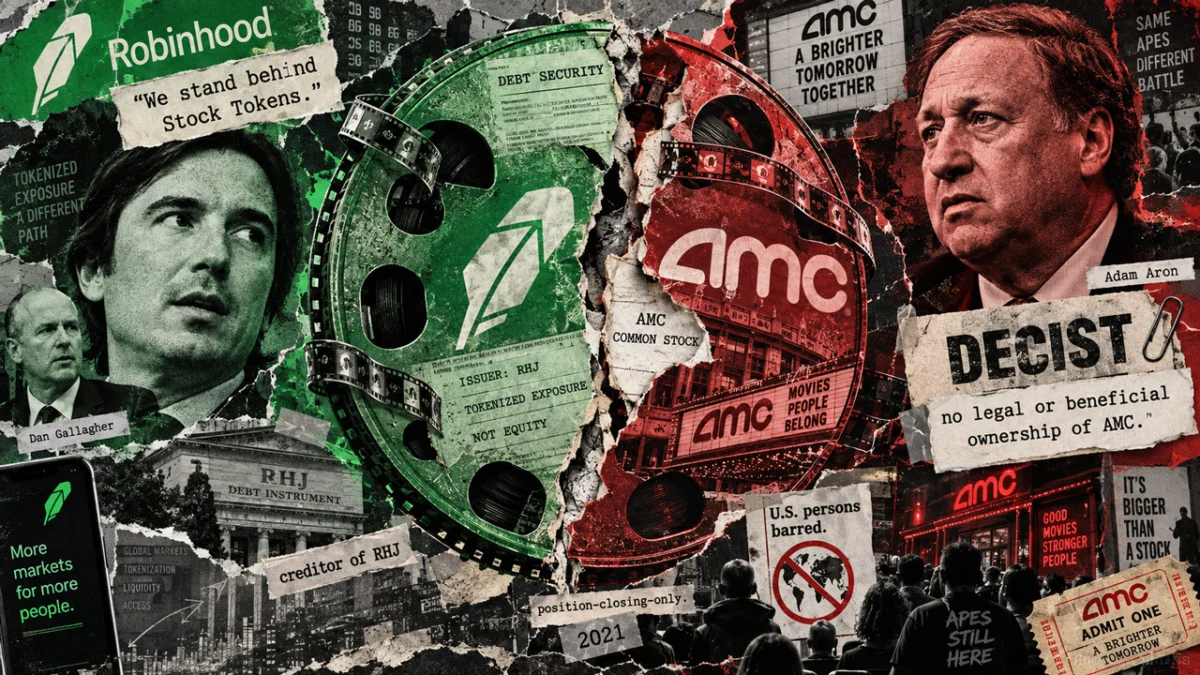
The volatile landscape of cryptocurrency and stock market intersections has once again become the epicenter of a high-profile dispute, this time involving financial technology giant Robinhood and AMC Entertainment, a company synonymous with the 2021 "meme stock" phenomenon. The core of the contention lies in Robinhood’s offering of an "AMC-linked Stock Token," a financial instrument that AMC CEO Adam Aron has vehemently opposed, demanding its cessation. Robinhood’s legal and executive leadership has, however, stood firm, asserting the product’s legitimacy and their commitment to it, setting the stage for a significant confrontation over the definition of ownership, economic exposure, and the boundaries of financial innovation.
At the heart of this escalating drama is a fundamental structural difference in how the Robinhood Stock Token operates compared to direct ownership of AMC Entertainment Holdings, Inc. (AMC) shares. Robinhood’s instrument is designed to mirror the economic performance of AMC shares, offering investors a way to gain exposure to its price movements. However, holders of these tokens do not possess any direct equity in AMC. Instead, the documentation reveals that they are essentially creditors of a Robinhood affiliate, Robinhood Assets (Jersey) Limited (RHJ), who have entered into a debt agreement. This distinction is critical, as it means token holders are not entitled to the traditional rights and privileges afforded to shareholders, such as voting rights, participation in shareholder meetings, pre-emption rights, or direct receipt of dividends.
The public exchange began with AMC CEO Adam Aron expressing his strong objections to the token. In a series of posts on social media platform X, Aron declared that AMC had no affiliation with the token and that the company’s external securities counsel would investigate the matter. He further articulated his concerns, highlighting that the product could "blur the line between economic exposure and share ownership," potentially decoupling trading activity from AMC’s capital-raising efforts. Crucially, Aron argued that token holders were being denied the rights inherent in AMC stock ownership. He also indicated AMC’s intention to escalate the issue to the Securities and Exchange Commission (SEC), signaling a potential regulatory challenge.
Robinhood’s response was swift and unyielding. Dan Gallagher, Robinhood’s chief legal, compliance, and corporate affairs officer, publicly rejected Aron’s demand, pointedly using the misspelling "DECIST" from Aron’s original communication and advising AMC to direct its legal representatives. Following this, Robinhood CEO Vlad Tenev reinforced the company’s position, stating unequivocally, "We stand behind Stock Tokens." This firm stance from Robinhood suggests a deep-seated belief in the legality and utility of their product, despite AMC’s opposition.
Unpacking the Robinhood Stock Token Structure
To fully comprehend the nuances of this dispute, a detailed examination of Robinhood’s Stock Token documentation is essential. Robinhood’s official disclosures describe Stock Tokens as "tokenized debt securities" issued by Robinhood Assets (Jersey) Limited (RHJ). The primary purpose of these tokens is to provide investors with "economic exposure to a referenced stock or exchange-traded fund." The critical caveat, as repeatedly emphasized in their legal materials, is that "holders receive no legal or beneficial interest in the company behind the reference security."
The specific terms for the AMC-linked token clearly identify RHJ as the issuer and AMC common stock as the "reference asset." Robinhood’s publicly accessible asset registry, as of September 4th, listed the AMC-linked instrument as active. This operational status underscores Robinhood’s intent to continue offering the product.
| Product Feature | Robinhood’s Disclosed Structure |
|---|---|
| Issuer | Robinhood Assets (Jersey) Limited (RHJ) |
| Legal Form | Debt security linked to AMC common stock |
| Holder Relationship | Creditor of RHJ under the product terms, with no legal or beneficial ownership of AMC |
| Company Rights | No AMC voting rights, no participation in meetings, no pre-emption rights, no direct dividend rights |
| Corporate-Action Economics | Dividends and stock splits are reflected through the product’s mechanics (e.g., onchain multiplier) |
| U.S. Distribution | Prospectus explicitly bars offering, sale, or delivery in the United States or to U.S. persons |
The RHJ base prospectus further elaborates on the creditor-debtor relationship. Token holders are classified as creditors of RHJ, with their claims governed by the terms of the debt product. This means their rights are contractually defined by RHJ, not by AMC’s corporate charter or shareholder agreements. The absence of direct rights to AMC’s voting, meetings, pre-emption, or dividends is a fundamental aspect of this structure. While economic events like dividends and stock splits are factored into the token’s value through specific product mechanics, often involving an "onchain multiplier," this is an economic replication, not a direct shareholder entitlement.
This intricate arrangement allows the Stock Token to track the economic performance of AMC’s underlying stock while maintaining a deliberate separation from AMC’s official shareholder registry. It is precisely this separation that fuels the sharp disagreement. Aron perceives an instrument that leverages AMC’s brand and stock performance without granting the corresponding ownership rights, potentially misleading investors or creating an unfair competitive dynamic. Robinhood, conversely, positions the product as a distinct financial security offering a novel way to gain economic exposure, operating within its own defined legal framework.
Geographic and Regulatory Boundaries
A crucial element of Robinhood’s Stock Token offering, as detailed in the prospectus, is its restricted distribution. The products are explicitly stated to remain unregistered under U.S. securities laws. Consequently, they "cannot be offered, sold, or delivered in the United States or to U.S. persons." This restriction is achieved by issuing the product through a Jersey-based entity, targeting eligible customers outside of the U.S. distribution boundary. This offshore issuance strategy is a common method for financial platforms to offer certain products while navigating complex U.S. regulatory landscapes.
The implications of these distribution restrictions are significant. While Aron’s broader challenge to the underlying structure remains a point of contention, Robinhood’s adherence to these geographic limitations suggests an attempt to operate within a defined legal perimeter. As of the current reporting, there has been no definitive regulatory decision from the SEC or any other governing body specifically addressing Robinhood’s AMC-linked instrument. The public record, therefore, consists of AMC’s threatened legal and regulatory scrutiny and Robinhood’s resolute refusal to withdraw the product.
For individual investors, the practical reality of holding the AMC-linked token is bifurcated. The token’s name and its reference to AMC provide a clear link to the company’s economic performance. However, the actual rights and recourse for holders stem solely from the debt terms established by RHJ. This fundamental gap between economic exposure and direct ownership is the central commercial and legal issue driving the current confrontation between AMC and Robinhood.
A Meme-Stock Role Reversal: Echoes of 2021
The current dispute carries a peculiar historical resonance, given AMC’s prominent role in the 2021 meme stock saga. During that period, retail investors, galvanized by online communities, rallied around a select group of volatile stocks, including AMC and GameStop. In a move that sparked widespread controversy and regulatory scrutiny, Robinhood, on January 28, 2021, restricted trading for AMC, GameStop, and other securities, limiting customers to "position closing-only" transactions. This decision, attributed by Robinhood to "market volatility and unprecedented volume," led to investigations by the SEC and other bodies, examining the market-structure pressures and the role of brokers in such frenzied trading environments.
Now, approximately five years later, the same entities find themselves on opposing sides of a new dispute concerning access and financial instruments. Robinhood is operating an instrument linked to AMC, while the CEO of AMC is actively demanding its removal. This parallel offers significant historical context but does not provide a direct legal precedent for the current situation.
The 2021 dispute centered on a broker’s decision to limit retail investors’ access to AMC shares during a period of intense market activity. The current conflict, conversely, questions whether Robinhood can continue to offer economic exposure to AMC through a separate debt instrument, even when the company itself objects.
AMC’s meteoric rise as a meme stock cemented direct share ownership and accessible retail market participation as integral to its public identity. Robinhood’s Stock Token model, by design, bifurcates the economic aspects tied to AMC from the traditional ownership rights and the corporate relationship that comes with being a shareholder. Adam Aron is actively contesting this separation, viewing it as a potential circumvention of established shareholder principles. Robinhood, on the other hand, is defending this separation as a legitimate offering within its innovative financial product suite.
The implications of this ongoing conflict extend beyond the immediate parties. It raises broader questions about the evolution of financial instruments, the definition of securities, and the regulatory frameworks required to govern these new products. The potential for a future SEC ruling on the matter could set important precedents for how tokenized debt securities linked to publicly traded equities are treated. Furthermore, the dispute highlights the ongoing tension between traditional corporate governance and the rapid innovation in the digital asset space. For investors, the clarity on the distinction between economic exposure and actual ownership remains paramount, and this confrontation serves as a stark reminder of that critical difference. The market will be closely watching as this high-stakes exchange unfolds, potentially shaping the future of how companies and financial platforms interact in the digital economy.