admin
admin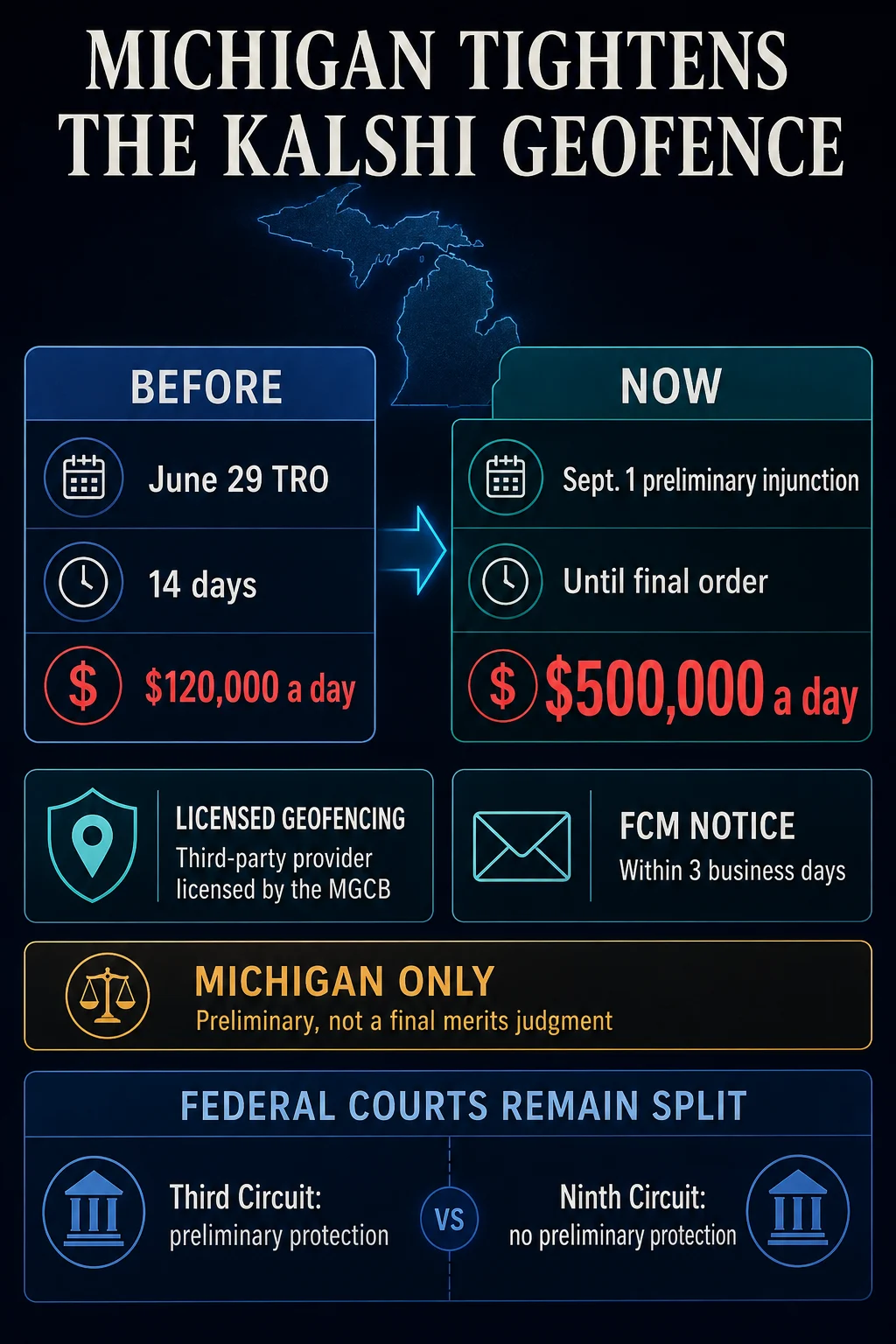
A Michigan judge has issued a preliminary injunction against the prediction market exchange Kalshi, effectively halting its sports event contracts within the state until a final court order is rendered. This ruling escalates the legal battle over whether Kalshi’s offerings constitute federally regulated event contracts or unlicensed internet sports betting, a distinction with significant regulatory and financial implications. The injunction, signed on September 1, 2026, mandates stringent geolocation controls and imposes substantial daily fines for non-compliance, underscoring Michigan’s assertive stance in regulating novel financial and betting products.
The core of the dispute lies in the classification of Kalshi’s products. While Kalshi asserts that its offerings are federally regulated event contracts overseen by the Commodity Futures Trading Commission (CFTC), Michigan authorities, including the Michigan Gaming Control Board (MGCB), contend that these contracts function as internet sports betting, requiring state licensing and adherence to Michigan’s gaming regulations. This fundamental disagreement has propelled the case into a complex legal arena, pitting federal regulatory oversight against state-level consumer protection and revenue generation mandates.
Key Provisions of the Michigan Injunction
The preliminary injunction, building upon an earlier temporary restraining order, imposes a comprehensive set of restrictions on Kalshi and any associated entities operating within Michigan. The order explicitly prohibits Kalshi and its affiliates from offering, facilitating, or enabling access to "covered internet sports-betting contracts" for individuals located in Michigan. This prohibition extends beyond the mere trading of contracts, encompassing related activities such as the acceptance of deposits, advertising, solicitation, and the provision of account access for such products within the state’s borders.
A critical component of the injunction is the mandate for Kalshi to implement robust geolocation verification. The exchange is required to engage a third-party geolocation provider that is licensed by the Michigan Gaming Control Board and capable of meeting the state regulator’s precise geofencing specifications. This measure is designed to ensure that individuals physically present in Michigan cannot access or trade the prohibited sports event contracts. The severity of this requirement is underscored by the substantial financial penalty associated with non-compliance: Kalshi faces daily fines of $500,000 for each day the court finds the company in violation of the geolocation mandate. This represents a significant increase from the $120,000 daily penalty stipulated in the initial temporary restraining order issued in June 2026.
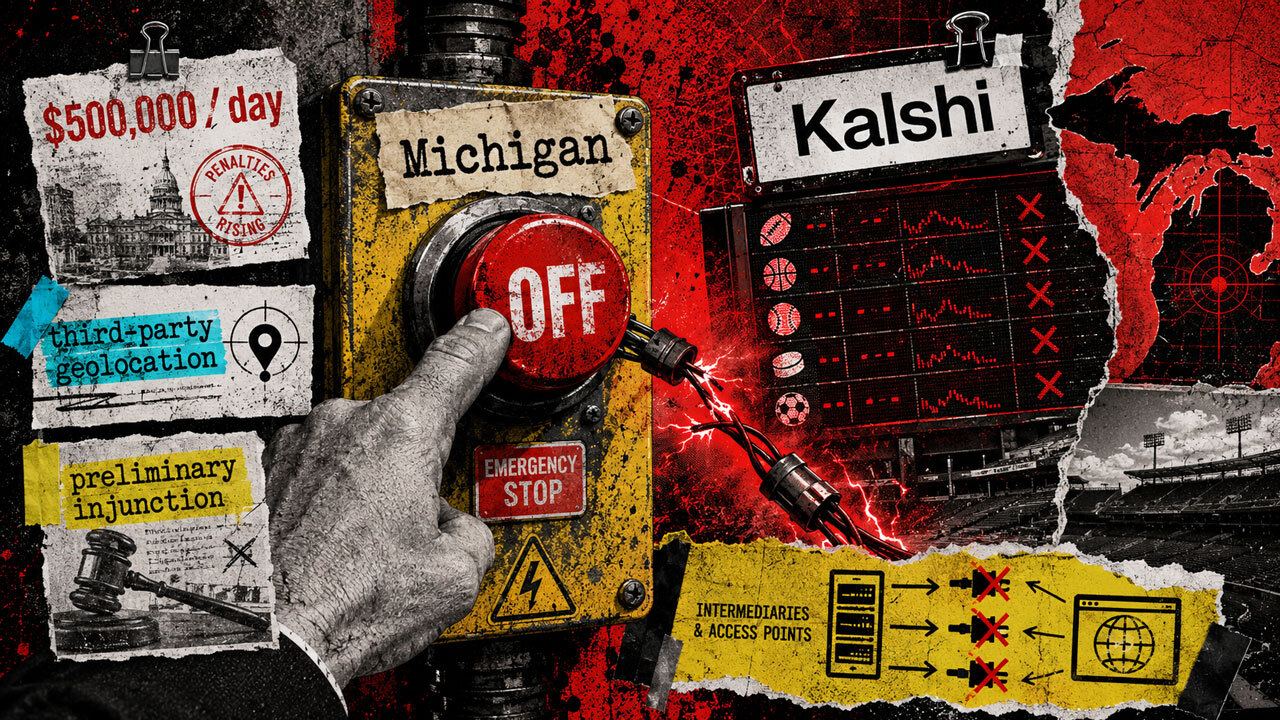
Furthermore, the injunction extends to intermediaries that provide customers with access to Kalshi’s exchange. Within three business days of the order’s entry, Kalshi is obligated to furnish a copy of the injunction and the contact details of Michigan’s legal counsel to every futures commission merchant (FCM) that offers its sports event contracts to customers. While Kalshi is not held liable for an FCM’s subsequent actions or inactions after receiving this notification, this provision aims to ensure that all parties involved in facilitating access to Kalshi’s products are aware of and bound by the Michigan court’s directive.
Timeline of Regulatory Action
The preliminary injunction marks a significant escalation in Michigan’s regulatory scrutiny of Kalshi. The timeline of events leading to this point highlights a progressive enforcement strategy by the state:
- Early 2026: Reports emerge of Kalshi expanding its offerings to include contracts based on the outcomes of sporting events.
- June 2026: The Michigan Gaming Control Board takes swift action, obtaining a temporary restraining order against Kalshi. This initial order aimed to immediately halt the offering of sports event contracts within the state, carrying a daily penalty of $120,000 for non-compliance. The MGCB issued a statement at the time, emphasizing its commitment to protecting Michigan residents from unlicensed gambling activities.
- September 1, 2026: Following legal proceedings and arguments from both sides, a Michigan judge issues a preliminary injunction. This order supersedes the temporary restraining order, imposing more stringent conditions, including enhanced geolocation requirements and a substantially higher daily fine of $500,000. The preliminary injunction is designed to remain in effect until a final court order resolves the case.
- September 2, 2026: News outlets, such as WILX, report on the issuance of the preliminary injunction. As of this reporting, Kalshi had not released an official statement regarding the court’s decision.
The preliminary injunction does not constitute a final judgment in the case. However, the judge’s finding that Michigan and its residents would suffer "immediate and irreparable harm" without such relief indicates the court’s preliminary assessment of the state’s allegations regarding the harms associated with unlicensed sports products. The ultimate resolution of these allegations will determine the long-term outcome of the case.
The National Regulatory Landscape and Appellate Split
Michigan’s injunction, while impactful within its borders, does not resolve the broader national debate surrounding the regulatory authority over prediction markets. Kalshi’s primary defense hinges on the argument that its operations fall under the exclusive jurisdiction of the Commodity Exchange Act, meaning federal law preempts state-level regulation.

This federal preemption argument has met with differing interpretations from federal appellate courts, creating a complex and fragmented legal landscape for prediction market operators:
- Third Circuit (April 2026): In a significant development for Kalshi, the Third Circuit Court of Appeals found that the exchange had a reasonable likelihood of demonstrating that federal law preempts New Jersey’s attempt to regulate its sports event contracts. This ruling preserved preliminary protections for Kalshi in that jurisdiction.
- Ninth Circuit (August 28, 2026): In contrast, the Ninth Circuit Court of Appeals reached an opposing conclusion regarding Nevada’s regulatory actions. The court held that Kalshi had not sufficiently demonstrated federal preemption for its sports event contracts in the context of Nevada’s laws.
These divergent rulings from different federal circuits highlight the ongoing legal uncertainty. The CFTC, for its part, has consistently asserted its exclusive jurisdiction over prediction markets offered on designated contract markets. The Michigan injunction, therefore, adds another layer of state-specific restriction without definitively settling the national conflict. This appellate split leaves operators, regulators, and intermediaries navigating a patchwork of rules that vary significantly across different jurisdictions.
Broader Implications and Analysis
The Michigan preliminary injunction against Kalshi carries several significant implications for the burgeoning prediction market industry and the broader regulatory environment:
- Increased Regulatory Scrutiny: The aggressive action by Michigan signals a growing willingness among state regulators to challenge the classification of prediction market products, particularly those closely resembling sports betting. This could embolden other states to pursue similar enforcement actions.
- The Importance of Geolocation Technology: The emphasis on sophisticated geolocation controls underscores the critical role of technology in enforcing regulatory boundaries. The substantial penalties associated with non-compliance highlight the high stakes involved in accurately identifying and restricting access for users in prohibited jurisdictions.
- Federal vs. State Authority: The ongoing legal battles, epitomized by the split in appellate court rulings, underscore the unresolved tension between federal and state regulatory authority. The outcome of these cases will have a profound impact on the future development and accessibility of prediction markets in the United States.
- Impact on Intermediaries: The requirement for Kalshi to notify FCMs about the injunction places a direct burden on these intermediaries. It necessitates robust compliance frameworks to ensure they are not facilitating access to prohibited products, potentially leading to increased due diligence and operational adjustments.
- Market Fragmentation: The current legal environment, characterized by state-specific restrictions and conflicting federal court interpretations, is likely to lead to further market fragmentation. This could hinder the growth of a cohesive and unified prediction market industry.
- Investor and User Uncertainty: The ongoing legal challenges create uncertainty for both investors who use these platforms and the platforms themselves. This uncertainty can stifle innovation and investment in the sector.
The dispute between Kalshi and Michigan is not merely a localized regulatory issue; it represents a crucial inflection point in the evolving landscape of financial innovation and its intersection with established regulatory frameworks. As the legal proceedings continue, the outcomes will undoubtedly shape how prediction markets are regulated, defined, and accessed across the United States, potentially setting precedents for other novel financial products that emerge in the digital age. The substantial daily fines serve as a stark warning to other platforms operating in this gray area, emphasizing the financial risks associated with navigating an unclear regulatory environment.