Dwi Wanna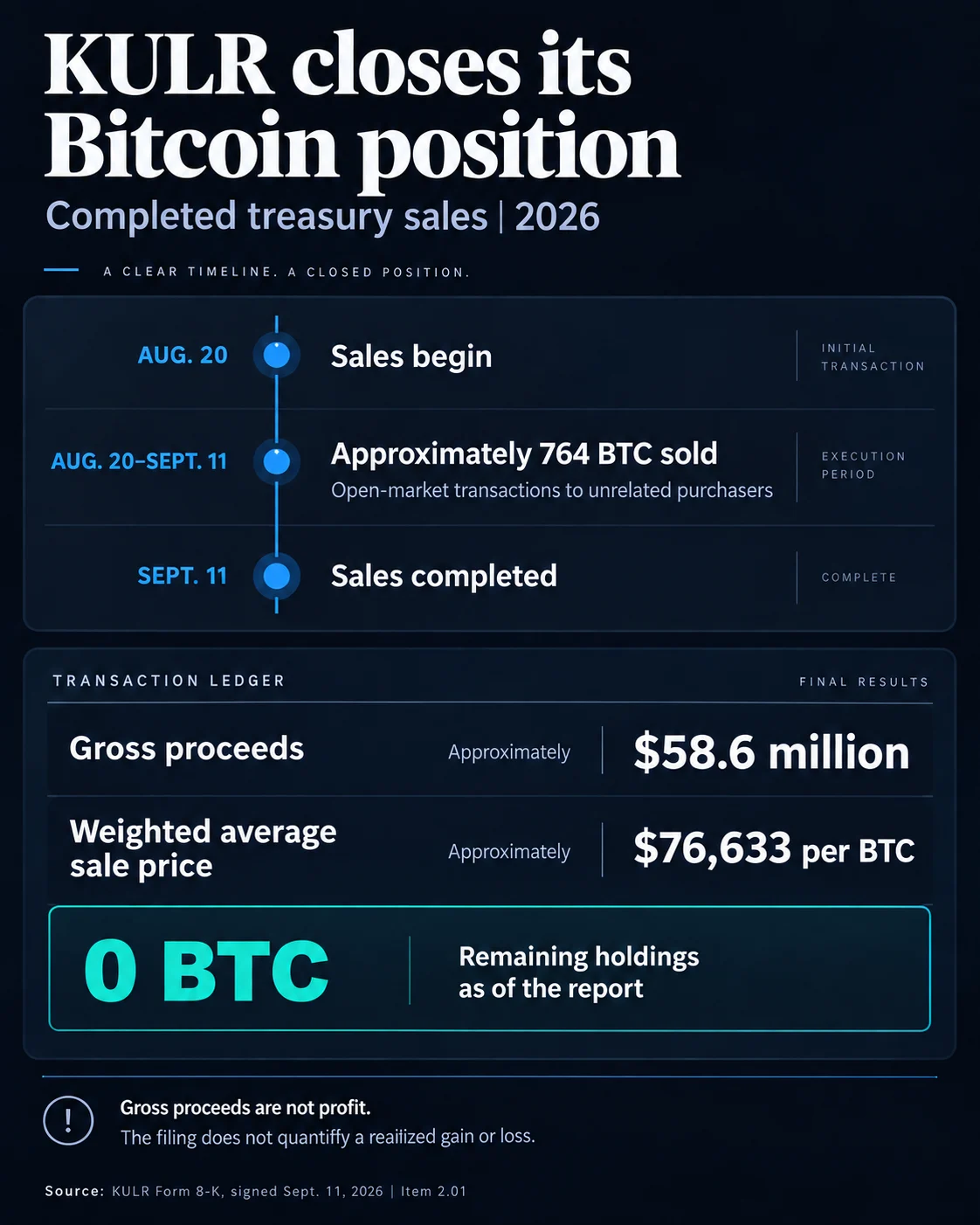
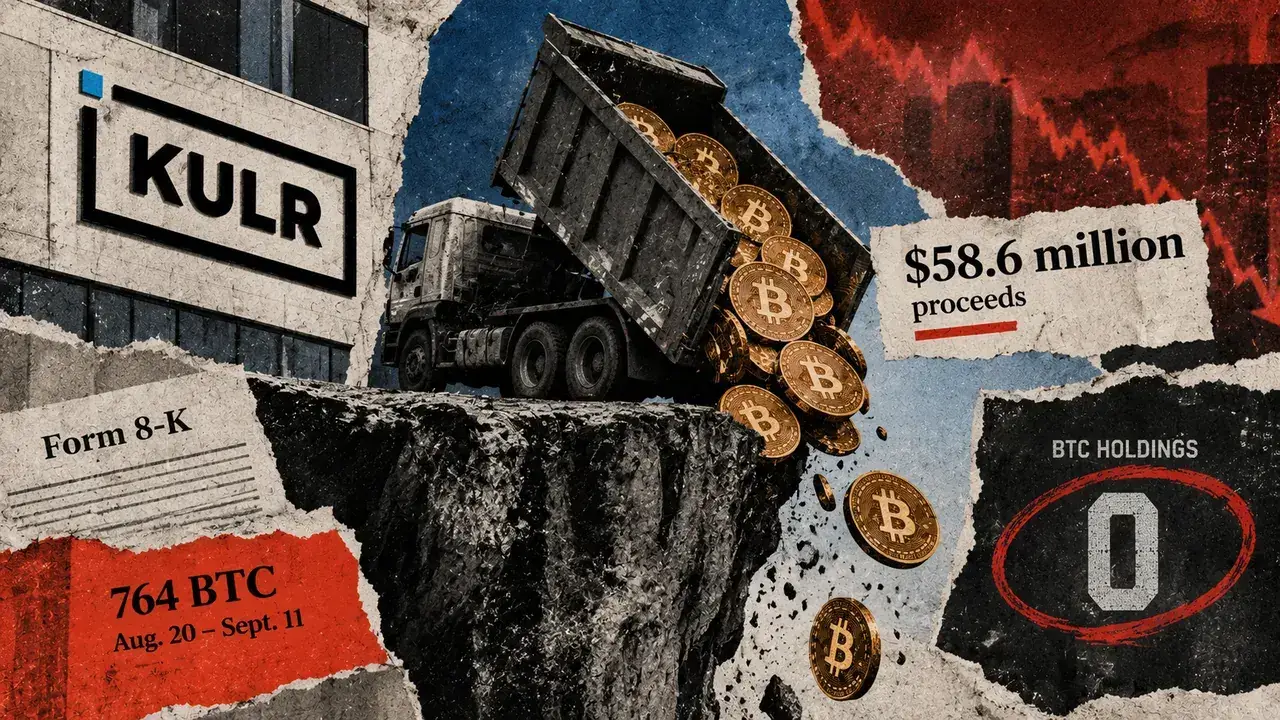
KULR Technology Group, a prominent player in the battery safety and thermal management sector, has officially concluded its high-stakes venture into cryptocurrency treasury management. According to a recent regulatory filing with the Securities and Exchange Commission (SEC), the company liquidated its remaining holdings of 764 Bitcoin (BTC) between August 20 and September 11, 2026. The series of open-market transactions generated approximately $58.6 million in gross proceeds, marking the final chapter of a strategic pivot that saw the firm move from a "Bitcoin-first" balance sheet approach back to a singular focus on its core energy technology operations.
The divestment was executed at a weighted average price of approximately $76,633 per Bitcoin. This valuation reflects a period of significant market activity, though the company’s filing did not specify the original cost basis for these particular coins. By reducing its Bitcoin holdings to zero, KULR has effectively decoupled its corporate valuation from the inherent volatility of the digital asset market, a move that follows a broader trend of non-crypto-native public companies reassessing the risks of holding substantial digital reserves.
The Mechanics of the Final Liquidation
The final exit was not an impulsive reaction to market swings but rather the culmination of a multi-month unwinding process. The SEC Form 8-K indicates that the 764 BTC were sold to unrelated third parties through various open-market channels. This method of disposal suggests a desire to achieve liquidity without the potential complications of large-scale over-the-counter (OTC) negotiations, which can sometimes result in price slippage or extended settlement periods.
Financially, the $58.6 million infusion provides KULR with a significant liquidity buffer. While the company has not yet detailed the specific allocation of these funds, analysts suggest the capital will likely be channeled into three primary areas: research and development for its next-generation battery safety platforms, potential strategic acquisitions within the energy storage sector, and the further strengthening of its balance sheet to support long-term government and aerospace contracts.
A Timeline of Strategic Reversal
KULR’s departure from the Bitcoin ecosystem was a phased retreat that began in earnest during the summer of 2026. To understand the significance of the final sale, one must look at the preceding months of financial restructuring.
In August 2026, KULR first signaled its intent to move away from cryptocurrency when it disclosed the sale of approximately 333 Bitcoin. Those transactions, occurring after the close of the second quarter on June 30, brought in roughly $21.5 million. A critical component of that initial sale was the immediate allocation of $20 million toward repaying the principal owed to Coinbase. This debt had been a cornerstone of KULR’s leveraged approach to Bitcoin accumulation, but as market conditions shifted, the cost of maintaining such a position began to outweigh the potential upside.
By the end of August, the company had already begun dismantling its ancillary crypto operations. This included the shuttering of its proprietary Bitcoin mining infrastructure. For a period, KULR had attempted to vertically integrate its energy expertise by operating mining rigs, theoretically using its thermal management technology to optimize mining efficiency. However, the operational overhead and the distraction from its primary mission of battery innovation eventually led management to categorize mining as a non-core asset.
Shift in Corporate Philosophy: Core Energy Over Digital Gold
The decision to abandon the Bitcoin treasury strategy reflects a deeper shift in corporate philosophy at KULR. In the early 2020s, several public companies followed the lead of MicroStrategy, adopting Bitcoin as a primary treasury reserve asset to hedge against fiat inflation and capture asymmetric upside. For KULR, this strategy initially appeared to offer a way to amplify balance sheet gains.
However, the reality of being a "dual-track" company—part battery innovator, part crypto investment vehicle—presented unique challenges. The volatility of Bitcoin often overshadowed the company’s operational successes in the energy sector. When Bitcoin prices surged, KULR’s stock often enjoyed a "crypto premium," but when the market corrected, the company’s equity was frequently punished, regardless of its progress in securing NASA contracts or expanding its lithium-ion recycling footprint.
Management’s decision to prioritize the "energy platform" suggests a move to regain favor with traditional institutional investors who prefer "pure-play" industrial and technology stocks. By removing the Bitcoin "noise" from its quarterly earnings reports, KULR can now be judged solely on its margins, revenue growth, and technological milestones in the thermal management space.
Financial Implications and Market Context
The weighted average sale price of $76,633 per BTC is a notable figure. It suggests that KULR exited its position during a period of relative strength in the cryptocurrency market. While many companies that exited Bitcoin in previous years did so under duress during "crypto winters," KULR appears to have liquidated its holdings in a structured manner that captured significant value.
Despite the successful liquidation, the broader impact on KULR’s financial health remains a point of analysis for shareholders. The company has moved from an asset class with high growth potential (and high risk) to a cash-heavy position. In an inflationary environment, holding $58.6 million in cash carries its own set of risks, primarily the erosion of purchasing power. Investors are now looking for "return on invested capital" (ROIC) metrics that justify the move away from Bitcoin.
Furthermore, the repayment of the Coinbase debt is a vital move for the company’s credit profile. By eliminating high-interest or margin-linked debt, KULR reduces its financial leverage, making it a more attractive candidate for traditional corporate lending and reducing the risk of a "margin call" scenario that could have threatened the company’s solvency during a crypto flash crash.

Broader Industry Trends: The "De-Bitcoining" of the Balance Sheet
KULR is not alone in its decision to step back from the digital asset frontier. While firms like MicroStrategy and Metaplanet continue to double down on Bitcoin, a growing number of mid-cap technology companies are finding that the complexity of crypto accounting and the resulting stock price volatility are not worth the potential gains.
The "Bitcoin treasury" experiment of the mid-2020s has led to a divergence in corporate strategies. On one side are the "Bitcoin Standard" companies that have essentially become proxies for the asset. On the other are firms like KULR, which have concluded that their expertise lies in physical engineering and industrial solutions rather than digital asset speculation. This trend highlights a maturing market where companies are no longer holding Bitcoin simply because it is a "trending" treasury move, but are instead making cold, calculated decisions based on their specific operational needs and investor expectations.
Reaction and Future Outlook
While KULR Technology Group has not issued an official press release specifically "celebrating" the exit, the language in the SEC filing is clinical and definitive. The company has pointedly moved to "redirect capital toward its core energy business," a phrase that serves as a signal to the market that the era of experimentation is over.
Industry analysts have reacted with a mix of caution and approval. Some argue that KULR may have "left money on the table" if Bitcoin continues its upward trajectory toward the six-figure mark. Others, however, believe the move was necessary to stabilize the company’s valuation. "For a company in the mission-critical battery space, credibility and stability are paramount," noted one industrial sector analyst. "Removing the volatility of a 700-plus BTC position allows the market to value KULR on its technological merits, which are substantial."
Looking forward, KULR’s management has not established a permanent ban on digital assets. The regulatory filing records the disposal of the holdings but leaves the door ajar for future treasury management adjustments. However, given the complete shutdown of their mining operations and the full repayment of crypto-related debt, a return to the Bitcoin market seems unlikely in the near to mid-term.
The immediate focus for KULR will be the deployment of the $58.6 million. With the global transition to electric vehicles (EVs) and the increasing demand for high-capacity energy storage systems (ESS), the capital is expected to fund the scaling of production for KULR’s proprietary thermal runaway shield (TRS) and other safety technologies.
Conclusion
The total liquidation of KULR’s Bitcoin reserves represents a significant moment in the intersection of traditional industry and decentralized finance. By selling its final 764 BTC, KULR has chosen a path of operational purity, betting that its future lies in the tangible world of battery safety rather than the digital realm of cryptocurrency. As the company moves forward with a fortified balance sheet and a renewed focus, it serves as a case study for other public entities navigating the volatile waters of modern treasury management. The $58.6 million raised from the sale provides the fuel, but the success of the strategy will ultimately depend on KULR’s ability to convert that cash into innovation and market share within the competitive energy landscape.