Dwi Wanna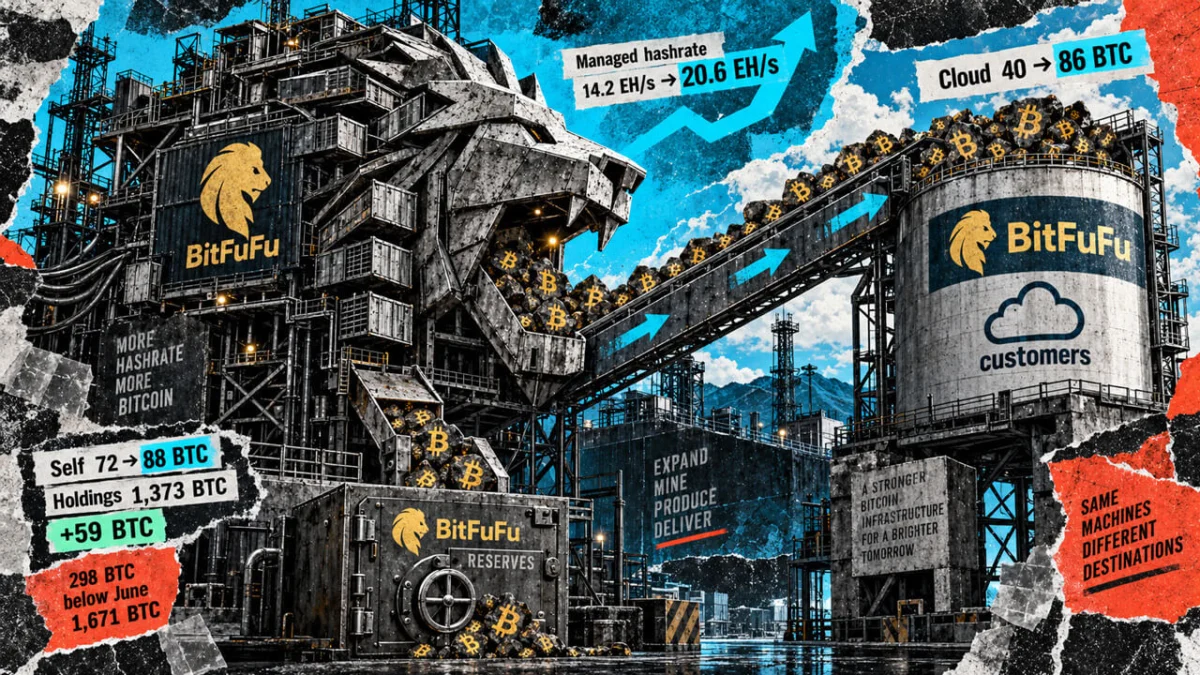
BitFuFu, a prominent digital asset mining service provider and cloud-mining specialized firm, has reported a significant recovery in its operational performance for August 2026. Following a period of strategic capital reallocation that saw a temporary dip in production and treasury holdings, the company successfully brought substantial new mining capacity online. The unaudited operating update, released on September 3, 2026, revealed a 55.4% month-over-month increase in total Bitcoin production, reaching 174 BTC compared to the 112 BTC generated in July. This surge is primarily attributed to the activation of previously secured hashrate, which has bolstered both the company’s self-mining operations and its third-party cloud-mining services.
The production split for August highlights the dual-engine nature of BitFuFu’s business model. Of the 174 BTC produced, 88 BTC were generated through the company’s self-mining division, while 86 BTC were produced for cloud-mining customers. While both segments saw growth, the cloud-mining sector experienced the most dramatic expansion, more than doubling its output from 40 BTC in July to 86 BTC in August. This 46 BTC increase in the cloud segment accounted for approximately 74% of the total monthly production growth, signaling a robust demand for BitFuFu’s retail and institutional cloud-mining products.
Strategic Treasury Management and Reserve Recovery
The financial narrative surrounding BitFuFu in mid-2026 has been defined by its decision to utilize its Bitcoin treasury as a tool for expansion. Unlike many North American miners that strictly adhere to a "HODL" strategy—retaining all mined Bitcoin regardless of market conditions—BitFuFu has demonstrated a willingness to liquidate or pledge its digital assets to fund infrastructure growth. This strategy was most evident in July 2026, when the company’s Bitcoin reserves dropped by 357 BTC.
According to regulatory filings and previous disclosures, this decline was not a result of operational failure but rather a strategic "burn" to secure future compute power. The company utilized these funds as advance payments for hashrate capacity contracts scheduled to run for 330 days. By the end of August, the fruits of this investment began to manifest. The company’s Bitcoin holdings saw a modest recovery, increasing by 59 BTC to reach a month-end total of 1,373 BTC. This figure includes 44 BTC that remain pledged as collateral for loans and miner procurement payables.
Despite this monthly increase, BitFuFu’s treasury remains 298 BTC below the peak levels of 1,671 BTC recorded in June 2026. For investors and analysts, the primary focus is now on the "payback period" of the Bitcoin spent on capacity. The 59 BTC net increase in holdings is a distinct metric from the 88 BTC produced via self-mining, reflecting the net balance change after accounting for operational costs, debt servicing, and other capital outflows.
Chronology of Operational Scaling: June to August 2026
The operational trajectory of BitFuFu over the summer of 2026 provides a clear look at the volatility and rapid scaling cycles inherent in the Bitcoin mining industry.
- June 2026: BitFuFu maintains a robust treasury of 1,671 BTC. Management identifies opportunities to secure additional hashrate through strategic contracts, opting to use liquid assets to fund the expansion rather than diluting shareholders through equity offerings or taking on high-interest traditional debt.
- July 2026: The company executes its capacity expansion plan. Total production dips to 112 BTC as older machines are potentially cycled out or as the network difficulty adjustments impact yield. Treasury holdings drop significantly as Bitcoin is committed to hashrate procurement. Managed hashrate sits at 14.2 EH/s.
- August 2026: The newly secured capacity begins to come online. By mid-month, CEO Leo Lu confirms that managed hashrate has returned to the 20 EH/s threshold. By August 31, the company reports a total managed hashrate of 20.6 EH/s, representing a 45% increase in computing power in just 30 days. Production rebounds to 174 BTC.
This timeline illustrates a deliberate "step-up" function in BitFuFu’s growth. The transition from 14.2 EH/s to 20.6 EH/s marks one of the most aggressive monthly capacity expansions in the company’s history, positioning it as a major player in the global hashrate market.
The Role of Managed Hashrate and Cloud-Mining Dynamics
In the context of BitFuFu’s reporting, "Managed Hashrate" serves as the primary KPI for total computational scale. This figure encompasses both the hardware owned and operated by BitFuFu for its own account (self-mining) and the hardware dedicated to fulfilling cloud-mining contracts for its global customer base.
The distinction between these two categories is critical for understanding the company’s revenue recognition. Bitcoin produced through cloud-mining (86 BTC in August) does not enter BitFuFu’s treasury; it is delivered directly to the customers who purchased the hashrate. BitFuFu’s economic benefit from this segment is derived from the initial sale of the cloud-mining contract and ongoing service or maintenance fees. Therefore, while the cloud-mining segment drives top-line revenue and demonstrates the platform’s scale, it does not contribute to the "digital gold" reserves that many crypto-adjacent investors value.
Conversely, self-mining production (88 BTC in August) is the engine that replenishes the corporate treasury. The fact that self-mining output only rose by 16 BTC (from 72 to 88) while cloud production jumped by 46 BTC suggests that the bulk of the newly activated 6.4 EH/s of capacity was allocated to the cloud-mining business. This indicates a strategic prioritization of the "Mining-as-a-Service" (MaaS) model, which provides more immediate cash flow and reduces the company’s direct exposure to Bitcoin price volatility compared to a pure self-mining play.

Industry Context: The 2026 Mining Landscape
The operational updates from BitFuFu arrive at a time when the Bitcoin mining industry is grappling with increased network difficulty and the lingering effects of the 2024 halving, while looking ahead to the next halving event in 2028. By August 2026, the global hashrate has reached record highs, forcing miners to find ways to increase efficiency and lower their levelized cost of energy (LCOE).
BitFuFu’s decision to spend Bitcoin to buy compute power reflects a broader industry trend toward "asset-light" or "flexible-capital" mining. By utilizing 330-day hashrate contracts, BitFuFu can scale its operations without the multi-year lead times and massive capital expenditures required to build proprietary data centers. This allows the company to remain agile, expanding capacity when market conditions are favorable and avoiding the "stranded asset" risk associated with owning aging hardware in a rapidly evolving technological landscape.
Furthermore, the Bitcoin market itself showed signs of consolidation in late August. At the time of the report, Bitcoin maintained a market capitalization of approximately $1.52 trillion, with a circulating supply of 20.08 million coins. Despite a 24-hour dip of 3.31%, the asset remained up over 20% on a 30-day basis. This price appreciation provides a favorable tailwind for BitFuFu, as the dollar value of its 1,373 BTC treasury increases, providing more "dry powder" for future capacity acquisitions or operational expenses.
Official Responses and Management Outlook
While BitFuFu’s management has not issued a new long-form commentary with the September 3 update, the recent statements from CEO Leo Lu provide a window into the company’s current philosophy. In the mid-August earnings release, Lu emphasized the importance of returning to the 20 EH/s milestone, viewing it as a foundational level for the company’s next phase of growth.
The management’s strategy appears focused on three pillars:
- Capacity Maximization: Rapidly deploying hashrate to stay ahead of network difficulty increases.
- Product Diversification: Balancing the treasury-building potential of self-mining with the steady, fee-based revenue of cloud mining.
- Capital Efficiency: Using the Bitcoin treasury as a strategic tool rather than a static reserve, essentially treating BTC as a form of "programmable capital" to be deployed for hardware and energy contracts.
Market analysts suggest that the "inferred" reaction from the board is one of cautious optimism. The successful deployment of the July-funded capacity validates the decision to spend treasury BTC. However, the pressure remains to prove that the 357 BTC "investment" will yield a higher total return than if the company had simply held the assets.
Broader Impact and Implications for Shareholders
For shareholders of BitFuFu, the August production report is a mixed but generally positive signal. The massive jump in managed hashrate proves that the company can execute on its scaling promises. The recovery of the treasury, albeit partial, alleviates concerns about a "death spiral" of selling assets to cover costs.
However, the report also highlights the inherent complexity of BitFuFu’s business model. Because such a large portion of the production increase belongs to cloud customers, the "per-share Bitcoin production" for BitFuFu’s own treasury is growing at a slower rate than the headline capacity figures might suggest.
The broader implication for the mining sector is that the era of "pure-play" mining—where companies simply plug in machines and hold the coins—is being replaced by more sophisticated financial and operational structures. BitFuFu is at the forefront of this shift, acting as much as a financial intermediary and service provider as a traditional miner.
As the company moves into the final quarter of 2026, the key metrics to watch will be the sustained uptime of the new 20.6 EH/s capacity and the potential for further treasury replenishment. If Bitcoin prices remain stable or continue their 30-day upward trend, BitFuFu may find itself in a position to leverage its increased scale into significant earnings growth, finally providing the "contract economics" and "payback figures" that shareholders are eagerly awaiting. For now, the August rebound serves as a critical proof-of-concept for BitFuFu’s aggressive, asset-utilization growth strategy.