Dwi Wanna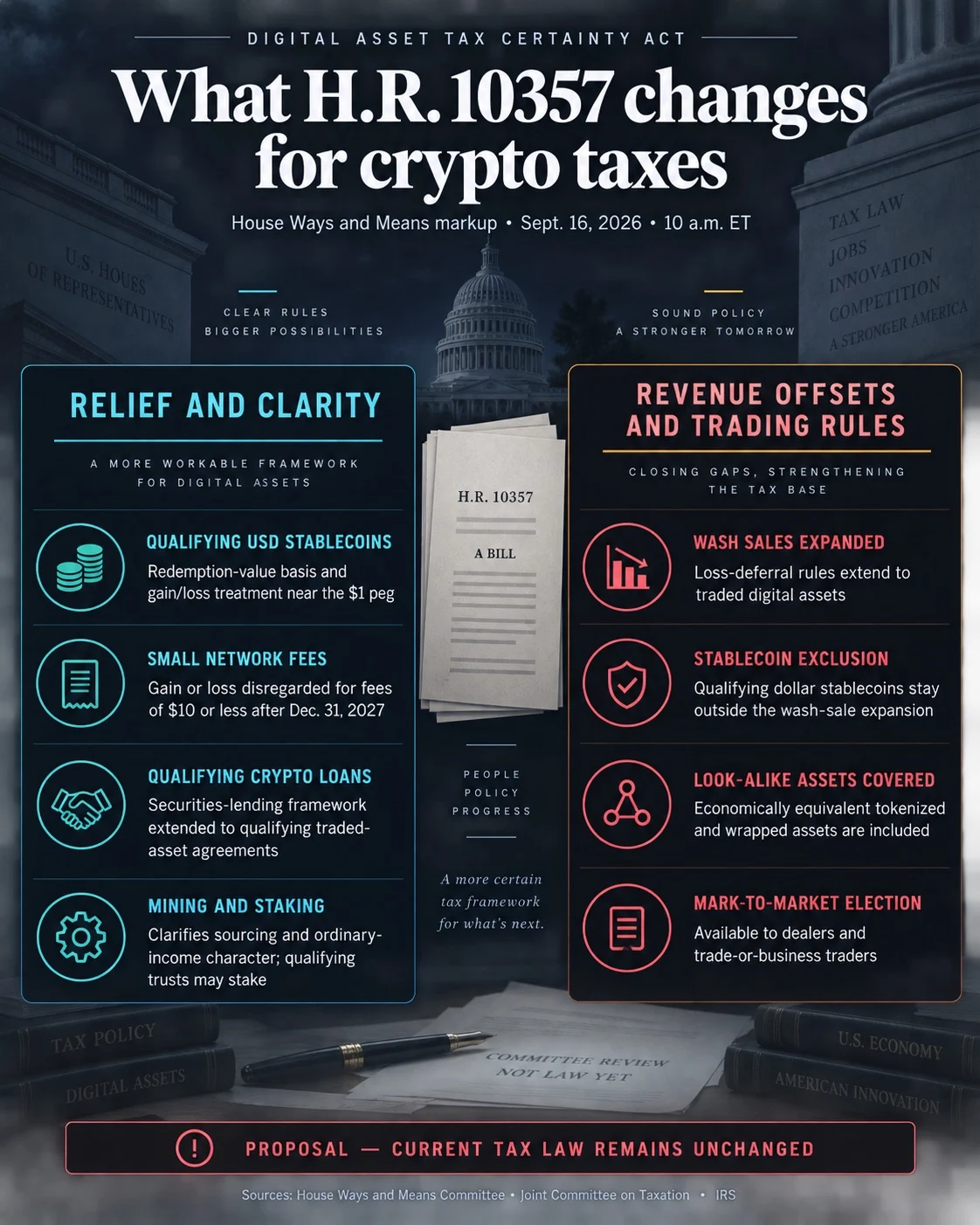
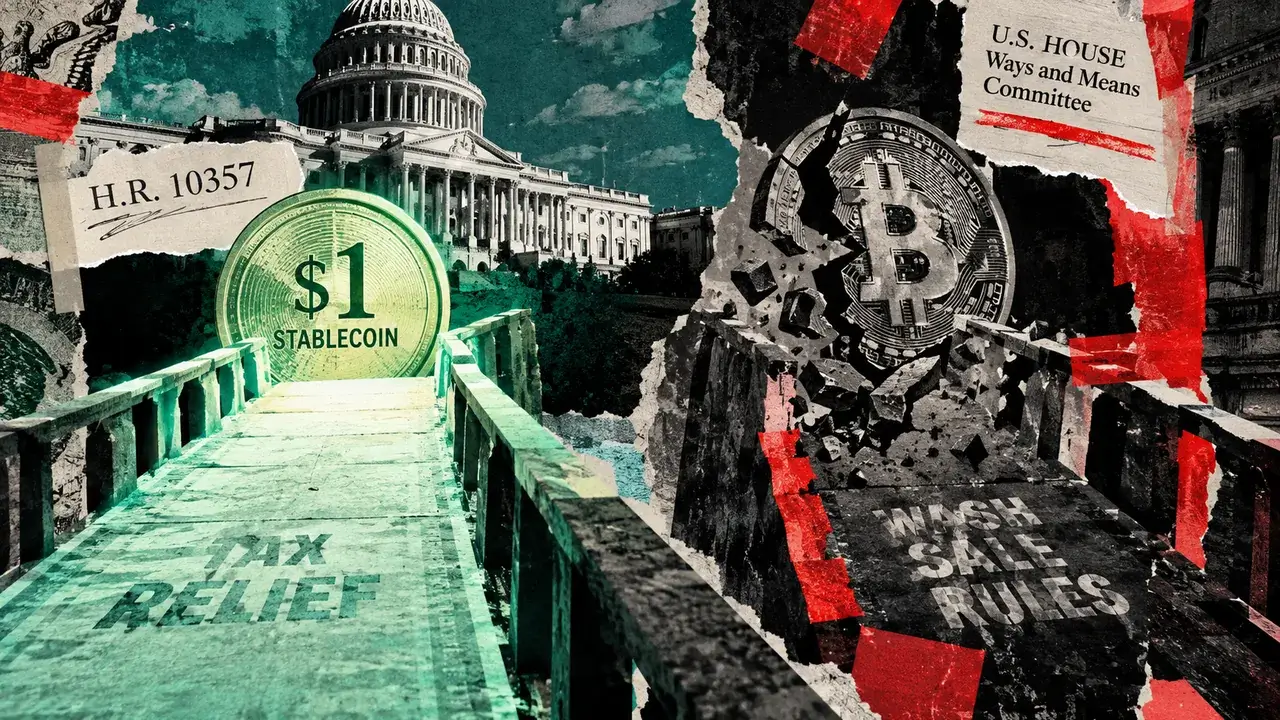
The House Ways and Means Committee is set to deliberate on H.R. 10357, formally known as the Digital Asset Tax Certainty Act, on September 16, marking a pivotal moment in the federal government’s decade-long effort to integrate decentralized finance into the traditional tax code. This legislative package represents the culmination of months of intense negotiations between lawmakers, industry stakeholders, and the Treasury Department, aiming to resolve long-standing ambiguities that have plagued both retail investors and institutional participants. The bill proposes a significant restructuring of how digital assets are treated for tax purposes, balancing the removal of operational "friction" for everyday users against the implementation of strict, securities-style regulations for professional traders. According to the Joint Committee on Taxation (JCT), the net effect of these changes is projected to increase federal receipts by approximately $500 million between the fiscal years 2027 and 2036, signaling a shift toward a more robust and enforceable crypto-tax regime.
The Evolution of Digital Asset Taxation in the United States
To understand the weight of H.R. 10357, one must look back at the historical lack of clarity provided by federal authorities. Since the Internal Revenue Service (IRS) issued Notice 2014-21, digital assets have been classified as "property" rather than currency. This classification meant that every single transaction—whether buying a cup of coffee with Bitcoin or swapping one token for another—triggered a taxable event requiring the calculation of capital gains or losses. As the market grew from a niche interest to a multi-trillion-dollar asset class, the administrative burden on taxpayers became unsustainable.
The introduction of the Infrastructure Investment and Jobs Act in 2021 began the process of tightening reporting requirements, particularly for "brokers." However, that legislation left many questions unanswered regarding the technical nuances of decentralized finance (DeFi), staking, and the unique mechanics of stablecoins. H.R. 10357 seeks to fill these gaps by treating certain crypto activities more like traditional financial instruments while acknowledging that the technology requires specific carve-outs to remain functional for the average consumer.
Relief for Stablecoins and Small Transaction Fees
One of the most anticipated components of the Digital Asset Tax Certainty Act is the specialized treatment of qualifying U.S. dollar-pegged stablecoins. Under current law, if a user buys a stablecoin at $1.0001 and spends it when the price is $0.9999, they technically must report a micro-loss. Multiply this by thousands of transactions, and the tax compliance becomes an impossible hurdle for the use of stablecoins as a medium of exchange.
The proposed legislation would establish "prescribed bands" around the $1.00 peg. For transactions occurring within these narrow price fluctuations, the redemption value would generally determine the basis and proceeds, effectively neutralizing the tax consequences of minor peg deviations. This relief, however, is targeted at genuine users rather than professional arbitrageurs. The bill explicitly excludes brokers, dealers, and high-frequency users who complete more than 5,000 counted transactions annually.
Furthermore, the bill addresses the "gas fee" problem. Blockchain networks require users to pay transaction fees in native tokens (such as Ether or Solana). Currently, paying a $2 gas fee is technically a "disposition" of property that could trigger a capital gains tax. H.R. 10357 would disregard gains or losses on digital assets used to pay network or transaction fees of $10 or less. While this sounds like a minor administrative tweak, the JCT estimates this provision alone will reduce federal revenue by $2.365 billion through 2036, highlighting just how pervasive these micro-transactions have become in the digital economy. It is important to note that this $10 exemption applies specifically to fees, not to the underlying purchase of goods or services, which remains subject to standard property tax treatment.
Closing the Wash Sale Loophole and Expanding Mark-to-Market
To offset the revenue lost from small-fee relief, lawmakers are targeting "tax loss harvesting" strategies that have long been a staple of the crypto market. In the world of stocks and securities, the "wash sale" rule (Section 1091 of the Internal Revenue Code) prevents investors from selling an asset at a loss and buying it back within 30 days to claim a tax deduction. Because the IRS currently classifies crypto as property rather than a security, the wash sale rule has generally not applied to Bitcoin or other digital assets.
H.R. 10357 would end this era of "securitized property" status by extending wash sale restrictions to all traded digital assets, excluding qualifying stablecoins. This expansion includes not just the assets themselves but also "economically equivalent" versions, such as wrapped or tokenized tokens. This change is expected to generate $1.707 billion in federal revenue over the next decade.
In addition to wash sale changes, the bill expands access to mark-to-market accounting for digital asset dealers and traders. This allows professional entities to treat their holdings as if they were sold at the end of the year at fair market value, aligning crypto accounting with the standards used by Wall Street firms. This transition to mark-to-market is projected to bring in an additional $2.332 billion, serving as a primary funding mechanism for the broader legislative package.
Formalizing Staking and Lending Frameworks
As the cryptocurrency ecosystem has matured, lending and staking have become central to the liquidity and security of blockchain networks. However, the tax implications of these activities have remained a "grey area." Institutional investors have been particularly hesitant to engage in crypto lending due to fears that transferring assets to a borrower could be viewed as a taxable sale.
The Digital Asset Tax Certainty Act proposes extending the tax-free treatment currently available for securities lending to qualifying digital asset loans. If the arrangement meets specific criteria—such as the guaranteed return of equivalent assets—the transaction would not trigger an immediate recognition of gains or losses. This provides a clear "safe harbor" for institutional desks and liquidity providers.
The bill also addresses the burgeoning market for crypto-based investment trusts (such as Spot Ethereum ETFs). Currently, there is legal ambiguity regarding whether a trust loses its tax-transparent status if it stakes the assets it holds to earn rewards. H.R. 10357 clarifies that staking by a trustee will not disqualify an otherwise eligible investment vehicle.
For individual miners and stakers, the bill takes a more conservative approach. It codifies that validation income is to be treated as ordinary income. Notably, the legislation does not include industry-backed proposals to defer taxes on staking rewards until the assets are sold. Instead, it maintains the current framework where income is recognized at the moment the taxpayer gains "dominion and control" over the rewards.
Compliance and the Voluntary Disclosure Program
Recognizing that many early adopters may have inadvertently failed to comply with the confusing maze of previous IRS guidance, the bill directs the Treasury to establish a Digital Asset Voluntary Disclosure Program. This program is designed as an "olive branch" to taxpayers, allowing them to correct past filings and pay back taxes and interest in exchange for relief from certain civil penalties.
This move is seen by analysts as a pragmatic attempt to bring "off-chain" wealth into the formal economy. By providing a clear pathway to compliance, the government hopes to increase long-term tax participation without the need for aggressive and costly litigation against thousands of individual hobbyists.
Industry Reaction and Economic Implications
The crypto industry has responded to the bill with a mixture of relief and caution. Andrew Gordon, a prominent crypto tax lawyer, noted that the legislation represents a "massive step forward" for investors who have been pleading for clarity. "We all pay taxes; the rules need to be clear," Gordon stated, echoing a sentiment prevalent among tax professionals who have struggled to advise clients in a vacuum of formal regulation.
From an economic perspective, the bill is an attempt to professionalize the digital asset market. By applying wash sale rules and mark-to-market accounting, the government is effectively treating crypto as a mature financial sector. This "normalization" is expected to encourage further institutional entry, as large-scale funds often prioritize regulatory certainty over tax optimization.
However, some critics argue that the $10 fee exemption is too narrow and that the failure to defer staking taxes until the point of sale could put U.S.-based miners and validators at a competitive disadvantage compared to jurisdictions with more favorable "point-of-sale" tax regimes.
The Legislative Path Forward
The September 16 markup in the House Ways and Means Committee is only the first hurdle. If the committee approves the measure, it must still pass a full House vote, navigate the Senate—where crypto legislation has historically faced stiffer opposition—and receive the President’s signature.
The fiscal neutrality of the bill is its strongest selling point. By balancing the $2.3 billion cost of fee relief against $4 billion in revenue from trading restrictions, the bill presents itself as a responsible "revenue-positive" package. However, any amendments made during the markup process that alter the wash sale or stablecoin provisions could shift the JCT’s $500 million net gain projection, potentially jeopardizing the bill’s bipartisan appeal.
As the 2027 implementation date looms, the Digital Asset Tax Certainty Act stands as the most comprehensive attempt yet to reconcile the innovative, high-velocity nature of blockchain technology with the rigid requirements of the Internal Revenue Code. For the millions of Americans holding digital assets, the outcome of this legislative push will determine whether the next decade of crypto activity is defined by continued confusion or by the "certainty" promised in the bill’s title.