Dwi Wanna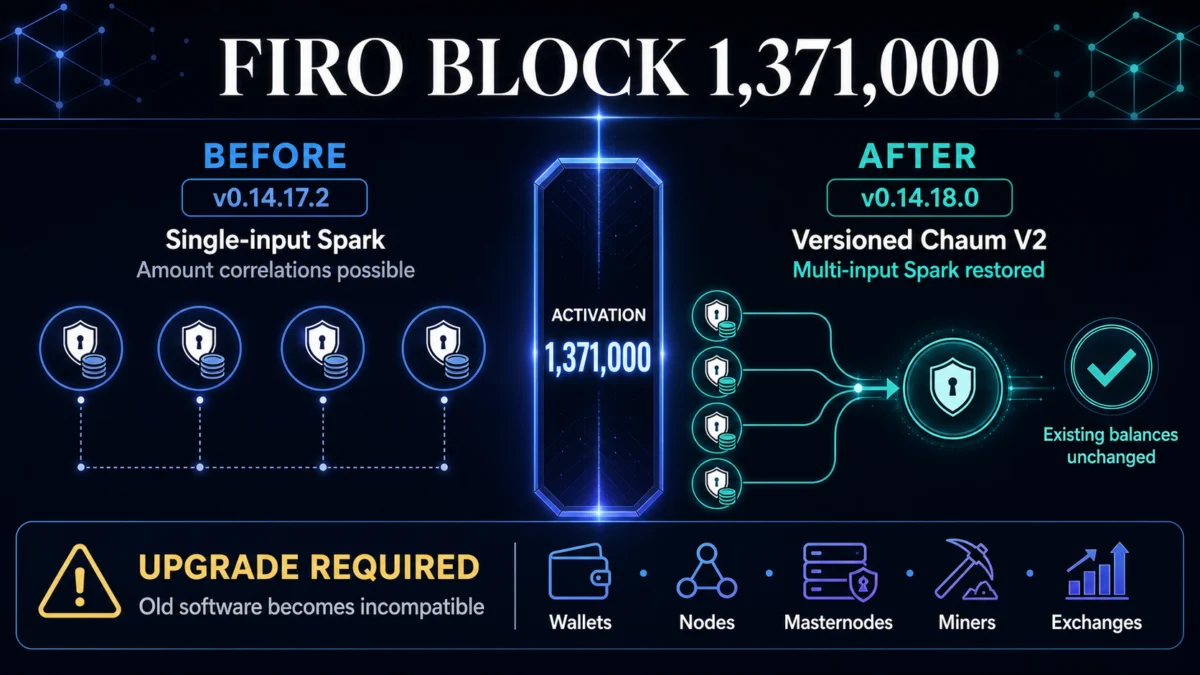
The urgency of this update stems from a disclosure made in mid-August regarding a fundamental flaw in how the Spark transaction system handled multi-input spends. According to technical documentation released by the Firo development team, the vulnerability could have allowed a sophisticated actor to forge coins out of thin air, effectively bypassing the network’s total supply limits. While the project confirmed that no user funds were ever at risk of theft and that private keys remained secure, the integrity of the FIRO monetary policy was under direct threat. The hard fork at block 1,371,000 serves as the final stage of a multi-phased remediation strategy intended to restore full privacy functionality while hardening the protocol against future exploitation.
Technical Origins of the Spark Vulnerability
Firo’s Spark protocol was originally introduced to provide a robust framework for private transactions, utilizing stealth addresses and zero-knowledge proofs to hide the sender, receiver, and transaction amount. Unlike its predecessor, Lelantus, Spark was designed to be more flexible and efficient. However, the complexity of managing privacy while ensuring that no new tokens are created during a transaction is one of the most significant challenges in blockchain cryptography.
The specific flaw discovered by a third-party researcher involved the logic governing multi-input spends. In a typical blockchain transaction, a user might combine several smaller "change" outputs to make a larger payment. In the Spark system, this process required the generation of cryptographic proofs to verify that the sum of the inputs equaled the sum of the outputs without revealing the actual values. The researcher demonstrated that under specific mathematical conditions, a malicious user could craft a proof that appeared valid to the network but actually resulted in the creation of additional FIRO tokens.
To prove the concept, the researcher successfully generated approximately 200 FIRO on the mainnet in a controlled, non-malicious test. While this amount was negligible in terms of market impact, it confirmed the theoretical possibility of "endless token creation." Upon receiving the disclosure on August 13, the Firo team immediately moved to implement an interim defense mechanism, which eventually led to the development of the v0.14.18.0 hard fork.
Chronology of the Mitigation and Recovery Effort
The path to the September 4 hard fork began immediately following the August 13 disclosure. The Firo development team acted with a tiered response strategy to balance network security with operational continuity.
On August 13, the team issued an emergency notice and released version 0.14.17.2. This was a temporary stopgap measure that restricted Spark spending to single-input transactions only. By disabling the ability to combine multiple inputs into a single private transaction, the team effectively "closed the door" on the inflation bug. However, this came at a cost to user experience and privacy. Users needing to send large amounts had to break their payments into multiple smaller transactions, which created a "traceability trail" that could potentially be analyzed by sophisticated chain-analysis tools.
Throughout late August, the Firo core developers worked on a permanent cryptographic fix. This involved the development of a new versioned Chaum V2 proof and a revised transaction format. By August 27, the team announced the release of v0.14.18.0, setting the activation target for block 1,371,000.
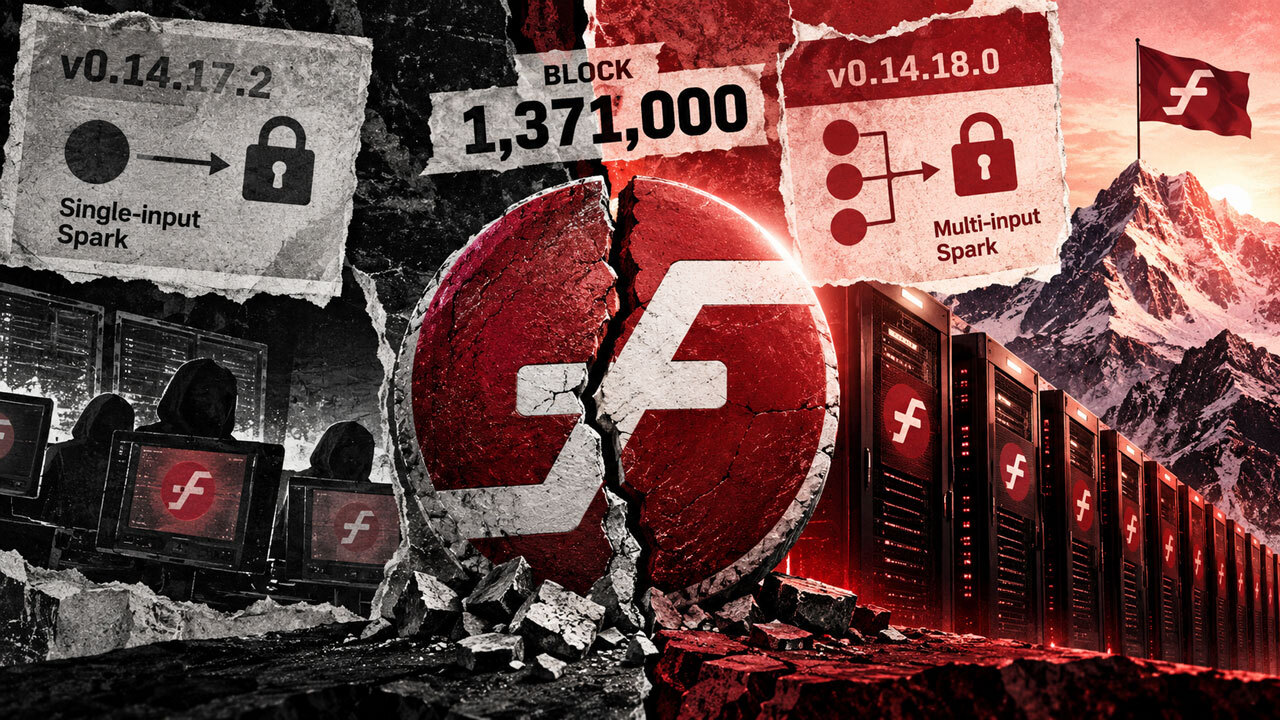
In the days leading up to the fork, the network’s block height was closely monitored. Early Friday, at approximately 1:45 a.m. UTC, the chain reached block 1,370,847, leaving only 153 blocks until the transition. Based on the network’s average block time, the 10:00 a.m. UTC estimate became the focal point for all infrastructure providers. The Firo team emphasized that the block height, rather than a specific time on the clock, would trigger the new rules, necessitating that all node operators remain vigilant.
Network Infrastructure and Stakeholder Requirements
The Firo hard fork is a "mandatory" upgrade, meaning that any node running software older than v0.14.18.0 will be unable to validate new blocks or participate in the network after block 1,371,000. This has significant implications for several key groups within the Firo ecosystem.
Masternode Operators
Firo utilizes a hybrid Proof-of-Work (PoW) and LLMQ (Long-Living Multi-Quorum) ChainLocks system, where masternodes play a critical role in network security and instant transaction finality. Masternode operators, who must collateralize 1,000 FIRO to run a node, are required to update their server software to ensure they continue receiving block rewards. A failure to upgrade would result in their nodes being marked as "POSE_BANNED," leading to a loss of income and a reduction in the network’s overall decentralization.
Mining Pools and Miners
Miners are responsible for the physical security of the chain. Because the hard fork changes the consensus rules regarding transaction validation (specifically the new Chaum V2 proofs), mining pools must update their back-end infrastructure. If a pool continues to mine on the old software, its blocks will be rejected by the upgraded network, resulting in wasted hash power and lost revenue for individual miners.
Exchanges and Service Providers
Centralized exchanges that list FIRO, such as Binance and HTX, typically suspend deposits and withdrawals during such upgrades. These entities must ensure their wallets are compatible with the new transaction format to prevent funds from being "stuck" on an incompatible chain fork. The Firo team reported that they had been in close communication with major exchanges to facilitate a smooth transition.
Wallet Users
For the average user holding FIRO in a desktop or mobile wallet, the funds themselves are safe and do not require migration. The "minted" Spark coins remain valid. However, users must update their wallet software to resume using the Spark private spending feature. Once the fork is active, the software will automatically allow multi-input spends again, restoring the high level of privacy that Firo users expect.
Market Reaction and Economic Context
Despite the technical challenges and the discovery of a potential inflation bug, the market sentiment surrounding Firo remained surprisingly resilient. In the 24 hours leading up to the hard fork, the price of FIRO saw a modest increase of approximately 3.03%, trading at a rank of #790 by market capitalization.
Data indicates that the market cap of Firo sits at approximately $14.48 million, with a circulating supply of 19.02 million tokens. The 30-day performance shows a significant gain of over 20%, suggesting that investors viewed the team’s transparent handling of the vulnerability as a sign of project maturity rather than a failure.

However, the threat of inflation is one of the most "toxic" events for any cryptocurrency. In 2018, Zcash (ZEC) famously dealt with a similar "counterfeiting" vulnerability that was discovered by cryptographer Ariel Gabizon. In that instance, the Zcash team kept the bug secret for months until a scheduled hard fork could fix it, a move that sparked intense debate over transparency in the privacy coin sector. Firo’s decision to disclose the issue within weeks of the stopgap fix reflects a different approach to community management, prioritizing immediate risk mitigation over price optics.
Broader Implications for Privacy-Preserving Technology
The Firo hard fork highlights the ongoing "arms race" between privacy-enhancing technologies and the discovery of cryptographic vulnerabilities. As privacy coins face increasing regulatory pressure—evidenced by delistings from major exchanges in Europe and elsewhere—the technical reliability of these networks is their primary defense.
The restoration of multi-input Spark spends is more than just a bug fix; it is a restoration of the protocol’s utility. Multi-input spends are essential for the "fungibility" of a privacy coin. If a user cannot easily combine their holdings into a single transaction, the coin becomes less practical for real-world commerce. Furthermore, the ability to correlate separate single-input transactions (as was necessary during the stopgap period) undermines the core value proposition of a privacy-centric asset.
The introduction of the versioned Chaum V2 proof suggests that the Firo team is looking toward a more modular future, where specific components of the privacy protocol can be versioned and upgraded without necessarily overhauling the entire system. This approach could shorten the response time for future vulnerabilities.
Post-Fork Expectations and Transparency
Firo has committed to publishing a comprehensive post-mortem and full technical disclosure following the successful activation of the fork. This document is expected to provide the global cryptographic community with insights into how the flaw was found, why it existed, and the exact mathematical corrections implemented in v0.14.18.0.
For node operators, the deadline remains absolute. As the network crosses the block 1,371,000 threshold, the "cracked coin" of the old protocol will be left behind, and a restored, more secure Spark system will take its place. The success of this transition will be measured by the stability of the network’s hash rate and the speed at which masternodes return to an "enabled" status.
In the broader context of the digital asset industry, Firo’s experience serves as a reminder of the inherent risks in cutting-edge cryptography. While zero-knowledge proofs offer a path to financial anonymity, they require rigorous, ongoing auditing. As the Firo network moves past this crisis, the focus will likely shift back to adoption and the continued development of its privacy stack in an increasingly transparent financial world.