admin
admin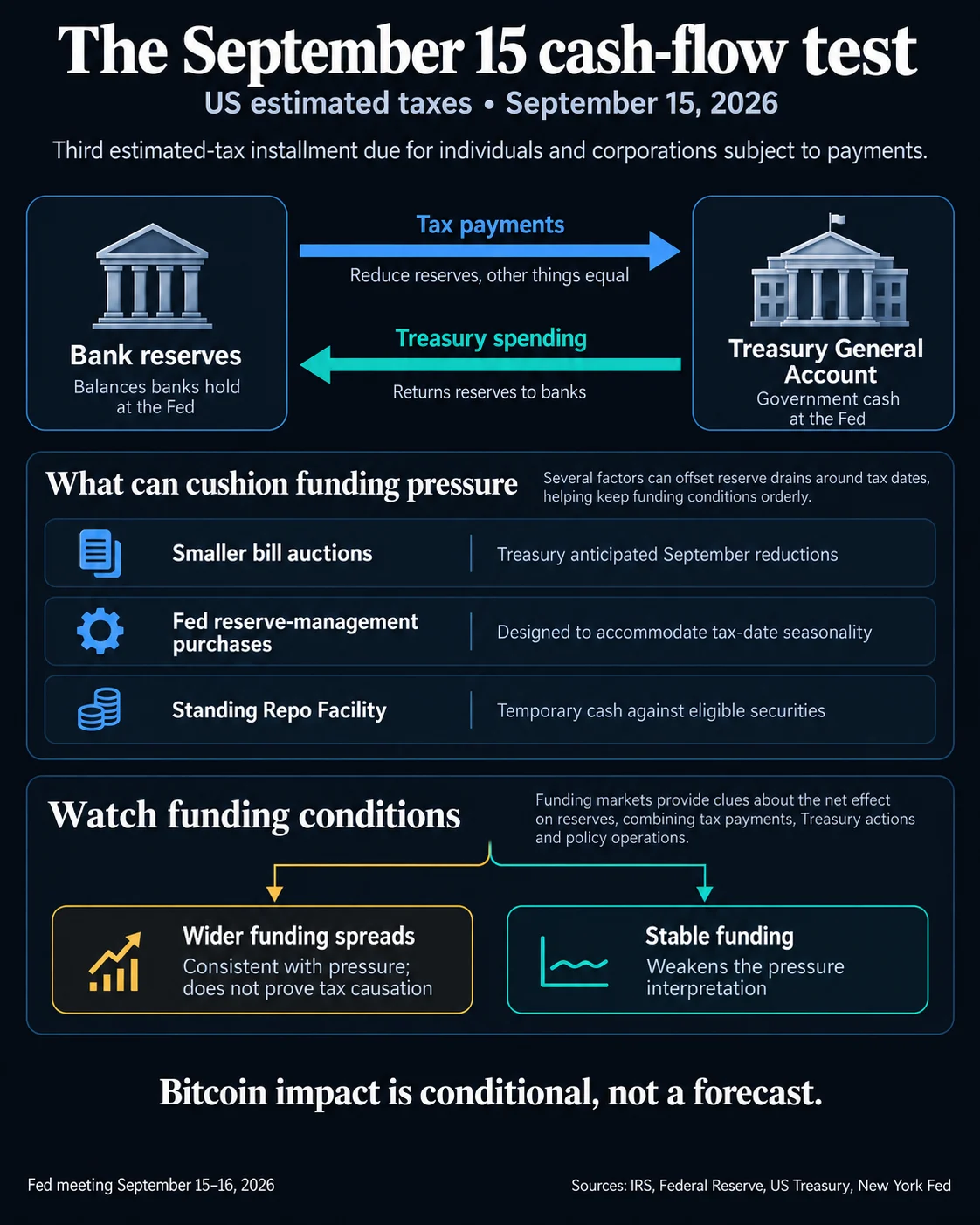
Tuesday’s US estimated-tax deadline will shift cash toward the Treasury, testing whether last week’s improvement in bank reserves can hold through the Federal Reserve’s meeting. Bitcoin liquidity could come under pressure if the transfer tightens dollar funding and limits risk-taking before policymakers conclude their September 15–16 meeting. The Internal Revenue Service (IRS) calendar sets September 15, 2026, as the third installment deadline for individuals and corporations subject to estimated-tax payments. This date coincides with the opening day of the Federal Reserve’s monetary policy meeting, placing a significant, scheduled cash movement directly alongside the policy decision due the following day.
This confluence of events creates a potential liquidity bottleneck, where substantial funds are redirected from the private sector to the government, immediately preceding a critical decision by the nation’s central bank. The implications for financial markets, including the cryptocurrency sector, warrant careful observation.
Understanding Bank Reserves and Treasury Operations
Bank reserves, defined as the balances commercial banks hold at the Federal Reserve, are crucial for facilitating payments and ensuring adequate funding within the financial system. They are not a direct measure of traders’ available cash but rather a foundational element of the banking system’s operational capacity. Recent data indicates a strengthening of these reserves. The Federal Reserve’s September 10 balance sheet release revealed that weekly-average bank reserves increased by $96.779 billion, reaching approximately $2.991 trillion in the week ending September 9. Concurrently, the Treasury General Account (TGA), the government’s primary account at the Fed, saw a decrease of $84.6 billion on a weekly-average basis, settling at $883.3 billion.
It is important to distinguish between these weekly averages and the specific snapshot levels on any given day. For instance, the levels on September 9 showed bank reserves at approximately $3.037 trillion and the Treasury’s cash balance at $843.705 billion. These figures provide a baseline against which the impact of the upcoming tax payments can be assessed.
The Mechanics of Tax Payments and Their Financial Impact
The accounting mechanism governing these cash flows is relatively straightforward. When individuals and corporations remit estimated tax payments, these funds are transferred from commercial banks’ reserve accounts to the Treasury’s account at the Federal Reserve. Conversely, Treasury spending involves the disbursement of funds from the TGA back into the accounts of recipient banks. Therefore, an influx of tax revenue into the Treasury effectively reduces overall bank reserves, while government expenditures serve to replenish them.
This dynamic can have a significant impact on short-term financing markets, including the repurchase agreement (repo) market, where cash is borrowed against securities. A historical precedent for such an event occurred in September 2019. The New York Fed’s account of that period describes how a combination of a temporary decline in reserves, Treasury settlements, and a corporate tax date converged with a sharp spike in repo rates. While this serves as a concrete example of the underlying mechanism at play, it is crucial to note that it does not predetermine a similar outcome this Tuesday. Market conditions and intervening factors have evolved since then.
Mitigating Factors and Treasury Management Strategies
Several factors are in place to potentially cushion the impact of this mid-September cash transfer. In its August 5 refunding statement, the Treasury had anticipated reductions in the auction sizes for shorter-dated Treasury bills due to the expected inflow of mid-month tax receipts. A decrease in bill issuance means the Treasury needs to borrow less from the market, which could partially offset the cash absorption resulting from tax payments, especially if the issuance levels are adjusted proportionally to the anticipated tax revenue. The precise magnitude of this offset will depend on the actual volume of borrowing and government spending in the coming days.

The Federal Reserve also actively manages its balance sheet to accommodate seasonal fluctuations in reserve demand. The Fed’s May 2026 balance sheet report acknowledges that reserve management purchases are designed to absorb or supply liquidity as needed to accommodate fluctuations, such as those related to tax payment cycles. Furthermore, the New York Fed has established the Standing Repo Facility (SRF) as a backstop. This facility is designed to provide eligible institutions with temporary cash against collateral, thereby mitigating upward pressure on short-term funding rates. The SRF acts as a crucial liquidity buffer, ensuring that the financial system has access to necessary funds even during periods of potential strain.
Potential Implications for Bitcoin and Risk Assets
For investors in Bitcoin and other risk-sensitive assets, the potential impact of these liquidity shifts is primarily channeled through changes in financing conditions and the broader appetite for risk. Research from the Bank for International Settlements (BIS) has indicated a correlation between US monetary tightening and declines in stablecoin market capitalization. This suggests a broader sensitivity of crypto markets to monetary policy and liquidity conditions, rather than a direct, measured response to a specific tax deadline.
The key indicator to watch will be whether short-term funding spreads widen relative to the Federal Reserve’s administered rates as tax payments are settled. An observed increase in these spreads would be consistent with tightening funding conditions, though it would not definitively prove that the tax payments were the sole cause. Conversely, if funding markets remain stable, it would weaken the interpretation that the tax deadline is imposing significant pressure.
Tuesday’s calendar presents a clear test of these dynamics. The interplay between tax collections, Treasury spending, the adjusted Treasury bill supply, and the effectiveness of the Fed’s liquidity management tools will ultimately determine the outcome.
A Deeper Dive into Market Dynamics
The estimated tax deadline on September 15 is a recurring event in the US financial calendar, typically impacting bank reserves as funds flow from commercial banks to the Treasury. However, its proximity to a Federal Reserve Federal Open Market Committee (FOMC) meeting amplifies its significance this year. The FOMC’s decisions on interest rates and monetary policy can have profound effects on liquidity, credit availability, and investor sentiment, all of which are critical factors for asset classes like Bitcoin.
The historical precedent of September 2019, where a confluence of factors led to repo market stress, serves as a cautionary tale. In that instance, a combination of factors including a significant tax payment date, reduced bank reserves, and Treasury settlements, coincided with a period of increased demand for funding in the repo market. This led to a sharp increase in repo rates, signaling a tightening of short-term liquidity. While the specific circumstances of 2019 may not be replicated, the underlying economic principles of supply and demand for liquidity remain relevant.
The Treasury’s proactive management of its debt issuance is a key strategy to smooth out these liquidity flows. By adjusting the sizes of its Treasury bill auctions, particularly for shorter maturities, the Treasury aims to align its borrowing needs with anticipated inflows and outflows of cash. This helps to prevent sharp contractions or expansions in market liquidity that could otherwise disrupt financial stability. For example, if the Treasury anticipates a substantial inflow of tax revenue, it might reduce the amount of new debt it plans to issue, thereby absorbing less cash from the market.
The Federal Reserve’s role extends beyond setting interest rates; it also actively manages the overall liquidity in the financial system through its open market operations and standing facilities. The Standing Repo Facility (SRF), introduced as a more permanent tool, provides a safety net for financial institutions facing temporary liquidity shortfalls. By offering overnight repurchase agreements against high-quality collateral, the Fed ensures that the cost of short-term funding does not spike uncontrollably, thereby maintaining orderly market functioning. This facility is designed to be responsive to market conditions, providing liquidity when needed and withdrawing it when conditions normalize.

Bitcoin’s Sensitivity to Macroeconomic Factors
Bitcoin, often perceived as a risk asset, tends to exhibit a correlation with broader market sentiment and liquidity conditions. When liquidity is abundant and risk appetite is high, investors are more likely to allocate capital to speculative assets like Bitcoin. Conversely, periods of tightening liquidity and heightened risk aversion can lead to outflows from these assets as investors seek safer havens.
The BIS research highlighting the decline in stablecoin capitalization following US monetary tightening underscores this sensitivity. Stablecoins, often used as a bridge between traditional finance and the cryptocurrency ecosystem, can reflect broader shifts in capital flows into and out of digital assets. A reduction in stablecoin supply can indicate that capital is being withdrawn from the crypto market, potentially due to tighter monetary conditions or a decrease in investor risk tolerance.
Therefore, the events of September 15 and 16 are not just about the technicalities of bank reserves and Treasury accounts; they are a barometer for the broader financial environment in which Bitcoin operates. A significant tightening of liquidity, evidenced by widening funding spreads, could signal a less favorable environment for risk assets. This could manifest as increased selling pressure on Bitcoin or a reduced capacity for new capital to enter the market.
The Role of Data and Observation
In navigating this complex landscape, market participants will be closely monitoring several key data points. The Treasury’s daily cash balance will provide insight into the actual volume of tax receipts. The Federal Reserve’s weekly balance sheet data will reveal the net impact on bank reserves. Crucially, the behavior of short-term funding markets, particularly the repo rate and its spread over the Federal Funds Rate, will serve as a real-time indicator of liquidity conditions.
If these indicators suggest a significant tightening of liquidity, it could translate into increased volatility for Bitcoin and other cryptocurrencies. Conversely, if the mitigating factors prove effective and liquidity remains stable, the impact on Bitcoin may be minimal. The narrative that emerges from the data will be critical for shaping market expectations and investment decisions in the short to medium term.
The upcoming period represents a critical juncture, where the interplay of fiscal policy, monetary policy, and market mechanics will be under intense scrutiny. The ability of the financial system to absorb the liquidity shift associated with the tax deadline, while simultaneously processing the Federal Reserve’s policy decision, will be a key determinant of market stability and risk appetite in the near future. For Bitcoin investors, understanding these underlying dynamics is paramount to navigating the potential volatility and making informed strategic decisions.