admin
admin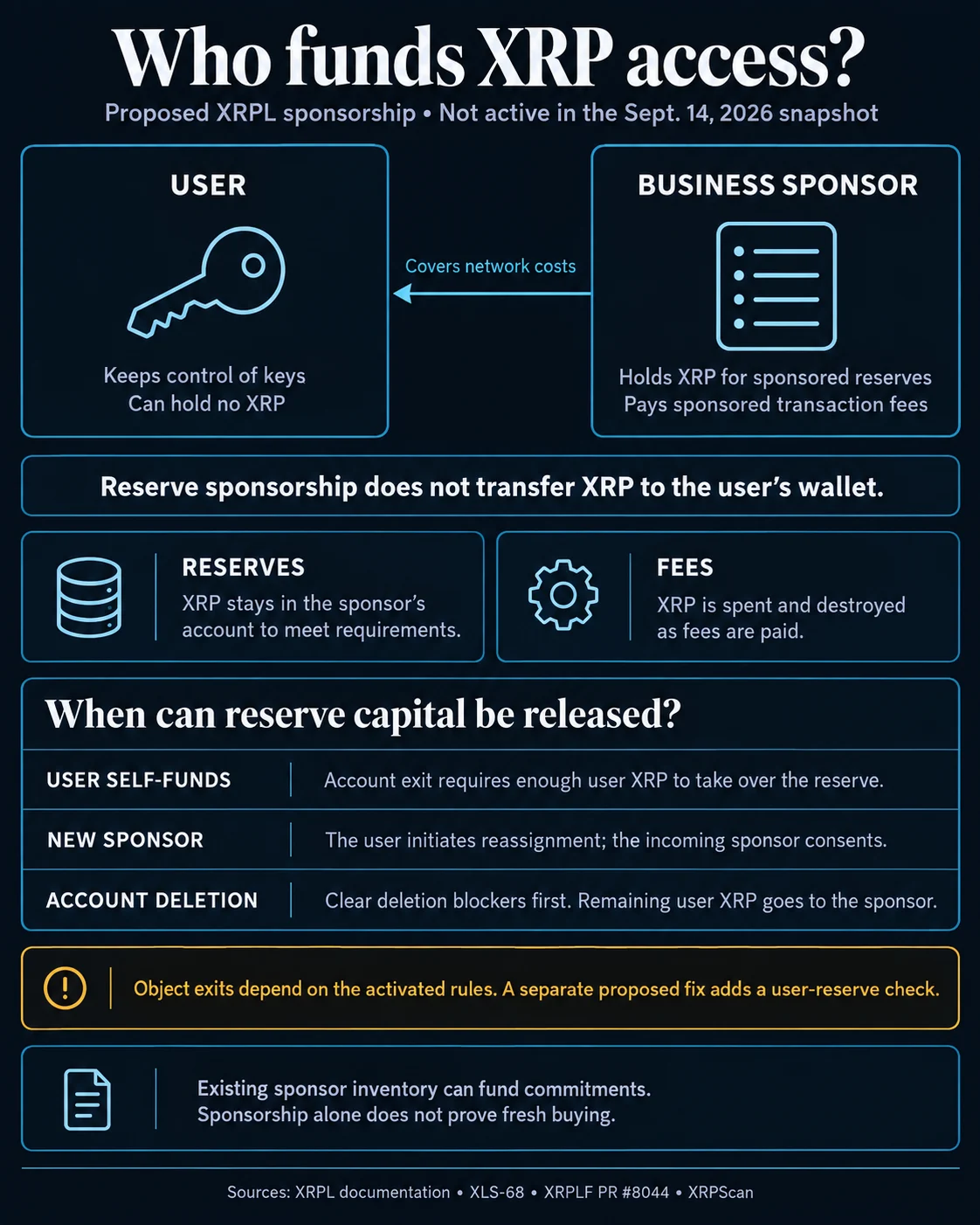
A significant proposed upgrade to the XRP Ledger (XRPL), known as the Sponsor amendment (XLS-68 Sponsored Fees and Reserves), is poised to fundamentally alter how financial institutions and fintech companies interact with XRP, potentially allowing them to absorb account reserve and transaction fee costs for their customers. This innovation aims to remove a key friction point in deploying XRPL-based products, enabling a more seamless customer experience where users may never need to directly hold or manage XRP themselves.
The core of the XLS-68 proposal lies in its ability to empower companies – referred to as "sponsors" – to cover the necessary XRP reserves and transaction fees on behalf of other XRPL users. Crucially, this arrangement would allow the end-user to retain complete control over their account and private keys, fostering trust and security. For financial institutions, this represents a substantial reduction in the complexity of integrating with the XRPL. Previously, any company looking to leverage the ledger for tokenized assets, payments, or other applications faced the hurdle of requiring every customer to acquire and manage XRP, a process that could deter adoption.
Jazzi Cooper, Ripple’s head of product, has highlighted the strategic intent behind this feature, stating that it is designed to allow entities like banks, asset issuers, or platform providers to shoulder these financial obligations. This abstraction of XRP mechanics from the end-user interface could pave the way for more intuitive consumer-facing applications and robust institutional platforms. The financial burden of maintaining account reserves and covering transaction fees would effectively shift from the individual user to the sponsoring entity, impacting their balance sheet rather than the customer’s.
The Mechanics of Sponsorship: Shifting Capital Requirements
Under the proposed sponsorship model, while customers would remain in control of their private keys, the XRP allocated to account reserves would reside within the sponsor’s account. The XRPL would then maintain a record of which entity is responsible for this obligation. Currently, the XRPL mandates a base reserve of 1 XRP per account, with an additional 0.2 XRP for each standard owner-reserve unit. While validators have the authority to adjust these parameters, the sponsorship amendment introduces a scenario where a business sponsoring one thousand customer accounts would effectively be responsible for approximately one thousand XRP in additional base reserve requirements, on top of its own reserves. This contrasts sharply with the current model, where such a reserve requirement would be distributed across individual users.
This shift in capital allocation could become particularly impactful as financial institutions plan to deploy XRPL products to potentially millions of customers. A firm serving one million users could, under current requirements, face approximately one million XRP in base-account reserve obligations. This figure does not account for trust lines, token-related objects, optional sponsorship relationships, or transaction fees, suggesting that the actual total could be significantly higher, depending on the specific design of the service.
The implementation of optional Sponsorship ledger entries further refines this model. These entries enable businesses to pre-fund sponsorship relationships, eliminating the need to sign every subsidized transaction individually. However, each sponsorship entry itself consumes reserve capacity, adding another layer of complexity to the reserve management for sponsoring entities.
The implication for XRPL adoption is profound: wider integration of the ledger would not necessarily translate into a proportional increase in retail XRP holders. Instead, it could lead to a consolidation of reserve requirements among a smaller number of institutional sponsors. This structure is anticipated to simplify the integration of XRP into products where banks prefer to present a unified customer experience, focusing solely on the asset or service being utilized, such as tokenized deposits, bonds, or money-market instruments. Ctrl Alt, a firm that has collaborated on the sponsorship proposal, has articulated this vision, describing it as a method for institutions to manage XRP requirements internally, allowing customers to interact with tokenized assets without the prerequisite of acquiring XRP.
Timeline and Current Status of the XLS-68 Amendment
The XLS-68 amendment is still in its nascent stages of development and adoption. As of the latest available data from XRPScan, the proposal has garnered support from only six validators, falling significantly short of the 29-validator threshold required for activation. Consequently, no activation date has been scheduled. This indicates that the path to implementation is contingent upon broader consensus-building within the XRPL validator community.
The proposal’s journey began with its introduction as a concept and has progressed through rigorous technical and community review. The development of the "Sponsored Fees and Reserves" amendment, underpinned by the technical specification XLS-68, represents a collaborative effort involving Ripple and various XRPL developers. The initial discussions and design phases likely involved extensive modeling of potential impacts on network economics and user experience. The subsequent submission to the validator network for approval marks a critical juncture, where the technical feasibility and perceived benefits are weighed against potential risks and operational complexities.

The Dual-Edged Sword: Easier Onboarding Versus Balance Sheet Commitments
While the sponsorship amendment promises a more streamlined onboarding process for end-users, it simultaneously introduces a new set of capital management challenges for sponsoring businesses. A key aspect of XRP reserves is that they remain committed as long as the sponsored account or ledger object relies on them. This means a company cannot simply assume that XRP allocated to a reserve becomes immediately available when a customer ceases to actively use a service.
The proposed SponsorshipTransfer mechanism offers a pathway to end or reassign sponsorships. However, account sponsorship comes with specific conditions. For a beneficiary to assume its own reserve, it must possess sufficient XRP to meet the requirement. This presents a potential hurdle for the very users the feature is designed to assist. A customer who has never held XRP might find themselves unable to cover the reserve cost if a bank decides to discontinue sponsoring their account.
In such scenarios, the sponsoring institution could transfer the necessary XRP to the customer to bridge the shortfall, incurring an additional cost. Alternatively, the customer could seek another sponsor to assume the obligation, provided the incoming sponsor consents. Account deletion offers another exit strategy, where, once relevant blockers are cleared, a sponsored account can be removed, and the reserve obligation released. Any remaining XRP within the account would then be directed according to the proposed rules.
The complexity is further amplified by object sponsorship. A code change merged into XRPL’s development branch in August introduced reserve checks upon the conclusion of certain sponsorships. However, this functionality is currently gated behind a separate amendment, fixCleanup3_4_0. The eventual mainnet status of this fix will dictate the ease with which certain reserve commitments can be unwound.
These intricate mechanics necessitate that banks and other financial institutions carefully model not only the initial cost of acquiring XRP but also crucial factors such as customer churn rates, average reserve requirements per user, transaction fee consumption, and the potential for XRP to remain committed to inactive yet open accounts. This necessitates a sophisticated approach to capital planning and risk management.
Analyzing the Implications: Demand, Adoption, and Institutionalization
The XLS-68 amendment has the potential to unlock new institutional use cases for XRP, but its impact on fresh buying pressure remains a subject of analysis. Existing XRP holders who are also potential sponsors could reallocate tokens already on their balance sheets to support sponsored customers, without necessarily acquiring additional supply. The emergence of new market demand will largely depend on the disparity between the available institutional XRP inventory and the aggregate reserve and fee commitments these entities choose to assume.
Therefore, the ultimate success of this amendment in driving demand will be revealed not by the headline reserve formula, but by the practical deployment data. Metrics such as the number of sponsored accounts, sponsor balances, transaction volumes, and the quantity of XRP tied to tokenized assets will provide clarity on whether businesses are accumulating XRP to support these new services or primarily utilizing their existing holdings.
This proposal could significantly accelerate the institutionalization of the XRP Ledger. By removing the direct requirement for end-users to manage XRP, it lowers the barrier to entry for a vast number of potential customers. This could lead to a scenario where XRP, rather than being a retail-focused asset, becomes an integral part of the underlying infrastructure for financial services, akin to how other digital currencies or payment rails operate.
The broader implication is a potential redefinition of XRP’s role in the digital asset ecosystem. Instead of being solely a speculative asset or a medium of exchange for individual users, it could evolve into a foundational element for institutional finance, facilitating the creation and management of tokenized real-world assets. This could attract significant capital and foster innovation within the financial sector, leveraging the speed and efficiency of the XRPL.
The critical first step, however, remains securing sufficient validator support. If the Sponsor amendment gains the necessary consensus and successfully navigates the activation period, the decision will then rest with banks and platforms. They will need to weigh the strategic advantage of a frictionless customer experience against the financial commitment of carrying XRP on their own balance sheets. For companies aiming to launch large-scale tokenized-asset products, this calculation could ultimately transform XRP from a token that every customer must manage into an essential, albeit concentrated, infrastructure cost borne by the institution itself. The evolution of the XRP Ledger through such amendments underscores a continuous effort to adapt and enhance its capabilities to meet the evolving demands of the global financial landscape.