admin
admin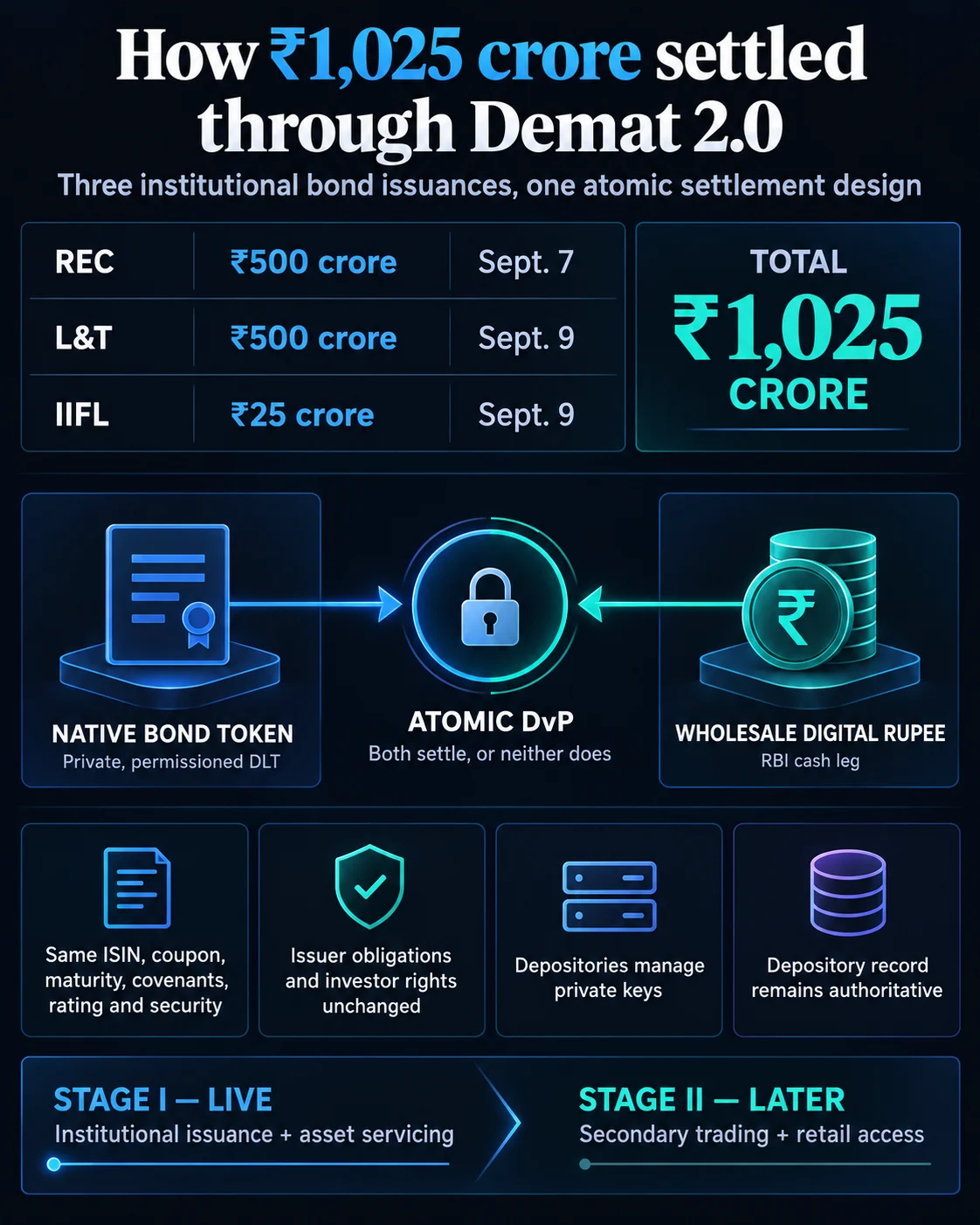
India’s ambitious foray into the tokenization of corporate bonds has officially begun, marking a significant milestone in the nation’s journey towards modernizing its financial infrastructure. The Securities and Exchange Board of India (SEBI) has successfully launched its Demat 2.0 pilot project, which seamlessly integrates corporate bond issuances and their cash settlement onto interconnected digital rails. This pioneering initiative saw its initial phase culminate in three substantial institutional issuances, collectively settling over ₹1,025 crore. Crucially, these early transactions have been designed to meticulously preserve the existing legal and economic rights of bondholders, ensuring a smooth transition and minimizing disruption to established market practices.
The groundbreaking pilot, announced by SEBI on September 10th, follows the successful completion of tokenized bond issuances by prominent entities including REC Limited, L&T Limited, and IIFL. These foundational transactions took place on September 7th and September 9th, with REC Limited issuing bonds worth ₹500 crore, L&T Limited also issuing ₹500 crore, and IIFL contributing ₹25 crore. These figures, detailed in SEBI’s official release, underscore the significant scale of the initial institutional engagement and signal strong market confidence in the underlying technology. The ongoing nature of Stage I issuances suggests that further institutional participation is anticipated as the pilot progresses.
The Core Innovation: Atomic Settlement on Digital Rails
The central innovation driving this pilot project lies in the novel mechanism for the simultaneous settlement of securities and payments. In this new paradigm, a corporate bond is issued not as a traditional certificate or dematerialized entry, but as a native digital token residing on a private, permissioned distributed ledger technology (DLT) network. This tokenization process is intrinsically linked with the Reserve Bank of India’s (RBI) wholesale digital rupee, a central bank digital currency specifically designed for interbank and institutional transactions.
SEBI’s comprehensive technical frequently asked questions (FAQ) document elaborates on the critical function of linking these two elements for "atomic delivery-versus-payment." This means that the settlement of the bond token and the corresponding cash payment are inextricably tied: either both transactions execute successfully and simultaneously, or neither does. This synchronized approach effectively eradicates the historical settlement risks associated with a time lag between the transfer of ownership of a security and the receipt of payment. Such an interval historically presented opportunities for buyers to remit funds without immediate receipt of the bond, or for sellers to deliver a bond without assured payment. The pilot, therefore, aims to eliminate counterparty risk inherent in such timing discrepancies, while importantly, maintaining the issuer’s credit risk and obligations unchanged.
Preserving Bondholder Rights and Existing Structures
A key objective of the Demat 2.0 pilot has been to ensure that the tokenized bond functions identically to its conventional counterpart from a legal and economic standpoint. The digital token is not merely a digital representation of an existing bond; it is the bond itself, imbued with all its defining characteristics. This includes retaining the same International Securities Identification Number (ISIN) identifier, coupon rate, maturity date, covenants, credit rating, and any underlying security. Furthermore, the issuer’s obligations to bondholders, the rights afforded to investors, and the overall regulatory treatment remain precisely the same as they would be for a traditionally issued and held dematerialized bond. This commitment to continuity is vital for fostering trust and encouraging widespread adoption.
The underlying network architecture is designed to be private and institutionally governed, reflecting a controlled and regulated environment. India’s central securities depositories are the designated owners of this network, and they continue to serve as the statutory and authoritative record-keepers of beneficial ownership. Market infrastructure institutions have been instrumental in the development and operation of this system. Initially, the network’s validating nodes, which are essential for processing transactions on the DLT, are being managed by depositories and stock exchanges. This collaborative approach ensures robust operational oversight and leverages existing expertise within the financial ecosystem.
Furthermore, the pilot maintains an intermediated custody model. Investors’ private keys, which are crucial for managing digital assets, are held and managed by the depositories. This preserves the familiar custody chain, allowing investors to access the tokenized ledger without the burden of directly managing private keys or replacing the established depository record that legally signifies ownership. This approach ensures that the transition to tokenized assets is as seamless as possible for the end investor, minimizing the learning curve and technical barriers.
Background: India’s Digital Transformation Drive
This initiative is not an isolated event but rather a crucial component of India’s broader national strategy to embrace digital transformation across its financial services sector. The Reserve Bank of India has been a prominent proponent of central bank digital currencies (CBDCs) and has actively explored the potential of distributed ledger technology for enhancing market efficiency. The wholesale digital rupee pilot, which began in November 2022, has been a critical testing ground for interbank settlements, providing the necessary technological and operational foundation for initiatives like the Demat 2.0 project.
The integration of SEBI’s regulatory oversight with the RBI’s digital currency infrastructure represents a significant step towards creating a unified and modernized financial ecosystem. The concept of tokenizing traditional assets, such as bonds, has been a subject of global discussion, with countries and financial institutions exploring its potential to reduce costs, increase speed, and enhance transparency. India’s structured approach, prioritizing institutional adoption and regulatory compliance, positions it as a leader in this domain.
The evolution of India’s capital markets has seen a steady move towards dematerialization, with the Securities and Exchange Board of India (SEBI) playing a pivotal role in driving this transition over the past two decades. The establishment of depositories like the National Securities Depository Limited (NSDL) and the Central Depository Services (India) Limited (CDSL) has been fundamental in facilitating the electronic holding and transfer of securities. The Demat 2.0 pilot builds upon this established foundation, leveraging DLT to introduce new efficiencies while maintaining the integrity and trust associated with these existing institutions. The pilot’s phased approach, starting with institutional players, is a deliberate strategy to de-risk the implementation and gather valuable insights before expanding to a broader audience.
Stage II: Paving the Way for Secondary Trading and Retail Access
The current live first stage of the Demat 2.0 pilot is focused on the issuance of bonds and the ledger-based servicing of these assets. SEBI has strategically reserved the introduction of tokenized secondary-market trading and the participation of retail investors for a subsequent phase, Stage II. This phased rollout allows for meticulous testing and refinement of the platform before it is exposed to the wider market.

During this interim period, investors who wish to exit their positions in the tokenized bonds can do so through peer-to-peer transfers or via a demat-to-demat transfer mechanism, both of which are managed by the depositories. The payment for these transfers can be settled outside the atomic settlement framework, utilizing either the digital rupee or conventional banking channels. This flexibility ensures that liquidity can be maintained during the initial phase of the pilot.
The successful execution of these initial institutional issuances demonstrates the viability of synchronizing regulated securities records with central bank money through advanced DLT. The true test of this architecture, however, will emerge in Stage II. This next phase will assess the platform’s capacity to support routine liquidity in the secondary market and accommodate a broader and more diverse investor base, including retail participants. The ability to facilitate efficient and secure trading for all investors will be a critical determinant of the pilot’s long-term success.
Broader Implications and Future Outlook
The implications of India’s tokenized bond pilot extend far beyond the immediate transactions. This initiative has the potential to significantly enhance the efficiency, transparency, and accessibility of the Indian debt capital markets. By reducing settlement times and associated risks, it can lower transaction costs for issuers and investors, thereby encouraging greater participation and fostering deeper market liquidity.
For issuers, the ability to tokenize bonds could streamline the issuance process, potentially reducing administrative overhead and speeding up the time to market for new issuances. For investors, particularly institutional ones, the prospect of faster and more secure settlements, coupled with the preservation of their existing rights, presents a compelling case for engaging with tokenized instruments.
The successful implementation of Stage II, which includes retail access, could democratize access to the bond market, allowing individual investors to participate in a more efficient and potentially more cost-effective manner. This could be particularly impactful in a country like India, where a growing middle class is increasingly seeking investment opportunities beyond traditional savings instruments.
Furthermore, this pilot serves as a valuable case study for other emerging markets looking to leverage DLT for financial innovation. India’s approach, characterized by strong regulatory oversight and a focus on interoperability with existing financial infrastructure, offers a blueprint for responsible and effective adoption of blockchain technology in capital markets. The integration of the wholesale digital rupee with tokenized assets sets a precedent for how central bank digital currencies can be utilized to facilitate the settlement of tokenized securities, potentially paving the way for broader applications in digital asset ecosystems. As the Demat 2.0 pilot progresses, the global financial community will be closely watching India’s advancements, anticipating the transformative impact of these digital innovations on the future of finance.