admin
In a pivotal legal confrontation that could redefine the landscape of American financial derivatives, major cryptocurrency exchanges and prominent trading firms have formally intervened to support the Commodity Futures Trading Commission (CFTC) against a lawsuit spearheaded by traditional finance powerhouses Citadel Securities and Cboe Global Markets. At the heart of this dispute lies the fundamental question of how single-stock perpetual futures — innovative, never-expiring contracts — should be classified under U.S. law: as "security futures" falling under the joint oversight of the CFTC and the Securities and Exchange Commission (SEC), or as "security-based swaps" which would exclusively fall under the SEC’s more stringent regulatory framework, typically limiting retail investor access. While a federal judge has permitted trading of these nascent products to continue for now, an early signal from the bench suggests the challengers may ultimately prevail, raising profound implications for market innovation, regulatory jurisdiction, and investor access.
The Genesis of a Regulatory Showdown
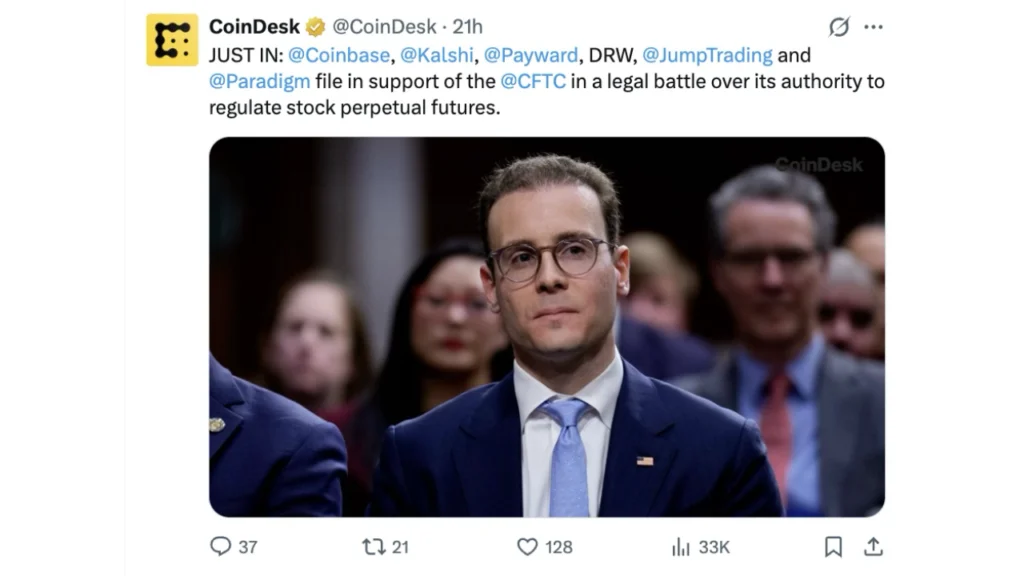
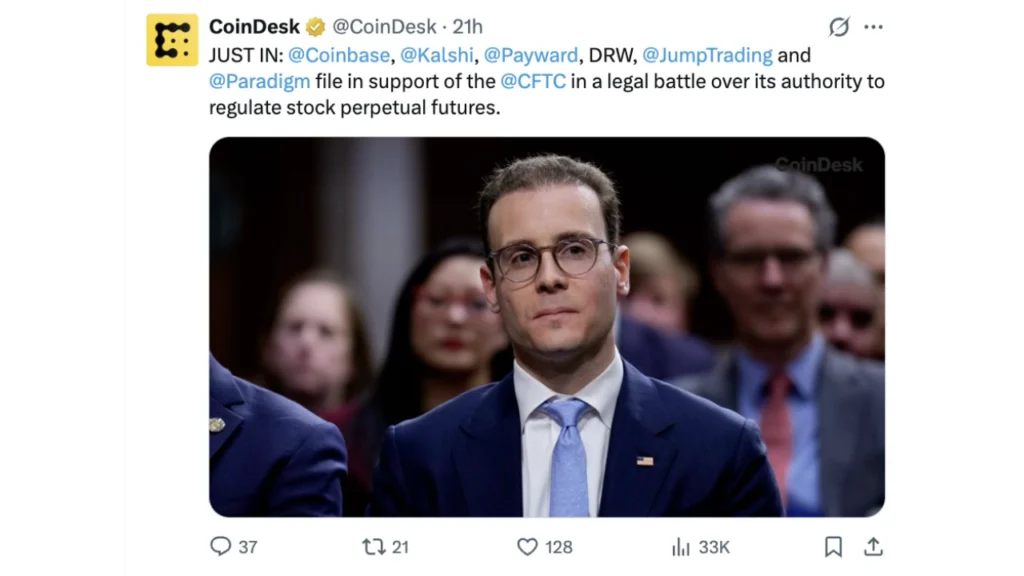
The current legal imbroglio, unfolding in a Manhattan federal courtroom, represents a critical juncture in the ongoing effort to integrate novel financial products, particularly those popularized in the cryptocurrency sphere, into the established U.S. regulatory architecture. On Monday, November 9, a powerful consortium of market participants — including Coinbase, prediction market operator Kalshi, Kraken parent company Payward, alongside trading giants DRW Holdings, Jump Trading, and Paradigm — formally petitioned the U.S. District Court for the Southern District of New York to accept an amicus curiae brief. This brief explicitly backs the CFTC’s stance, arguing for the agency’s authority to approve and oversee single-stock perpetual futures.
Their formidable opponent is the Capital Markets Alliance (CMA), a newly formed trade group whose membership boasts Citadel Securities, one of the largest market makers globally, and Cboe Global Markets, a leading exchange operator. The CMA’s objective is clear: to invalidate the CFTC’s recent approval of single-stock perpetual futures and to immediately halt all trading of these instruments as the lawsuit progresses. This legal challenge underscores a deeper struggle for control over nascent markets and the considerable commercial stakes involved for both established financial institutions and innovative digital asset firms.
A Timeline of Swift Action and Legal Responses
The rapid escalation of this conflict can be traced through a series of key events:
- Early 2023: Against a backdrop of increasing calls to bring offshore derivatives activity into regulated U.S. markets, the CFTC signaled its openness to innovative products. Regulators, including those during the previous administration, had expressed a desire to onshore the thriving, yet often opaque, offshore perpetual futures market.
- October 29: NYSE owner Intercontinental Exchange (ICE), a significant player in traditional finance, announced a partnership with Trade.xyz to develop U.S.-regulated perpetual venues utilizing Hyperliquid technology. This move highlighted that not all incumbent financial institutions are uniformly opposed to perpetual futures, suggesting a nuanced debate about who regulates them, rather than if they should exist.
- November 2: Applications from firms like Coinbase, Kalshi, and Payward to list perpetual futures on U.S. stocks were "deemed approved" by the CFTC. This approval mechanism, often triggered when an agency does not formally reject an application within a specified timeframe, allowed the new products to move forward.
- November 3: CFTC Chairman Michael Selig publicly announced that eligible exchanges could now offer these contracts, framing the approvals as part of the agency’s mandate to foster responsible innovation within the U.S. financial system.
- Within Hours of Announcement: The Capital Markets Alliance (CMA) filed its lawsuit, challenging the CFTC’s authority and seeking an immediate injunction to halt trading. The speed of their response underscored the perceived threat to existing market structures and regulatory precedents.
- November 9: The consortium of crypto and trading firms — Coinbase, Kalshi, Payward, DRW Holdings, Jump Trading, and Paradigm — formally sought to intervene in the lawsuit, filing their amicus brief in support of the CFTC. Their intervention highlights the direct commercial interests these firms have in the continued legality and availability of single-stock perpetual futures.
This tightly compressed chronology illustrates the intense regulatory and commercial pressure surrounding these innovative financial instruments.
Deconstructing the Perpetual Future
To understand the core of this legal battle, one must first grasp the nature of a single-stock perpetual future. A "perp," as it’s commonly known, is a derivative contract that allows traders to speculate on the price movement of an underlying asset — in this case, a single company’s stock — without ever owning the asset itself. Its defining characteristic, and the source of much of the legal controversy, is its lack of an expiry date. Unlike traditional futures contracts, which have a fixed settlement date and require traders to "roll over" their positions into new contracts periodically, a perpetual future theoretically allows a position to be held indefinitely.
To maintain the contract’s price closely aligned with the underlying spot price of the asset, perpetual futures employ a unique mechanism: periodic funding payments. When the perpetual future trades at a premium to the underlying stock, traders holding long positions pay a fee to those holding short positions. Conversely, if the perp trades at a discount, shorts pay longs. This funding rate mechanism is crucial for anchoring the derivative’s price to the actual market value of the stock, preventing significant divergence.
Perpetual futures have become the dominant trading instrument on offshore cryptocurrency exchanges, prized for their ability to facilitate highly leveraged positions and continuous exposure to price movements. A single-stock perp applies this identical design to individual company shares, offering U.S. traders the theoretical ability to maintain a leveraged position on a stock without the complexities and costs associated with owning the shares outright or rolling over traditional futures. The appeal of such a product for both retail and institutional traders, particularly those seeking continuous exposure and efficient capital deployment, is evident, yet it also raises significant questions about risk management and investor protection.
The Heart of the Matter: Futures or Swaps?
The entire legal challenge hinges on a precise definitional distinction within U.S. derivatives law. Under the existing framework, a derivative contract tied to a single stock can be categorized in one of two ways, each with distinct regulatory implications:
- Security Future: These are futures contracts on a single security (or a narrow-based security index). They fall under the joint jurisdiction of both the CFTC and the SEC. This dual oversight, established by the Commodity Futures Modernization Act of 2000, aimed to create a harmonized regulatory environment for these specific products, allowing them to trade on futures exchanges.
- Security-Based Swap (SBS): These are swaps where the underlying asset is a single security or a narrow-based security index. Following the Dodd-Frank Wall Street Reform and Consumer Protection Act of 2010, security-based swaps are primarily regulated by the SEC. The Dodd-Frank Act introduced a comprehensive regulatory regime for swaps and security-based swaps, largely in response to the 2008 financial crisis, which exposed significant risks in the opaque over-the-counter (OTC) swaps market. This regime typically imposes stricter requirements, including central clearing, exchange trading mandates for certain instruments, and often restricts retail investor access.
The Capital Markets Alliance (CMA) contends that single-stock perpetual futures, with their indefinite expiry and periodic funding payments, functionally behave more like security-based swaps than traditional futures contracts. If this argument holds, the CFTC would have exceeded its statutory authority in approving these products as "security futures." Consequently, perpetual futures would then fall under the SEC’s more rigorous swaps regime, which generally seeks to shield ordinary retail traders from the complexities and risks of such instruments. The CMA’s argument is rooted in the belief that the "perp" structure fundamentally alters the nature of the derivative, pushing it beyond the traditional definition of a future.

The CFTC has unequivocally rejected this interpretation. A spokesperson for the agency characterized the lawsuit as "troubling" and asserted that markets "should be governed by law, not litigation campaigns intended to block innovation." This statement underscores the CFTC’s commitment to its mandate of fostering responsible innovation and its view that the CMA’s challenge is more about stifling competition than upholding regulatory principles.
The Crypto Firms’ Counterarguments and Commercial Stakes
The six companies intervening in the lawsuit — Coinbase, Kalshi, Payward, DRW Holdings, Jump Trading, and Paradigm — present a robust counterargument that reframes the central legal question. They assert that the resemblance of stock perps to swaps is largely irrelevant to the legal classification. Instead, the pertinent test is whether these instruments satisfy the statutory definition of a "security future," and their brief unequivocally states that they do. Their argument likely delves into the specific legal criteria for security futures, aiming to demonstrate how perpetual futures, despite their novel characteristics, align with those established definitions.
Furthermore, the intervening firms push back against any insinuation that the CFTC is attempting to circumvent the SEC. They highlight that the two agencies, in fact, jointly sought public comment on the classification of perpetual contracts as security futures. This collaborative approach, they argue, indicates that both regulatory bodies with jurisdiction over "security futures" already consider these products to fall within that category, rendering the CMA’s challenge unfounded in its claim of unilateral CFTC action.
Beyond the legal definitions, the amicus brief also incorporates a direct commercial critique. The firms argue that stock perps represent a superior product compared to conventional single-stock futures, offering greater flexibility and efficiency. They contend that the CMA’s members, had they genuinely believed in the product’s value, possessed the capabilities to develop and offer it themselves. Instead, by resorting to litigation, the CMA is accused of attempting to stifle competition and prevent a new, potentially more efficient, product from entering the market, thereby protecting their existing commercial interests and market dominance. This commercial dimension adds another layer of intensity to the dispute, framing it not just as a regulatory debate but as a battle for market share and the future direction of financial innovation.
A Broader Regulatory Landscape: The "Second Front"
This lawsuit is not an isolated incident but rather the second major legal challenge facing the CFTC over its approval of perpetual futures. In June, CME Group, a global leader in derivatives exchanges, filed a separate lawsuit against the CFTC in Washington, D.C., federal court. That case concerns the CFTC’s May 29 approval of a Kalshi bitcoin perpetual contract, with CME Group arguing that such contracts should be classified as swaps under the Dodd-Frank Act. The CFTC has labeled CME’s suit as "frivolous" and moved for its dismissal, though the court has yet to rule.
While both lawsuits challenge the CFTC’s classification of perpetual contracts, their potential outcomes carry distinct implications:
- CME vs. CFTC (Bitcoin Perps): If CME Group prevails, crypto perpetual futures would likely remain under the CFTC’s purview, but they would be reclassified as swaps, subject to the more stringent and potentially retail-limiting rules established by the Dodd-Frank Act.
- CMA vs. CFTC (Stock Perps): If the Capital Markets Alliance wins, single-stock perpetual futures could entirely exit the CFTC’s jurisdiction. This would either halt their trading altogether or force them into the SEC’s security-based swaps regime, which typically involves higher capital requirements, stricter clearing mandates, and significant barriers to retail participation. The greater jurisdictional threat in the stock perp case explains why crypto firms, who largely left the CME fight to the CFTC, have chosen to file their own arguments here.
A Warning from the Bench and the Path Ahead
The judicial proceedings have already provided a significant indicator of the potential trajectory of this case. U.S. District Judge Valerie Caproni, while allowing trading of single-stock perpetual futures to continue temporarily, issued a notable preliminary finding. She indicated that the Capital Markets Alliance (CMA) is "likely to succeed" on its claim that the CFTC exceeded its statutory authority in approving these products. This early assessment, though not a final ruling, is a substantial warning shot for the CFTC and the firms backing it. It suggests that the judge perceives considerable merit in the CMA’s legal arguments regarding the fundamental classification of these instruments.
Judge Caproni’s early view carries significant weight. It means that the CFTC and the exchanges listing these products must seriously prepare for an outcome where their current regulatory framework for single-stock perps is deemed invalid. The possibility of an injunction to halt trading or a reclassification under a different regulatory regime looms large.
The Broader Implications: Who Controls the Future of Finance?
This legal battle is more than a dispute over technical definitions; it is a profound policy clash embedded within a larger governmental push to regulate and bring onshore the thriving, yet often unregulated, offshore derivatives markets, particularly those involving digital assets. CFTC Chairman Michael Selig has consistently framed the agency’s approvals as integral to its mandate to foster responsible innovation and maintain U.S. competitiveness in global financial markets. The argument is that if the U.S. fails to provide a clear, regulated path for these popular products, American traders and capital will simply flow to offshore venues, increasing systemic risk and diminishing U.S. regulatory oversight.
The market itself is not monolithic in its opposition to perpetual futures. As evidenced by NYSE owner Intercontinental Exchange’s (ICE) partnership with Trade.xyz, some established Wall Street players are actively exploring ways to incorporate perpetual futures into regulated U.S. markets. This nuance highlights that the core contest is less about whether perpetual futures will come to America, but rather who will control these markets and under which specific rulebook they will operate. The turf war between the CFTC and the SEC, exacerbated by the emergence of novel financial instruments, reflects deeper tensions about regulatory boundaries, institutional mandates, and the future evolution of financial markets.
For now, single-stock perpetual futures can continue to trade, but their long-term viability in the U.S. market hangs precariously on Judge Caproni’s impending decisions. She must rule on whether to formally accept the industry’s amicus brief, granting their arguments full consideration, and critically, whether to grant the CMA’s request for an injunction to halt trading. Given her initial assessment that the CFTC likely overstepped its authority, market participants, exchanges, and regulators are bracing for an outcome that could either cement the CFTC’s role as an innovation-friendly regulator or significantly reshape the regulatory landscape for next-generation financial derivatives in the United States. The stakes are immense, promising to shape not only the immediate future of single-stock perps but also the broader trajectory of financial innovation and regulation for years to come.