Dwi Wanna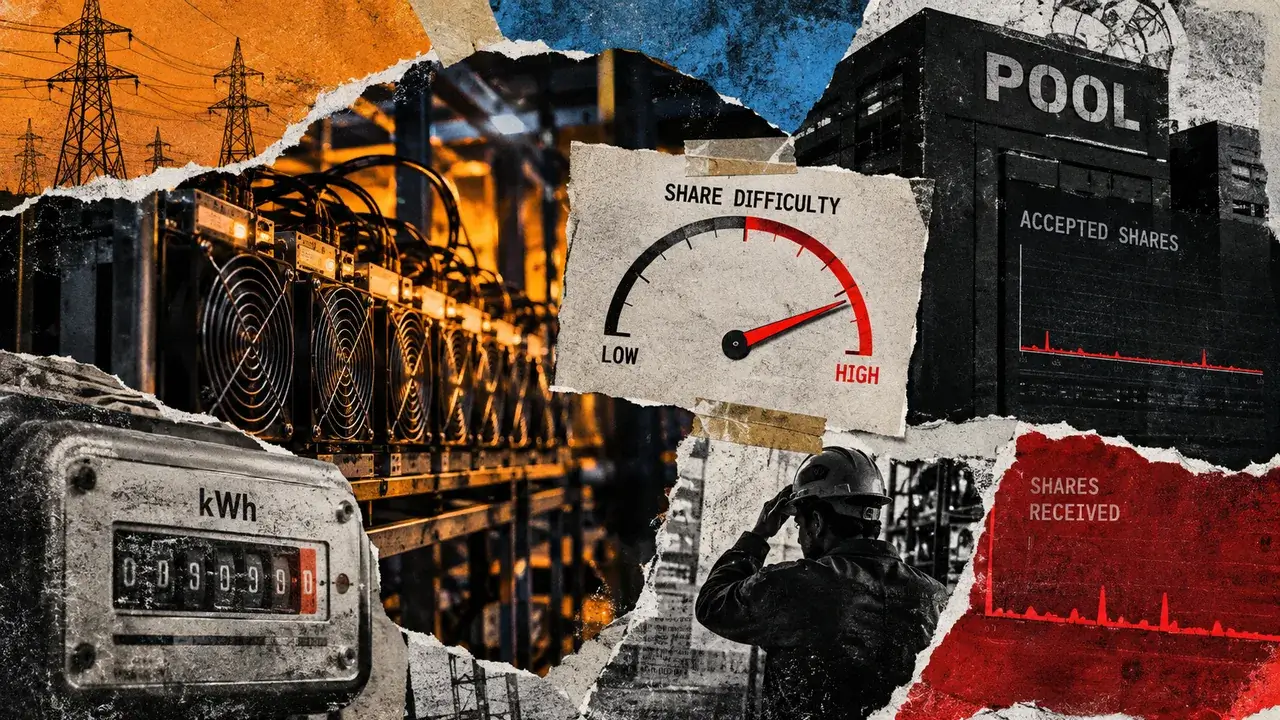
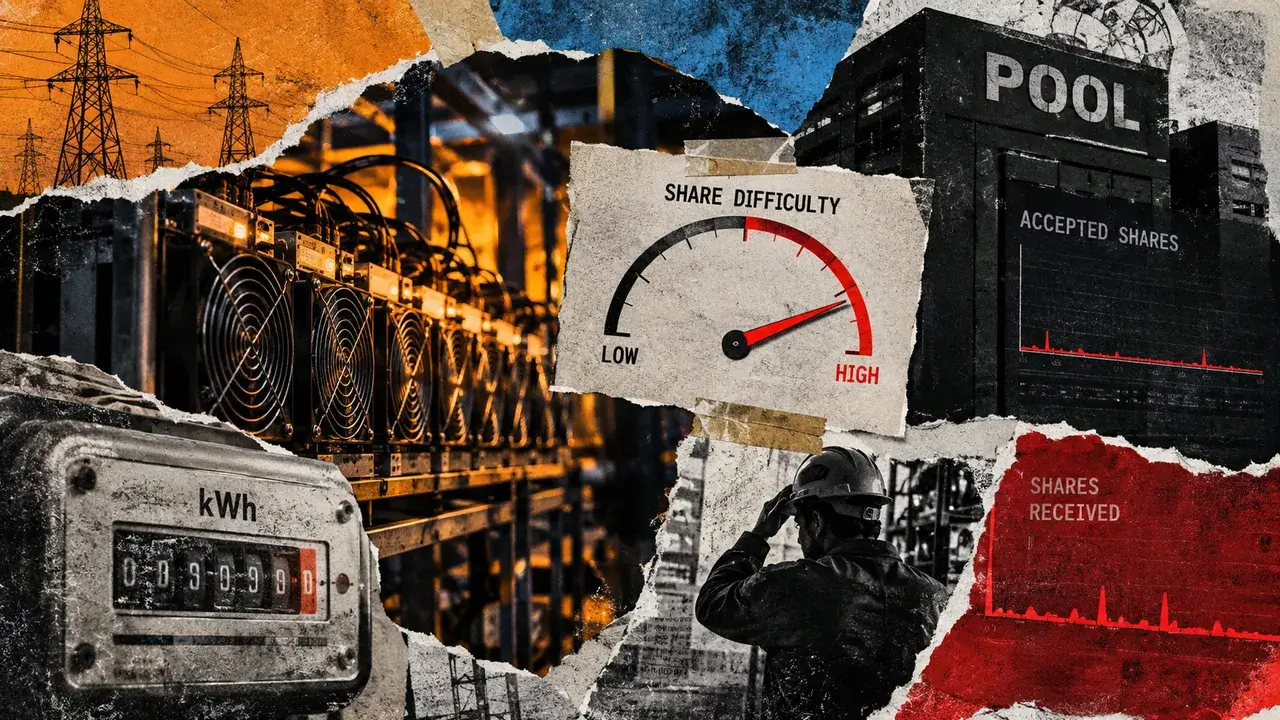
The intricate relationship between Bitcoin mining hardware, pool-side software, and the global energy grid has revealed a counterintuitive technical vulnerability that can lead to significant energy waste during periods of power curtailment. Recent technical analyses suggest that certain variable difficulty (vardiff) controllers, designed to optimize the communication between individual mining rigs and their respective mining pools, can become "trapped" in a high-difficulty state when a miner’s hashrate is abruptly reduced. This failure mode results in a scenario where mining equipment continues to consume electricity and perform intensive computations, yet fails to produce "shares" that are accepted by the pool, effectively rendering the energy consumption useless for the miner’s revenue generation.
The Mechanics of Variable Difficulty and Share Submission
To understand how cutting power can lead to increased energy waste, one must first examine the fundamental architecture of mining pool communication. In the Bitcoin ecosystem, the network difficulty is an incredibly high threshold that determines how hard it is to find a valid block. Because individual miners or small farms have a low probability of finding a block on their own, they join mining pools. To track the work performed by these participants, pools assign a much lower "share difficulty."
A share is essentially a hash that meets a specific target set by the pool, though it may not meet the much harder target required to secure a Bitcoin block. These shares serve as proof of work, allowing the pool to estimate the miner’s hashrate and distribute rewards proportionally. The vardiff controller is a software mechanism within the pool server that dynamically adjusts the share difficulty for each connection. If a miner has a high hashrate, the controller increases the difficulty to prevent the pool from being overwhelmed by a flood of easy shares. Conversely, if the hashrate drops, the controller should lower the difficulty to ensure the miner can still submit shares at a regular interval, typically every 10 to 60 seconds.
The vulnerability arises when the vardiff controller is "share-triggered" rather than "timer-triggered." In a share-triggered system, the controller only re-evaluates and updates the assigned difficulty when a new share is successfully submitted. If a miner’s hashrate is suddenly curtailed—perhaps due to an automated response to high energy prices or a grid stability request—the machine continues to hash at a significantly lower speed. However, because the vardiff controller is still expecting work at the previous, higher difficulty level, the slowed miner may take an exceptionally long time to find a share that meets that high threshold. Without a share submission to trigger a difficulty adjustment, the miner remains stuck attempting to solve work that is statistically too difficult for its current power state.
Chronology of the Discovery and Technical Disclosure
The identification of this specific failure mode follows a timeline of rigorous technical observation within the Bitcoin development community. The issue was brought to the forefront by mining engineer Eric Price, who published a detailed analysis on the "Delving Bitcoin" research forum in July. Price’s research, titled "A clockless vardiff strands a slowing miner," utilized mathematical modeling to demonstrate how a miner could be effectively "orphaned" from the pool’s accounting system during a down-ramp in power.
Following the initial research, the technical newsletter Bitcoin Optech highlighted the failure mode on September 18, 2026, drawing wider industry attention to the risks associated with legacy pool software. The disclosure noted that while this does not affect the overall security of the Bitcoin network—as it concerns pool-assigned share difficulty rather than the global network difficulty—it represents a significant operational risk for industrial-scale mining operations that participate in demand-response programs.
This technical revelation comes at a time when the Bitcoin mining industry is increasingly integrated with national energy grids. For instance, during the severe U.S. winter storms of January 2026, Bitcoin’s global hashrate saw a measurable slump as major North American miners curtailed their operations to return electricity to the grid. While that specific event was not publicly linked to widespread vardiff losses, the occurrence of such sharp network-wide drops underscores the operational reality of abrupt curtailment and the need for robust software controllers.
Economic Implications for Mining Operations
The financial impact of a vardiff trap depends largely on the reward structure employed by the mining pool. Most modern pools utilize either Pay-Per-Share (PPS) or Full Pay-Per-Share (FPPS) models, where miners are paid for every valid share they submit, or PPLNS (Pay-Per-Last-N-Shares), which rewards based on the shares submitted during a specific window before a block is found.
In a PPS model, if a miner is hashing but failing to submit shares because the difficulty is pinned too high, the miner receives zero credit for the electricity consumed during that interval. If the vardiff controller fails to adjust for an hour, the miner effectively "donates" an hour of electricity and hardware wear-and-tear to the void, with no corresponding revenue. In proportional or PPLNS models, the lack of submitted shares can lead to a miner’s contribution being undervalued during a reward window, effectively increasing the share of the rewards for other participants in the pool who did not experience a hashrate drop.
Furthermore, the "realized window" of mining becomes highly volatile. While a high-difficulty share is technically worth more in terms of accounting weight once it is eventually found, the extreme variance introduced by a vardiff trap can lead to long periods of zero income. For industrial miners operating on thin margins, these periods of "invisible hashing" can turn a profitable curtailment event into a net loss.
Technical Solutions and the Role of Stratum V2
The industry has not remained stagnant in the face of these findings. The development of Stratum V2, the next-generation protocol for communication between miners and pools, includes specific architectural improvements designed to mitigate such issues. The reference implementation of Stratum V2 avoids the permanent freeze seen in older systems by utilizing a timer-based recalculation.
Unlike the share-triggered controllers found in older software like "ckpool," a timer-triggered controller periodically checks the hashrate regardless of whether a share has been submitted. If it detects a "share drought," it automatically lowers the difficulty to probe for the miner’s current capability. This ensures that even if a miner is running at 1% of its capacity, it will eventually receive a difficulty assignment that allows it to contribute work and receive credit.
However, researchers note that even with timer-based updates, recovery can be slow on long-lived communication channels. The Stratum V2 protocol itself is a set of specifications, and its effectiveness depends on the specific implementation chosen by pool operators. As of late 2026, the transition from Stratum V1 to V2 is ongoing, and many legacy pools still utilize the older, more vulnerable share-triggered logic.

Diagnostic Tools and Industry Response
To address the lack of empirical data on how common this behavior is, the MARA Foundation—the non-profit arm of one of the world’s largest Bitcoin mining firms—has released an open-source tool called "shape-proxy." This utility allows mining farm operators to simulate hashrate drops without physically powering down their machines.
By using "shape-proxy," an operator can acknowledge shares locally while forwarding only a small fraction of those shares to the pool. This makes the pool "see" an apparent decline in hashrate. Operators can then observe if the pool’s vardiff controller responds by lowering the difficulty or if it remains pinned at the previous high level. This proactive testing allows miners to audit their pool providers and ensure that their curtailment strategies are not being undermined by inefficient software.
Industry reactions have been a mix of technical concern and a call for better standardization. Mining pool operators have been urged to review their vardiff logic, particularly those catering to large-scale institutional miners who are most likely to engage in frequent power scaling. The consensus among mining engineers is that as Bitcoin mining becomes a more integral part of energy grid balancing, the software layers must become as resilient as the hardware.
Broader Impact on Grid Integration and Sustainability
The discovery of the vardiff trap has broader implications for the narrative of Bitcoin mining as a "flexible load" for energy grids. One of the primary arguments for the environmental and social utility of Bitcoin mining is its ability to shut down nearly instantly when the grid is under stress, acting as a "virtual battery." However, if the software controlling these transitions is inefficient, the "flexible" nature of the load is compromised.
If a miner reduces its power consumption by 50% but, due to a vardiff error, continues to waste the remaining 50% of its power on unrewarded computation, the total efficiency of the system drops. For grid operators, the predictability of the load is paramount. For miners, the ability to accurately calculate the opportunity cost of curtailment is essential for participation in demand-response programs.
As the Bitcoin network continues to mature, with a market capitalization exceeding $1.6 trillion and a circulating supply approaching its 21-million-coin limit, the focus is shifting from raw hashrate growth to operational efficiency. Addressing the vardiff failure mode is a critical step in this evolution. It represents a move toward a more sophisticated, transparent, and energy-efficient mining ecosystem where every watt of electricity consumed is accurately accounted for and rewarded.
In conclusion, the "vardiff trap" serves as a reminder that in the highly technical world of cryptocurrency infrastructure, small software oversights can have outsized real-world consequences. By transitioning to timer-triggered controllers and adopting more advanced protocols like Stratum V2, the mining industry can ensure that when they choose to cut power, they are truly saving energy rather than simply burning it in the dark.