Dwi Wanna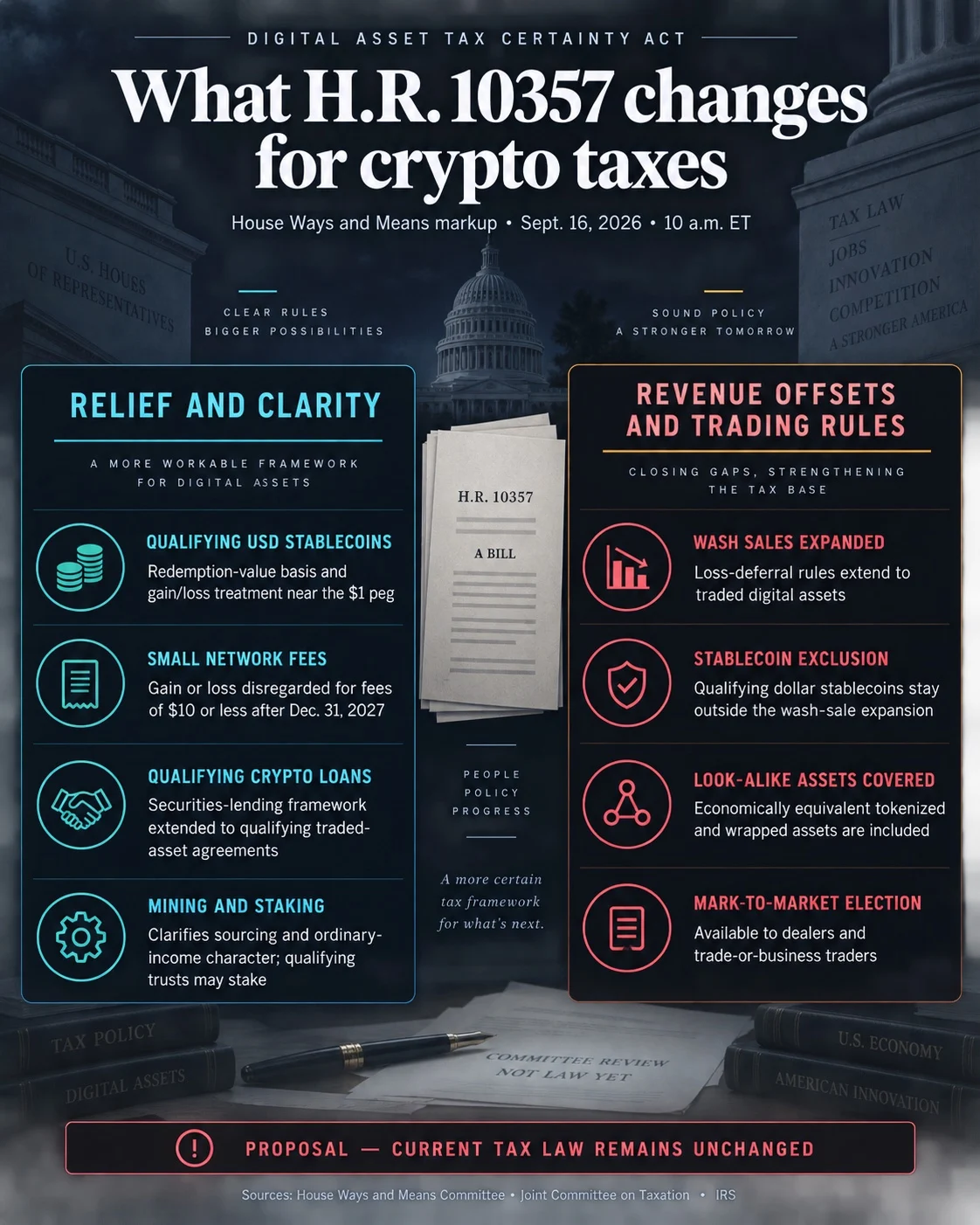
The House Ways and Means Committee is set to deliberate on H.R. 10357, formally known as the Digital Asset Tax Certainty Act, on September 16, marking a pivotal moment in the federal government’s decade-long effort to integrate cryptocurrencies into the American tax code. This legislative package represents the culmination of months of bipartisan negotiations aimed at reconciling the unique technical nature of digital assets with the established principles of the Internal Revenue Code. By introducing a blend of taxpayer relief for everyday transactions and stringent new regulations for professional traders, the bill seeks to generate a net increase of approximately $500 million in federal receipts over the 2027–2036 fiscal window.
The Joint Committee on Taxation (JCT) provided a detailed fiscal analysis of the proposal, revealing a complex balancing act between revenue-generating enforcement measures and revenue-reducing administrative easements. The legislation targets several "friction points" that have historically made the use of digital assets for payments cumbersome, while simultaneously closing loopholes that have allowed crypto investors to enjoy tax advantages not available to traditional equity or bond market participants.
The Fiscal Architecture of H.R. 10357
The $500 million net revenue projection is the result of significant fluctuations in specific tax categories. According to the JCT, the most substantial revenue loss stems from a proposed $10 de minimis exclusion for network and transaction fees. This provision, which would exempt gains or losses triggered when digital assets are used to pay blockchain "gas" fees or liquidity charges, is estimated to reduce federal receipts by $2.365 billion through 2036. Lawmakers argue this cost is necessary to facilitate the functional use of blockchain technology, as the current requirement to calculate capital gains on a $2 transaction fee is a significant barrier to adoption.
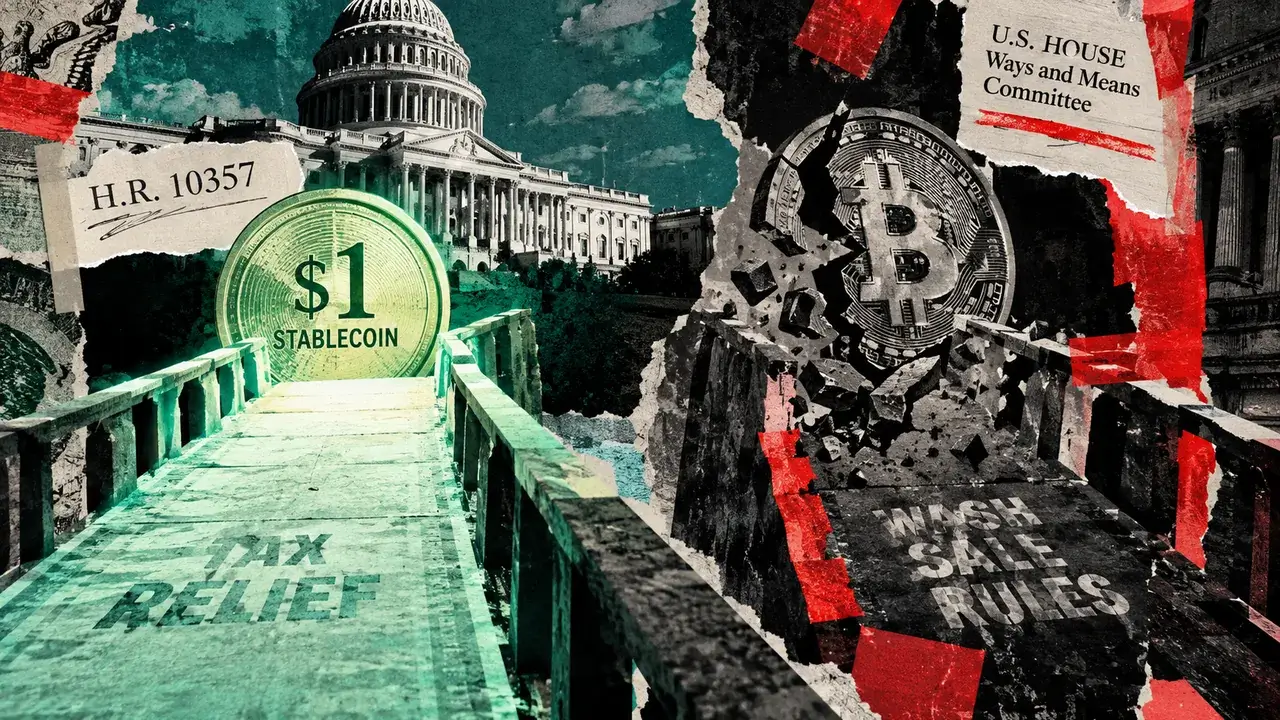
To offset these losses, the bill introduces two major revenue-raising provisions targeting professional and high-frequency traders. First, it extends the "wash sale" rules found in Section 1091 of the Internal Revenue Code to digital assets. Currently, crypto investors can sell an asset at a loss and immediately repurchase it to claim a tax deduction—a strategy prohibited in the stock market. Closing this loophole is expected to raise $1.707 billion. Second, the bill expands access to "mark-to-market" accounting for digital asset dealers and traders. While this provides administrative simplicity for professionals, the JCT estimates the transition to this accounting method will generate an additional $2.332 billion in revenue as unrealized gains are brought into the tax net more efficiently.
Stablecoin Normalization and Payment Relief
One of the most anticipated elements of the Digital Asset Tax Certainty Act is the specialized treatment of qualifying U.S. dollar stablecoins. Under current IRS guidance, every time a consumer uses a stablecoin to purchase goods or services, they technically trigger a taxable event. Even if a stablecoin is pegged to $1.00, minor fluctuations (e.g., a move to $0.999 or $1.001) require the user to calculate and report a micro-gain or loss.
H.R. 10357 addresses this by mandating that the redemption value generally determines the basis and proceeds for qualifying transactions, provided the stablecoin remains within a prescribed "peg band." This effectively treats the stablecoin as a cash equivalent for tax purposes within those narrow margins. However, the bill includes safeguards to prevent abuse: the relief is restricted to taxpayers completing fewer than 5,000 transactions annually and excludes professional brokers, dealers, and those whose functional currency is not the U.S. dollar.
Crucially, the legislation stops short of creating a general tax exemption for purchases made with volatile assets like Bitcoin or Ethereum. While transaction fees up to $10 are exempt, the underlying purchase of a product or service remains a realization event. This distinction highlights the committee’s intent to promote stablecoins as a medium of exchange while maintaining the classification of other cryptocurrencies as taxable property.
Parity in Lending and Institutional Staking
The bill also seeks to bring digital asset lending into alignment with the rules governing securities lending. In the current environment, uncertainty persists over whether transferring crypto to a platform or borrower under a lending agreement constitutes a "sale" for tax purposes. H.R. 10357 proposes that qualifying lending arrangements avoid the immediate recognition of gains or losses, provided the borrower returns an equivalent asset and the economic terms of the transaction meet specific criteria.
For institutional investors, the bill provides a significant clarification regarding investment trusts. Under existing rules, a trust risks losing its tax-transparent status if it engages in certain active business activities. The new legislation specifies that a trust will not lose its status solely because the trustee stakes the digital assets held by the vehicle to earn rewards. This change is expected to pave the way for more "staked" Exchange Traded Products (ETPs), allowing institutional vehicles to pass staking yields through to investors without jeopardizing their tax structure.
However, the treatment of individual miners and stakers remains more conservative. The bill classifies validation income—the rewards earned for securing a network—as ordinary income. Furthermore, it reinforces the "receipt" timing framework, meaning rewards are taxed the moment the taxpayer gains "dominion and control" over them. This is a setback for industry advocates who had lobbied for a "deferral" model, where taxes would only be owed when the newly minted or staked coins are eventually sold for fiat currency.
Historical Context and the Path to Compliance
The push for H.R. 10357 comes after years of ambiguity following the IRS’s initial 2014 guidance (Notice 2014-21), which first defined virtual currency as property. Since then, the growth of Decentralized Finance (DeFi) and the proliferation of tokens have outpaced the government’s ability to provide clear instructions. The 2021 Infrastructure Investment and Jobs Act introduced broader "broker" reporting requirements, but many in the industry argued those rules were too broad and failed to account for the decentralized nature of blockchain technology.
To address the backlog of non-compliance resulting from this era of ambiguity, H.R. 10357 directs the Treasury Department to establish a Digital Asset Voluntary Disclosure Program. This "amnesty-lite" initiative would allow eligible taxpayers to correct past filing errors, pay outstanding liabilities and interest, and potentially receive relief from the more draconian penalties associated with tax evasion or failure to report foreign bank and financial accounts (FBAR).
Andrew Gordon, a prominent crypto tax attorney, noted that the bill represents a transition from the "enforcement-only" era to a "rules-based" era. "This is a massive step forward for crypto investors who simply want rules on tax," Gordon stated. "We all pay taxes; the rules need to be clear. This bill provides the roadmap that has been missing for the last decade."
Timeline and Legislative Outlook
The September 16 markup by the House Ways and Means Committee is the first major hurdle for the Digital Asset Tax Certainty Act. During this process, committee members from both parties will have the opportunity to propose amendments. Given the bill’s impact on federal revenue, the debate is expected to focus heavily on the JCT’s projections and whether the revenue raised from wash-sale restrictions is sufficient to cover the "cost" of the stablecoin and fee exemptions.
If the bill passes the committee, it must then move to the House floor for a full vote. Its prospects in the Senate remain less certain, as the upper chamber has historically taken a more skeptical view of digital asset tax relief. Furthermore, any legislation passed in the current session must contend with a crowded legislative calendar dominated by appropriations and the upcoming election cycle.
Analysis: Implications for the Digital Economy
The Digital Asset Tax Certainty Act is more than just a collection of tax tweaks; it is a strategic attempt to define the "permissible" use cases for digital assets in the United States. By easing the burden on stablecoins and small fees, Congress is signaling a desire to see blockchain technology used for payments and micro-transactions. Conversely, by imposing wash-sale rules and mark-to-market accounting, it is signaling that the era of "regulatory arbitrage" for crypto traders is coming to an end.
For the DeFi sector, the $10 fee exemption is a significant win. Many smart contract interactions involve multiple small fees that, under current law, create a nightmare of record-keeping. Eliminating the tax consequences for these fees could significantly lower the barrier to entry for decentralized applications.
For the broader financial market, the bill’s emphasis on "certainty" is its most valuable attribute. Institutional capital often sits on the sidelines not because of tax rates, but because of tax uncertainty. By codifying the treatment of lending, staking, and trust structures, H.R. 10357 provides the legal infrastructure necessary for the next wave of institutional adoption. Whether the bill becomes law in its current form or serves as a template for future sessions, it marks the most comprehensive attempt to date to modernize the American tax system for the digital age.