admin
admin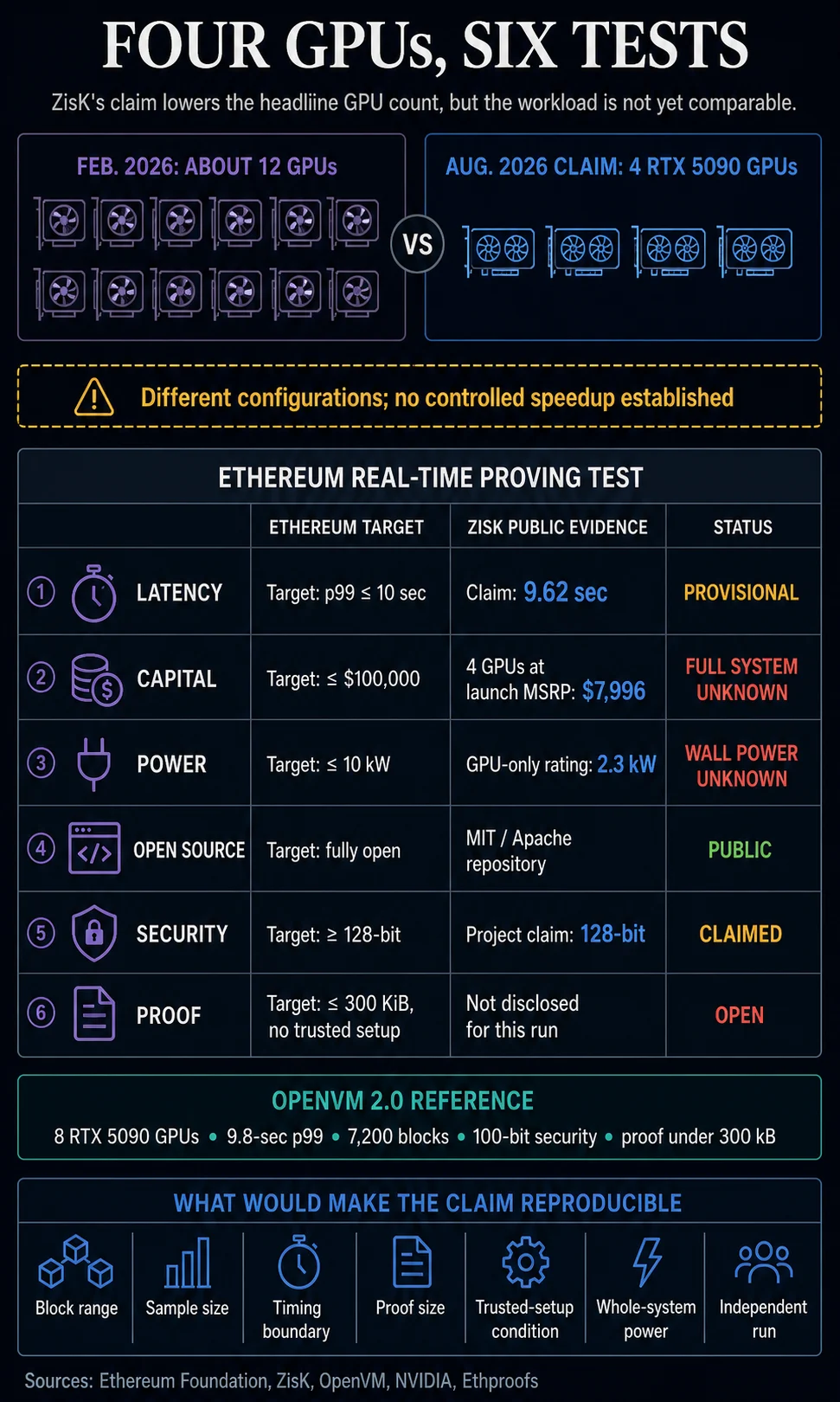
The pursuit of efficient and decentralized proof generation for Ethereum’s evolving infrastructure has taken a significant turn with ZisK, an open-source zero-knowledge virtual machine project, announcing a benchmark claim involving a four-GPU setup. This development potentially lowers the hardware barrier for independent operators to participate in the real-time proving race, a critical component of Ethereum’s future scalability and security. Previously, in February, concerns were raised about a roughly 12-GPU configuration posing a centralization risk. ZisK’s latest assertion, if validated under comparable workloads and operating conditions, could bring proof generation closer to the reach of a broader range of participants, a move long sought by the Ethereum community.
On August 18, ZisK declared that its v1.1.0-alpha prover achieved a p99 (99th percentile) latency of 9.62 seconds utilizing four NVIDIA RTX 5090 GPUs. Further details indicated that 99.7% of tested Ethereum blocks were proven in under 10 seconds. Jordi Baylina, a prominent figure in the ZK space, amplified this announcement, characterizing it as a milestone that combines four-GPU proving capabilities with claimed 128-bit security and post-quantum resistance.
Ethereum’s established working standard for real-time proving mandates that at least 99% of mainnet blocks must be proven within a 10-second window. If ZisK’s p99 metric was calculated over a workload and timing boundary equivalent to that of mainnet blocks, the reported 9.62 seconds would fall comfortably 0.38 seconds below this critical threshold. However, a crucial caveat remains: ZisK has yet to publicly disclose the specific block range, sample size, methodology for p99 calculation, exact timing boundary, proof size, or the measured whole-system power consumption for this four-GPU run. Consequently, this announcement currently stands as a benchmark claim, awaiting independent verification and comprehensive data.
The Six Pillars of Ethereum’s Real-Time Proving Standard
The Ethereum Foundation has not only focused on latency but has also established a comprehensive framework of six criteria designed to safeguard decentralization in its real-time proving ecosystem. These criteria include:
- Capital Cost: On-premises equipment must not exceed a budget of $100,000.
- Power Consumption: Total power usage should remain at or below 10 kilowatts.
- Code Openness: All associated code must be fully open-source.
- Security Level: A minimum security of 128 bits is mandated.
- Proof Size: Proofs should not exceed 300 KiB.
- Trusted Setups: No trusted setups should be required for proof generation.
The Ethereum Foundation’s emphasis on the 128-bit security threshold has been a consistent theme in its recent publications and strategic directives, aiming to ensure robust cryptographic integrity against future computational advancements.
ZisK’s project repository, available under the permissive MIT or Apache 2.0 licenses, aligns with the open-source criterion. The project also claims 128-bit security for its latest benchmark, addressing another key requirement. However, the latency condition remains provisional due to the absence of specific workload and measurement details that are essential for a direct, equivalent comparison with Ethereum’s mainnet block proving.
Hardware Practicality and Cost Analysis
From a hardware perspective, ZisK’s utilization of four RTX 5090 GPUs presents a promising picture. NVIDIA specifies a total graphics power (TGP) of 575 watts for a single RTX 5090. Thus, four cards would have a combined GPU-only power draw of approximately 2.3 kW. This figure is well within the 10 kW ceiling set by the Ethereum Foundation, even before factoring in the power requirements for CPUs, memory, storage, power conversion losses, and cooling systems.
The capital cost associated with this hardware is also noteworthy. NVIDIA launched the RTX 5090 at a manufacturer’s suggested retail price (MSRP) of $1,999. Consequently, a four-GPU setup would cost around $7,996 at launch MSRP. This expenditure leaves substantial room within the $100,000 budget for other essential components of a multi-GPU proving machine, such as high-performance CPUs, ample RAM, robust storage solutions, and a reliable power supply unit.
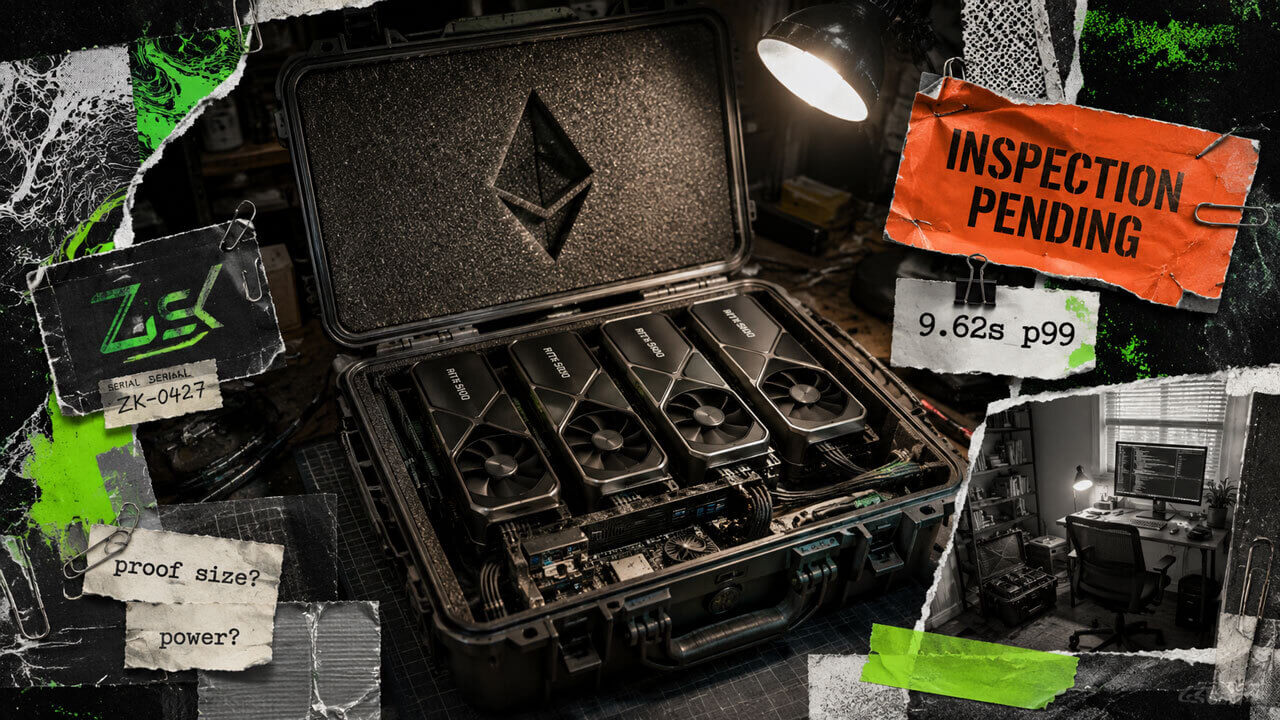
However, even within a nominal budget, assembling a rig capable of efficient proof generation can present significant practical challenges. Smaller operators might encounter limitations in their existing power delivery infrastructure, cooling capacity, or the host hardware’s ability to support such a demanding setup. Beyond hardware, the speed of proof generation must also adhere to Ethereum’s stringent rules regarding proof size and the elimination of trusted setups.
Comparative Benchmarking: ZisK vs. OpenVM 2.0
To better understand the significance of ZisK’s announcement, it is beneficial to compare it with other publicly available benchmarks. OpenVM, another ZK-EVM project, released its production version 2.0 in July, reporting a p99 latency of 9.8 seconds using eight RTX 5090 GPUs. This benchmark was conducted over 7,200 Ethereum mainnet blocks, starting from block 24,000,000. The OpenVM 2.0 run utilized 100-bit provable security and generated proofs under 300 KiB.
While ZisK’s four-GPU claim may indeed represent a genuine advancement in efficiency, the lack of equivalent inputs in its announcement makes a direct, reliable ranking difficult. The security levels differ, ZisK has not yet specified the proof size for its four-GPU result, and the exact block population and timing boundary used in its test remain unpublished.
The Ethproofs API, a key resource for understanding ZK-EVM performance, defines proving time as encompassing witness generation but excluding data fetching and proof submission latency. A p99 calculated over a different interval or under varying conditions can yield superficially similar results while masking significant differences in the operational burden. Currently, Ethproofs lists ZisK versions up to v0.18.0 and features a 16-GPU RTX 5090 configuration. An independent benchmark for the four-GPU v1.1.0-alpha p99 is not yet available on Ethproofs, leaving ZisK’s latest announcement without a public baseline for reproducibility.
ZisK’s release history indicates that v1.1.0-alpha is indeed the designation for this version. The project’s repository describes this line of development as a foundational element for a production release that is currently undergoing rigorous security and correctness audits. An OpenZeppelin review, published in November 2025, examined a limited set of ZisK’s binary and main constraints at a historical commit. This review identified 13 findings, including one critical and two high-severity issues, none of which were marked as resolved in that particular report.
Implications for Decentralization and Future Development
The narrative surrounding GPU requirements for Ethereum proving has evolved significantly. CryptoSlate’s February analysis highlighted a roughly 12-GPU setup, achieving a seven-second proof time, as a potential new centralization risk. ZisK’s current claim of a four-GPU setup directly contrasts with this earlier concern. While the hardware configurations are not directly equivalent, the reduction in the number of GPUs required is a substantial development for aspiring independent operators.
For ZisK’s claim to be fully substantiated and to represent a true breakthrough for home-based proving, several critical pieces of information are needed. These include:
- A disclosed set of mainnet blocks used for testing.
- A complete definition of the timing parameters and measurement methodology.
- Proof sizes consistently below 300 KiB without reliance on trusted setups.
- Measured wall power consumption for the entire system.
- An independently runnable release that allows for public verification.
Until these details are provided, ZisK’s announcement, while promising, remains a benchmark claim. It has, however, effectively weakened the argument that proof generation is solely feasible at a data-center scale. The operational case for independent participation is now more plausible, shifting the focus to the verifiable evidence needed to confirm this potential.
The ongoing development in ZK-EVM technology, exemplified by ZisK’s advancements and the established benchmarks from projects like OpenVM, underscores the rapid progress being made towards achieving Ethereum’s scalability and decentralization goals. The community eagerly awaits further details and independent verification to fully assess the impact of ZisK’s latest achievement on the future of Ethereum’s real-time proving infrastructure. The journey towards accessible and secure decentralized proving continues, with each new benchmark bringing the ecosystem closer to its aspirational targets.