admin
admin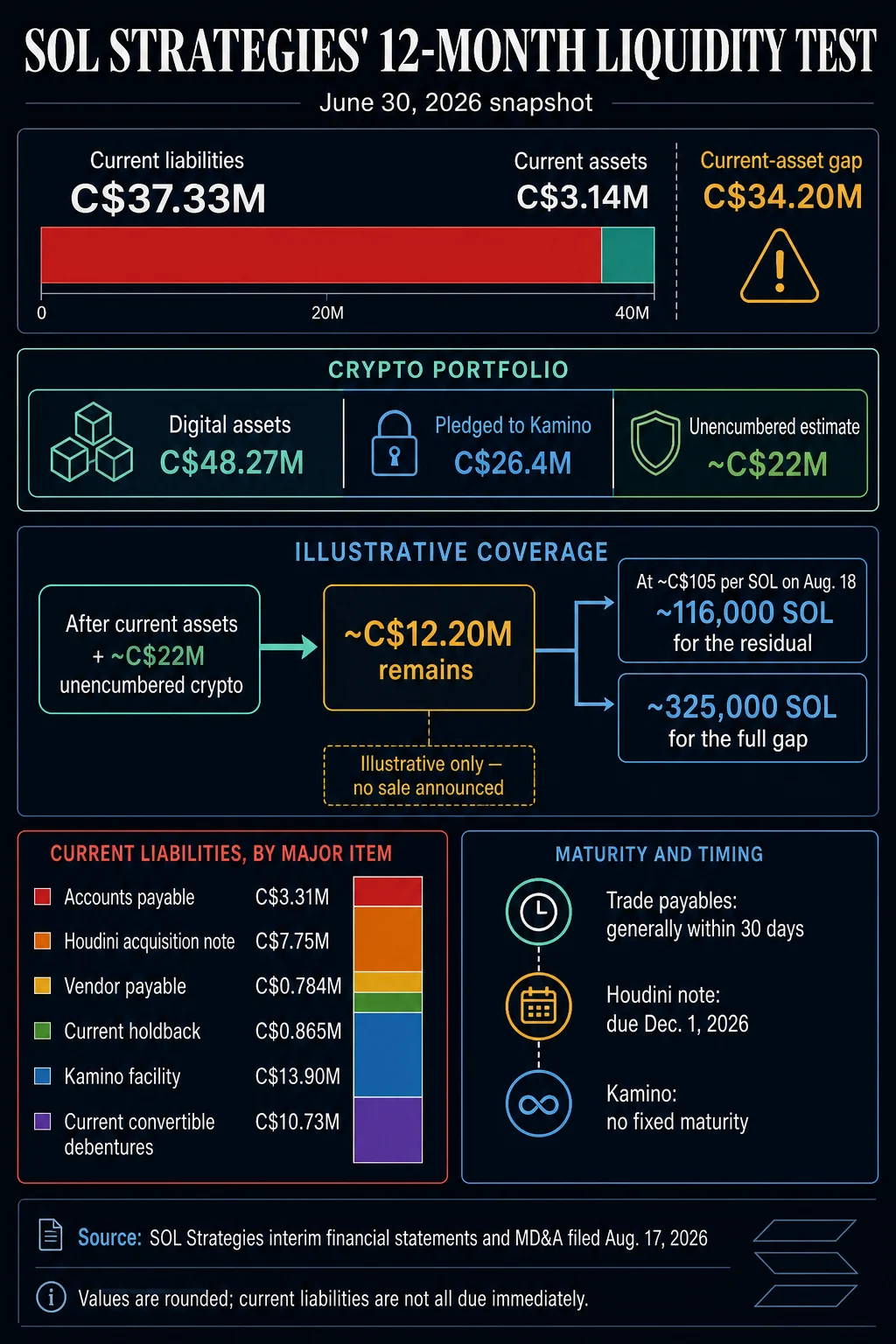
SOL Strategies, a company deeply invested in the Solana ecosystem, is reportedly considering the sale of a portion of its substantial Solana (SOL) treasury holdings to meet its immediate financial obligations. This strategic move comes as a significant portion of the company’s digital asset reserves remain pledged as collateral against existing debts, creating a delicate liquidity balance. The company’s recent SEC filing for the period ending June 30, 2026, reveals a complex financial picture, highlighting both the scale of its Solana exposure and the pressing need for capital.
The filing indicates that SOL Strategies held approximately C$1.87 million in cash as of June 30, 2026. While this provides a baseline level of liquidity, the company’s primary source of readily available capital lies in its digital assets. Roughly C$22 million worth of digital assets were reported as unencumbered and available for conversion into fiat currency, offering a crucial buffer against its liabilities. However, this figure is dwarfed by the company’s current liabilities, which stand at a considerable C$37.33 million. It is crucial to note that these obligations are not consolidated into a single immediate payment but are instead staggered over varying repayment schedules, offering SOL Strategies some flexibility in managing its cash flow.
Unpacking the Liability Structure
A detailed breakdown of SOL Strategies’ current liabilities paints a comprehensive picture of the company’s financial commitments. The C$37.33 million comprises several key components. Accounts payable, representing routine operational expenses and invoices from vendors, amount to approximately C$3.31 million. A significant portion of the company’s short-term debt stems from its acquisition of HoudiniSwap, with a note for this transaction valued at C$7.75 million. Further operational expenses include C$784,000 owed to a vendor.
Adding to the immediate financial pressures is a C$865,000 current acquisition holdback, likely related to the HoudiniSwap deal or other recent strategic acquisitions. Perhaps the most substantial short-term liability is the C$13.90 million borrowed through the decentralized finance (DeFi) protocol Kamino Finance. This significant DeFi exposure underscores the company’s reliance on the burgeoning DeFi lending market within the Solana ecosystem. Finally, C$10.73 million in current convertible debentures represent debt that could potentially be converted into equity, adding another layer of complexity to the company’s capital structure.
A Varied Repayment Timeline
The staggered nature of these liabilities provides SOL Strategies with a degree of breathing room, as not all obligations are due concurrently. Trade payables are typically settled within 30 days, a standard business practice. The HoudiniSwap acquisition note, however, has a more defined maturity date of December 1, 2026, requiring focused attention as the deadline approaches. The US$1.25 million Houdini acquisition holdback is structured into two payments, due nine and 18 months after the June 1, 2026 closing date, indicating a phased repayment strategy for this component.
The Kamino Finance borrowing presents a unique repayment profile. Unlike traditional loans with fixed maturity dates, this DeFi facility carries no fixed maturity. This offers flexibility but also introduces the risk of automatic liquidation if certain conditions are met. Meanwhile, some of the convertible debentures have conversion or maturity dates extending well into the future, with some stretching as far as 2028 and 2030. This long-term debt structure, while not an immediate cash drain, represents a significant future financial commitment.
Strategic Liquidity Management Plan
In response to these financial considerations, SOL Strategies’ management has outlined a multi-faceted liquidity plan. This strategy encompasses several key initiatives aimed at bolstering cash reserves and managing outstanding debts. Significant cost reductions are reportedly being implemented across the organization to streamline operations and conserve capital. Furthermore, the company anticipates generating revenue from its staking and validator operations, as well as through fees generated by its HoudiniSwap business.
The potential sale of SOL is explicitly mentioned as a selective strategy to enhance liquidity. This option, while potentially impactful, also carries implications for the company’s overall exposure to the Solana cryptocurrency. To further strengthen its financial position, SOL Strategies is exploring the issuance of new securities, which could dilute existing shareholder equity but provide necessary capital. Additionally, the company is considering further borrowing through its existing ATW convertible note facility, a move that would increase its overall debt burden but could provide immediate liquidity.

The Double-Edged Sword of the SOL Treasury
The company’s substantial treasury of approximately 460,000 SOL, valued at C$48 million at the end of the quarter, is central to its financial strategy. This significant holding represents a substantial asset, but also a point of vulnerability. A critical detail revealed in the SEC filing is that more than half of these holdings are not freely available. Specifically, 252,851 SOL, valued at C$26.4 million, have been pledged to Kamino Finance as collateral against the roughly C$13.9 million in debt.
This collateralization strategy, while enabling access to capital, exposes SOL Strategies to significant market risk. The absence of a fixed maturity date for the Kamino loan means that if the loan-to-value ratio reaches 75%, Kamino Finance has the right to automatically liquidate the collateral. This scenario could lead to substantial losses for SOL Strategies if the price of SOL experiences a sharp decline, forcing the company to sell its pledged assets at a disadvantageous rate.
Despite this pledged collateral, SOL Strategies asserts that its digital assets provided approximately C$34 million in net liquidity after accounting for the Kamino borrowing. Management also expressed confidence that its available cash, cryptocurrencies, and other resources are sufficient to support operations for at least the next 12 months, suggesting a belief in their ability to navigate the current financial landscape.
A Significant Net Loss Amidst Operational Cash Flow
The financial statements for the nine months ending June 30, 2026, reveal a substantial net loss of C$119.36 million. This significant accounting loss is primarily driven by non-cash items, including C$61.95 million in digital-asset revaluation losses, C$22.82 million in realized crypto losses from asset sales, and C$16.11 million in impairment charges. These figures reflect the volatile nature of digital asset markets and the accounting implications of holding such assets.
Crucially, the actual cash outflow from operations during this period was considerably lower. SOL Strategies utilized C$7.80 million in cash for operating activities, indicating that the reported net loss was largely a consequence of accounting adjustments rather than a direct depletion of cash reserves. This distinction is important for understanding the company’s true operational cash burn.
SOL Sales: A Proven Debt Reduction Tactic
The potential sale of SOL as a liquidity measure is not merely a theoretical option for SOL Strategies; it is a strategy that has already been employed. On June 8, 2026, the company executed a sale of 65,001 SOL at an average price of C$87.88 per token, generating approximately C$5.75 million. This capital was explicitly used to repay existing debt, demonstrating the company’s willingness to leverage its SOL holdings to manage its liabilities.
While selling SOL can provide immediate capital, it also reduces the company’s direct exposure to potential future appreciation of the cryptocurrency. To mitigate this, SOL Strategies has explored alternative capital-raising avenues. These include the conversion of ATW debt into equity, which saw US$2.85 million converted into approximately 1.78 million shares during the nine-month period. Additionally, the company raised C$2.14 million through its at-the-market equity program, a method that allows for the gradual sale of shares to the public.
Diversifying Revenue Streams and Future Challenges
The acquisition of HoudiniSwap appears to be contributing positively to the company’s revenue. In June 2026 alone, the business generated C$1.2 million in fees and C$768,000 in EBITDA (Earnings Before Interest, Taxes, Depreciation, and Amortization). Staking and validator operations also provided a steady income stream, contributing C$622,299 during the third quarter. These revenue-generating segments offer a potential path to reducing reliance on asset sales and external financing.
However, the near-term challenge for SOL Strategies lies in the ability of these diversified revenue streams to generate sufficient cash to meet its staggered obligations. The success of this strategy will be critical in determining whether the company can avoid substantially increasing its SOL sales or resorting to further shareholder dilution to maintain its financial stability. The interplay between its substantial SOL treasury, its existing debt obligations, and its operational revenue generation will be closely watched by investors and market observers within the dynamic Solana ecosystem.