Dwi Wanna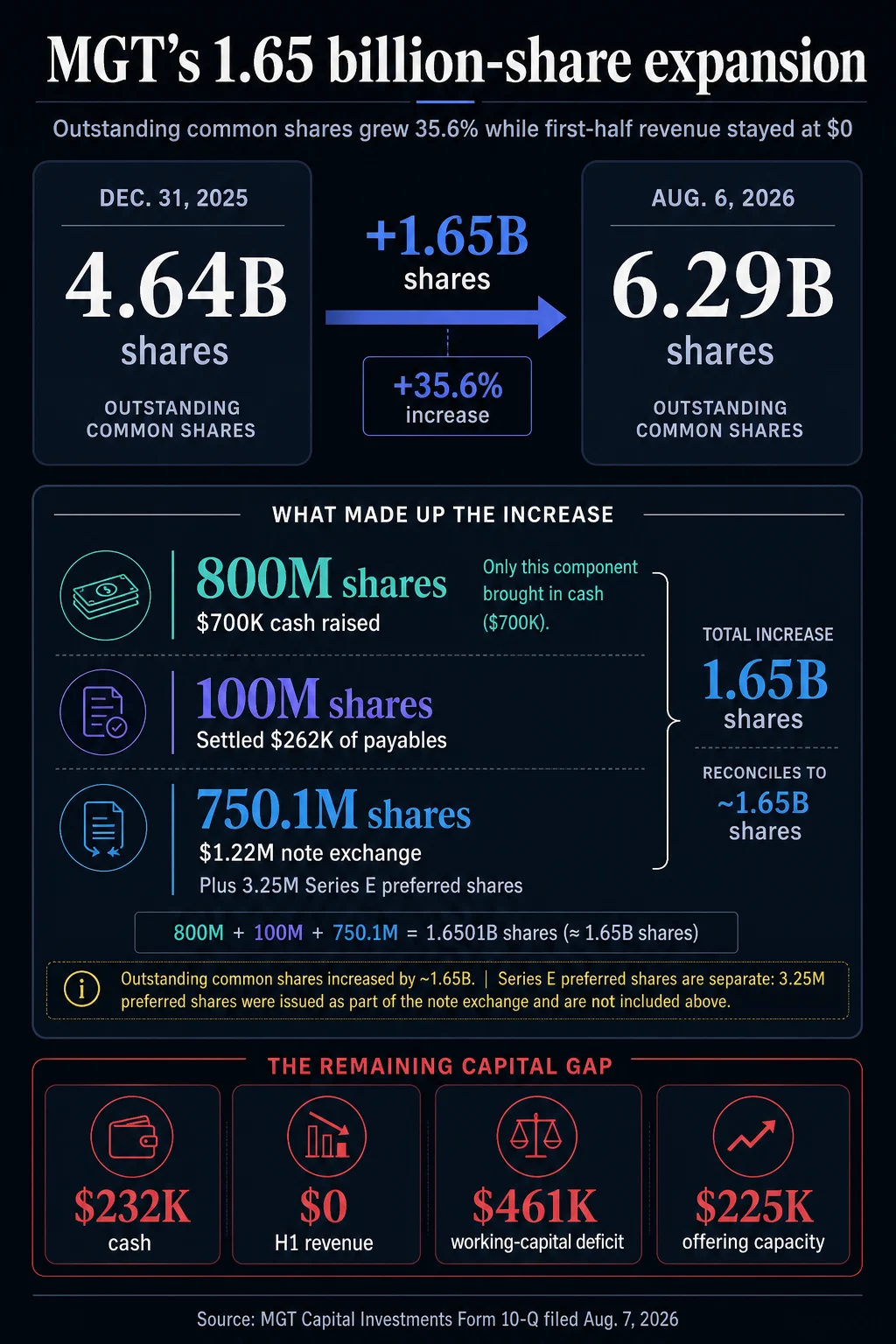
MGT Capital Investments (MGT), a once-active player in the cryptocurrency mining sector, has reported a dire financial state for the first half of 2026, characterized by a complete lack of operational revenue and a massive expansion of its share count to maintain liquidity. According to its most recent quarterly filing with the Securities and Exchange Commission (SEC), submitted on August 7, 2026, the company issued approximately 1.65 billion common shares between the end of 2025 and August 6, 2026. This move, representing a 35.6% increase in outstanding stock, was executed as the firm struggled to manage a working capital deficit and a lack of active mining operations.
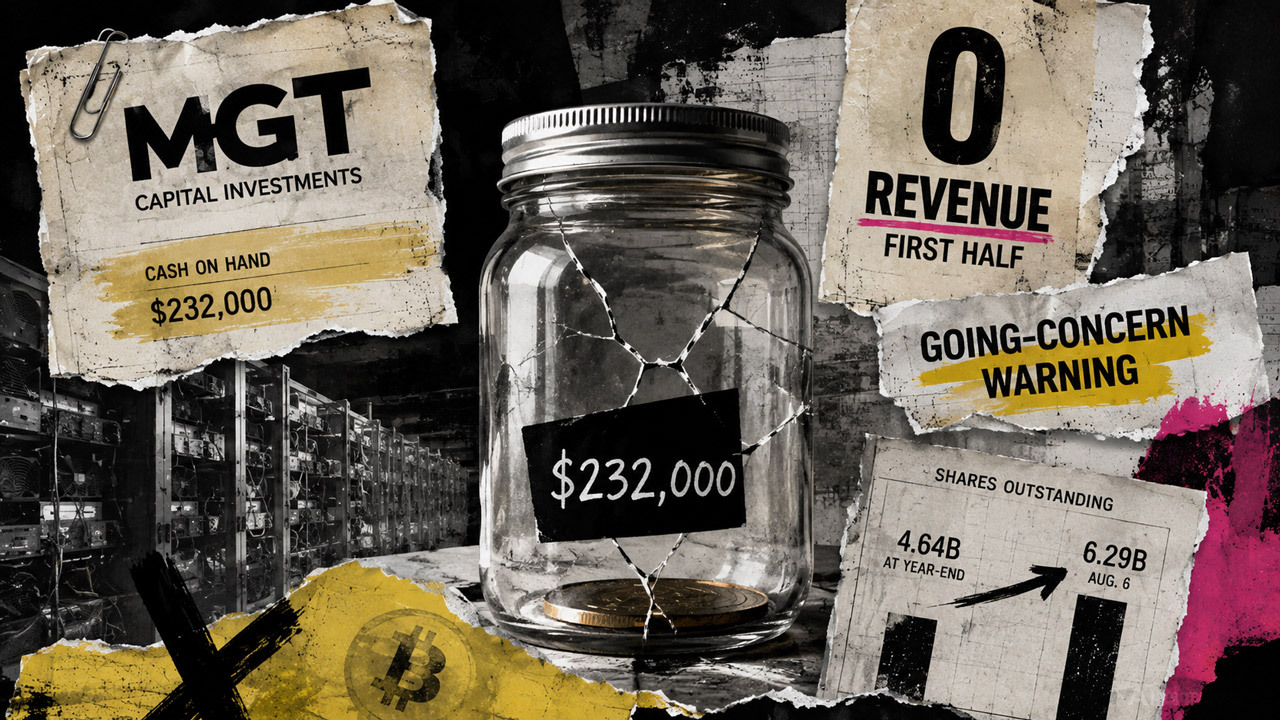
The financial data paints a picture of a company in a state of suspended animation. For the six-month period ending June 30, 2026, MGT recorded zero dollars in revenue from its mining or hosting activities. This total operational standstill follows the expiration of its primary hosting contract in March 2025 and the subsequent sale of its LaFayette, Georgia, mining facility in May 2025. Despite holding 35 Antminer S19 Pro machines in storage—hardware that was once at the cutting edge of the industry—the company has been unable to deploy them profitably or secure a new hosting arrangement.
Financial Breakdown of Share Issuance and Debt Restructuring
The increase in common shares from 4.64 billion at the close of 2025 to 6.29 billion by early August 2026 was not a singular event but a series of calculated moves to address different financial pressures. Of the 1.65 billion new shares, only a portion directly contributed to the company’s cash reserves. Specifically, MGT sold 800 million common shares to raise $700,000 in cash. While this provided a temporary lifeline, the effective price per share in these transactions underscores the highly diluted nature of the company’s equity.
In addition to cash raises, the company utilized its equity as a currency to settle outstanding obligations. Approximately 100 million shares were issued to settle $262,000 in accounts payable, a move that allowed the company to reduce its immediate debt without depleting its meager cash reserves. However, the most significant block of shares was issued as part of a complex debt-for-equity swap. On June 30, 2026, MGT issued 750.1 million common shares and 3.25 million Series E convertible preferred shares to retire a secured convertible note valued at $1.22 million.
The accounting treatment of this debt retirement resulted in a $2.81 million non-cash loss on debt extinguishment. This single accounting entry was the primary driver behind MGT’s $2.96 million net loss for the first half of the year. Beyond the paper losses, the company’s actual cash burn remained a concern, with $531,000 used in operating activities during the period. As of the filing date, the company reported total assets of just $232,000 against current liabilities of $693,000, leaving a working-capital deficit of $461,000.
A Timeline of Operational Decline
The current predicament is the culmination of a multi-year decline in MGT’s operational capacity. To understand the company’s current "zombie" status, one must look at the sequence of events that led to the idling of its fleet:
- March 2025: The company’s primary hosting contract expires. Without a facility to house its machines and access to competitive power rates, MGT is forced to cease self-mining operations.
- May 13, 2025: In an effort to shore up its balance sheet, MGT sells its LaFayette, Georgia, mining site. While the sale provided an immediate influx of capital, it stripped the company of its primary physical infrastructure.
- Late 2025 – Early 2026: The company enters a period of total inactivity regarding revenue generation. Its remaining 35 Antminer S19 Pro machines are moved into storage.
- December 2025 – June 2026: MGT engages in a series of equity offerings and private placements to cover administrative costs and executive salaries, raising approximately $975,000.
- July 20, 2026: The company issues a corporate update announcing the appointment of new directors and a commitment to evaluating "growth opportunities."
- August 7, 2026: The SEC filing confirms that the company has no revenue and warns of "substantial doubt" regarding its ability to continue as a going concern.
The Technical Reality of Idle Hardware
The 35 Antminer S19 Pro machines currently held in storage by MGT represent a vestige of its former mining ambitions. At its peak, the S19 Pro was a workhorse of the Bitcoin network, offering a hashrate of 110 TH/s with an efficiency of roughly 29.5 J/TH. However, in the context of the 2026 mining landscape, these machines face significant headwinds.
With the Bitcoin network difficulty continuing to climb and more efficient models like the Antminer S21 and T21 series dominating the market, the window for profitably deploying S19 Pros is rapidly closing. For a company like MGT, which lacks its own power infrastructure, the cost of third-party hosting would likely exceed the value of the Bitcoin produced by these 35 machines. This explains why the hardware remains in storage; without a massive scale-up or a pivot to a different business model, the fleet is effectively obsolete.
Management’s Search for a "Restart"
In its July 2026 update, MGT management expressed optimism about a potential turnaround, citing the appointment of new board members as a step toward "positioning for growth." The company stated it is actively evaluating various strategic opportunities and has finalized engagements with outside advisers to explore acquisitions or new business lines.
However, the SEC filing is more cautious. The company admitted that it has not yet signed any definitive agreements for an acquisition, nor has it secured a path to reopening its mining operations. "The company cannot assure investors that additional capital will be available when needed or on acceptable terms," the filing stated. This admission is a standard but serious regulatory warning, indicating that without a significant shift in fortune, the company may be unable to sustain operations for the next twelve months.
A recent $500,000 private placement has yielded only $25,000 in capital since the end of the second quarter, leaving MGT with $225,000 in remaining capacity under that specific offering. This suggests that investor appetite for the company’s equity may be waning, even at penny-stock valuations.

Broader Industry Implications and the "Zombie Miner" Phenomenon
MGT’s situation is emblematic of a broader trend within the cryptocurrency sector often referred to as "zombie companies." These are firms that have lost their primary revenue-generating assets but continue to exist as publicly traded shells, using equity dilution to pay for the regulatory and administrative costs of remaining listed.
The Bitcoin mining industry, in particular, has become increasingly consolidated. Large-scale miners with access to hundreds of megawatts of low-cost power and the latest ASIC hardware have squeezed out smaller operators. For a company with only 35 idle machines, the barriers to entry have become nearly insurmountable. The cost of "restarting" is not merely the cost of plugging in machines; it involves securing power purchase agreements (PPAs), finding physical space that meets cooling and security requirements, and having enough scale to weather the volatility of Bitcoin’s price and network difficulty.
Some former miners have successfully pivoted to providing infrastructure for High-Performance Computing (HPC) or Artificial Intelligence (AI) workloads. These pivots require significant capital expenditures to upgrade data centers with the necessary cooling and networking hardware for GPUs rather than ASICs. Given MGT’s current cash position of $232,000 and a working capital deficit, such a pivot would require a massive influx of external investment, likely leading to even further dilution of existing shareholders.
Conclusion and Outlook
As of August 2026, MGT Capital Investments remains a company in search of a purpose. While it has successfully used share issuance to stave off immediate bankruptcy and retire a significant portion of its debt, it lacks the fundamental engine of any business: revenue. The 1.65 billion shares "printed" in the first half of the year served as a bridge, but the destination of that bridge remains unclear.
For shareholders, the massive expansion of the share count means that any future recovery will be spread across a much larger base, significantly dampening the potential for per-share value growth. For the broader market, MGT serves as a cautionary tale of the challenges facing small-cap miners in an increasingly professionalized and capital-intensive industry. Until the company can transition from "evaluating opportunities" to "generating revenue," it remains a speculative entity dependent entirely on its ability to sell more equity to a diminishing pool of investors.