Dwi Wanna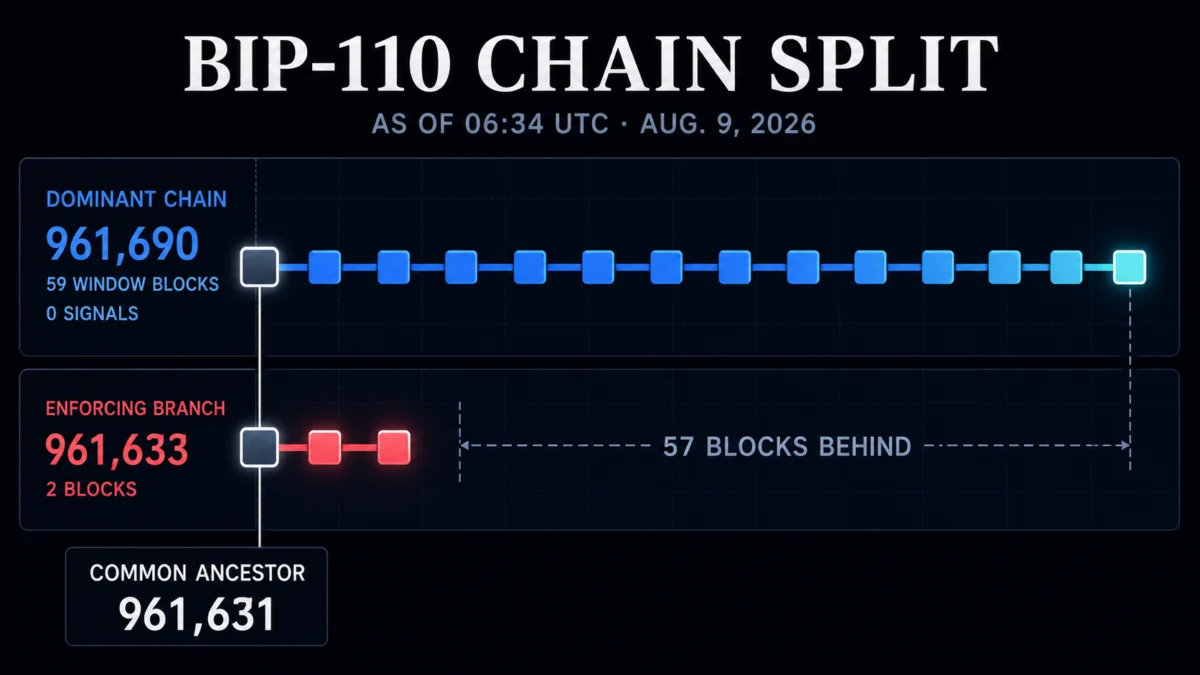
The Bitcoin network experienced a significant consensus divergence in the early hours of August 9, 2026, as a mandatory signaling window for Bitcoin Improvement Proposal 110 (BIP-110) triggered a split between enforcing nodes and the majority of the network’s hashpower. While the dominant Bitcoin chain continued to produce blocks at a regular cadence, the minority branch—enforcing a controversial set of new rules—stalled after producing only two blocks. This divergence highlights a profound disagreement between a subset of the development community and the global mining industry regarding the future of arbitrary data storage on the world’s largest blockchain.
As of 6:34 a.m. UTC, data from primary blockchain explorers indicated that the dominant proof-of-work chain reached block height 961,690. In contrast, the BIP-110 enforcing branch remained frozen at height 961,633. The resulting 57-block gap represents a clear "silent boycott" by the vast majority of Bitcoin miners, who have opted to ignore the proposed soft fork in favor of the existing consensus rules. The enforcing branch’s last block was recorded nearly nine hours prior to the snapshot, suggesting that the miners supporting the proposal lack the necessary computational power to maintain a viable chain.
Understanding BIP-110 and the Conflict Over Arbitrary Data
BIP-110 is a proposed temporary soft fork designed to impose strict consensus limits on the use of arbitrary data within Bitcoin transactions. For several years, the Bitcoin network has seen a surge in "inscriptions" and other forms of data embedding—such as Ordinals and Runes—which utilize the witness portion of a transaction to store non-financial information. Proponents of BIP-110 argue that this practice leads to "blockchain bloat," increasing the costs for individual users to run full nodes and potentially compromising the long-term decentralization of the network.
The proposal aims to restrict several methods currently used to place this data on-chain. However, these data-heavy transactions have become a significant source of revenue for mining pools, as users often pay premium fees to ensure their data is permanently etched into the Bitcoin ledger. The current split appears to be a direct consequence of this economic misalignment; while some developers and node operators seek to "purify" the block space, miners are incentivized to maintain the status quo that supports a diverse range of fee-paying transactions.
Technical Mechanics of the Split
The deployment of BIP-110 utilizes a version-bit signaling mechanism, a standard process for upgrades in the Bitcoin ecosystem. The proposal requires a 55% signaling threshold, or 1,109 out of 2,016 blocks within a specific retarget period, to move toward activation. The mandatory signaling window for BIP-110 was set to begin at block height 961,632 and extend through height 963,647.
According to the BIP-110 state machine, the process involves several stages:
- STARTED: The signaling window begins, and miners must set "version bit 4" in their block headers to indicate support.
- LOCKED_IN: If the 55% threshold is met by height 963,648, the proposal is locked in.
- ACTIVE: The restrictions on arbitrary data only become enforced as consensus rules once the chain reaches height 965,664.
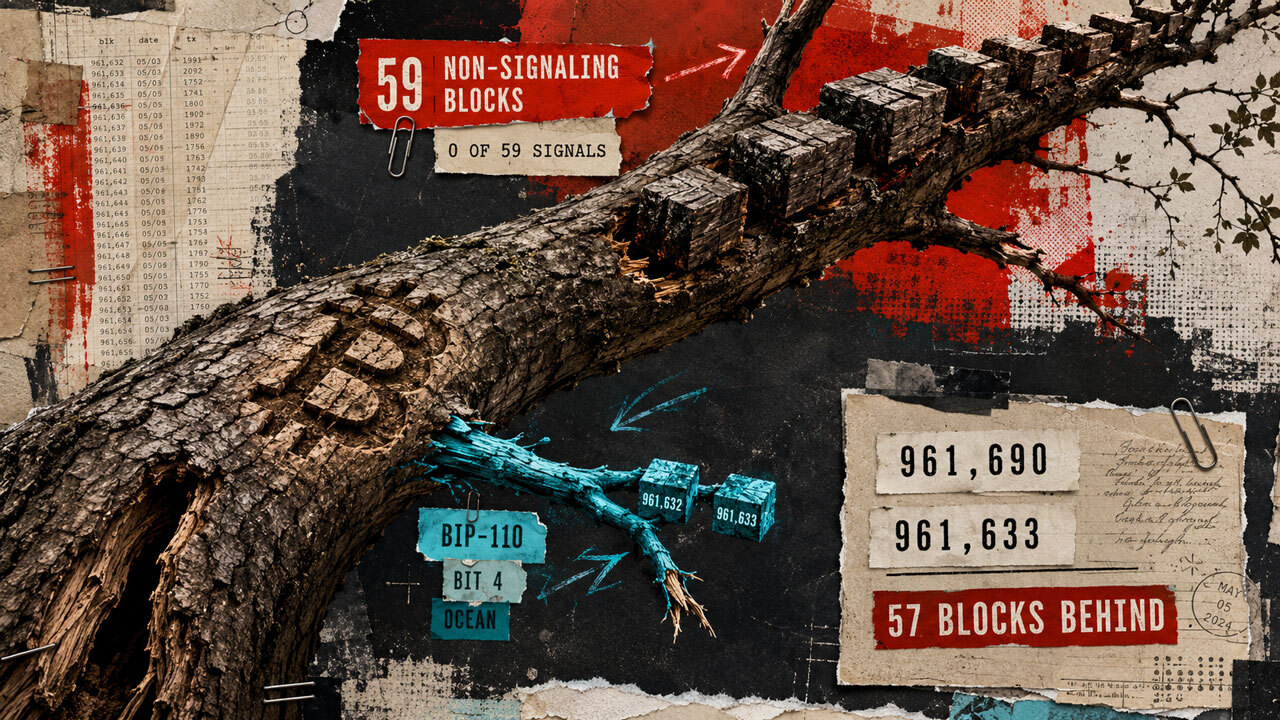
The current split occurred during the initial signaling phase. Nodes that were configured to enforce BIP-110 began rejecting any blocks that did not carry the "bit 4" signal starting at height 961,632. Because the first 59 blocks produced by the dominant chain failed to include this signal, enforcing nodes viewed those blocks as invalid, leading them to follow a separate, minority branch of the blockchain.
Chronology of the Divergence
The divergence began precisely at height 961,632. At this juncture, the Bitcoin network effectively bifurcated into two realities. On one side, the dominant chain—supported by major mining pools—continued its operations without adopting the BIP-110 signaling. On the other side, a small group of miners attempted to bootstrap the enforcing branch.
The enforcing branch managed to produce two blocks:
- Block 961,632: Successfully mined with the required bit 4 signal.
- Block 961,633: Successfully mined with the required bit 4 signal.
Both of these blocks were attributed to the OCEAN mining pool, an entity known for its vocal support of "non-custodial" mining and its stance against what its leadership characterizes as "spam" on the Bitcoin network. However, after height 961,633, the enforcing branch ceased to find new blocks. By 06:34 UTC, the dominant chain had advanced by 57 blocks, leaving the OCEAN-backed branch isolated and effectively non-functional.
A review of the block headers on the dominant chain revealed a total absence of support among the industry’s largest players. Blocks produced during this window were attributed to Foundry USA, F2Pool, AntPool, ViaBTC, and MARA (formerly Marathon Digital). None of these pools set the version bit required by BIP-110, signaling a unified front against the proposed restrictions.
Market and Infrastructure Response
Despite the technical split, the broader Bitcoin ecosystem remained largely unaffected. Major cryptocurrency exchanges, including Coinbase and Kraken, reported that their Bitcoin-related systems were operating normally. This stability is due to the fact that most commercial infrastructure follows the "longest chain" or, more accurately, the "chain with the most accumulated proof-of-work." Since the BIP-110 branch possesses negligible hashpower compared to the main chain, it is ignored by the vast majority of wallets, exchanges, and payment processors.
As of the latest market data, Bitcoin (BTC) was trading at approximately $64,800, representing a minor 24-hour decline of 0.09%. The network’s total market capitalization remains robust at $1.3 trillion, with a 24-hour trading volume of $12.51 billion. Bitcoin dominance in the overall cryptocurrency market sits at 58.83%, indicating that the technical friction surrounding BIP-110 has not translated into significant market volatility or a loss of investor confidence.
The lack of market reaction suggests that participants view this not as a contentious hard fork (like the Bitcoin Cash split of 2017), but rather as a failed attempt at a soft fork. In a soft fork, if the majority of hashpower does not support the new rules, the enforcing nodes simply end up on a stalled minority chain, which is exactly what has transpired over the last eight hours.
Analysis of Miner Incentives
The "silent boycott" by the major mining pools is a pragmatic response to the economic realities of modern Bitcoin mining. In the current era, transaction fees constitute an increasingly vital portion of miner revenue, particularly as block subsidies continue to halve every four years. Arbitrary data protocols like Ordinals have significantly increased the floor for transaction fees, as these users are often willing to pay more to occupy block space than those performing simple peer-to-peer transfers.

By refusing to signal for BIP-110, pools like Foundry and AntPool are protecting a lucrative revenue stream. Furthermore, the mandatory nature of the signaling window in BIP-110 was viewed by some as an aggressive tactic. Unlike "Speedy Trial" upgrades (such as Taproot), which allowed for a period of voluntary signaling to gauge consensus, BIP-110’s enforcing nodes were programmed to reject non-signaling blocks immediately, forcing a confrontation.
Industry analysts suggest that the mining pools’ refusal to participate is also a matter of governance. Miners have historically been resistant to protocol changes that are perceived as being "pushed" by a minority of developers without broad community and industrial consensus. The zero-out-of-59 result for signaling bit 4 is a powerful statement of the mining industry’s current alignment.
Future Implications and Potential Outcomes
With 1,957 blocks remaining in the BIP-110 mandatory-signaling window, the proposal is not yet officially dead, but its prospects are grim. For the enforcing chain to become viable, it would require a massive migration of hashpower—upwards of 55% of the total network—to switch from the dominant chain to the BIP-110 branch. Given the current distribution of hashpower and the stated interests of the major pools, such a shift is highly improbable.
If the enforcing branch remains stalled, the nodes following it will remain "stuck" at height 961,633, unable to see the transactions or blocks occurring on the main network. This creates a "partitioned" experience for any user or merchant running an enforcing node. To rejoin the main network, these users would be forced to disable the BIP-110 enforcement and re-index their nodes to follow the dominant proof-of-work chain.
This event serves as a critical case study in Bitcoin’s governance model. It demonstrates that while node operators can choose which rules they wish to enforce, the ultimate progression of the ledger is determined by proof-of-work. Without the support of the miners who provide the network’s security, even the most well-intentioned protocol changes cannot be successfully implemented.
The failure of the BIP-110 enforcing chain to gain traction may also signal a temporary end to efforts to restrict arbitrary data via consensus changes. Future attempts to manage blockchain bloat may instead focus on "layer-2" solutions or incentive-based structures that do not require mandatory signaling or risk splitting the network. For now, the dominant Bitcoin chain continues its uninterrupted path, proving once again that the network’s consensus mechanism is designed to resist changes that do not have the overwhelming support of its primary stakeholders.