admin
admin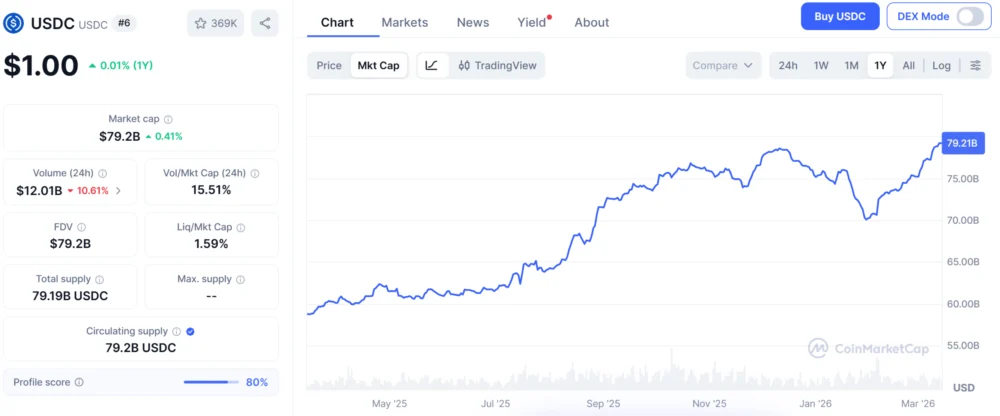
The market capitalization of the USD Coin (USDC) stablecoin is rapidly approaching an unprecedented $80 billion, driven by a pronounced surge in demand originating from the Middle East. This significant increase has prompted analysts to link the spike, in part, to concerns over capital flight from the United Arab Emirates (UAE), particularly in the wake of a reported downturn in Dubai’s real estate sector. This development underscores the growing utility of stablecoins as a potential sanctuary for capital amidst regional economic shifts and geopolitical uncertainties.
According to comprehensive data compiled by CoinMarketCap, USDC’s circulating supply has recently escalated to approximately $79.2 billion. This figure not only represents a substantial increase but also establishes a new all-time high for the dollar-pegged stablecoin, surpassing its previous peak of just under $79 billion recorded in December of the previous year. The trajectory of this growth has been notably steep, with the stablecoin’s market capitalization expanding by billions of dollars in a matter of weeks. As recently as early February, USDC’s market cap stood at just over $70 billion, before climbing to $75 billion earlier this month, illustrating a rapid acceleration in its adoption and demand.
The Middle East Nexus: Capital Flight and Investor Sentiment
The epicenter of this burgeoning demand appears to be the Middle East, with particular emphasis on financial hubs like Dubai. Rami Al-Hashimi, a self-proclaimed Dubai-based analyst, has publicly asserted that the recent surge in USDC reflects a growing urgency among investors to reallocate funds away from traditional financial markets. In a detailed post on the social media platform X, Al-Hashimi highlighted the immense pressure faced by over-the-counter (OTC) desks in Dubai, which have reportedly struggled to adequately meet the overwhelming demand for the stablecoin. These OTC desks, acting as crucial intermediaries in the crypto ecosystem, facilitate large-volume transactions between buyers and sellers, often bypassing traditional exchanges. Their struggle points to a significant institutional or high-net-worth individual interest in acquiring USDC.
Al-Hashimi’s analysis draws a direct correlation between this stablecoin demand and a perceived state of "turmoil" within the UAE’s real estate market. He posited that property prices in Dubai have experienced a precipitous decline, estimated at roughly 27% within the current month alone. This alleged slump, according to the analyst, has ignited a rush among investors to move their capital into digital assets, seeking both stability and liquidity that traditional markets may currently lack. "War panic. Capital flight. Sellers are bleeding," Al-Hashimi wrote, vividly describing what he perceives as a rapid and significant shift in investor behavior and market dynamics. While the specific "war panic" refers to broader geopolitical tensions in the region, its precise impact on investor decisions is complex and multifaceted, but certainly contributes to an environment of caution and capital redeployment.
Dubai’s Property Market Under Scrutiny
To corroborate the analyst’s claims regarding the real estate downturn, data from TradingView offers a stark perspective on the performance of Dubai’s property sector. The DFM Real Estate Index, a key benchmark that tracks the collective performance of listed real estate and construction companies in Dubai, has indeed experienced a sharp and sustained sell-off. The index has plummeted from a recent peak of approximately 16,800 points to around 11,516 points, representing a significant decline of roughly 31%. This substantial contraction in the index lends credence to the notion of a challenging environment for real estate investors in the emirate, potentially prompting them to seek alternative asset classes.
The implications of this real estate volatility extend beyond mere price depreciation. Al-Hashimi further claimed that the dire situation has compelled some property sellers in Dubai to resort to accepting cryptocurrency payments directly as a means to facilitate transactions and attract buyers. He cited instances where certain real estate listings now openly advertise discounts for buyers willing to pay using Bitcoin (BTC), with incentives ranging from "5–10% off." This emerging trend, if widespread, signals a profound shift in traditional asset liquidity and a growing acceptance, born out of necessity, for digital assets within conventional markets. It highlights the increasing permeability between the established financial system and the burgeoning crypto economy, especially in times of stress.
Stablecoins: A Digital Lifeline in Economic Uncertainty
The broader context for USDC’s surge lies in the fundamental role stablecoins play within the cryptocurrency ecosystem. Stablecoins are cryptocurrencies designed to minimize price volatility, typically by pegging their value to a stable asset like the U.S. dollar, a commodity, or a basket of assets. This stability makes them ideal for a variety of purposes: as a medium of exchange, a store of value, a tool for cross-border payments, and crucially, as a temporary safe haven during periods of market volatility in both traditional and crypto markets.
The UAE, particularly Dubai, has long positioned itself as a global hub for finance, trade, and luxury real estate, attracting significant foreign investment and high-net-worth individuals from around the world. Its open economy and relatively liberal capital movement policies have historically been a draw. However, regional geopolitical tensions, global economic shifts, and localized market corrections can trigger concerns among investors, leading to a desire to diversify or externalize capital. Stablecoins, offering digital portability, relative speed of transfer, and the perceived safety of a dollar peg, present an attractive option for those seeking to move funds discreetly and efficiently without the complexities or delays associated with traditional banking channels, which might be subject to stricter controls or scrutiny in times of uncertainty.
USDC’s Ascendancy in Adjusted Transaction Volume

Beyond its market capitalization, USDC has also demonstrated a significant milestone in its operational utility. Japanese investment bank Mizuho recently reported that USDC has surpassed Tether’s USDt (USDT) in adjusted transaction volume for the first time since 2019. This is a pivotal development in the ongoing competition between the two largest stablecoins. According to Mizuho’s research note, USDC recorded approximately $2.2 trillion in adjusted transaction volume year-to-date, dwarfing USDt’s $1.3 trillion. This gives USDC a commanding share of roughly 64% of the combined transaction volume between the two leading stablecoins.
The term "adjusted transaction volume" is crucial here. It typically refers to transaction data that has been filtered to exclude non-economic or internal transactions, such as those between exchange wallets, ensuring that the reported volume reflects genuine economic activity. This metric is often considered a more accurate indicator of a stablecoin’s real-world utility and adoption for payments, trading, and transfers. While USDt still maintains a dominant lead in market capitalization, standing at approximately $184 billion compared to USDC’s $79 billion, USDC’s lead in adjusted transaction volume suggests a higher velocity of circulation and a greater role in active economic transactions. This could be attributed to several factors, including USDC’s perceived regulatory compliance, its transparent backing by reserves held in regulated financial institutions, and its widespread integration across various DeFi protocols and institutional platforms.
The Stablecoin Landscape: A Shifting Dynamic
The rivalry between USDC, issued by Circle, and USDt, issued by Tether, defines much of the stablecoin market. Tether has historically been the market leader, benefiting from first-mover advantage and extensive integration across crypto exchanges, particularly for trading pairs. However, concerns regarding the transparency of its reserves and regulatory scrutiny have periodically cast shadows. USDC, on the other hand, has often been lauded for its more transparent reserve attestations and its adherence to U.S. regulatory frameworks, making it a preferred choice for institutional investors and regulated entities.
The recent surge in USDC’s market cap and its lead in adjusted transaction volume indicate a potential shift in the stablecoin landscape. This shift may reflect evolving investor preferences towards stablecoins with perceived stronger regulatory compliance and transparency, especially as the crypto industry matures and seeks broader institutional adoption. The demand from the Middle East, particularly for capital flight, could also be leaning towards USDC due to its reputation for robust auditing and clear operational standards, which might offer greater peace of mind for those moving significant sums.
Broader Implications for the UAE and Global Crypto Adoption
The unfolding situation has several significant implications. For the UAE, the reported capital flight and real estate slump could signal underlying economic vulnerabilities or a loss of investor confidence, at least in certain traditional sectors. While the UAE has actively embraced digital assets and blockchain technology, aiming to become a global crypto hub, a significant outflow of capital via stablecoins could pose challenges for its financial authorities in monitoring and managing economic stability. It could also accelerate the integration of cryptocurrencies into its mainstream economy, albeit potentially under duress.
Globally, USDC’s impressive growth reinforces the narrative that stablecoins are evolving beyond mere crypto trading instruments. They are increasingly becoming integral to global payments, remittances, and capital preservation strategies, especially in regions experiencing economic volatility, geopolitical tensions, or stringent capital controls. Billionaire investor Stanley Druckenmiller’s prediction that stablecoins could form the backbone of global payments within a decade appears increasingly prescient in light of such developments.
Regulatory Scrutiny and the Future of Stablecoins
The expanding role of stablecoins, particularly in scenarios involving capital flight, inevitably draws the attention of regulators and policymakers worldwide. Governments are grappling with how to classify, regulate, and oversee these digital assets, balancing innovation with financial stability and anti-money laundering (AML) concerns. The use of stablecoins to bypass traditional financial systems, while offering efficiency, also raises questions about illicit finance and tax evasion.
For Circle, the issuer of USDC, this growth trajectory underscores its strategic positioning as a provider of a highly liquid, transparent, and regulatory-friendly stablecoin. The company recently announced plans to go public, and its continued expansion, coupled with its lead in adjusted transaction volume, provides a strong narrative for investors regarding its long-term viability and market penetration.
In conclusion, the nearing $80 billion market capitalization of USDC, fueled by robust demand from the Middle East and linked to capital flight from the UAE’s real estate market, represents a multifaceted development. It highlights the increasing utility of stablecoins as a responsive tool for capital management in times of economic and geopolitical uncertainty. Furthermore, USDC’s ascendancy in adjusted transaction volume over USDt signifies a potential shift in the competitive dynamics of the stablecoin market, favoring assets perceived to offer greater transparency and regulatory alignment. As global financial landscapes continue to evolve, stablecoins like USDC are poised to play an even more critical role, attracting both opportunities and scrutiny from investors, markets, and regulators alike.