admin
admin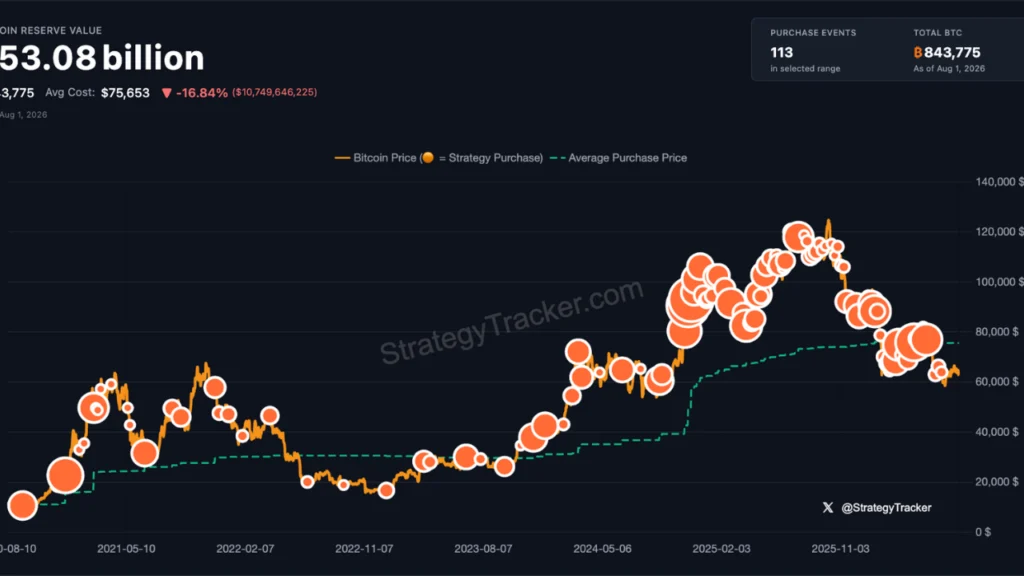
Strategy (NASDAQ: MSTR) reported an $8.22 billion net loss for the second quarter of 2026, a significant financial reversal primarily driven by a sharp decline in Bitcoin prices which drastically reduced the reported value of its extensive digital asset holdings under new fair-value accounting rules. The results underscore the profound and increasing entanglement of the enterprise software company’s financial performance with the highly volatile cryptocurrency market, even as its leadership, spearheaded by Executive Chairman Michael Saylor, steadfastly continues to expand what has become the world’s largest corporate Bitcoin treasury.
A Deep Dive into Q2 2026 Financials: An Accounting-Driven Loss
The substantial quarterly loss stemmed almost entirely from an $8.32 billion fair-value markdown applied to Strategy’s massive Bitcoin portfolio. This markdown was not a result of operational deterioration within its core software business, which continued to generate steady revenue, nor did it signify a liquidation of its digital assets. Instead, it was a direct consequence of the company’s adoption of the Financial Accounting Standards Board’s (FASB) Accounting Standards Update (ASU) 2023-08, which mandates that companies report digital assets at their fair value each quarter. Under this new standard, unrealized gains and losses on Bitcoin are recognized directly in net income, causing reported earnings to fluctuate dramatically in lockstep with cryptocurrency market movements.
This headline figure, representing one of the largest losses in the company’s history, prompted executives to emphasize that it primarily reflects an accounting treatment rather than realized losses from actively selling Bitcoin at a lower price. For shareholders, this translated into a net loss of $24.45 per diluted share. This performance marks a dramatic reversal from the prior-year quarter, Q2 2025, when robust cryptocurrency prices contributed to Strategy reporting a multibillion-dollar profit, illustrating the double-edged sword of its Bitcoin-centric strategy under fair-value reporting.
The Evolution of Digital Asset Accounting: From Impairment to Fair Value
For years, companies holding cryptocurrencies faced a unique accounting challenge under U.S. Generally Accepted Accounting Principles (GAAP). Digital assets were typically classified as indefinite-lived intangible assets under ASC 350. This standard required companies to report Bitcoin at its historical cost and only recognize impairments when its market value dropped below the cost basis. Crucially, companies could not report subsequent unrealized gains until the asset was sold, leading to a skewed financial picture that often masked the true market value of their holdings and understated periods of significant appreciation. For Strategy, this meant that despite Bitcoin’s soaring value in previous bull markets, its balance sheet often reflected a lower historical cost, only showing a loss when prices dipped below that cost.
The adoption of FASB ASU 2023-08 represents a seismic shift in how digital assets are treated on corporate balance sheets. Effective for fiscal years beginning after December 15, 2024, the standard allows for the fair-value accounting of digital assets, recognizing both unrealized gains and losses in net income. Strategy’s early adoption of this standard for Q2 2026 positions it at the forefront of this new reporting era, but it also exposes its earnings reports to unprecedented volatility. The $8.32 billion fair-value markdown is a stark example of this new reality, directly impacting the reported net income even though the underlying assets remain on the balance sheet. This change makes Strategy’s quarterly reports a real-time barometer of Bitcoin’s market performance, a feature both fascinating for investors seeking crypto exposure and challenging for those accustomed to traditional enterprise earnings stability.
Unwavering Conviction: The Expanding Bitcoin Treasury
Despite the significant accounting loss and the inherent volatility, Strategy has remained steadfast in its core mission: accumulating Bitcoin. As of July 26, 2026, the company reported owning an astonishing 843,775 BTC, a substantial increase of 25% since the beginning of 2026. This aggressive accumulation strategy saw Bitcoin acquired for an approximate total of $63.7 billion, translating to an average purchase price of about $75,500 per coin.

At recent market prices during the reporting period, these colossal holdings were valued at roughly $54.8 billion. This valuation left the company with an unrealized shortfall of approximately $9 billion compared to its total acquisition cost. This figure, while significant, represents an accounting loss on paper, not a realized loss from selling the assets. Executive Chairman Michael Saylor has consistently articulated his long-term bullish outlook on Bitcoin, viewing it as a superior treasury reserve asset and a hedge against inflation. His vision has transformed Strategy from a conventional software company into a proxy for Bitcoin investment, attracting a unique cohort of investors who share this long-term conviction. The latest figures only reinforce Strategy’s unparalleled position as the largest publicly traded corporate holder of Bitcoin globally, solidifying its identity as a “Bitcoin development company.”
Strategic Evolution: The Bitcoin Monetization Program
One of the most significant developments of the second quarter was Strategy’s decision to initiate a novel Bitcoin Monetization Program, marking a notable departure from its long-standing practice of accumulating Bitcoin without selling. Under this new program, the company disclosed that it sold approximately 3,588 BTC for around $218.4 million. The proceeds from this sale were strategically deployed to strengthen cash reserves and assist in funding preferred stock dividend payments, underscoring a more flexible approach to capital management.
While the sale represented a minuscule fraction—less than 0.5%—of Strategy’s total Bitcoin holdings, its symbolic significance was considerable. For years, Saylor had maintained a near-absolute stance against selling Bitcoin, often reiterating that the company viewed its holdings as a long-term strategic asset. This partial sale, therefore, signals an evolving treasury strategy designed to optimize liquidity and meet financial obligations without undermining the core Bitcoin accumulation strategy. Michael Saylor clarified that this move does not signal a change in the company’s long-term conviction in Bitcoin or its commitment to expanding its "Digital Credit" business. Instead, management described the sales as an integral part of a broader capital management strategy, providing financial flexibility to support obligations while maintaining substantial Bitcoin exposure. This pragmatic shift aims to demonstrate to investors that Strategy can manage its capital structure responsibly even amidst market downturns, potentially alleviating concerns about its ability to service debt and dividends.
Fortifying the Balance Sheet: Liquidity and Capital Management Initiatives
Alongside its earnings report, Strategy highlighted several proactive balance sheet initiatives aimed at reinforcing its financial resilience and supporting its ambitious long-term Bitcoin strategy. The company successfully raised $17.06 billion through at-the-market (ATM) equity offerings during the year, demonstrating robust investor appetite for its equity, despite the inherent volatility. Furthermore, Strategy repurchased $1.5 billion of its convertible notes at an 8% discount, a shrewd financial move that reduced outstanding debt and lowered future interest payment obligations.
Chief Financial Officer Andrew Kang provided reassuring commentary on the company’s liquidity position, stating that Strategy’s U.S. dollar reserve had increased significantly to $3.75 billion. This robust reserve, according to Kang, is sufficient to cover existing preferred dividend payments and interest obligations for more than 2.1 years, providing a substantial buffer against market fluctuations. Management emphasized that this strengthened liquidity position grants the company considerable flexibility to navigate periods of market volatility while simultaneously continuing its strategic investments in Bitcoin.
In additional capital management moves, the company authorized a $1 billion share repurchase program for its common stock, though no shares have yet been repurchased under this authorization. Separately, Strategy proactively bought back approximately $25 million of its STRC preferred shares when they were trading below par value, another step to optimize its capital structure and reduce future financial commitments. These initiatives collectively aim to project an image of financial prudence and strategic foresight, balancing aggressive Bitcoin accumulation with responsible treasury management.
Strategy’s Dual Identity: Software Business vs. Bitcoin Holdings
While the narrative surrounding Strategy is overwhelmingly dominated by its Bitcoin strategy, it is crucial to remember that the company originated and still operates a core enterprise analytics software business. This segment continues to generate steady, albeit modest, revenue streams and profit. However, in the context of Strategy’s overall valuation, the software business now represents a relatively small portion compared to its colossal Bitcoin holdings.

For example, in previous quarters, the software segment typically contributed hundreds of millions in revenue, with operating margins that provided a stable, if not rapidly growing, cash flow. This operational stability from its legacy business provides a baseline of revenue and profitability that, in theory, can help absorb some of the shocks from Bitcoin’s volatility. However, the sheer scale of the Bitcoin treasury means that even significant performance changes in the software division are overshadowed by even minor percentage shifts in Bitcoin’s price. This creates a unique investment proposition where traditional software metrics are secondary to the performance of the underlying digital asset.
Investor and Analyst Focus: Capital Structure and Market Sensitivity
Beyond the headline quarterly earnings, investors and financial analysts continue to scrutinize Strategy’s increasingly sophisticated and complex capital structure. The company has funded its extensive Bitcoin purchases through a diverse combination of common equity offerings, preferred stock issuances, convertible debt, and its own cash reserves. While this multi-pronged approach has enabled unprecedented Bitcoin accumulation, it also creates ongoing financial obligations in the form of preferred dividends and interest payments on its debt.
Management consistently argues that its fortified liquidity position, bolstered by recent financing activities, provides ample flexibility to support these commitments, allowing the company to continue executing its Bitcoin strategy without undue stress. However, many analysts remain keenly focused on the company’s ability to maintain this delicate balance, particularly if cryptocurrency prices were to remain under sustained pressure for an extended period. Concerns often revolve around the cost of capital, potential dilution from equity offerings, and the impact of sustained unrealized losses on investor confidence. The introduction of the Bitcoin Monetization Program can be seen as a direct response to some of these concerns, providing a mechanism for cash generation without fully abandoning the long-term Bitcoin vision.
Outlook: A Future Tied to the Digital Asset Market
Strategy’s latest earnings report serves as a profound illustration of how dramatically fair-value accounting has reshaped the company’s financial reporting landscape. Quarterly profits and losses are now predominantly driven by the ebb and flow of Bitcoin’s price movements rather than the operational performance of its software business, rendering its earnings considerably more volatile and unpredictable.
Despite the significant accounting loss in Q2 2026, Strategy’s management remains unwavering in its commitment to increasing its Bitcoin holdings and strengthening its balance sheet through innovative financing initiatives. The introduction of the Bitcoin Monetization Program, while a pragmatic shift towards a more flexible treasury strategy, is framed by management as a tool to support financial health rather than a signal of waning conviction. They maintain that Bitcoin remains the cornerstone of the company’s long-term business model and strategic vision.
Future quarters for Strategy will largely depend on the performance of the broader cryptocurrency market. A sustained recovery in Bitcoin prices could swiftly reverse much of the current accounting loss under fair-value reporting, potentially leading to substantial reported profits. Conversely, continued weakness in the digital asset market would likely keep earnings under pressure, despite relatively stable operations within its software division. For investors, Strategy remains one of the market’s clearest and most direct publicly traded proxies for long-term Bitcoin exposure, with its financial results increasingly serving as a magnified reflection of the cryptocurrency’s price cycles. This unique position ensures that Strategy will continue to be a closely watched entity, not just within the technology sector, but across the entire financial landscape influenced by digital assets.