admin
admin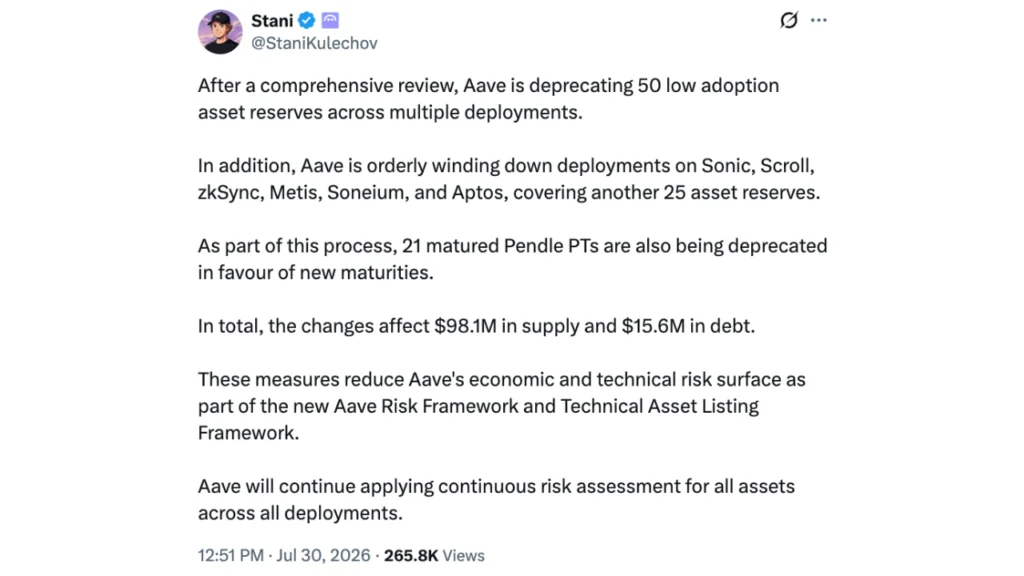
This ambitious initiative, currently under rigorous governance review, represents a pivotal moment for Aave, signaling a deliberate shift from an expansive multi-chain strategy to a more concentrated and economically sustainable operational model. If approved by the Aave Decentralized Autonomous Organization (DAO), the protocol would systematically phase out its presence on Sonic, Scroll, zkSync, Metis, Soneium, and Aptos, alongside the deprecation of numerous low-adoption reserves and matured Pendle Principal Tokens (PTs). While affecting nearly $98 million in supplied assets, the proposal meticulously outlines a phased migration process, ensuring existing users have ample time to unwind their positions without facing immediate liquidations, prioritizing user safety and orderly transitions.
A Strategic Pivot in a Maturing DeFi Landscape
Aave’s journey began as a trailblazer in decentralized finance (DeFi), pioneering the concept of flash loans and establishing itself as the preeminent lending protocol on the Ethereum blockchain. Its early success and robust security model propelled it to become a cornerstone of the DeFi ecosystem. As the industry evolved, the allure of expanding beyond Ethereum became undeniable. The promise of lower transaction fees, faster processing times, and access to burgeoning new user bases on alternative Layer 1 (L1) and Layer 2 (L2) networks led Aave, like many other prominent DeFi protocols, to embark on an aggressive multi-chain expansion strategy. This led to Aave deploying its protocol across a multitude of blockchain networks, ultimately reaching 23 distinct deployments.
The rationale behind this widespread expansion was clear: to capture market share in nascent ecosystems, enhance accessibility for users deterred by Ethereum’s high gas costs, and diversify risk across different network infrastructures. However, this proliferation of deployments, while initially promising, introduced unforeseen complexities and inefficiencies. Maintaining each blockchain deployment is a resource-intensive endeavor, demanding dedicated infrastructure including oracle price feeds for accurate asset valuation, sophisticated liquidation systems to manage collateral risks, continuous monitoring for security vulnerabilities, and ongoing risk management by specialized teams. These operational costs are largely fixed, regardless of the activity or revenue generated by a particular deployment.
The current proposal, developed by LlamaRisk in collaboration with Aave’s expert risk providers, is a direct outcome of the protocol’s updated Risk Framework and Technical Asset Listing Framework. These frameworks emphasize a more stringent, data-driven approach to evaluating the economic viability and risk profile of each market. The stark reality is that several smaller deployments are no longer generating sufficient revenue to justify their substantial upkeep, leading to a significant economic drain on the protocol’s resources.
The Economic Imperative: Revenue Disparities Drive Consolidation
The financial data underpinning the proposal reveals a pronounced disparity in revenue generation across Aave’s various deployments. Each of the six targeted networks—Sonic, Scroll, zkSync, Metis, Soneium, and Aptos—currently produces less than $5,000 in quarterly revenue. Disturbingly, Metis, Soneium, and Aptos each generate under $1,000 per quarter, translating to annual revenues of less than $4,000. These figures pale in comparison to Aave’s primary revenue drivers. Ethereum, for instance, remains the bedrock of Aave’s financial success, generating over $142 million annually. Even newer deployments like Base have quickly proven their economic value, contributing approximately $4.7 million per year.
This widening chasm between high-performing and underperforming markets underscores the economic inefficiency of maintaining a broad, undifferentiated multi-chain footprint. The fixed costs associated with oracle maintenance, security audits, developer support, and governance oversight for each chain deployment become economically unsustainable when user activity and borrowing demand are minimal. By consolidating its operations, Aave aims to reallocate these valuable resources—both financial and human—towards core development, innovation, and the expansion of its most successful and strategically important markets. This move is not merely about cost-cutting; it is about optimizing resource allocation for long-term sustainable growth and enhanced resilience.
Declining User Activity: A Clear Signal for Change

Beyond the financial metrics, the decision to retire these deployments is strongly supported by a sustained and dramatic decline in liquidity and user activity across the affected networks. Over the past six months, the data paints a clear picture of user disengagement:
- Sonic: Deposits have plummeted by 74%, settling at approximately $7.6 million.
- Scroll: Experienced an 86% drop in deposits, now standing at roughly $2.2 million.
- zkSync: Saw an 88% decline, with deposits reduced to about $844,000.
- Metis: Deposits decreased by 79%, reaching around $297,000.
- Soneium: Recorded the steepest decline, plunging a staggering 95% to roughly $173,000.
- Aptos: Available liquidity contracted by 94%, leaving approximately $1.7 million supplied.
Combined, the total deposits across these six deployments now amount to only about $13 million. To put this into perspective, this sum represents well below 1% of Aave’s impressive $14 billion in total value locked (TVL) across its 23 active blockchain networks. The marginal contribution of these deployments to Aave’s overall ecosystem highlights their limited product-market fit and the wisdom of re-evaluating their continued support. The decline in user activity is a critical indicator that these markets have not achieved the sustainable demand necessary to justify their operational overhead, reinforcing the strategic imperative for consolidation.
Beyond Chain Closures: Streamlining Asset Markets
The scope of Aave’s proposal extends beyond the mere retirement of blockchain deployments. The protocol also plans a significant cleanup of its asset markets, targeting those with low adoption, redundancy, or those facing external support cessation. This includes:
- Low-adoption reserves: Many assets, despite having some deposits, have attracted negligible borrowing activity, rendering them inefficient to maintain.
- Matured Pendle Principal Tokens (PTs): These tokens, which represent the principal component of yield-bearing assets, often have a finite lifespan. Once they mature, their utility diminishes, making their continued listing unnecessary.
- Bridged versions of stablecoins: Where a native version of a stablecoin, such as USDC, is already available on a particular chain, bridged versions often become redundant. Removing them simplifies the asset offering and reduces potential confusion or fragmentation of liquidity.
- Specific liquid staking tokens: A prime example is MaticX, which is slated for removal following Stader Labs’ announcement to discontinue support for this particular liquid staking token. Such external decisions necessitate proactive adjustments within Aave’s supported asset list.
Eliminating these inactive or redundant assets is crucial for simplifying protocol management. It reduces the operational burden on Aave’s governance participants, who must continually monitor these markets, and on risk providers, who are tasked with assessing their collateral factors and liquidation thresholds. This streamlined approach fosters a cleaner, more efficient, and easier-to-manage protocol, ultimately benefiting all users by concentrating liquidity and focus on the most relevant and actively used assets.
A Phased and User-Centric Transition Plan
Crucially, the proposal emphasizes a meticulously planned, phased transition designed to protect existing users and encourage an orderly unwinding of positions, rather than imposing immediate disruptions. Aave’s commitment to user protection is paramount throughout this process.
The proposed phased transition will unfold as follows:
- Initial Freeze: Affected markets will first be frozen to new deposits, new borrowing, and new collateral usage. This means existing lending and borrowing positions will remain active, but no new activity can be initiated.
- Reduced Caps: Supply and borrowing caps would then be gradually reduced, potentially to a single token, effectively preventing any significant new activity while allowing existing markets to naturally unwind as users repay loans and withdraw assets.
- Economic Incentives for Exit: To actively encourage users to close their positions, Aave proposes adjusting the economic parameters of the affected markets:
- Increased Reserve Factor: The reserve factor would be raised significantly, potentially to 99%. This means nearly all interest paid by borrowers would be directed to the Aave protocol treasury, drastically reducing the yield for depositors. This provides a strong incentive for lenders to withdraw their assets.
- Elevated Base Borrowing Rate: A 5% base borrowing rate would be introduced. This higher cost of borrowing would actively encourage borrowers to repay their loans and retrieve their collateral.
- Further Adjustments: If necessary, borrowing rates and liquidation parameters could be adjusted further to ensure markets become largely inactive.
- Fixed-Price Oracles: Once activity dwindles to negligible levels, live oracle feeds, which continuously provide real-time price data, would be replaced with fixed-price oracles. This critical step reduces the ongoing operational complexity and security risks associated with maintaining active price feeds for inactive markets.
- Permanent Retirement: Only after these extensive measures have been implemented and markets are largely dormant will each deployment be permanently retired.
This thoughtful, multi-stage approach underscores Aave’s commitment to responsible protocol management and user welfare, demonstrating a best-in-class approach to decommissioning underperforming assets and deployments within a decentralized ecosystem.
Aave’s Broader Strategic Evolution: Beyond Consolidation

This proposal is not an isolated event but rather a reflection of Aave’s broader strategic direction, which has been evolving over recent months. The protocol has placed an increasing emphasis on operational efficiency, disciplined expansion, and strengthening its governance mechanisms. Earlier governance discussions within the Aave DAO had already raised questions about whether several newer blockchain deployments had achieved meaningful product-market fit, with community members proposing minimum revenue thresholds for future expansions. This consolidation move is a direct response to these internal evaluations and community sentiments.
At the same time, Aave continues to invest heavily in forward-looking initiatives. The development of Aave V4 represents a significant leap in its core technology, promising enhanced features, improved capital efficiency, and greater flexibility for users. The protocol is also actively exploring and expanding its offerings in institutional DeFi products, recognizing the growing demand for compliant and robust decentralized financial services from traditional financial entities. Furthermore, ongoing infrastructure upgrades are focused on bolstering the resilience and scalability of its larger, more active markets.
Founder Stani Kulechov has consistently framed these strategic adjustments as primarily a risk-reduction measure aimed at simplifying operations and allocating resources more efficiently. His vision for Aave emphasizes sustainable growth and long-term viability, prioritizing quality and impact over sheer breadth of deployment. This strategic recalibration positions Aave not just as a reactive entity but as a proactive leader in adapting to the dynamic and maturing DeFi landscape.
The Governance Process: A Testament to Decentralization
The proposal is currently in the Aave Request for Comment (ARFC) stage, a crucial initial phase where community members can provide feedback, raise concerns, and suggest refinements. This open discussion is vital for ensuring that all perspectives are considered before moving forward. Following the ARFC stage, the proposal must pass an off-chain Snapshot vote, which gauges broader community sentiment without incurring gas fees. If it garners sufficient support, it then proceeds to a final on-chain Aave Improvement Proposal (AIP) vote. Only upon successful execution of the AIP, which involves on-chain smart contract interactions, will the plan be implemented.
This multi-step governance process highlights the decentralized nature of Aave. It ensures that significant strategic decisions are not made unilaterally but are instead the result of collective deliberation and consensus among token holders. Until the final AIP is executed, users are not required to take any immediate action, reinforcing the orderly and transparent nature of Aave’s governance framework.
Implications for Aave and the Broader DeFi Ecosystem
If approved, this plan would mark one of Aave’s most significant operational consolidations to date. For Aave itself, the implications are profound:
- Enhanced Efficiency and Resource Optimization: The protocol will benefit from reduced operational overhead, allowing resources to be reallocated towards core development, innovation, and expansion in strategically viable markets.
- Mitigated Risk Profile: By reducing exposure to smaller, potentially less secure, or less liquid chains, Aave strengthens its overall security posture and simplifies its risk management framework.
- Sharpened Strategic Focus: This move solidifies Aave’s commitment to sustainable growth and concentrated liquidity, moving away from a "deploy everywhere" mentality to one of "quality over quantity."
- Precedent for Future Expansion: It sets a clear precedent for more stringent evaluation criteria for future blockchain deployments, ensuring that any new expansion is economically justified and aligned with long-term strategic goals.
For the targeted blockchain ecosystems, the impact could be more challenging. The departure of a major DeFi primitive like Aave sends a strong signal about the economic viability and user adoption levels of these chains. It could potentially lead to a decrease in their Total Value Locked (TVL) and impact user perception, possibly prompting users to migrate to other lending protocols on those chains or to more established chains entirely. This underscores the intense competition within the blockchain space and the critical importance of cultivating a robust, active, and economically sustainable ecosystem to attract and retain major protocols.
More broadly, this decision by Aave serves as a bellwether for the entire DeFi ecosystem. It signals a maturation of multi-chain strategies, where the initial enthusiasm for broad expansion is giving way to a more pragmatic, data-driven approach focused on sustainability. Protocols are increasingly becoming selective about their multi-chain presence, recognizing that fragmented liquidity and high operational costs can undermine the very benefits of decentralization. This trend may lead to a further consolidation of liquidity on a few dominant chains, strengthening network effects for those ecosystems that can demonstrate consistent user demand and economic viability. Ultimately, Aave’s proposed consolidation reflects a strategic evolution towards a leaner, more resilient, and more efficient future for one of DeFi’s most critical infrastructures.