admin
admin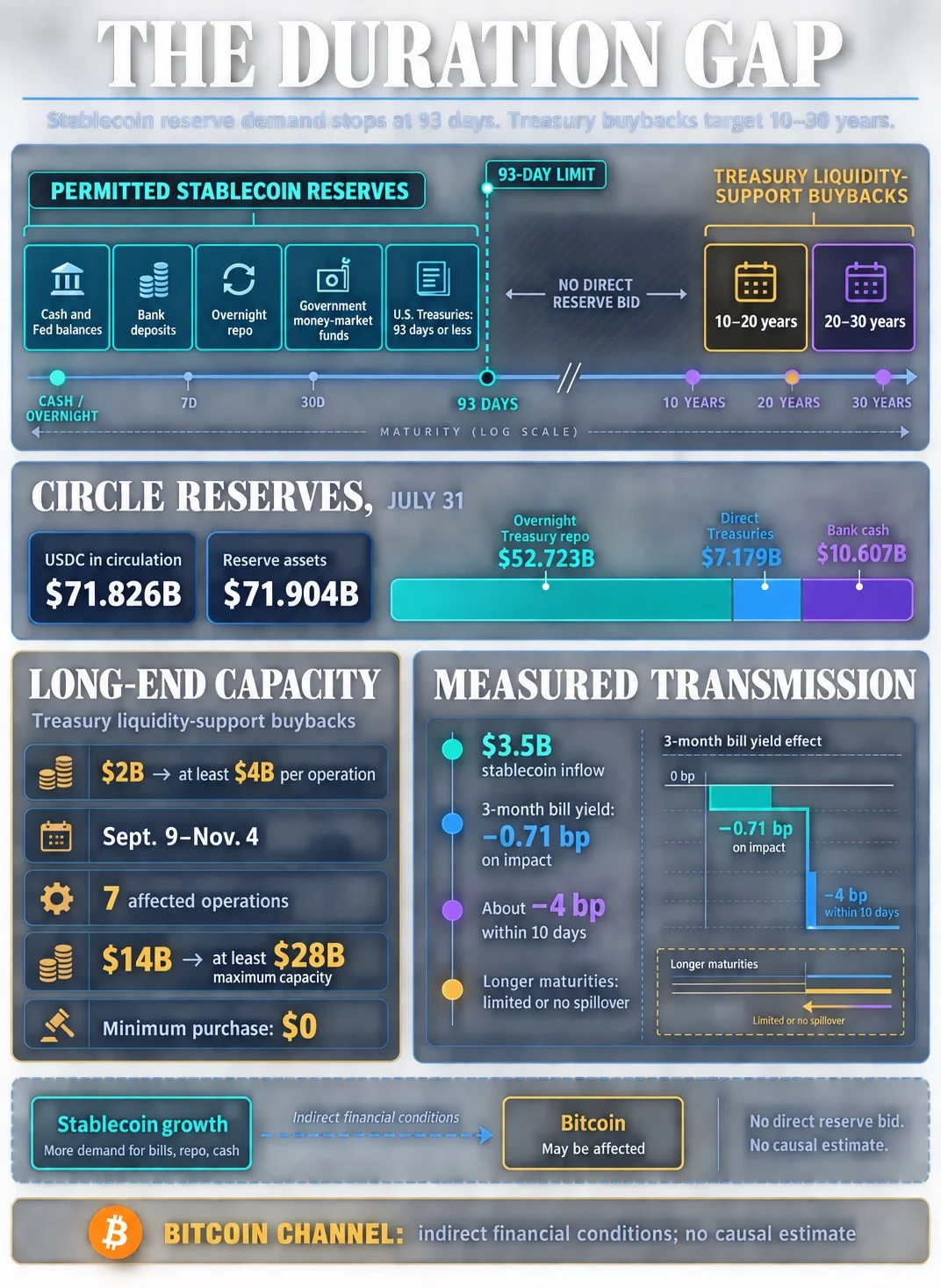
The burgeoning demand for stablecoins is increasingly influencing the U.S. government debt market, but the significance of this demand hinges critically on the maturity of the assets involved, rather than solely on the headline figures. This evolving landscape presents two distinct narratives within Washington’s debt management strategy: one driven by regulatory frameworks for stablecoin reserves, and another by the Treasury Department’s proactive measures to support longer-duration debt instruments. Together, these developments are reshaping the dynamics of U.S. debt financing, though their impacts remain largely segmented, with stablecoin flows primarily influencing the short end of the yield curve and direct connections to assets like Bitcoin remaining indirect.
Regulatory Frameworks Define Stablecoin Reserve Investments
At the heart of the stablecoin market’s interaction with U.S. debt lies the regulatory framework governing permitted payment stablecoins. The foundational legislation, often referred to by its legislative intent as the GENIUS Act (though the official designation may differ depending on final enactment and specific legislative vehicles), mandates that issuers maintain reserves equivalent to at least one U.S. dollar for every outstanding payment stablecoin. This reserve requirement, as outlined in proposed regulatory guidance and statutory provisions, carves out a specific menu of eligible assets designed to ensure liquidity and stability.
These eligible assets include U.S. currency, balances held at the Federal Reserve, withdrawable bank deposits, and crucially, U.S. Treasury securities with an original or remaining maturity of 93 days or less. The framework also extends to qualifying overnight repurchase agreements (repo) and reverse repo transactions, government money-market funds invested in these instruments, and other regulator-approved, highly liquid federal assets, including their tokenized equivalents.
The emphasis on a 93-day maturity ceiling for Treasury securities within this reserve mandate is a critical determinant of stablecoin demand’s market impact. It means that while stablecoins can indeed bolster demand for short-term Treasury bills and overnight financing, their direct influence on the longer end of the yield curve—specifically, on 10-year, 20-year, and 30-year bonds—is significantly constrained. A newly issued 10-year note or a 30-year bond, by definition, falls outside the direct reserve category for these regulated stablecoin issuers.
The implementation of these regulations is an ongoing process. While the legislative groundwork has been laid, with key provisions enacted, the general effective date is tied to future regulatory finalization, set for the earlier of January 18, 2027, or 120 days after the issuance of final implementing rules. The Office of the Comptroller of the Currency (OCC) has been a key player, issuing its proposed framework in February, with a final rule expected by November. Current operational portfolios of major stablecoin issuers, such as Circle, offer a practical glimpse into how these short-duration reserve strategies are being implemented, even before the full federal regime is universally in force.
Circle’s Reserve Allocation: A Microcosm of Short-Duration Strategy
Circle, a prominent issuer of the USD Coin (USDC) stablecoin, provides a tangible case study of how stablecoin reserves are currently allocated, demonstrating a clear preference for short-duration assets. As of its second-quarter filing, USDC circulation stood at approximately $73.269 billion. A more detailed assurance report for July revealed $71.826 billion in circulation with $71.904 billion in reserve assets.
Of these reserves, a substantial $60.717 billion was held within the Circle Reserve Fund. This fund primarily consisted of $52.723 billion in overnight Treasury repo transactions and $7.179 billion in Treasury securities. An additional $11.187 billion was held outside this fund, predominantly as $10.607 billion in cash at regulated financial institutions. Significantly, every Treasury security listed in this report matured by September 22, underscoring the short-term nature of these holdings. The repo exposure represents cash lent against Treasury collateral, further reinforcing the focus on short-term liquidity. These holdings collectively keep Circle’s asset duration firmly anchored to the front end of the market.
These reserve balances illustrate the scale and the boundaries of the demand stablecoins can generate. While increased USDC circulation can indeed channel more cash into Treasury bills, repo markets, or bank deposits, the specific destination is dictated by each issuer’s reserve allocation strategy. Long-duration bonds remain outside this direct channel of influence.
Furthermore, data on stablecoin flows highlight a distinction between market growth and new federal financing needs. During the second quarter, Circle saw gross issuance of $83.004 billion in USDC and redemptions of $86.784 billion, resulting in net redemptions of $3.780 billion. Although quarter-end circulation was still 19% higher than a year prior, it had dipped slightly from its December peak. Gross issuance figures measure market activity, but even net growth does not definitively reveal the origin of the dollars flowing into stablecoins.
The Treasury Borrowing Advisory Committee (TBAC), a key private-sector advisory body to the Treasury Department on debt management, has echoed this sentiment. They recognize that stablecoin issuance can indeed contribute to demand for short-maturity Treasuries. However, part of this effect may be offset if users are simply shifting balances from existing cash-like instruments, such as bank deposits or money-market funds, which already provide financing for Treasury bills. Demand from new offshore dollar users would represent a more additive source of demand, but official data currently lacks the granularity to quantify this specific segment. Consequently, stablecoins may alter which balance sheet holds a Treasury bill rather than creating a wholly new pool of lenders for every dollar of token growth.

Treasury’s Long-End Buyback Program: A Separate Market Intervention
In parallel to the regulatory landscape shaping stablecoin reserves, the U.S. Treasury Department has initiated measures to address the longer end of the debt market. On August 19, the Treasury announced its intention to at least double the maximum size of its liquidity-support buyback operations in the 10- to 20-year and 20- to 30-year nominal Treasury sectors, commencing September 9.
These operations specifically target "off-the-run" nominal coupon securities within these longer maturity buckets. The stated purpose is to enhance liquidity, providing dealers and investors with a predictable outlet for older securities that may not trade as actively as newly issued ones. The Treasury’s tentative buyback calendar lists seven such operations scheduled between September 10 and November 4. By raising the maximum buyback amount from $2 billion to at least $4 billion per operation, the aggregate capacity across these targeted buybacks will increase from $14 billion to a minimum of $28 billion.
It is important to note that these figures represent a ceiling, not a guaranteed purchase total. Treasury guidance allows for buybacks to be as low as zero if market offers are unattractive, and the department reserves the right to accept less than the maximum.
Crucially, these Treasury buyback programs are distinct from quantitative easing (QE). When Treasury securities are repurchased, they are retired. The financing for these buybacks is treated as any other government outlay, meaning that, all else being equal, each dollar spent on buybacks necessitates an equivalent increase in Treasury issuance elsewhere to meet overall financing needs. The Treasury can adjust the mix of bills and coupons to meet its borrowing requirements. While stablecoin demand might absorb a portion of the bill component if the issuance mix leans short-term, the government’s overall borrowing requirement remains unchanged, and stablecoin reserves do not directly participate as purchasers in the long-bond buyback market.
Empirical Evidence Supports Maturity Divide
Empirical research consistently reinforces the division in market impact between short-term and long-term debt instruments. A working paper by the Bank for International Settlements (BIS), analyzing data through March 2026, found that a $3.5 billion inflow into stablecoins led to an immediate reduction of 0.71 basis points in three-month Treasury bill yields. This effect deepened to approximately 4 basis points within 10 days and reached an estimated trough of around 5 basis points. The paper noted that this impact was amplified under specific conditions of market stress and bill scarcity.
In contrast, the same research indicated limited or no spillover effects on longer maturities. This pattern aligns with the nature of stablecoin reserve investments. Cash deployed into securities maturing within weeks can compress bill yields, but it leaves investors to bear the duration risk associated with 10-, 20-, and 30-year debt.
The current yield curve serves as a contextual indicator rather than definitive proof of causality. As of August 28, Treasury data indicated a 10-year yield of 4.73%, a 20-year yield of 5.21%, and a 30-year yield of 5.22%. These maturities lie well beyond the GENIUS Act’s ceiling for direct Treasury reserve assets held by stablecoin issuers. The levels of these yields are influenced by a multitude of factors, but they clearly delineate the segment of the curve where a direct, regulatory-driven stablecoin bid is absent.
Bitcoin’s Indirect Connection to Debt Market Dynamics
The connection between stablecoin flows, Treasury operations, and the price of Bitcoin is indirect and operates through broader financial conditions. Long-term Treasury yields can influence the cost of credit, the discount rates applied to riskier assets, and overall investor appetite for volatile positions. Improvements in the trading conditions of longer-dated bonds could enhance market functioning, while a larger base of bill purchasers can support the Treasury’s short-term financing.
These links establish a potential macroeconomic channel, rather than a direct, mechanical price signal to Bitcoin. A stablecoin inflow might compress bill yields without necessarily lowering long-term yields. Similarly, a Treasury buyback could improve liquidity without reducing net borrowing. Bitcoin’s price is subject to a complex interplay of factors, including changes in interest rates, dollar liquidity, risk appetite, and numerous other unrelated market drivers.
The available evidence does not provide a causal estimate linking stablecoin flows, long-end buyback programs, or long-term yields directly to the price of Bitcoin. Consequently, it does not support fixed predictions for Bitcoin’s trajectory based solely on stablecoin growth or the expanded Treasury buyback schedule.
Conclusion: A Bifurcated Impact on Debt Markets
The measurable conclusion from these developments is relatively narrow. Stablecoins are poised to become a more significant source of demand for U.S. Treasury bills, particularly when their growth reflects genuinely new dollar demand. The market for long-dated government bonds, however, continues to rely on investors willing and able to hold duration risk. Treasury’s liquidity operations in this segment, and Bitcoin’s sensitivity to broader financial conditions, remain largely separate from the direct demand generated by the regulated stablecoin reserve bid. The maturity of assets held as reserves is the pivotal factor determining the precise nature and scope of stablecoins’ influence on the U.S. debt market.