admin
admin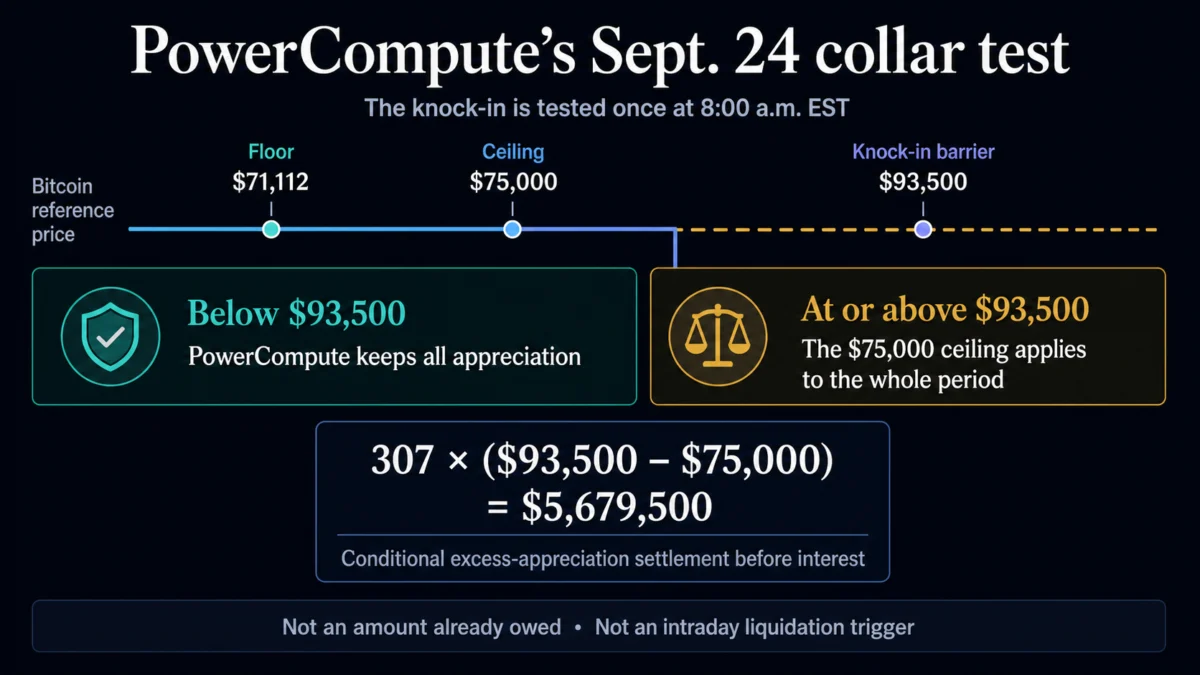
PowerCompute, a prominent player in Bitcoin treasury management and mining operations, has seen its debt obligations increase by $3.765 million due to an early termination of a Bitcoin collar agreement. This financial maneuver, involving 307 Bitcoin, saw the calculated unwind cost of the agreement added directly to the company’s principal debt rather than being settled in cash or stablecoins like USDC. The decision to incorporate this cost into the principal signals a strategic choice by PowerCompute to bolster its balance sheet through debt accumulation rather than immediate cash outlay, a move that could have significant implications for its financial leverage and operational flexibility.
The company’s latest filing with the Securities and Exchange Commission (SEC) on August 28th details a revised 30-day collar balance with Arch Lending. This replacement agreement now stands at $21,892,131.88, a substantial increase from the previous $18,127,131.88. While the underlying collateral remains 307 Bitcoin, the annual interest rate on this facility has been significantly adjusted, climbing from a modest 2% to a more robust 6.5%. This escalation in interest rate reflects the increased risk perceived by the lender or the market conditions influencing such financial instruments.
The Mechanics of the Bitcoin Collar Reset and Principal Increase
The decision to integrate the cost of unwinding the Bitcoin collar into the principal balance was made by PowerCompute’s borrowing subsidiary, US Digital Mining and Hosting Co. According to the annex filed with the SEC, this approach was agreed upon as an alternative to any separate settlement for excess appreciation that might have occurred during the terminated period of the collar. This method effectively defers the financial impact of the collar’s early termination, embedding it within the company’s long-term debt structure.
The original Bitcoin collar agreement was initiated on August 3rd and was slated for a reset on September 2nd. PowerCompute opted for an early termination on August 25th, a decision made 22 days into the 30-day term. At the time of termination, the reference price for Bitcoin was $78,500. This price point was notably above the collar’s pre-defined ceiling of $66,370, as documented in a prior reset confirmation filing. The initial loan, documented in the original loan filing, carried a balance of $18.13 million and a considerably lower interest rate of 2%. The early unwinding suggests a strategic move by PowerCompute, potentially to reallocate its Bitcoin holdings or to mitigate risks associated with the then-current Bitcoin price trajectory.
The newly established replacement loan, covering the period from August 25th to September 24th, incurs an interest charge of $118,582.38. This calculation is based on the 30/360 day count convention stipulated in the contract. The specific mechanics of the 30-day collar are governed by an annex, which provides the commercial figures, even though the master agreement contains more extensive legal language. This distinction highlights the importance of the detailed annex in understanding the immediate financial implications of the collar agreement.
The New Collar Structure and Its Implications
The updated collar agreement, effective from August 25th, sets a new reset date for September 24th. Under this new structure, the floor price for Bitcoin is established at $71,112, the ceiling at $75,000, and a "knock-in" barrier at $93,500. Arch Lending will conduct a single test of the reference price at 8:00 a.m. Eastern Standard Time on the reset date.
The operational dynamics of this new collar are crucial for understanding PowerCompute’s potential future financial exposures. Below the $93,500 knock-in barrier, the ceiling of $75,000 has no bearing on the settlement. This means PowerCompute retains all appreciation of Bitcoin, even if the reference price exceeds the $75,000 ceiling, as long as it remains below the $93,500 barrier. However, if the reference price reaches or surpasses the $93,500 knock-in barrier on September 24th, the ceiling of $75,000 will apply to the entire period.
The calculation for excess appreciation, should the price hit the barrier, is outlined clearly. If the reference price on September 24th is exactly at the $93,500 barrier, the conditional settlement amount is calculated as follows: 307 Bitcoin multiplied by the difference between the barrier price and the ceiling price ($93,500 – $75,000), resulting in $5,679,500. It is critical to note that this figure represents a conditional settlement amount before interest, not a debt already incurred. PowerCompute retains the flexibility to settle this potential obligation through either its remaining Bitcoin holdings or by using USD or USDC. Furthermore, if the company chooses to roll over the loan, this amount can either be added to the principal of the new loan or incorporated into the subsequent ceiling and interest rate quotations.

Risk Management and Collateral Protection
The annex explicitly states that the knock-in barrier is not an intraday liquidation trigger. It prohibits ordinary margin calls and liquidations during the rolling period of the collar. The pledged Bitcoin serves as the primary collateral, with recourse limited to this asset, subject to specific exceptions outlined in the agreement. The collar is tested solely at the reset date, providing a degree of predictability for PowerCompute’s risk management. However, a voluntary decision by the company to exit the agreement mid-period would necessitate an earlier testing of the collar’s parameters.
As of 2:23 a.m. UTC on August 29th, Bitcoin was trading around $77,808.23, according to CryptoSlate’s live Bitcoin tracker. This price point places the $93,500 knock-in barrier approximately 20.2% above the current market price. This comparison offers context regarding the current market sentiment and the potential for the barrier to be triggered, but it should not be interpreted as a price forecast for September 24th.
Background and Broader Context
CryptoSlate has previously reported on PowerCompute’s financial strategies, including its initial Bitcoin collar arrangement and a prior bridge loan. The recent SEC filing effectively translates the theoretical trade-offs of the initial collar structure into a realized financing cost. This event marks the commencement of a new 30-day testing period under the revised agreement, highlighting the dynamic nature of Bitcoin treasury management in response to market volatility and financing needs.
The company’s approach to managing its Bitcoin reserves through complex financial instruments like collars underscores the evolving strategies employed by mining companies. These instruments are designed to provide a degree of price protection while allowing for participation in upside potential, but they also introduce complexities and potential costs, as evidenced by the current debt increase.
Analysis of Implications
The decision to add $3.765 million to the principal debt rather than settling in cash or stablecoins has several implications. Firstly, it increases PowerCompute’s overall leverage, which could impact its creditworthiness and borrowing capacity in the future. Secondly, the higher interest rate of 6.5% on the significantly larger debt principal will result in higher financing costs moving forward, potentially affecting profitability.
However, this strategy also allows PowerCompute to preserve its liquidity, a crucial factor for mining operations that require capital for equipment, energy, and operational expenses. By deferring the settlement cost, the company maintains greater immediate cash reserves. The terms of the new collar, with its defined floor, ceiling, and knock-in barrier, provide a structured framework for managing Bitcoin price risk over the next 30 days. The company’s ability to manage these risks effectively will be critical in navigating the volatile cryptocurrency market.
The inclusion of a knock-in barrier at $93,500 suggests a calculated optimism about Bitcoin’s potential upside. The conditional settlement calculation highlights the significant financial exposure if this barrier is breached. PowerCompute’s flexibility in settling this potential obligation through Bitcoin, USD, or USDC, or by rolling it into future financing, provides strategic options. However, the market’s reaction to such debt-financed strategies can be significant, potentially influencing investor sentiment and the company’s stock performance if publicly traded.
The broader implications for the Bitcoin mining industry are also noteworthy. As Bitcoin’s price fluctuates, mining companies are increasingly employing sophisticated financial tools to manage their treasury reserves and operational costs. The PowerCompute situation exemplifies the trade-offs involved: securing financing against Bitcoin holdings can provide liquidity, but it also introduces debt and interest rate risks, especially when the price of Bitcoin experiences significant rallies that trigger collar settlements. The ongoing evolution of these financial strategies will continue to shape the landscape of Bitcoin mining and treasury management.
PowerCompute’s latest filing with the SEC indicates a proactive, albeit costly, approach to managing its Bitcoin treasury amidst market fluctuations. The company’s financial maneuvering underscores the intricate relationship between Bitcoin price action, debt financing, and operational sustainability in the digital asset mining sector. The effectiveness of this strategy will ultimately be determined by future Bitcoin price movements and PowerCompute’s ability to adapt its financial arrangements accordingly.