admin
admin
US-listed spot Bitcoin exchange-traded funds (ETFs) witnessed a robust resurgence in capital inflows on Monday, reversing a recent dip and signaling renewed investor confidence in the digital asset market. The sector recorded a net inflow of $216.7 million, predominantly spearheaded by BlackRock’s iShares Bitcoin Trust (IBIT), which accounted for an overwhelming 95% of the day’s total. This positive turnaround follows a brief interruption to a significant nine-session inflow streak, during which these funds attracted over $3 billion. Concurrently, exchange-traded products (ETPs) tracking Ether, XRP, and Solana continued their impressive run, drawing consistent capital and highlighting a broadening appetite for diversified digital asset exposure among investors.
According to data compiled by SoSoValue, Monday’s inflows represent a decisive recovery from the $201.8 million in withdrawals experienced on the preceding Friday, which had momentarily halted the longest continuous streak of positive inflows since the ETFs’ inception. At the time of reporting, Bitcoin (BTC) was trading near $78,700, reflecting an approximate 1.5% gain over the past 24 hours, as per CoinGecko data, indicating a generally bullish sentiment returning to the market. Beyond Bitcoin, the sustained interest in other major cryptocurrencies through structured investment vehicles underscores a significant evolution in how institutional and retail investors are engaging with the broader digital asset ecosystem. Ether ETPs extended their inflow streak to 11 consecutive trading sessions, while XRP and Solana ETPs each marked their 10th consecutive positive session, further solidifying the trend of diversification.
The Resurgence of Bitcoin ETF Capital Inflows
The return to positive territory for spot Bitcoin ETFs on Monday was largely a testament to BlackRock’s dominant position in the market. Its iShares Bitcoin Trust (IBIT) alone attracted a staggering $205.9 million in net inflows, as reported by Farside Investors. This singular performance accounted for nearly the entirety of the category’s daily total, cementing IBIT’s status as a preferred vehicle for institutional and retail investors seeking exposure to Bitcoin. The immense scale of BlackRock’s contribution underscores the powerful brand recognition and operational efficiency that large financial institutions bring to the nascent crypto ETF space.
Other significant players also contributed to the day’s positive momentum, albeit on a smaller scale. Fidelity’s Wise Origin Bitcoin Fund (FBTC) saw inflows of $6.9 million, reinforcing its position as a strong contender in the market. The Bitwise Bitcoin ETF (BITB) added $4.3 million, demonstrating continued investor interest in its offerings. Notably, Morgan Stanley’s Bitcoin Trust also recorded $3.6 million in fresh capital. Furthermore, Grayscale’s Bitcoin Mini Trust, a newer offering designed to provide a lower fee alternative to its flagship GBTC product, attracted $9.4 million. These diverse contributions, though dwarfed by BlackRock’s, collectively illustrate a healthy and competitive market for Bitcoin investment products.
However, the day was not universally positive across all funds. VanEck’s Bitcoin ETF (HODL) was the sole fund to experience withdrawals, posting $13.4 million in net outflows. This isolated outflow, while relatively small compared to the overall inflows, serves as a reminder of the dynamic nature of fund flows and potential rebalancing or profit-taking activities by investors. The remaining spot Bitcoin ETFs reported no significant flows, indicating a period of stability or neutrality for those specific products. The overall picture, however, was one of robust recovery and sustained institutional interest, particularly in the most liquid and well-marketed products.
Background and Chronology: The Journey of Spot Bitcoin ETFs
The approval of spot Bitcoin ETFs in the United States in January 2024 marked a pivotal moment in the history of cryptocurrency, culminating years of advocacy and regulatory hurdles. For over a decade, proponents argued for the necessity of a regulated investment vehicle that would allow mainstream investors to gain direct exposure to Bitcoin’s price movements without the complexities of direct ownership or reliance on futures contracts. The Securities and Exchange Commission (SEC) had long expressed concerns about market manipulation, custody risks, and investor protection, leading to repeated rejections of previous applications.
Key Milestones in the Bitcoin ETF Timeline:

- 2013: Winklevoss twins file the first application for a spot Bitcoin ETF.
- 2017-2023: Numerous applications from various asset managers are filed and subsequently rejected by the SEC, often citing concerns about surveillance-sharing agreements and market integrity.
- August 2023: Grayscale Investments wins a landmark court case against the SEC, challenging the agency’s denial of its application to convert its Grayscale Bitcoin Trust (GBTC) into a spot ETF. This ruling pressured the SEC to reconsider its stance.
- January 10, 2024: The SEC officially approves 11 spot Bitcoin ETFs, including offerings from BlackRock, Fidelity, Bitwise, Ark Invest, VanEck, and Grayscale (via GBTC conversion). This decision unleashed a wave of institutional capital into the crypto market.
- Post-Approval: The initial weeks saw significant inflows, primarily driven by new capital entering the ecosystem and some conversions from existing Grayscale Bitcoin Trust (GBTC) holdings, which experienced outflows as investors moved to lower-fee options. The market observed a "honeymoon" period with consistent net inflows, interspersed with occasional days of outflows, before the recent nine-session streak.
The introduction of these ETFs has dramatically transformed the accessibility of Bitcoin for a broader investor base. It provides a regulated, transparent, and familiar investment structure, akin to traditional stock market investments, thus bridging the gap between conventional finance and the burgeoning digital asset economy. This regulatory legitimacy has been instrumental in attracting institutional capital that previously shied away from direct crypto investments due to compliance and operational complexities.
Altcoin ETPs: Diversification Beyond Bitcoin
While Bitcoin ETFs capture significant headlines, the sustained performance of Ether, XRP, and Solana ETPs highlights a growing trend of diversification within the digital asset investment landscape. These products, which encompass spot ETFs in certain international markets and futures-based ETFs or other exchange-traded notes (ETNs) in the US, offer investors exposure to leading alternative cryptocurrencies.
Ether ETPs Maintain Strong Momentum:
Spot Ether ETPs, particularly those available in jurisdictions outside the US or futures-based products within the US, attracted an impressive $87.7 million on Monday. This marked their 11th consecutive trading session of inflows, indicating robust and consistent demand. BlackRock’s iShares Ethereum Trust (ETHA), a prominent player in this segment, led with $59.9 million in inflows, mirroring its Bitcoin counterpart’s dominance. Grayscale’s Ethereum Mini Trust added $13.5 million, and Fidelity’s Ethereum Fund contributed $9.3 million, according to Farside Investors.
The consistent interest in Ether ETPs reflects several factors. Ether, as the native cryptocurrency of the Ethereum blockchain, is central to the decentralized finance (DeFi), non-fungible token (NFT), and broader Web3 ecosystems. Investors are increasingly recognizing Ethereum’s utility and potential for long-term growth, viewing it as a foundational layer for future digital innovation. The anticipation of potential US spot Ether ETF approvals, with the SEC having already approved 19b-4 filings for several such products, further fuels investor interest, even as S-1 effectiveness awaits. This regulatory progress, though still incomplete, lends an air of legitimacy and future potential to Ether as an investable asset.
XRP and Solana ETPs Extend Positive Runs:
XRP ETPs extended their positive run to 10 consecutive sessions, drawing $5.64 million in net inflows on Monday, as reported by SoSoValue. These funds have attracted capital during every US trading session since August 18, demonstrating a strong and consistent belief in XRP’s future. The market for XRP has been significantly influenced by the ongoing legal battle between Ripple Labs (the company behind XRP) and the U.S. Securities and Exchange Commission (SEC). Recent positive developments for Ripple in the courts have arguably instilled greater confidence among investors, leading to increased capital allocation into XRP-linked products. Investors may perceive XRP as undervalued given its regulatory uncertainty, and are positioning themselves for potential upside should regulatory clarity further improve.
Similarly, Solana ETPs also posted their 10th consecutive positive session. However, daily inflows saw a notable slowdown, dipping to $925,010 from $18.1 million on Friday. While this figure represents the weakest inflow during its current run, it nonetheless marks a continuous positive trend. Solana has emerged as a high-performance blockchain, challenging Ethereum with its speed and lower transaction costs, and has garnered significant attention for its growing ecosystem of decentralized applications and NFT projects. The sustained, albeit decelerating, inflows into Solana ETPs suggest that investors are looking to capitalize on the growth of alternative layer-1 blockchains that offer scalability and developer-friendly environments. The dip in daily inflows could indicate some profit-taking or a temporary shift in investor focus, but the overall trend remains positive.
Broader Market Impact and Analyst Insights
The robust inflows into Bitcoin ETFs and the sustained momentum of altcoin ETPs collectively paint a picture of a maturing digital asset market characterized by increasing institutional adoption and strategic diversification. Market analysts view these trends as highly significant indicators of evolving investor sentiment.
"The unwavering demand for spot Bitcoin ETFs, particularly the consistent leadership from BlackRock, underscores a fundamental shift in how traditional finance views digital assets," stated a senior market analyst at a prominent global investment bank, who wished to remain anonymous due to internal media policies. "This isn’t just retail speculation; it’s institutional capital finding its footing in a regulated, accessible manner. The $200 million rebound after a single day of outflows clearly demonstrates underlying strength and conviction."
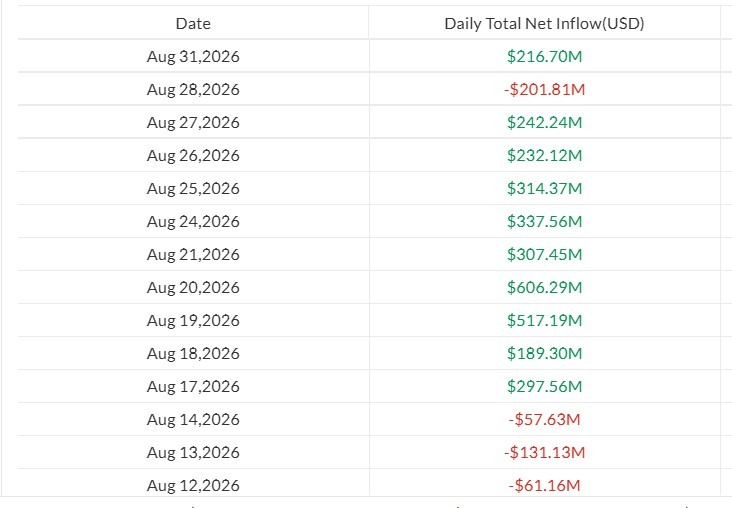
The renewed inflows suggest that the brief dip on Friday was likely a temporary blip, possibly driven by short-term profit-taking or market rebalancing, rather than a fundamental shift in institutional appetite. The ability of the market to quickly absorb and reverse such outflows indicates a resilient demand base. This resilience is crucial for sustaining Bitcoin’s price stability and upward trajectory in the long term.
Furthermore, the simultaneous strength in Ether, XRP, and Solana ETPs signals a broadening of investment horizons. "Investors are no longer solely focused on Bitcoin as the sole entry point into crypto," commented another industry observer specializing in digital asset strategies. "The sustained interest in altcoin ETPs points to a sophisticated understanding of the diverse value propositions within the crypto ecosystem. They are looking to capture growth across different blockchain use cases – from Ethereum’s smart contract dominance to Solana’s high throughput and XRP’s role in cross-border payments. This diversification trend is a healthy sign of market maturation."
These developments also have implications for market liquidity and price discovery. With more capital flowing into regulated ETPs, the overall market depth for these digital assets increases, potentially reducing volatility and making them more attractive to larger institutional players. The price of Bitcoin, hovering near $78,700, reflects this renewed optimism, suggesting that the ETF inflows are acting as a significant upward pressure on market valuations.
Regulatory Landscape and Future Outlook
The regulatory environment continues to play a critical role in shaping the future of digital asset ETPs. While the US has made significant strides with spot Bitcoin ETF approvals, the path for other cryptocurrencies remains dynamic. The SEC’s approval of 19b-4 forms for several spot Ether ETFs, while not yet making them effective for trading (awaiting S-1 registration statements), is a monumental step that signals a potential broadening of the spot ETF market in the US beyond Bitcoin. Should these products become fully effective, they are expected to unleash a similar wave of institutional capital into Ether, mirroring the impact seen with Bitcoin.
Globally, the US market developments often set a precedent. Other jurisdictions, such as Canada and parts of Europe, have already offered spot crypto ETPs for a longer period, including for assets like Ether and Solana. The success and regulatory clarity in the US could encourage further product development and approvals worldwide, leading to a more interconnected and accessible global digital asset investment landscape.
However, challenges and risks persist. The inherent volatility of cryptocurrencies, while attractive to some, remains a concern for more conservative investors. Regulatory uncertainties, particularly regarding the classification of various digital assets as securities, continue to pose challenges for product issuers. Concerns about market manipulation, although addressed through surveillance-sharing agreements for ETFs, are still topics of ongoing debate.
Despite these challenges, the long-term vision for digital asset ETPs appears robust. They are proving to be effective conduits for mainstreaming digital assets, allowing them to be integrated into traditional investment portfolios. As more financial advisors and wealth managers become comfortable with these products, the accessibility and adoption of cryptocurrencies as a legitimate asset class are likely to continue their upward trajectory. The consistent inflows observed across Bitcoin, Ether, XRP, and Solana ETPs suggest that the investment community is increasingly viewing digital assets not as a speculative niche, but as a legitimate and evolving component of the global financial ecosystem. This trend is expected to continue driving innovation in product offerings and expand the reach of digital asset investments to an even wider audience.