admin
admin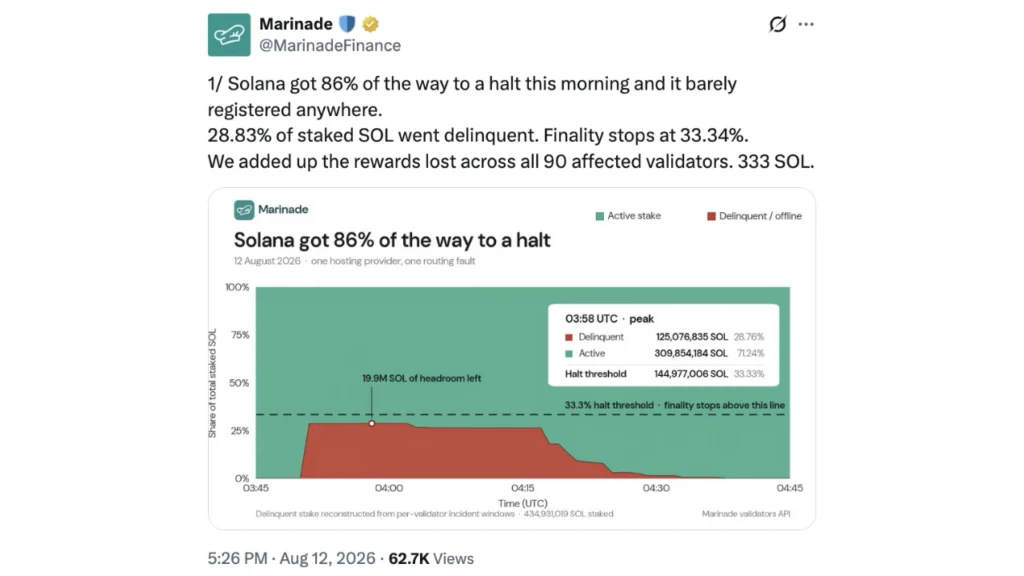
Solana narrowly averted a catastrophic network-wide finality halt on August 12, an incident that temporarily incapacitated nearly 29% of the blockchain’s staked SOL. The disruption stemmed from a routing failure originating at TeraSwitch, a critical infrastructure provider, which pushed the high-throughput network perilously close to the threshold where transactions could no longer be irreversibly confirmed. While block production and transaction processing continued uninterrupted, the episode cast a stark light on the often-overlooked vulnerabilities inherent in infrastructure concentration within decentralized systems, highlighting that validator decentralization does not automatically equate to robust infrastructure diversity.
The incident, which saw 28.83% of Solana’s staked SOL become delinquent, brought the network within approximately 20 million SOL of the critical 33.34% finality threshold. According to detailed reports from staking platform Marinade Finance, this delicate balance underscores the fundamental importance of maintaining a supermajority of participating stake for a Proof-of-Stake (PoS) blockchain to function securely. Had the delinquent stake exceeded this one-third threshold, Solana would have lost its ability to guarantee the irreversibility of transactions, a core tenet of blockchain technology, potentially triggering a system-wide crisis far more severe than a simple slowdown.
The Anatomy of a Near Miss: A Detailed Chronology
The genesis of the August 12 disruption traced back to TeraSwitch’s Miami facility, where a faulty internet route was erroneously advertised. This single point of failure quickly cascaded across TeraSwitch’s extensive global network, illustrating the interconnectedness and potential fragility of modern internet infrastructure. A route reflector situated in Amsterdam played a pivotal role in the propagation, distributing the problematic route to various data centers across Europe and Asia. Consequently, key operational hubs in London, Amsterdam, Dublin, Frankfurt, Singapore, and Tokyo experienced connectivity failures, while North American locations were largely spared.
TeraSwitch’s network operations team moved swiftly to address the issue, identifying the root cause within approximately 10 minutes. Traffic restoration efforts commenced rapidly, with services largely recuperated around 4:16 a.m. UTC. Despite the relatively swift resolution, the impact on Solana was profound. A significant number of validators, although operated by diverse entities, shared a common reliance on the affected TeraSwitch infrastructure. As these validators lost connectivity, they ceased participating in the consensus process, leading to their classification as "delinquent." Marinade Finance estimated that the affected validators collectively missed approximately 333 SOL in staking rewards during the roughly 33-minute period of disruption. While a minor financial loss, expected to be covered through validator bonds, the operational risk exposed was far more substantial. The incident directly impacted around 90 validators, yet a robust 597 out of 699 staked validators continued their voting activities, a testament to the partial resilience built into Solana’s architecture.
Understanding Blockchain Finality and Solana’s Consensus Mechanism
To fully grasp the gravity of the August 12 incident, it is essential to understand the concept of "finality" in a blockchain context. Finality refers to the guarantee that once a transaction is recorded on the blockchain, it cannot be altered, reversed, or canceled. In Proof-of-Stake networks like Solana, this guarantee is achieved through a consensus mechanism that requires a supermajority of the network’s total staked value (SOL in Solana’s case) to vote on and confirm blocks. Solana’s specific implementation dictates that more than two-thirds (66.67%) of the total staked SOL must actively participate in voting for blocks to achieve finality.

The critical threshold of 33.34% thus represents the point at which the remaining voting stake falls below the required two-thirds supermajority. If validators representing more than one-third of the total staked SOL simultaneously become inactive or unable to participate, the network loses its capacity to confidently declare transactions irreversible. While blocks might still be produced and transactions processed, the fundamental assurance of immutability — a cornerstone of trust in any blockchain — would be compromised. At the peak of the TeraSwitch incident, with 28.83% of staked SOL offline, Solana was operating with a dangerously narrow margin of just 4.5 percentage points separating it from a complete loss of finality.
The implications of crossing this threshold are far-reaching. As Marinade Finance highlighted, a more severe consensus failure could mirror events like Solana’s February 2024 halt, which took approximately five hours to fully restart. Such an event would paralyze the network, halting all DeFi activities, NFT transactions, and dApp operations, leading to immense financial losses and a severe erosion of user and developer confidence. This distinction is crucial: an isolated validator outage is a routine occurrence in decentralized networks, but a simultaneous outage affecting a significant portion of total stake represents a systemic threat to the network’s core functionality.
Solana’s Operational Resilience: A Mixed Picture
Despite the alarming proximity to a finality halt, Solana’s network did continue to operate throughout the incident. Blocks were consistently produced, and transactions continued to be processed, demonstrating a degree of inherent resilience. Jacob Creech, Vice President of Technology at the Solana Foundation, acknowledged the event but emphasized that infrastructure diversity played a role in protecting the network. He noted that the vast majority of validators — 597 out of 699 staked validators — remained active and continued voting. Furthermore, validators participating in the Solana Foundation Delegation Program were reportedly unaffected, suggesting that strategic delegation and diverse hosting arrangements can provide a buffer against localized infrastructure failures.
This operational continuity is a key distinction from previous, more severe outages that have plagued Solana, where block production itself ceased. The August 12 incident was not another full Solana blockchain outage in the traditional sense. Instead, it served as a critical stress test, revealing how an external infrastructure failure, seemingly outside Solana’s direct control, could push the network to the brink of a consensus-level disruption without necessarily stopping the fundamental process of block creation. This nuance is vital for understanding the nature of blockchain reliability, where maintaining finality is arguably more critical for user trust than simply keeping the lights on.
The Unseen Vulnerability: Infrastructure Concentration
Perhaps the most significant revelation from the TeraSwitch incident was its exposure of a structural weakness that transcends individual infrastructure providers: the often-overlooked distinction between validator decentralization and infrastructure decentralization. While Solana boasts a large number of independent validators, the incident starkly illustrated that many of these validators can inadvertently rely on shared underlying infrastructure, creating common points of failure.
Marinade Finance’s analysis revealed a particularly concerning statistic: a single autonomous system, AS20326, was found to account for approximately 27.34% of total staked SOL. Critically, about 94% of the stake associated with this autonomous system went offline during the TeraSwitch incident. This demonstrates that even if individual validators are run by different entities, their geographical co-location or reliance on the same routing provider or cloud service can consolidate risk in ways that are not immediately apparent by merely counting validator nodes.

Further compounding this issue, an additional 14.1 million SOL became delinquent across validators hosted by other providers, including Latitude.sh, Limestone, Butterfly Research, and Allnodes. While Marinade could not definitively confirm a direct connection between these simultaneous outages and the TeraSwitch incident, their concurrent nature underscores the broader challenge of infrastructure dependency. These numbers provide a compelling argument that simply assessing the number of validators provides an incomplete and potentially misleading picture of a blockchain’s true resilience. Hundreds of theoretically independent validators might still share vulnerabilities if they are concentrated within the same cloud provider, data center, routing infrastructure, or even a specific geographic region.
This hidden concentration means that a single infrastructure failure can disproportionately affect a much larger share of network stake than the number of directly compromised validators might suggest. Marinade Finance itself acknowledged this broader issue, noting that a small number of autonomous systems control a significant portion of the stake allocated through its own infrastructure. This incident will undoubtedly intensify pressure on staking providers, validator operators, and the Solana Foundation to actively promote and implement greater diversification in hosting arrangements, cloud providers, and network routing to mitigate such systemic risks in the future.
Broader Implications for Proof-of-Stake Networks
The Solana near-miss serves as a potent warning not just for Solana, but for the entire ecosystem of Proof-of-Stake blockchains. The immediate positive outcome – finality was never interrupted, block production continued, and the network recovered – should not overshadow the critical lessons learned. The incident demonstrated with alarming clarity how swiftly an infrastructure problem, seemingly external to a blockchain’s core protocol, can escalate into a network-level concern capable of undermining fundamental guarantees. The nearly 29% of staked SOL going offline simultaneously left an uncomfortably narrow margin before the 33.34% finality threshold, a margin that could easily be breached by a more widespread or prolonged infrastructure failure.
This episode reinforces a fundamental principle for all PoS networks: true decentralization must be measured not solely by the number or ownership of validators, but also by the robustness and diversity of the underlying physical and logical infrastructure supporting those validators. The economic stakes are enormous; with billions of dollars deployed across Solana’s burgeoning DeFi ecosystem, the consequences of a finality halt would reverberate far beyond the validators themselves, impacting liquidity, trading, lending, and every other facet of the decentralized financial landscape.
Solana’s architecture ultimately absorbed the shock this time, lending credence to the Solana Foundation’s argument that geographic and infrastructure diversity can indeed provide meaningful resilience. However, the TeraSwitch failure vividly exposed that hidden concentrations can still create significant systemic risk. As the blockchain industry matures and more critical financial infrastructure relies on these networks, the continuous pursuit of deeper, more comprehensive decentralization, extending to every layer of the technology stack, will remain paramount. The near miss of August 12 is a stark reminder that infrastructure diversity is not merely an ideal, but a critical and ongoing requirement for Solana’s long-term security, reliability, and its ambition to host a significant portion of the global financial system.