admin
admin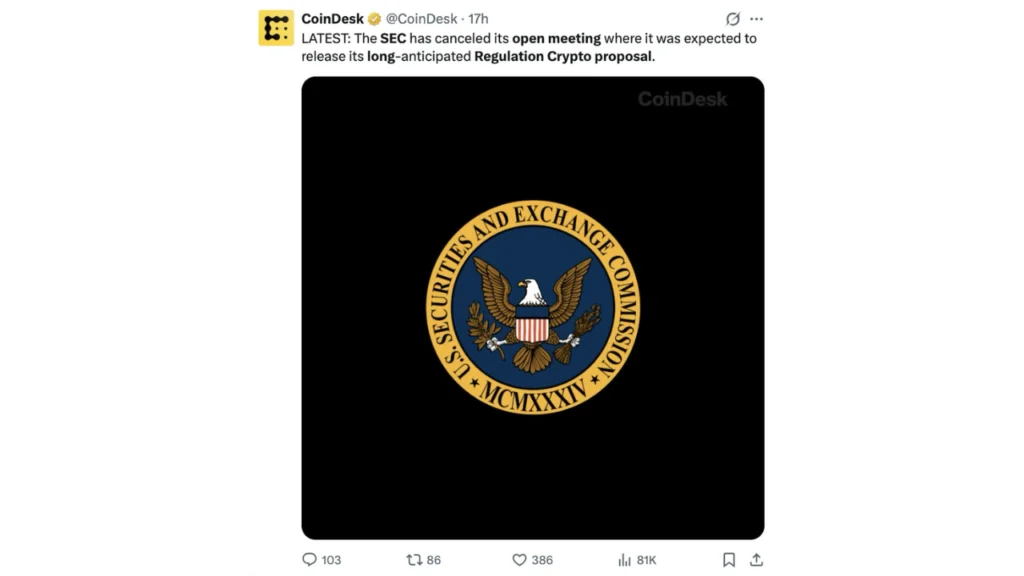
The U.S. Securities and Exchange Commission (SEC) has unexpectedly canceled an open meeting that was poised to address critical proposals designed to redefine how digital assets are issued and regulated across the United States. This abrupt decision, announced late Thursday, cited an "unforeseen scheduling issue" as the reason for deferring Friday’s highly anticipated discussion to an unspecified later date. The postponement leaves the burgeoning cryptocurrency industry once again grappling with regulatory ambiguity, delaying the potential implementation of a comprehensive framework that SEC Chairman Paul Atkins has consistently emphasized as a cornerstone of his digital-asset agenda.
The cancellation arrives at a particularly sensitive juncture for U.S. crypto policy. While the industry eagerly awaits clear guidance, legislative efforts to establish a broader legal foundation for cryptocurrency markets, such as the Digital Asset Market Clarity Act, remain stalled in the Senate. With Congress temporarily out of session and bipartisan negotiations still unresolved, market participants had increasingly looked to the SEC to provide much-needed momentum and independent regulatory action. This latest delay underscores the persistent challenges in developing a coherent and predictable regulatory environment for digital assets in one of the world’s largest financial markets.
The Genesis of Regulatory Ambiguity: A Brief History
The U.S. regulatory landscape for digital assets has long been characterized by fragmentation and a reliance on applying existing statutes, often leading to uncertainty. Since the early days of Bitcoin, regulators have grappled with classifying digital assets, often relying on the 1946 Howey Test to determine if a token constitutes an "investment contract" and thus a security subject to SEC oversight. This case-by-case, enforcement-driven approach, exemplified by numerous actions against crypto projects for unregistered securities offerings, has drawn considerable criticism from the industry for stifling innovation and creating an unpredictable environment.
For years, the SEC, under various chairs, has maintained that most cryptocurrencies, especially those initially offered to the public, fall under securities laws. This stance often places the U.S. at odds with other jurisdictions, which have begun developing bespoke regulatory regimes for digital assets. Chairman Atkins, however, has signaled a more accommodating approach, hinting at the need for tailored frameworks that acknowledge the unique characteristics of blockchain technology and digital assets. The now-postponed meeting was expected to be a pivotal step in translating this evolving philosophy into tangible rules.
Unpacking "Regulation Crypto": A Bid for Clarity
The centerpiece of the canceled meeting was the discussion surrounding "Regulation Crypto" (or "Reg Crypto"), a proposal widely anticipated to establish a more specialized framework for certain crypto projects seeking to raise capital. Chairman Atkins has previously characterized this initiative as a "tailored offering regime for certain investment contracts," suggesting a departure from the one-size-fits-all application of traditional securities laws.
Under such a framework, qualifying digital-asset projects could potentially raise funds without immediately facing the full spectrum of conventional securities registration requirements. Crucially, it could also provide a defined pathway for projects to transition away from direct SEC oversight as they mature, decentralize, or meet other specified conditions. This would represent a significant paradigm shift from the SEC’s historical enforcement-first strategy. Instead of relying primarily on retrospective enforcement actions and interpretive policy statements, the agency would be proactively establishing a formal regulatory regime, subject to public notice and comment – a process that offers greater transparency and predictability.
For cryptocurrency companies, this distinction is paramount. A clearly defined framework could significantly ease the burden of compliance, making it easier to ascertain when a token qualifies as a security, how a project can legally raise capital, and what ongoing obligations apply as a network evolves. The current lack of such clarity has often forced companies to operate under a cloud of legal risk or to seek friendlier regulatory environments abroad. The indefinite postponement of this discussion means these fundamental questions, crucial for the industry’s growth and stability in the U.S., will regrettably remain unanswered for the foreseeable future.
Setback for Tokenization: The Innovation Exemption
Beyond Regulation Crypto, the canceled meeting was also expected to provide a crucial update on a separate, equally significant SEC initiative: an "innovation exemption" designed to facilitate experimentation with tokenized securities. This exemption aims to reduce regulatory barriers for firms looking to issue and trade traditional securities using blockchain infrastructure, thereby potentially unlocking new efficiencies and liquidity in capital markets.

However, sources within the industry indicate that this initiative has faced considerable headwinds, reportedly encountering resistance from both the White House and established financial institutions. This pushback may have contributed to the latest delay. One key concern reportedly revolves around the SEC’s perceived legal authority to provide such broad relief, as well as questions regarding whether the agency has completed the necessary economic analysis and procedural work to adequately support the exemption. Critics argue that significant regulatory changes should be underpinned by robust economic impact assessments and a thorough understanding of their potential systemic effects.
Traditional Wall Street firms, represented by powerful lobbying groups like the Securities Industry and Financial Markets Association (SIFMA), have voiced a different set of concerns. SIFMA, for instance, has questioned how blockchain-based trading venues – including nascent decentralized platforms and automated market makers (AMMs) – would seamlessly interact with existing equity-market rules. A major point of contention is "best execution." Under current U.S. market structure, Regulation NMS generally mandates that brokers seek the best available protected quotation when executing customer trades. Applying these stringent requirements to the often fragmented, asynchronous, and novel structures of decentralized or blockchain-based markets could prove extraordinarily complex, potentially undermining market integrity or creating unintended competitive disadvantages. SIFMA has consistently advocated that fundamental market-structure reforms should be addressed through a transparent, open rulemaking process, rather than through exemptions or no-action relief, to ensure comprehensive stakeholder input and mitigate unforeseen risks.
The Accelerating Trend of Tokenization and U.S. Competitiveness
The timing of this regulatory delay is particularly critical given the rapid global acceleration of tokenization. What was once largely a crypto-industry experiment is swiftly transforming into a mainstream financial-market trend. Major exchanges, including Nasdaq and the New York Stock Exchange, are actively developing infrastructure to support tokenized securities. The Depository Trust & Clearing Corporation (DTCC), a cornerstone of U.S. financial market infrastructure, has already reported processing live production trades involving tokenized securities as part of extensive test phases. Analysts at Citi have projected that tokenized assets could eventually swell into a colossal $5.5 trillion market by 2030, highlighting the immense potential and the urgency of establishing clear regulatory pathways.
The SEC, under Chairman Atkins, has increasingly acknowledged blockchain technology as a powerful tool for modernizing financial markets, reversing several policies associated with the previous administration. In March, Atkins publicly indicated that the SEC was exploring a "safe harbor" provision and a "fit-for-purpose startup exemption." These measures were intended to grant crypto entrepreneurs greater flexibility to raise capital or operate for a limited period without immediate, full compliance with the exhaustive securities regime. Such initiatives reflect a growing recognition that existing rules, primarily designed for traditional assets, may not be optimally suited for the unique characteristics and rapid evolution of digital assets.
Yet, the latest postponement starkly highlights the inherent tension between the imperative to move swiftly to embrace innovation and the equally critical need to establish robust, well-considered rules that can withstand rigorous legal, political, and market scrutiny. The U.S., a historical leader in financial innovation, risks falling behind other jurisdictions, such as the European Union with its comprehensive Markets in Crypto-Assets (MiCA) regulation, or pioneering nations like the UAE and Singapore, which have actively developed clearer frameworks. Prolonged regulatory uncertainty could lead to a "brain drain" or "capital flight," as innovative companies and talent migrate to regions offering greater legal certainty and a more supportive environment.
SEC or Congress: The Enduring Regulatory Standoff
For the crypto industry, the immediate and pressing question is no longer merely what the SEC might propose, but rather which branch of government – regulators or lawmakers – will ultimately deliver the next significant piece of regulatory clarity. The Digital Asset Market Clarity Act, which aims to create federal rules specifically tailored to digital assets and provide companies with a more definitive legal foundation, remains stalled in the Senate. Lawmakers departed Washington for a five-week recess without voting on the legislation, and its prospects have become increasingly uncertain. Negotiations are still required to garner enough bipartisan support to clear the Senate’s formidable 60-vote threshold, a challenge in a deeply divided Congress.
This leaves the industry in an unusual and precarious holding pattern. On one hand, the SEC, under Chairman Atkins, appears to be signaling a willingness to construct a more crypto-specific regulatory framework, acknowledging the limitations of existing statutes. On the other hand, Congress is simultaneously attempting to define the statutory boundaries of the digital asset market, potentially preempting or influencing the SEC’s rulemaking authority. This parallel, often uncoordinated, effort creates a layer of complexity that can paralyze progress.
The current vacuum of comprehensive regulation carries significant implications for investor protection, market integrity, and national competitiveness. Without clear rules, retail and institutional investors alike face heightened risks, while legitimate businesses struggle to comply with an ambiguous legal landscape. The lack of a decisive U.S. stance also complicates international cooperation on global financial standards for digital assets.
The canceled meeting does not necessarily imply that the SEC has abandoned Regulation Crypto or its broader digital asset agenda. Instead, it adds yet another frustrating delay to an initiative that has the potential to become one of the agency’s most consequential policy moves concerning cryptocurrencies. Until a new meeting date is formally announced, digital-asset companies, investors, and even traditional financial institutions will remain in limbo, eagerly watching to see whether the SEC can successfully translate its emerging crypto agenda into formal, enforceable rules – or whether Congress, against increasing odds, manages to provide a legislative solution first. The stakes are high, and the world is watching how the U.S. navigates this critical frontier of financial innovation.